
The Middle East's Energy Crisis is about to Get So Much Worse
Simon Whistler • September 17, 2026
Members only
Note: this transcript was generated by AI and may contain errors or inconsistencies.
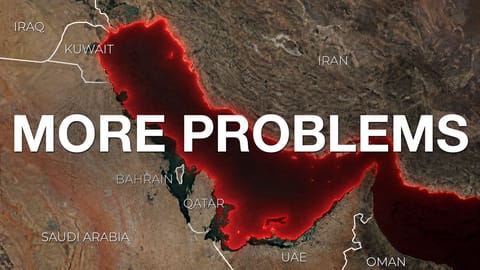
If a headline like "Iran fires on civilian shipping in the Strait of Hormuz" were to run at any other point prior to this year, it would have been massive news. In 2026, though, it's just another Tuesday, isn't it?
The world has sort of grown accustomed to Hormuz being shut down, in no small part because the world has largely been able to avoid the doomsday scenarios that some were predicting back in March.
That's not to say things have been great, but they've at least fallen short of the energy crisis many predicted. Well, it looks like that crisis may finally be here. In Saudi Arabia, a major pipeline constructed specifically to bypass Hormuz has been so badly damaged that it's currently offline.
Meanwhile, the Houthis are attacking Saudi shipping to the south. As a result, Riyadh recently cancelled small shipments to Europe. And that is only half the problem.
Iran, meanwhile, is stepping up attacks in Hormuz and against its neighbours, likely out of fear that it otherwise won't be able to maintain control of the strait. All of which leads us to an uncomfortable question. Is the energy crunch we thought we'd avoided finally here?
All Hell Breaking Loose For the last few months, things were held together by a very fragile combination of factors, one of the most important being Saudi Arabia's ability to partially bypass the Strait of Hormuz.
Given just how vital that waterway is for the flow of oil exports, Riyadh started building a partial alternative decades ago as a hedge against Tehran, doing exactly what it did back in March. As the name suggests, the East-West pipeline takes Oshkosh.
And it's only a few days away from being completely destroyed. It's only a few days away from being completely destroyed. It's only a few days away from being completely destroyed.
It's only a few days away from being completely destroyed. It's only a few days away from being completely destroyed. It's only a few days away from being completely destroyed.
It takes oil from the eastern part of the country, where most of the oil fields are, and wait for it across Saudi Arabia's west coast, specifically to the city of Yambu. It was never enough to fully replace Hormuz, of course, but it was capable of sending about 7 million barrels per day.
After Washington and Jerusalem launched their war against Iran, Riyadh maxed this thing out, allowing the kingdom to keep exporting.
At least, that was the case until September 10th. That day, Iranian-linked militias in Iraq launched a wave of drone attacks against Saudi Arabia, hitting a pump station just south of the city of Medina. The damage was significant enough to shut the pipeline down entirely.
Estimates vary widely in terms of how long repairs will take to get the pipelines back up and running, with the most optimistic claims saying that it will at least partially be operational within a few days, and the more pessimistic stretching out as long as six weeks.
The pipeline consists of two distinct parallel lines, each with its own pumping infrastructure, which could help get at least some of the flow back up and running. And while the internet is not as good as it used to be, it's not as good as it used to be.
And while the internet is not as good as it used to be, it's not as good as it used to be. And while the internet is not as good as it used to be, it's not as good as it used to be.
And while the international community will certainly be relieved when the pipeline is flowing again, that will only solve part of the problem, because even if you can get the stuff to Yanbu, it's still a world away from its final destination.
Directly to Yanbu's south sits Yemen, where the Saudi-backed government has spent years locked in an unresolved, mostly cold war with the Iran-backed rebel group Ansar Allah, better known as the Houthis.
Back in July, partially inspired by the success that their friends in Tehran have had with Hormuz, the Houthis decided that it was the perfect time to announce a blockade on Saudi shipping. They stopped short of blocking the entire waterway.
International shipping is free to proceed as usual, and the Houthis have reportedly told Washington that American and other commercial vessels are not their concern. For Saudi energy exports, and by extension the wider world, that's only partial relief, though.
Yanbu had been shipping on average 4 million barrels of oil a day between April and June, but saw that collapse to just 1.1 million last month.
Ironically, Riyadh is now finding itself in an uncomfortably similar situation to Iran. The Saudis have an enormous amount of oil, but limited ways to sell it, and a rapidly dwindling amount of storage where they can put it.
Saudi oil production had recently fallen to roughly 6.2 million barrels per day in August, which is its lowest level in more than three decades.
If these export blockages keep up, Riyadh will be forced to cut production even further. And given just how much they've already cut, further reductions would put the world into dangerous territory. These wells are not something you can switch off and back on like a light.
Prolonged shutdowns can damage them, meaning that restarting production can be either an uphill battle or require drilling new access points. Unsurprisingly, markets have already responded.
Brent crude surged back above $100 following the latest attacks, reaching as high as $109 earlier this week, and remains in triple-digit territory at the time of recording.
Just for context, it was trading in the mid-60s late last year, so we're looking at this nearly doubling since then, and almost exclusively, because of the Iran war. Yet, while hearing things like "oil is over $109 a barrel" can sound a little abstract, trust us on this one that the impacts will not be.
If the Middle East's energy crisis doesn't get sorted soon, then all of our lives are going to quickly go from relatively normal to absolutely foobar.
THE BEST MAIN PLANS What makes the timing of the pipeline attack so egregious is that it happened at a moment when Tehran's grip over Hormuz seemed to be finally weakening.
Iran was never able to fully close the strait, a route that hugs the Armani coast, has long been utilized by ships that decided they wanted to risk it and try to sneak past the Iranian military presence. That route was quite limited at first, only allowing through a trickle compared to pre-war traffic.
After months of US forces trying to degrade Iran's coastal outposts and radar systems, though, that trickle has started to turn into a steady stream. US officials are claiming that somewhere around 40 vessels carrying some 14 million barrels of oil are making the journey through Hormuz on a daily basis.
That's still less than half the pre-war numbers, but it is a hell of a lot more than even a few months ago.
In Tehran, this is seen as something close to an existential threat. While the regime may have survived the joint US-Israeli campaign with or without Hormuz, the strait has been the ace up its sleeve, a way to exert maximum pressure on the world as a whole. Previously, Tehran was able to close down the strait quickly and easily.
Merely shooting at a few ships was enough to jack insurance premiums up to levels where it wasn't viable to risk the journey. But that's no longer the case. There's a lot of time left in the race.
Today, in mid-September, the Critical Threats Project believes that Iran is facing real operational constraints in the strait on everything from laying mines to finding and targeting ships, which makes its original strategy of simply blocking all Gulf exports harder to sustain.
Keep in mind, total control of Hormuz has repeatedly been compared by senior Iranian military personnel and politicians alike to having a nuclear weapon. This was meant to be the guarantee keeping them safe from renewed attack.
As such, the growing traffic in the strait in Hormuz has become the motivation Iran needed to escalate things. Attacking something as significant as the East-West Pipeline is not a small escalation either, even if the regime is able to deflect responsibility by pointing out that it was the militias operating out of Iraq that blew it up.
But as we've already seen in this war, Tehran's actions have longer-term consequences for the regime.
Just as America is discovering that "don't warn your allies before launching a badly thought-through war" is not a great way to maintain friendships, so too is Iran discovering that "attack all your neighbors and hope for the best" is not a good long-term strategy.
Beyond closing Hormuz, Tehran's strategy has rested on the premise that simply raising the costs for the entire region will be enough to get America and Israel to back off. But it turns out that hitting people with drones and then asking them to play ball can sometimes backfire.
It's shocking, we know. Oman is a particularly good example, because it's the country that sits opposite Iran in the Strait of Hormuz, and has continued to permit ships to pass through the strait, and has continued to permit ships to pass through without tolls.
Muscat has long tried to maintain decent relations with Tehran, and was one of the leading voices in the region advocating against bombing the Islamic Republic.
Their foreign minister, Badr al-Basidi, was quite literally in Washington meeting with Vice President J.D. Vance the day before the bombs started falling. Despite that, Oman was bombed repeatedly by Iran.
Several of their ports were hit by drones at the outset of the war, and even though they were spared the all-out blitz that the Emirates suffered, it was still pretty intense. At Salalah, one strike seriously damaged fuel storage tanks and forced the entire terminal to shut down, while also setting the place ablaze.
What's so dumb about this is that Tehran needs Muscat's approval to implement a Hormuz toll.
The regime had even been planning to use a meeting this week to start formal discussions on the process with other Gulf states. Unsurprisingly, those nations that had suffered under Iranian attack didn't want to get involved. Bahrain refused to attend, and Oman continued to oppose.
Tehran's demand for mandatory fees. All of which leaves Iran in something of a nightmare scenario. The regime's plans have all revolved around maintaining control over Hormuz as a permanent pressure point, and now it's starting to look like that won't be possible.
But rather than a cause to celebrate, this should function as a warning. Because Tehran does not want to give up its ability to strangle global markets, and that means it is now reaching for more extreme solutions. A WIDER WAR 4.
A WIDER WAR For much of the war, the full impact of the fuel shortage caused by the Hormuz closure has been relatively tame. Back in March, remember, some analysts were predicting oil at $150 or more a barrel, widespread fuel shortages, and a global recession.
That this was avoided is mostly due to the short-term measures that many countries deployed at the outset of the war.
Those, however, are now starting to approach the end of their use-by date. The most obvious example is the emergency stockpile release in the US that helped to keep prices under control. While prices have gone up stateside, it's been to a level that's more annoying rather than catastrophic.
The international side of the equation looked pretty similar.
Back in March, the International Energy Agency coordinated the release of some 400 million barrels of oil from the strategic reserves of its member states, the largest such intervention in its entire history, and more than double what it released during the crisis that followed Russia's invasion of Ukraine back in 2022.
The problem with using your reserves, though, is that the price of oil has gone up, and you can't keep drawing them down forever, and the US already went into the war with its reserves sitting relatively low for peacetime.
As of last week, the US strategic petroleum reserve hit its lowest level since November 1982. And while we do want to point out that the chance of the US just running out of oil is zero, there is a world of difference between not running out and keeping prices at a level that would stop a consumer revolt.
The world also benefited from one of its largest economy companies deciding to limit its own consumption of oil.
Beijing has long been paranoid about being cut off from the international energy market, and has thus built up an enormous amount of storage capabilities.
Just for context, even after six months of minimal oil purchases, China still has roughly 1.23 billion barrels in onshore storage as of September 9th, which is what analysts technically call a "f*** ton of oil". Over a billion barrels in Beijing is apparently considered, I think, to be low.
Chinese buyers have begun returning to the international market again in the last week or two. Overall imports remain down by some 40%, so this isn't a full return to pre-war levels, but China seems pretty unwilling to let their reserves dip nearly as low as Washington has.
So when we look at all of these factors individually, they're not great, but they're survivable.
The issue is that they're increasingly happening all at once. Despite the good news out of Hormuz, it's actually emboldened Iran to lash out even harder at the rest of the region.
We now have all hell breaking loose in Yemen, and while the Houthis aren't quite as interested in inflicting maximum pain on the international community, they're also more than happy to let the world squeal if it'll help them f*** over the Saudis.
Just the other day, the Wall Street Journal reported that major oil executives now believe the long-feared fuel crisis is either close or perhaps already upon us.
Chevron CEO Mike Wirth warned that the inventories and other buffers that kept prices relatively contained for months have now "largely plummeted". "It's just not the same as it used to be," he said in a statement to The Wall Street Journal.
"It's just not the same as it used to be. There are still ways around this, of course. They're just not ideal and not able to offset the broader damage being done." The Emirates has their own pipeline that runs from one side of Hormuz to Fujairah port on the other, which has let them continue to export.
But the problem with this is that if Iranian-backed militias are willing to hit a Saudi pipeline, then there's nothing to indicate the Emirates would be spared. The UAE is the single most targeted country by Iran in this war, eclipsing even Israel in terms of attacks.
And as the world enters this new phase of the crisis, it's doing so from a weakened position.
Reserves are running dry. China is buying oil again. Pain has already been absorbed, with apparently more pain on the way.
And while the richest countries in Europe and Asia will likely cough up whatever's necessary to avoid an economic apocalypse, they will be doing so at a time when rich countries have already racked up eye-watering levels. In short, things could get extremely painful in the coming months.
Back in February, Washington and Jerusalem started this war in the belief that it would give them a quick, epoch-defining win.
As we enter the final stretch of 2026, it may be the entire world that winds up paying for this strategic miscalculation. Thank you for watching.
Watch with Fronts Insider
Fronts Insiders get every video, the complete archive, and private sponsor-free playback.
Insiders Receive
- Every WarFronts, HomeFronts, and Insider video
- Complete sponsor-free video archive
- Support independent conflict journalism
Already a member? Log in →
Signed in or already a member, but still locked? Fix an access problem
From $5/month — cancel anytime