
WarFronts Weekly 11.25.2025.
Warfronts Weekly: November 25, 2025. Context and analysis on conflicts across the world. Two emails each week: Warfronts Weekly on Tuesdays, Friday Blitz on Fridays.
Evan Moloney • November 25, 2025

“I make a heartfelt appeal for the immediate release of the hostages.”
-Pope Leo XIV, speaking at St. Peter’s Square in Rome.
Mass Kidnappings Return to Nigeria:
A Catholic boarding school in Nigeria’s north-central Niger State was attacked on Friday , in one of the first mass kidnappings to hit the nation since early 2024. 303 students and twelve teachers were initially taken hostage in the assault, although, according to recent reports, at least fifty of the abducted schoolchildren had managed to escape by Sunday.
The children and teachers were abducted in the rural community of Papiri , from the St. Mary’s School. The attackers have yet to be identified , and no group within Nigeria has yet taken credit ; thus, the fates that may await the kidnapped students are unclear.
Mass kidnappings of schoolchildren are familiar in modern Nigeria; Boko Haram, in particular, has gained a reputation for these sorts of attacks, with kidnapped girls often forced to become child brides and wed the organization’s fighters. In 2014, Boko Haram kidnapped 276 schoolgirls in Chibok; many have never been located. Papiri and the surrounding Niger State, however, are not typical Boko Haram or Islamic State-West Africa Province territory.
This part of Nigeria, near the western edge of the Middle Belt region , is far from peaceful, but the threat profile in this area is different. The Middle Belt has long hosted Nigeria’s farmer-herder conflict , between semi-nomadic, mostly Muslim herding groups, and sedentary, mostly Christian farming communities. The area is also home to groups referred to, colloquially, as ‘ bandits’ —armed, loosely affiliated or independent organized criminal groups that terrorize local communities.
Although the farmer-herder conflict and Nigeria’s bandit problem frequently overlap , a mass kidnapping of this size would be more consistent with a premeditated bandit attack , in which the ultimate objective is to ransom the kidnapped students . It’s possible that the incident could be related to the farmer-herder conflict, or even Boko Haram, but it’s more likely to be the work of organized criminals.
Their decision, to kidnap hundreds of children from a Nigerian Catholic school, comes at an odd time. The United States, under Donald Trump, has increasingly shone a light on Nigeria’s security situation, while alleging a genocide against Christians . Although the reality on the ground is more complicated ( as we discuss here on WarFronts ), Christian communities are frequently attacked , and the United States has threatened military intervention in response.
US attention, however, isn’t necessarily a deterrent —and may even be a motivating factor in these attacks. If the perpetrators represent an ideologically motivated non-state insurgency, they may be an act of acceleration , intended to draw the United States into a limited asymmetric conflict.
If, however, a criminal group was the culprit, the motivations may be purely financial . Right now, the plight of Nigerian Christians is an internationally salient issue , and attackers may believe they have an opportunity to extort far higher ransoms from the global faith community. Catholic leaders, including Pope Leo XIV , have called for the children and staff’s immediate release .
Timing matters, because mass kidnappings—especially in this area—have been quite rare for Nigeria in 2024 and 2025 , until the last two weeks. On Monday the seventeenth, however, twenty-five schoolchildren of mixed religions were seized in neighboring Kebbi State, in the majority-Muslim town of Maga, while in Zamfara State, another 64 people were taken from their homes. On Wednesday, gunmen attacked a church in central Kwara State. There, two people were killed and the pastor and thirty-seven worshippers were abducted; they were freed on Sunday by security forces.
Image Credit: “Pope Leo XIV during an audience with the media (May 12, 2025)” by Edgar Beltran is licensed under CC BY 4.0 .
This Week on WarFronts:
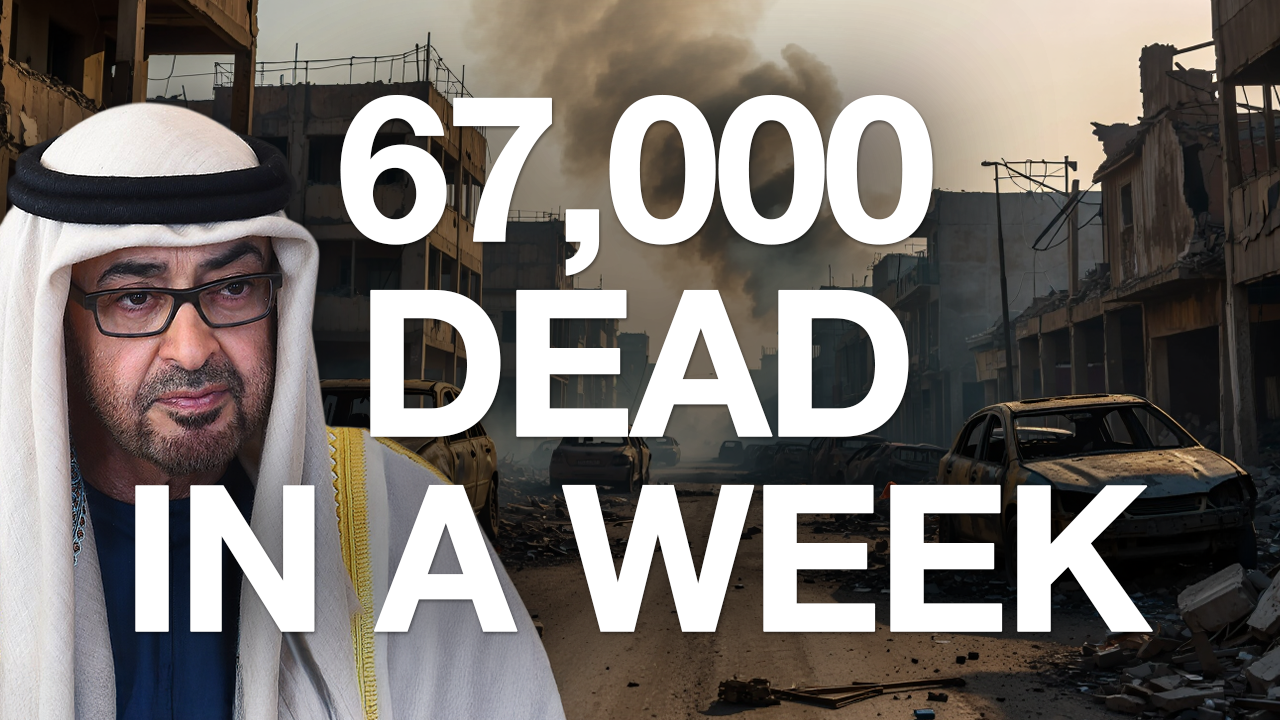
This week, we published this episode on Sudan, the United Arab Emirates, and the Emirates’ ongoing efforts to arm and supply the paramilitary Rapid Support Forces . But although the Emirates have enabled and facilitated genocide, and brought about the deaths of estimated hundreds of thousands in Sudan already, Sudan is just one piece of the UAE’s larger regional chess game.
This report by Middle East Eye catalogues the UAE’s other regional efforts, from Yemen to Somalia to Libya, and the larger network of trusted non-state actors that the Emirates are building today.
Airshow Crash Dooms India’s Tejas:
The 2025 Dubai Airshow was the site of a tragedy this week, when a copy of the Tejas Light Combat Aircraft (LCA), made by India’s state-owned Hindustan Aeronautics Limited, crashed during low-level maneuvers at Al-Maktoum International Airport. The aircraft’s pilot, Wing Commander Namansh Syal , was killed in the crash—and, according to international defense experts, India’s hopes for the Tejas may have died with him.
At the Dubai Airshow, the Tejas had already drawn less-than-stellar reviews before the attempted demonstration. On the tarmac, the Tejas was observed spilling fluid into a bucket while it sat in a static display—in what India denied was an oil leak—and it did not take part in an earlier flyover involving most of the military aircraft featured at the event.
Although the in-flight cause of the crash was unclear, the aircraft did not appear to suffer from any outwardly visible malfunction prior to impact. Instead, the pilot performed a negative-g maneuver before attempting to roll the aircraft, but the jet descended rapidly , while already at low altitude.
For India, the crash is a tragedy for reasons beyond the death of the aircraft’s pilot. The Tejas has long been a pet project of New Delhi , and is an attempt to create a modern, fourth-generation light fighter , not just for India’s use, but for sale on the export market . Forty copies of the aircraft exist today.
But although the first production-line Mk. 1A aircraft took its first flight in just March of 2024, the Tejas has been a decades-long project, beset with delays and suffering from lagging production rates. Its first prototype flew in 2001 . A Tejas Mk. 1 aircraft—an earlier version— crashed in March of last year , due to an engine seizure, and while India has attempted to court international customers, it faces stiff competition as an advanced light fighter, from America’s F-16V, Sweden’s Gripen E, South Korea’s F/A-50, and other more proven models.
Now, after major expenditures on the Tejas project including a $7 billion order for ninety-seven copies to fill its own air force, India has watched the jet literally crash and burn in its highest-profile exhibition to date . India will likely continue to procure the Tejas, and it’s not inconceivable that one or two foreign buyers may be able to push past this recent crash and place small, cheap orders. But in a difficult export market, with a delayed and already-unproven platform, India’s Tejas ambitions may be finished for the foreseeable future.
Image Credit: “Top view HAL Tejas” by Mark Jones Jr. is licensed under CC BY 2.0 .
What We're Reading:
It’s been nearly a year since the surprise downfall of Syria’s Assad regime , and reports on Assad-era atrocities and flagrant human-rights violations continue to mount. But Syrian activists like Ussama Uthman , today living in exile in France, had been working for many years to uncover Assad’s abuses, long before the fall of Damascus last December.
This report by the Associated Press catches up with Uthman, architect of the Caesar Files and Atlas Files , over a decade after he began to upload gigabytes upon gigabytes of sensitive photos and documents. Uthman describes both his team’s efforts to record Assad-era atrocities, and the immense challenges they’ve faced in preserving those files, after the rise of Syria’s new leadership.
Around the World:
After a Geneva summit between Ukraine, the US, and European representatives, Ukraine has proposed a substantially modified counter-offer to the US-Russia ceasefire proposal revealed last week. Ukraine’s new framework has reportedly been accepted by Washington, as US President Donald Trump declines to follow up on early threats to force Ukraine to accept the initial deal. Russia, however, dismissed the deal on Monday, with Kremlin representative Yuri Ushakov calling it “ completely unconstructive ”.
The United States designated the murky Cartel de los Soles a foreign terrorist organization on Monday, expanding its pretext for anticipated covert operations and strikes against Venezuela. While Cartel de los Soles is not truly a cartel or even a centralized organization, it refers to a loose aggregation of Venezuelan military and civil officials believed to be involved in the drug trade.
Somalia has reached a critical point in its defense against al-Shabaab, as the pressures of a continuing jihadist offensive toward Mogadishu are compounded by growing infighting, military weakness, and rejection of Mogadishu’s authority by several Somali states.
Elsewhere across the African Horn, tensions are spiking between Ethiopia and Eritrea this week, after Eritrea publicly raised alarms about Ethiopia’s renewed desire to secure control of a Red Sea port, possibly by force. The news comes as a ceasefire in northern Ethiopia, covering the nation’s powerful Tigray ethnic faction, continues to unravel .
Israel announced that it killed Hezbollah’s top military leader in a Sunday airstrike, targeting the outskirts of Lebanon’s capital Beirut for the first time in several months. Hezbollah confirmed that the target, organizational Acting Chief of Staff Ali Tabtabai, was killed in the strike, and declared that Israel’s actions crossed a “ red line ” demanding some sort of response. Five people were killed in the strike, counting Tabtabai.
Taliban authorities vowed retaliation after a series of airstrikes , which it said killed nine children and a woman in Khost, near the countries’ shared border. Pakistan dismissed the claim of civilian casualties; its overnight operations included additional strikes in Kunar and Paktika provinces.
Those strikes were a retaliation after a militant attack in Pakistan on Sunday. Three men launched a failed attack on a paramilitary headquarters in Peshawar on Monday, blowing themselves up inside the compound and killing three paramilitary troops in the process. Five others were injured, although pro-Islamabad fighters were able to contain the attack as it happened. The Pakistani Taliban took credit for the assault.
A Russian drone flew deeper into Romanian airspace than ever this morning, flying more than 100 kilometers into NATO airspace. Romanian and German jets were scrambled to respond, but avoided shooting the drone down due to fears of damage on the ground; drone debris was later located on Romanian territory, with no explosive charge.
Protests in Tunisia’s capital city intensified this week, as medical organizations, banks, journalistic institutions, and local and civic leaders threw their support behind a movement in opposition to autocrat Kais Saied. In recent years, Saied has engaged in wide-reaching repression against Tunisians, trying to secure a state of one-man rule.
Repression in Kyrgyzstan only grew more expansive this week, when Kyrgyz law enforcement conducted the mass detentions and interrogations of opposition figures ahead of a snap parliamentary vote this Sunday. The vote is expected to help the nation’s president, populist Sadyr Japarov, crack down on dissent in future years.
Brazilian former president Jair Bolsonaro was arrested and placed in police custody over the weekend, as he awaits the outcome of a final appeals attempt in advance of his expected 27-year prison sentence. Bolsonaro blamed medications after he took an iron to his ankle monitor this weekend; his return to prison, after an extended stay in house arrest, is likely to inflame tensions among his supporters.
Bosnia’s ethnic Serb-majority Republika Srpska elected a new leader this weekend in a snap election, with Sinisa Karan, a close ally of ousted former leader Milorad Dodik, securing roughly 51% of all votes in a low-turnout affair. Karan, like Dodik, is a member of the autonomous region’s political separatist wing, and pledged to continue Dodik’s policies.