
Congo Said No to Wagner. Then It Let Russia In.
President Sassou-Nguesso rejected Wagner as a private threat to his rule. Three years on, he welcomed its state-run successor — buying coup insurance ahead of an election he won with 94%.
Raphael Parens • October 5, 2026
Up next
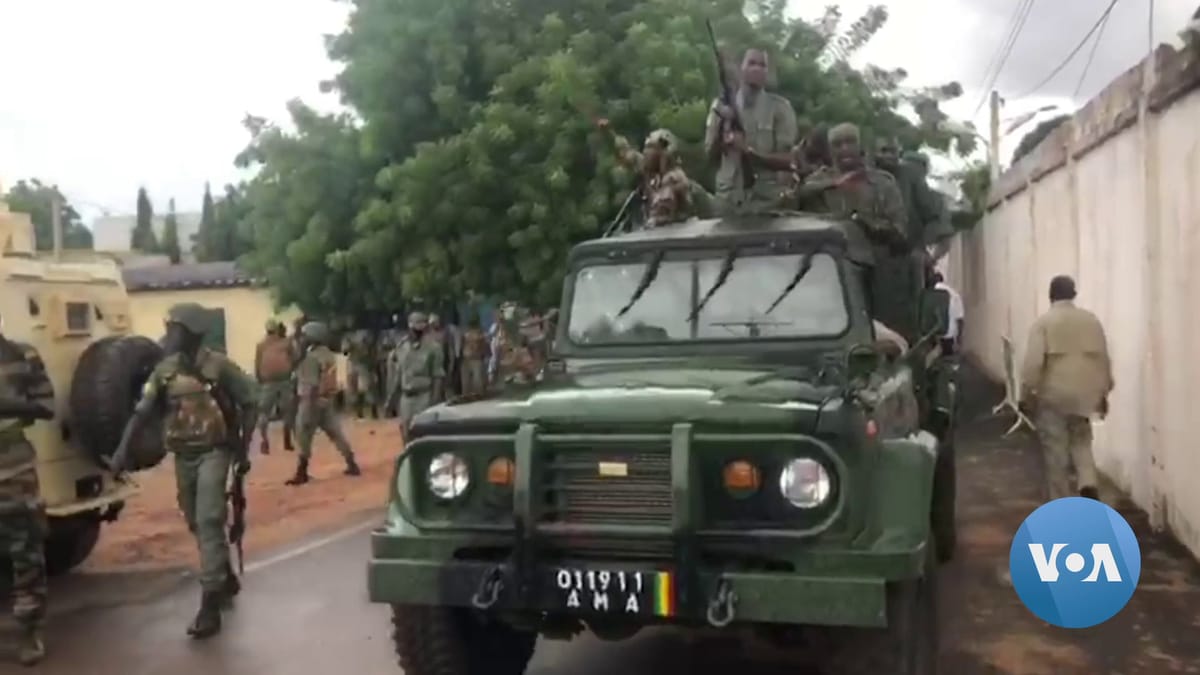
Mali's Conflict is Nearing Crisis Point. Here's What Comes Next.
JNIM's capture of Kidal and tightening grip on northern Mali have pushed the junta and its Russian backers toward the brink — but Islamic State Sahel's rivalry may yet decide who rules, and whether the state survives.
Paweł Wójcik · September 29, 2026 · 7 min read
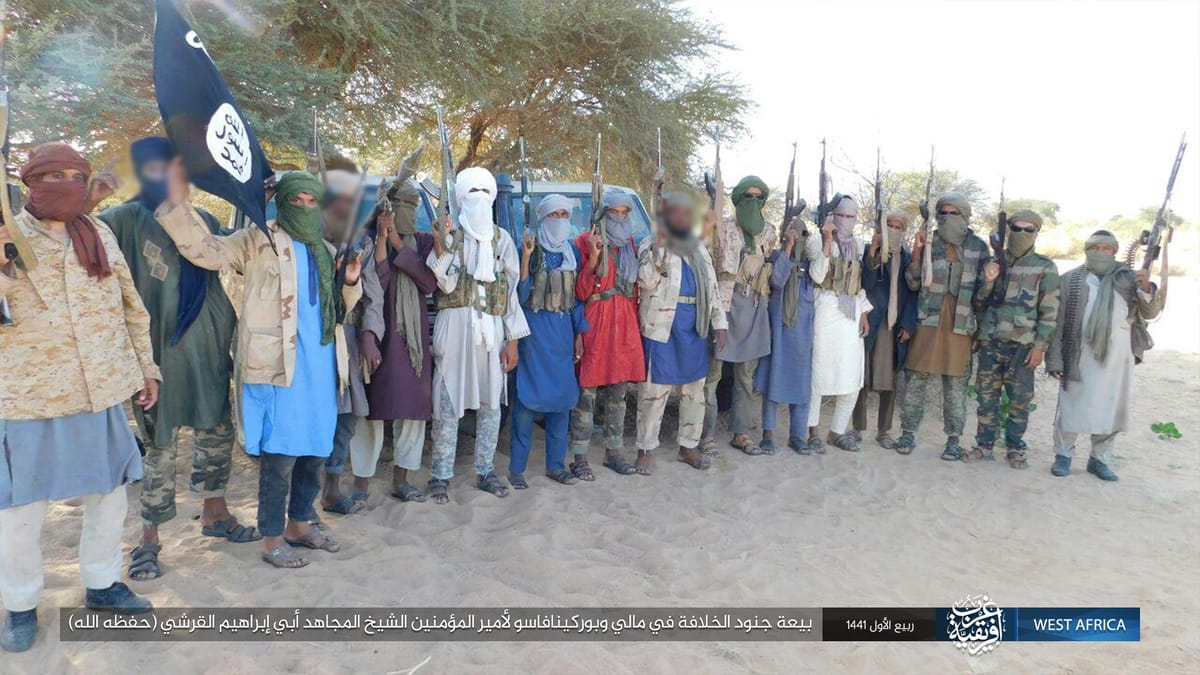
West Africa's Jihadist Groups Are at War. Here's Why.
Brant Philip · September 28, 2026 · 13 min read
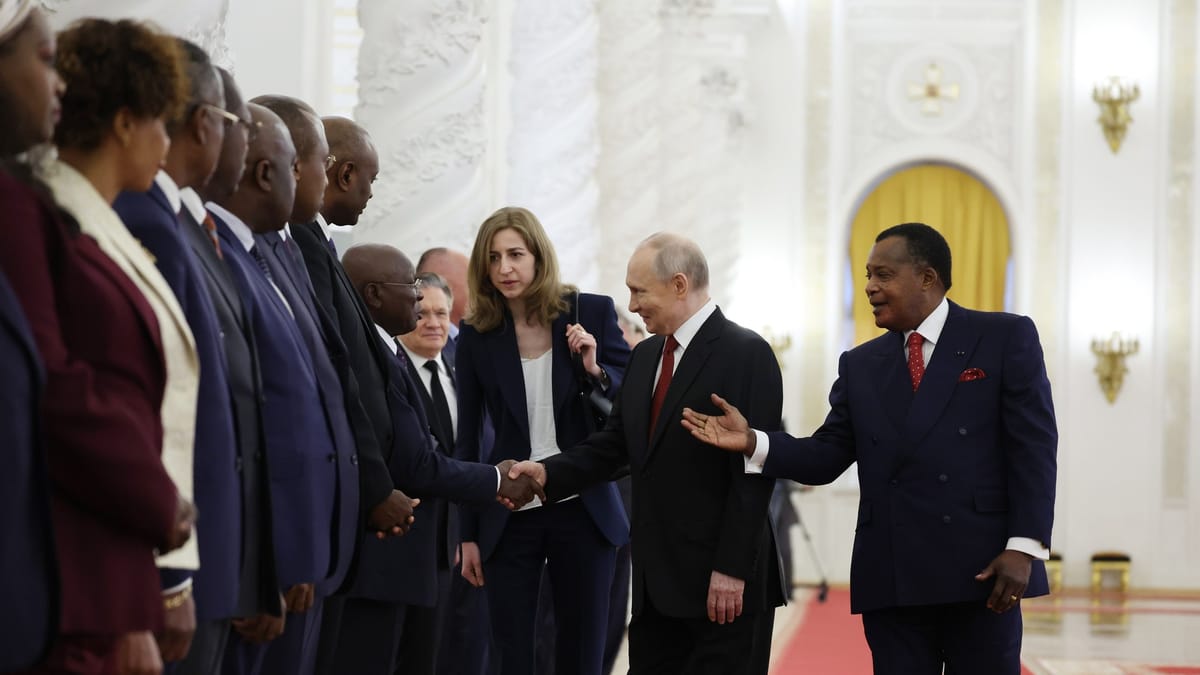
Moscow is Struggling to Drum Up Interest in its Africa Summit. Here's What that Means
Casus Belli · September 8, 2026 · 14 min read
Brazzaville is a sleepy riverside city, a calmer younger sibling next to its boisterous and chaotic older brother Kinshasa across the river. However, the arrival of Russian soldiers from the Africa Corps last year to train the Congolese military suggests that change is afoot. This is particularly surprising after President Denis Sassou-Nguesso pushed back hard on rumors of the Wagner Group's involvement in Congo in 2022. This begs the question: why was its successor group welcomed with open arms in 2025?
2022: The Making of a Debacle
To understand the reversals in Congo’s recent Russia policy, you first have to understand the man behind it all: President Sassou. First rising to power in 1979, this less-heralded member of the Congolese Labor Party (PCT) stepped in to fill the shoes of the movement’s leader, Marien Ngouabi, after his death the previous year. Sassou ruled as a communist for the first decade of his presidency, yet with the fall of the Soviet Union, the Republic of Congo moved toward democratization. Sassou stood for election in 1992 and lost to rival Pascal Lissouba, sparking a period of unrest and civil war in the mid-late 1990s when he attempted to return to power.
This was the era when Elf, the precursor to French oil major TotalEnergies, felt it could play both sides in the civil war, selling military helicopters for oil to Lissouba and boats to Sassou. While Sassou’s faction eventually triumphed, returning him to the presidency, he would not forget the role that private money played in the civil war.
Tensions once again escalated around a presidential election in 2016, when President Sassou’s victory was contested by the so-called Ninja militia from the southern Pool region, leading to a brief conflict, including a helicopter attack on the Pool region that killed 30 people, that ended with a ceasefire in December 2017. Since then, Congo-Brazzaville has remained relatively calm, especially in comparison to neighbors like the Central African Republic (CAR) or the Democratic Republic of Congo.
With the Wagner Group’s arrival in several other countries across the continent in the late 2010s and early 2020s, including neighboring CAR, Sudan, and Mali, President Sassou and Russian Foreign Minister Sergey Lavrov convened in Oyo for a closed–door meeting. Rumors began to circulate about Wagner arriving at the port of Pointe Noire in late September 2022, which appeared to worry both Washington and Paris. An article by Africa Intelligence speculating on the nature of this meeting – and the potential for military cooperation between Congo and Wagner – shocked people in Brazzaville… apparently including the president.
President Sassou’s response was forceful, suggesting a desire to remain independent and to maintain full control of Congo’s natural resources, while also harkening back to the 1997 civil war. An October 2022 press release from the Office of the President noted that Congo had “never accepted the establishment of foreign military bases, particularly Soviet ones,” on its territory, “even when navigating the turbulent waters of the Cold War and flying the flag of Marxist-Leninist ideology.” In particular, it emphasized that “the article in question is essentially part of the destabilization maneuvers whose modus operandi remains well known.”
The latter statement was seen as a clear repudiation of Wagner Group’s resource extraction projects in CAR and Sudan at the time and the group’s designs on Congo. The focus on destabilization also spoke to Sassou’s fear of outside forces threatening his hold on power, a lesson the Congolese president seems to have taken to heart following Elf’s war-profiteering in the 1990s. Whether or not the Africa Intelligence claims were real, a Wagner Group deployment in the Republic of Congo was quashed.
2025: Africa Corps Arrives
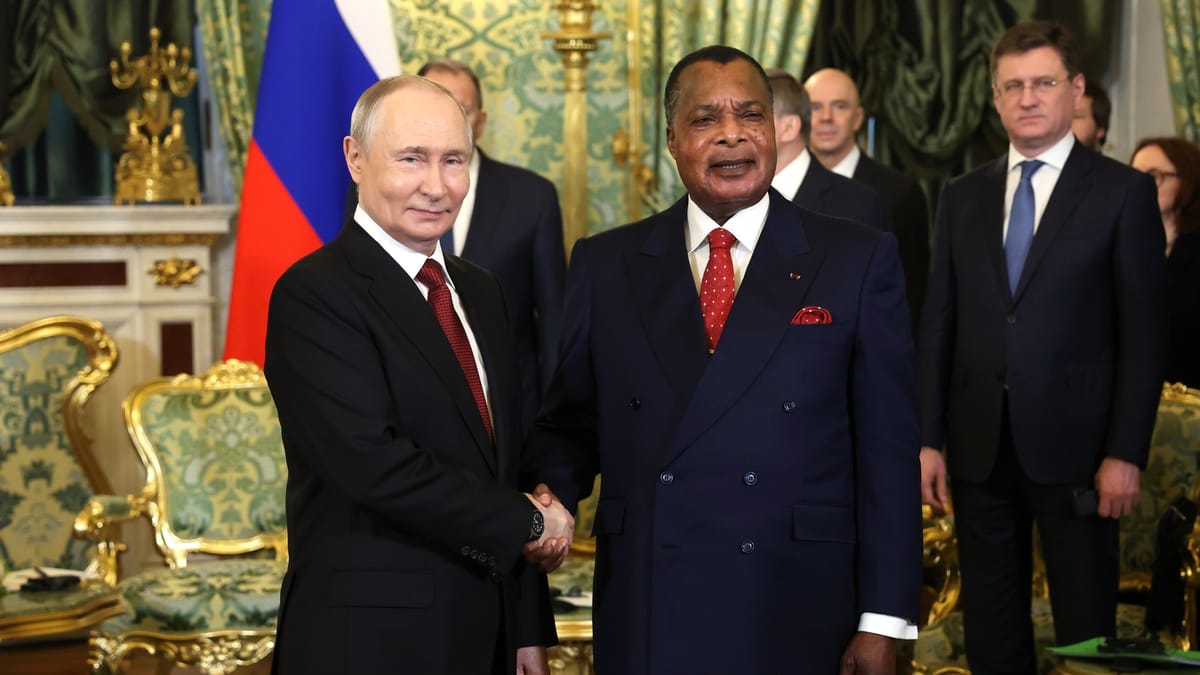
Despite President Sassou’s harsh words in 2022, his immediate political needs and fears in 2025 dictated a new course. Russia’s Africa Corps quietly arrived in the Republic of Congo in January 2025, undertaking both a personal security and a military assistance function. Then, in February 2025, the Russian ship Lady Mariia stopped in Pointe Noire, allegedly dropping weapons that would transit to the Russian deployment in the Central African Republic through Congo. By the end of that year, Africa Corps were training the Congolese military, with a video published on Russia Today (RT) Telegram Channels in November that was subsequently geo-located to the town of Mingali.
Beyond training, the deployment also focused on providing private security to President Sassou Nguesso, particularly ahead of the March 2026 presidential elections. These elections, which President Sassou won with 94% of the vote, saw an intensification of Russian security and media coverage. It quickly became clear that the Kremlin was pushing a suite of information operations that have accompanied other Africa Corps and Wagner Group deployments. In this case, an RT team with two cameramen and French-speaking journalist Daria Vaganova arrived to cover the elections, with the Africa Corps-associated Africa Initiative propaganda organization reposting this coverage on its Telegram channel. On election day, Vaganova asked Sassou about future Congo-Russia relations, and the President tellingly stated that Congo “will continue to maintain good relations with all countries working for peace.” Whether the average person would consider Russia as working for peace remains open for interpretation.
Even more strangely, the Russian Orthodox Church became involved. The Church has “big plans” in the Republic of Congo, aiming to build a church in Pointe Noire, the key port city. This follows a pattern adopted in neighboring CAR, where religion has followed Russian boots on the ground. These operations provide a cultural and spiritual element to whitewash deployments that have become particularly bloody, as in the cases of CAR and Mali.
The presentation of the country’s highest civilian or military medal, the Order of Merit, to four Russian service members on October 30, 2025 was particularly revealing. One is General Andrey Averyanov, the overall commander of the Africa Corps, an officer in the Russian Military Intelligence (GRU) known for his role in the attempted assassination of Sergey Skripal in Salisbury in 2018 with the nerve agent Novichok. Another is General Alexei Orekhov, Director of the Main Administration for Military Cooperation (GUMVS) of the Russian General Staff. These awards provide a level of strategic messaging about the importance of the Africa Corps mission to the Congolese government and the involvement of high-profile Russian military officers in the operation.
Explaining Russian Interests in Congo
The obvious question to ask here is: why is Russia interested in the Republic of Congo? Africa Corps' motives in Brazzaville are clearly different from many of its other deployments. Unlike deployments in CAR, Mali, or Sudan, there are no active conflicts to participate in, so the Russian investment is low risk but also low reward because the state is not particularly threatened. Instead, they concern Russia's desire to rebuild old Soviet partnerships, an interest in Congo's oil industry, and Congo's geo-strategic location in the region.
The economic piece might be essential, as Russia attempts to recoup financial resources from its Africa Corps deployments amidst a costly war in Ukraine. Sassou’s visit to Moscow in May 2025 saw a bilateral agreement to renew the moribund Pointe-Noire to Oyo pipeline project via the Russian company ZNGS Prometey, which aims to double Congo’s oil production by 2027. Russia aims to profit off this agreement, either through Africa Corps, Prometey, or other Russian companies. However, such infrastructure projects in sub-Saharan Africa are frequently not completed, suggesting this may simply be another halfhearted attempt at cooperation rather than an actual economic win for Russia. Like in Mali, it will be very difficult for Africa Corps to break into Congo’s oil industry because of the powerful international companies involved (French TotalEnergies and Italian Eni), and in Congo’s case, a Congolese state company (SNPC) that dominates the oil industry. Other lucrative industries, such as potash, magnesium, and iron mining, would require a significant amount of capital investment that the Kremlin has yet to offer to Africa Corps.
History has to be at play here as well, as Congo was at one point a staunch Soviet ally. Recently, Congo has drifted more toward the Chinese Communist Party, helped in part by Chinese investment in the economy, including a $23 billion dollar investment by Wing Wah in the oil industry on September 10, 2025. As such, the Africa Corps deployment is an attempt to compete with China as much as it is with France or the United States. In many ways, Russia hopes to recreate its Soviet predecessor’s partnerships, while also responding to present day circumstances. Today, those include the need for building military relationships to reinforce and strengthen diplomatic ties across the African continent, and thus garner support for its war in Ukraine in the United Nations.
Beyond the economic and diplomatic pieces, Congo-Brazzaville’s geo-strategic position is also important for Russia. As a nation with a conveniently-placed deep water port, Pointe Noire, the Republic of Congo offers key logistics advantages for Moscow as it supplies other deployments, particularly in CAR. Further, any Russian activities in the Democratic Republic of Congo, Angola, Cameroon, or Gabon could be more easily accessible from the Republic of Congo (and from Equatorial Guinea) than from Russia’s deployments further north in the Sahel or east in CAR. In the past, Wagner Group conducted cross-border operations from CAR into Sudan, while today the Africa Corps has closed this border in a bid to deny the RSF a resupply route. Africa Corps could potentially do the same from Congo-Brazzaville, should conflicts sprout up on its borders.
Explaining Congolese Interests in Africa Corps
The case for an Africa Corps intervention from a Congolese perspective is even more perplexing. Why is a Russian intervention happening now after it was discouraged so strongly in 2022? A combination of factors have led to this change of heart, including a desire to secure the presidency against external and internal threats.
Since 2022, something has profoundly changed when it comes to President Sassou’s sense of security within his own regime. Regional politics are certainly part of the answer. As the author wrote in September 2023, the military coup in neighboring Gabon was symptomatic of an aging regional cohort of presidents, including Presidents Paul Biya of Cameroon (now 93), Denis Sassou-Nguesso of Congo (82), and Teodoro Obiang Nguema Mbasogo of Equatorial Guinea (84), many of whom could also be forced out by their militaries like President Bongo in Gabon. Ahead of presidential elections in 2026, it is unsurprising that President Sassou turned to the Africa Corps to deter political or military challengers to his regime, following President Obiang of Equatorial Guinea in 2024.
Another part of the answer involves the president’s history with private backers for military activities. President Sassou distrusted Wagner Group because of negative associations with other mercenary organizations in Central and Southern Africa, including the former South African mercenary company Executive Outcomes, alongside his own experience with Elf in 1997. But an Africa Corps deployment beholden to the Russian state might represent something else entirely.
Looking back on his 2022 press release, another quote is key here: “This principled position remains inviolable and cannot be called into question in favour of a private company whose services and interests would, given their apparent purpose, have no use for the Republic of Congo and for the well-being of our compatriots.” Instead, “it is important to emphasize that the Republic of Congo scrupulously observes the principle of state-to-state military cooperation, particularly with several countries, based on existing agreements and conventions.” Members of the Africa Corps deployment have made similar comments, “‘We are not what the press describes: violent soldiers operating in secret,’” said one. “‘There have been abuses perpetrated by the Wagner Group. Africa Corps consists of state agents placed at the service of another partner state.’” President Sassou’s faith in Africa Corps reflects a state-backed institution beholden to the will of Moscow, rather than to private individuals with varying loyalties.
Further, faith in the coup proofing capacity of Russian military assistance is warranted. Despite numerous failings in their counterterrorism operations, Africa Corps and the Wagner Group before it have been successful regarding their coup proofing services for African leaders, including President Faustin-Archange Touadéra in CAR, President Ibrahim Traoré in Burkina Faso, and President Assimi Goïta in Mali. In Niger, the group stopped a coup attempt by disgruntled soldiers against President Abdourahamane Tchiani in late August. The only exception has been Sudan’s President Omar al-Bashir, although Wagner’s counter-protest advice was ignored and the organization switched to supporting one of al-Bashir’s eventual ousters, General Abdel Fattah al-Burhan (Wagner would later go on to support al-Burhan’s rival, General Hemedti, in the Sudanese civil war, following a common pattern of Russia playing both sides to extract political gains).
Expected Returns
Africa Corps’ deployment to the Republic of Congo presents a conundrum to all parties involved. For the Congolese, Africa Corps is in place to deter a coup and to keep the president in power. As a Congolese businessman told me, “Congo is at a crossroads today, as it will have a parliamentary election next year and will eventually change the actual constitution to allow another one (or two) term(s) for the president. Africa Corps will play a shadow role, making sure that things do not go sideways if this scenario is carried out.” However, should President Sassou pass away, would the Africa Corps choose sides in a succession crisis? It is unclear if Moscow would be willing to gamble on a single candidate.
The Russian investment in Congo, even if comparatively low relative to the Malian or Central African projects, begs some type of return. What natural resources or economic offerings might the government present to Africa Corps to keep it invested in the country? At the moment, none have been named beyond a questionable pipeline project. Perhaps access to the deep water port at Pointe Noire and diplomatic support for the war in Ukraine is enough. However, this logistical access could affect Congo’s Western partnerships, particularly if secondary sanctions are enacted on any Congolese companies for their involvement in supporting the Russian war in Ukraine. A worst case scenario could see Ukrainian drone attacks on Russian shipping in Pointe Noire, threatening the very sovereignty that President Sassou clings to.
Put together, the Congolese deployment of the Africa Corps provides an intriguing case of foreign military involvement, alongside long term questions about sovereignty, governance, and diplomacy for a country that rarely makes headlines. Where things go from here is anyone’s guess.
Written by
Raphael Parens is a senior fellow at Delphi Global Research Center and a fellow at the Foreign Policy Research Institute. He is an international security analyst focused on Africa and Eurasia. Parens has been published in Foreign Affairs, Foreign Policy, War on the Rocks, and the Sentinel. His first book, entitled Moscow’s Mercenaries: The Rise and Fall of the Wagner Group and co-authored with Colin P. Clarke and Christopher Faulkner, was published in the spring of 2026.
Related articles
Mali's Conflict is Nearing Crisis Point. Here's What Comes Next.
JNIM's capture of Kidal and tightening grip on northern Mali have pushed the junta and its Russian backers toward the brink — but Islamic State Sahel's rivalry may yet decide who rules, and whether the state survives.
Paweł Wójcik · September 29, 2026 · 7 min read
West Africa's Jihadist Groups Are at War. Here's Why.
Brant Philip · September 28, 2026 · 13 min read
Moscow is Struggling to Drum Up Interest in its Africa Summit. Here's What that Means
Casus Belli · September 8, 2026 · 14 min read
Become a Member
Members get full access to premium reporting, in-depth briefings, and subscriber-only analysis.
Insiders Receive
- Full access to all premium articles and briefings
- Exclusive subscriber-only analysis and dispatches
- Support independent conflict journalism
Signed in or already a member, but still locked? Fix an access problem
From $5/month — cancel anytime