A Quick Overview of the Conflict
The Ethiopian federal government is facing internal ethno-nationalist rebellions and deteriorating bilateral relations with Eritrea, Sudan, and Egypt. Taken together, these anti-Addis forces threaten to turn the Horn of Africa into a regional battleground. The potential to reignite a war with the Tigray People’s Liberation Front (TPLF), after the Tigray War (2020-2022), is the federal government’s most pressing flashpoint. However, certain Amhara ethno-nationalist militias, known as Fano, and the Oromo ethno-nationalist Oromo Liberation Army are also waging deadly insurgencies in Ethiopia’s two most populous regions, Amhara and Oromia.
Ethiopia’s deteriorating relations with Eritrea, Sudan, and Egypt have layered onto these domestic tensions, creating a flashpoint with regional implications. Eritrea-Ethiopia ties have devolved back into animosity, after a brief improvement in their decades-long adversarial relationship, with Ethiopian sea-access ambitions further fueling the fire.
Ethiopia and the Sudanese military regime have also had a falling-out over longstanding tensions related to proxy support for opposition armed groups, border disputes, and Ethiopia’s Grand Ethiopian Renaissance Dam on the Nile River. Eritrea and Sudan have each increased cooperation with the Ethiopian federal government’s domestic adversaries, as part of a tactical anti-Addis alliance of convenience. Egypt, which views the dam and similar planned projects as existential threats, has sought to strengthen its ties with Eritrea and Sudan to contain and isolate Ethiopia on the regional level.
Where Things Currently Stand
The Ethiopian federal government and TPLF are on the precipice of war, as both sides have increasingly looked to military means in 2026 to address an intractable political dispute. In April, the TPLF rejected the federal government’s extension of the federally backed Tigray Interim Administration’s mandate. It then reinstated the pre-Tigray War legislative council, which promptly selected TPLF head Debretsion Gebremichael as regional president. This move restored the pre-Tigray War status-quo and effectively voided the Pretoria peace agreement, which ended the prior conflict. The absence of elections in Tigray during Ethiopia’s national elections on June 1 reinforced the region’s isolation.
The region has slipped into low-intensity conflict throughout 2026. The Ethiopian military and Tigrayan forces amassed forces on the Tigray regional border beginning in February, after the first large-scale fighting between the two sides in disputed areas of Tigray since 2022 occurred. Both forces have maintained elevated presences on the border. The two sides have also escalated their rhetoric against each other since the TPLF reinstated the regional government. The Ethiopian military and allied forces then engaged in large-scale fighting with the TPLF in western Tigray on August 1, reportedly due to TPLF forces advancing toward Addis-controlled Humera, a town near the Eritrean and Sudanese borders. The two sides reportedly clashed again in southern Tigray on August 15, and the Ethiopian military has conducted numerous drone strikes around Tigray, including the regional capital, Mekele, since mid-August.
The renewed Tigray conflict threatens to spark a chain reaction across Ethiopia and the region. Ethiopia’s other major ethno-nationalist rebel groups, the Amhara Fano and the Oromo Liberation Army, have continued their insurgencies in their respective regions. The groups now claim to have formed a loose military coalition against the federal government, aligning with the TPLF despite the long-standing tensions between the groups.
These rebel groups have become a vector for regional proxy competition, as Eritrea-Ethiopia relations have returned to their pre-2018 status-quo: elevated military postures, sponsorship of rival proxy groups, and a lack of diplomatic outreach. Ethiopia-Sudan relations are at a recent low point, due to dueling proxy support. Egypt has backed the Sudanese military regime against the paramilitary Rapid Support Forces in hopes of stabilizing its border with Sudan and having a key anti-Ethiopian ally in Nile politics. Simultaneously, Egypt is strengthening its relationship with Eritrea and Somalia to more broadly isolate Ethiopia.
The Deep Overview
How did we get here?
Abiy’s larger aims of domestic centralization and regional preeminence set conditions for the challenges currently facing the Ethiopian federal government. The Tigray war initially started in 2020 over federal tensions, as Abiy sidelined the TPLF, which had governed Ethiopia from 1991 to 2018, and sought to centralize power at the expense of Ethiopia’s controversial ethno-federal system. The Ethiopian military (ENDF) had the battlefield advantage over the TPLF and had imposed a siege on Tigray by late 2022, leading the TPLF to concede to the federal government. The ensuing Pretoria agreement restored federal authority and monopoly on force in Tigray. The Pretoria agreement promised to establish an interim regional government, rebuild Tigray’s economy, and facilitate the return of displaced Tigrayans.
Renewed tensions have reached a breaking point, with TPLF hardliners now in control of Tigray. Debretsion and his faction believed that the Pretoria agreement marginalized the TPLF, and they opposed the agreement from the outset. Hardliners’ opposition led to infighting between them and more moderate TPLF leaders, including the head of the Tigray Interim Administration (TIA). The hardliners also criticized the enduring presence of non-federal forces in Tigray, and the displacement of approximately one million Tigrayans. The Debretsion-led faction eventually launched a de-facto coup to install a more pro-TPLF TIA head in March 2025. The federal government responded by revoking the TPLF’s status as a political party in May 2025 and then cutting financial support and fuel shipments to the TIA as part of a renewed economic blockade on Tigray later in the year. Those tensions led the TPLF to dispose of the TIA altogether.
Today, certain Amhara Fano factions and Eritrea are aligned with the TPLF. They have returned to their historically antagonistic relations with the Ethiopian federal government despite their past alliance with Abiy against the TPLF during the Tigray War. Fano and Eritrea each viewed the Pretoria agreement as a betrayal, albeit for different reasons. Fano criticized the deal for failing to formalize Amhara land claims in disputed areas of southern and western Tigray and omitting alleged TPLF abuses against Amhara during the Tigray war. Eritrea, on the other hand, disapproved of any peace deal that did not disband the TPLF.
Abiy’s broader agenda to centralize power en route to regional hegemony has caused Addis Ababa’s tensions with Fano and the Oromo Liberation Army (OLA) to worsen. Fano decided to launch its insurgency in April 2023 after the federal government disbanded the Amhara regional special forces in a broader effort to subsume all security forces under the federal government. The OLA also rejected an Abiy-led federal government peace offer in 2018, instead splitting from the Oromo Liberation Front (OLF) due to distrust of the federal government’s intentions in the Oromia region. The OLA then aligned with the TPLF during the Tigray war and has since continued its low-grade insurgency.
Abiy’s agenda has also roused strong regional resistance. Ethiopia has made Eritrea’s port of Assab a focal point of its efforts to obtain sea-access since 2023, sometimes citing its historical access to Assab when Eritrea was part of Ethiopia. The Eritrean regime has denounced these claims, rejected dialogue, and strengthened preexisting ties with Ethiopian rebels, viewing Ethiopian aims as a threat to its security and an opportunity to bolster its own domestic support. Ethiopia-Sudan relations were already strained due to the Sudanese military (SAF) reactivating longstanding ties to Eritrea and the TPLF to bolster its war effort. Addis viewed the SAF’s ties as strengthening its domestic and regional adversaries. The relationship has rapidly deteriorated since Ethiopia began actively supporting the SAF’s adversary in the Sudanese civil war, the Rapid Support Forces (RSF), by facilitating weapons shipments and enabling rear basing in Ethiopia in late 2025.
Who’s fighting, and who’s backing them?
On one side is the Ethiopian federal government under Abiy. The ENDF is one of the largest militaries in Africa, with approximately 500,000 soldiers and a capable air force. The ENDF is also allied with some Amhara and Tigrayan forces, including units based in Amhara, disputed areas of southern and western Tigray, and the Afar region, respectively. The United Arab Emirates (UAE), Turkey, and China are Abiy’s key financial and military backers. Emirati and Turkish support, especially through the provision of drones, played a vital role in the ENDF halting a Tigrayan counteroffensive and gaining a definitive edge over the TPLF during the Tigray war in 2022.
On the other side are Ethiopia’s ethno-nationalist rebel groups. The TPLF only possesses ground forces, but it is adept at both conventional and unconventional warfare. The TPLF had up to 250,000 fighters at the height of the Tigray war, although limited demobilization and waning public support since the war has reduced the size of the TPLF’s force. The TPLF has conducted a mass conscription campaign in Tigray in 2026 to bolster its ranks. Fano is a loose group of Amhara ethno-nationalist militias that lack a shared platform and leadership, although the strongest Fano militia, the Amhara Fano National Movement (AFNM), united the two most significant Fano factions under a command structure in January 2026. The OLA is an Oromo ethno-nationalist militant group that had been the military wing of the OLF since the 1970s, before it split from the OLF in 2018.
Eritrea and the SAF are the primary partners of the ethno-nationalist rebel groups. The Eritrean regime under long-time President Isaias Afwerki has provided materiel and intelligence support to the TPLF and deployed Eritrean military forces into Tigray. Eritrea has also provided materiel and training to Fano since the Tigray war. The SAF has let the TPLF use Sudanese territory as a rear base since the Ethiopian civil war (1974-1991) through the present. The SAF has also facilitated collaboration between Eritrea, the TPLF, Fano, and the OLA, hosting meetings between the disparate factions on Sudanese territory. Egypt is the biggest opponent of the Grand Ethiopian Renaissance Dam, which it views as an existential threat to its economic and environmental stability.
What are they fighting for?
Abiy is committed to centralizing authority with the federal government so that he can implement his Prosperity Agenda, designed to elevate Ethiopia to the role of dominant regional powerhouse. Abiy’s governing ideology, known as medemer (“synergy” in Amharic), mandates unity and the elimination of ethno-nationalism to realize Ethiopia’s potential. Abiy has also made harnessing Ethiopia’s share of the Nile and sea-access, particularly at its former seaport Assab, key prerequisites to realizing Ethiopia’s demographic and geographic potential.
The ethno-nationalist rebel groups each have different goals despite their anti-Addis alignment. The TPLF wants to control the Tigray region’s full de-jure boundaries without federal interference. It may also seek to accomplish national objectives related to preserving the ethno-federal system that it established. The OLA also seeks to preserve ethnic federalism to prevent the economic and political marginalization of Oromo and achieve Oromo self-determination. The organization has not ruled out Oromo secession, if it believes that its end goals are not being met through its current strategy.
On the other hand, Fano’s goals are in some ways diametrically opposed to the TPLF’s and OLA’s. Various Fano militias have differing goals, but the AFNM has called for Amhara self-determination and an end to Ethiopia’s ethno-federal system, which the AFNM believes marginalizes the historically dominant Amhara. The AFNM does not trust Abiy’s government to uproot ethnic federalism either, due to concerns that Abiy—an ethnic Oromo—will centralize power at the expense of Amhara. Along with the conflicting goals, Fano has long-standing land disputes with the TPLF and the OLA that undermine further alignment.
Eritrea and Sudan, as well as their Egyptian partners, are seeking to isolate Ethiopia to contain its regional ambitions. The Eritrean regime under Isaias has consistently sponsored Ethiopian rebel groups to fracture Ethiopia internally so that Ethiopia cannot threaten Eritrea or Isaias’s regime. The SAF also prefers a weakened Ethiopian federal government to strengthen its leverage on border and Nile disputes, even more so now given Ethiopia’s role in the Sudanese civil war, while the Nile dispute is Egypt’s focus.
How has the war unfolded?
The Ethiopian federal government’s dispute with the TPLF has slid into a low-intensity conflict since 2025 as the Pretoria agreement has collapsed. The federal government backed a newly established anti-TPLF Tigrayan proxy force known as the Tigray Peace Forces soon after the TPLF’s de facto coup in March 2025, leading to several proxy clashes with the TPLF. The ENDF conducted drone strikes on TPLF-linked forces in support of its proxy in November 2025, for the first time since the Tigray War. TPLF-linked forces then launched an offensive to push the ENDF and allied Amhara ethno-nationalist forces out of southern and western Tigray in January 2026, resulting in the first large-scale engagement since the Tigray war. Rather than de-escalate and return to implementing the Pretoria agreement, the two sides initiated a military standoff that has persisted since. Renewed fighting since August has, so far, been localized in southern and western Tigray, although drone strikes, mobilizations, and escalatory rhetoric from both sides have set conditions for a larger conflict.
The other ethno-nationalist insurgencies have continued at a steady state, if not worsened. Fano has been able to better withstand ENDF counteroffensives and sustain its offensives since late 2025, recording its highest levels of activity ever since starting its insurgency in April 2023. Fano’s effective targeting of election infrastructure across Amhara, in the lead-up to and during the June national elections, indicates that it contests ENDF control of most territory in the region outside of major population centers. The OLA has maintained a similar rate of activity since the Tigray War despite repeated ENDF offensives against the group. The OLA has targeted election infrastructure in Oromia, as well.
Defining Dynamics
A key feature of the conflicts in Ethiopia is the fluid nature of alliances, both in Ethiopia and across the surrounding region. Eritrea and the TPLF had initially worked together during the Ethiopian Civil War to overthrow the communist Derg regime, and the TPLF even acceded to Eritrean independence when it took power in Addis Ababa. However, the two former allies fell out within a few years and fought a border war that made them archrivals for the remaining decades of TPLF rule in Ethiopia.
Eritrea was very receptive to working with the Ethiopian federal government once Prime Minister Abiy Ahmed took power. Ethiopia and Eritrea pursued a rapid rapprochement after 2018, agreeing to end their border dispute and reopen their border for the first time in decades. A major objective of this relationship was to isolate the TPLF, which both sides viewed as a major threat. When the Tigray War finally began in 2020, Eritrea was one of the main fighting forces to join Ethiopia against the TPLF.
However, the two neighbors have returned to their historical rivalry, and Eritrea has formed an alliance of convenience with its longtime rivals in the TPLF. Eritrea wanted to completely neutralize the TPLF and remove that threat from its border. However, Abiy ultimately pursued a peace deal that aimed to bring Tigray and TPLF elements back under federal control, disregarding Eritrea entirely. Eritrea felt betrayed by Abiy and viewed the deal with the TPLF as an indicator that Abiy may use Tigray to threaten Eritrea. The nationalist and irridentist rhetoric from Addis regarding Ethiopian sea-access at the Eritrean port of Assab, which it lost when Eritrea gained independence, has only exacerbated any concerns Eritrea had. The TPLF, for its part, is in need of regional allies, especially after it experienced the dangers of being physically and politically isolated during the Tigray war.
Beyond Eritrea’s flip-flopping, Ethiopia’s myriad ethno-nationalist rebels, especially Amhara factions, have had a complicated relationship with the Ethiopian federal government and each other. The TPLF initially rose to power as part of a coalition that involved Amhara, Eritrean, and Oromo rebels. As members of Ethiopia’s two largest ethnic groups, Amhara and Oromo ethno-nationalist groups view each other as a direct threat, as well as major rivals for power and resources within Ethiopia. Both rivals also came to resent the TPLF after decades of perceived minority rule by Tigrayans, and Amhara forces fought alongside Ethiopian federal forces during the Tigray War, largely to settle decades-long grievances related to disputed parts of Tigray region claimed by Amhara. However, thousands of Amhara fighters launched the Fano insurgency after Abiy moved to consolidate control of their forces after the Tigray war ended, and Fano is now forming a loose anti-Addis coalition with the OLA and TPLF.
Another key feature of Ethiopia’s conflict is its roots in longstanding ethnic grievances and still-unsettled questions of national identity among Ethiopian elites. “Pan-Ethiopianists” trace Ethiopia’s beginnings back to 800 BC and the Axumite empire, which was based in modern day Eritrea and Tigray and shifted southward into Amhara as the empire declined. They maintain that an Ethiopian state and culture have existed uninterrupted for the past three millennia. This viewpoint is more predominantly held by Amhara, which were at the center of gravity in imperial Ethiopia. Ethno-nationalists, which primarily includes some Oromos, Tigrayans, and members of Ethiopia’s smaller minority groups, say that a modern state and national identity was only formed as the result of Amhara-led expansion, subjugation, assimilation, and centralization during the modern Ethiopian empire in the 19th and 20th centuries.
Ethiopia’s controversial ethno-federal system now lies at the heart of these debates. The TPLF established the system, which created administrative regions and political parties along ethnic lines, as a rejection of what it perceived as Amhara domination during the preceding imperial and Derg periods. Abiy is now attempting to dismantle the system and re-centralize power. Critics have argued that the ethno-federal system has exacerbated domestic strife and limited Ethiopia’s potential by unmooring Ethiopians from a shared identity. However, Abiy’s agenda has exacerbated these very dynamics, prompting various ethno-nationalist movements to take up arms against the central government. Even among these rebels there is a wide range of views, with Fano advocating for the total end of the federal system, while the OLA and TPLF seek to preserve the system but dispose of Abiy himself.
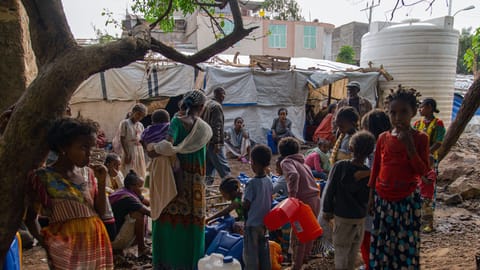
The deeply ethnic nature of these disputes has normalized the targeting of civilians on an ethnic basis. Several UN bodies and rights groups report that all parties in the Tigray war perpetrated committed war crimes or crimes against humanity, including mass sexual violence, ethnic killings, and forced displacement. International human rights organizations also claim that Eritrean and Amhara forces—with Ethiopian federal complicity—committed acts of ethnic cleansing, which is a constituent act of genocide, against Tigrayans in western Tigray. Today, the federal government’s renewed blockade to push the TPLF to the negotiating table disproportionately impacts Tigrayans. Beyond Tigray, abuses are rife throughout Amhara and Oromia, where ethnic targeting of civilians by all parties is commonplace, and federal forces have been accused of extrajudicial killings, arbitrary detentions, forced displacement, destruction of property, and widespread sexual violence.
The growing entanglement with regional actors across Africa and the Middle East is increasingly shaping how fighting unfolds, adding another unique dynamic to the Horn. The civil war in neighboring Sudan has become increasingly intertwined with conflict dynamics in Ethiopia. TPLF fighters that fled to Sudan at the end of the Tigray war have been a key part of the SAF’s coalition in the Sudanese civil war, and Eritrea has helped train pro-SAF militias and served as a rear base for the SAF. Meanwhile, Addis began backing the RSF in late 2025 and has accused the SAF of working with its regional adversaries. While Egypt lacks formal ties with the TPLF, it is a major military partner of both Eritrea and Sudan. These bilateral ties position Egypt to play an indirect role, as conflict in Ethiopia continues to draw in these Eritrea and Sudan.
Beyond Africa, Middle Eastern countries are partnering with Ethiopia’s belligerents as proxies in their competition for regional influence in the Red Sea and Horn of Africa. Their influence is shaping regional alliances and impacting how the belligerents wage war. The UAE was a key Ethiopian partner during the Tigray War and has remained a staunch supporter of Abiy, serving as the main financier of Abiy’s modernization projects and the leading supporter of Ethiopian sea-access efforts. On the other side, Egypt has served as a link between its Eritrean and Saudi partners, the latter of which is increasingly looking to contain Emirati influence in the region. Turkey is also a key Ethiopian partner, but its growing regional alignment with Egypt and Saudi Arabia raises questions on how it would handle a major regional conflict in Ethiopia. These partnerships have further entangled local conflicts within a regional patchwork, given local actors the political and military backing to launch and sustain more intense conflicts, and led to intense speculation on how much influence external partners have over African decision-making.
Future Outlook
The continuation of low-intensity conflict is the most likely short-term scenario, as neither the Ethiopian federal government nor the TPLF seem to have the capacity or will for another conflict on the scale of the Tigray War. Aside from the aforementioned domestic and regional challenges that Addis faces, the fallout from the Iran war has created serious fuel shortages. The perilous future of the African Union and United Nations counterterrorism missions in neighboring Somalia create another potential headache. In Tigray, the TPLF has dealt with internal splintering that it did not experience in 2020. The TPLF’s forcible conscription campaign also signals that the Tigrayan people are less supportive of the TPLF now, and even less supportive of a war, than they were in 2020.
However, the same internal pressures make an open-ended conflict unsustainable for both parties in the medium term. The Ethiopian federal government may eventually decide that tolerating the status-quo stalemate is too strategically costly and move to neutralize the hardline TPLF leadership. Even if Addis tolerates the stalemate, the TPLF will struggle to withstand the federal government’s ongoing siege indefinitely. The TPLF may reach a breaking point and launch an offensive to regain the initiative. Alternatively, the TPLF may calculate that it lacks the capacity for such an offensive. It could instead seek to reopen dialogue channels and deescalate, although this scenario is much less likely given the TPLF hardliners in power and the lack of trust between the two sides. Some middle paths could also emerge, wherein growing unrest within Tigray unseats the TPLF, with or without help from the federal government or Addis-aligned Tigrayan factions.
The delicate state of play and heightened tensions in the interim raises the risk that miscalculation from either side accidentally triggers a larger conflict. Ethiopia, the TPLF, and Eritrea have narrowly avoided a large-scale war multiple times since 2025. Diplomatic efforts have helped prevent war, but the wider region and the global community have since become increasingly distracted with the fallout of the US-Iran war. The belligerent rhetoric coming from all sides only raises the risk that some probing maneuver, isolated clash, or simple misinterpretation will cause a larger conflagration. Meanwhile, Fano and the OLA have continued their insurgencies and have sought to increase cooperation with TPLF, and even if strategic differences prevent the emergence of a cohesive alliance, all these actors will exploit opportunities to tactically cooperate.
External factors complicate all these calculations, adding additional trip-wires and threatening to multiply the severity of any conflict. A regional escalation cycle regarding Sudan could spark a conflict in Tigray, should the SAF retaliate against Addis by sending Tigrayan units in Sudan back to Tigray or other means. Egypt has warned that any further Ethiopian dams on the Nile would draw a firm response, which could lead it to deepen its partnership with Eritrea in a manner that emboldens Asmara or spooks Addis. Middle Eastern partners, most notably including Ethiopia’s allies in Abu Dhabi, have also shown a willingness to bankroll their regional allies and remain focused on regional Red Sea competition despite the added factor of the Iran war.
The Ethiopian federal government and TPLF are undoubtedly on a collision course, but the twists, turns, and size of the cliff at the end are much less clear. The conflict currently unfolding across various parts of Ethiopia doesn’t feel “low-intensity” for Ethiopian civilians who have been subject to drone strikes, siege, and ethnic violence. Nor does the low-grade conflict imply low costs of escalation. Ethiopia lies at the heart of the African Horn, and what goes down in Ethiopia will undoubtedly reverberate in the neighboring Sudanese civil war, al Qaeda-afflicted Somalia, the Nile River Basin, and the increasingly strategically relevant Red Sea.
Ethiopia is known as the land of origins. Right now, it stands at the origin of a multilayered crisis that could upend not only Africa, but also heavily impact the Middle East and the wider world.