
Skip to content
Fronts.co
InsiderBriefing

Ethiopia on the Brink. And More.

Simon Whistler • August 28, 2026
Ethiopia on the Brink. And More.

Members only

Note: this transcript was generated by AI and may contain errors or inconsistencies.

Welcome to The Briefing Room, the weekly show where we scour the globe for conflict stories so obscure you didn't even know you needed to be worried about them. I'm Simon, and this week we're looking at a country most regular folk probably don't even know is in the grips of an insurgency.

We're talking about Thailand, where a series of coordinated attacks recently revealed the scale of the problem facing Bangkok.

Alongside that, we're also checking in on Mali, where enormous sums of money have recently been paid to terror groups and insurgents to free hostages from Russia and America. It will be discussing how these ransom payments are likely to mean bigger attacks down the line.

But first, we're checking in on the nation of Ethiopia, where unresolved tensions from the Tigray War could soon plunge the entire country into chaos.

As always, thank you so much for being a subscriber of Fronts.co. Your membership not only pays for niche content like this series, but also allows us to occasionally cover lesser-known topics over on the main channel.

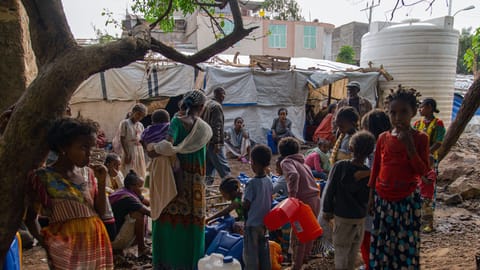
And with that out of the way, let's head to Ethiopia, where a new alliance may soon spell a catastrophe for the government. in Ethiopia, where it's becoming increasingly likely that the 21st century's deadliest war will restart, and it promises to be much worse than before.

Regular viewers of War Fronts will remember that on 1st of August this year, the Ethiopian National Defense Forces, or ENDF, and fighters loyal to the Tigrayan People's Liberation Front, an ethno-nationalist group that at one point dominated Ethiopian politics, clashed near Shararina, a town on the Ethiopia-Sudan border.

It was the first real ground fighting between the two sides since the Praetoria Agreement ended the previous iteration of the Tigray War, which killed an estimated 600,000 people between 2020 and 2022. The fighting happened after months of escalating tensions, which began almost immediately after the deal was signed.

Because while the Praetoria Agreement ended the war, it didn't resolve the underlying issues that had caused it, and nor did it create a stable political order in the Tigray region. After the war, the TPLF was consumed by internal power struggles that culminated in a faction of the TPLF seizing control of key officers in the regional capital, Mekela.

This set the stage for an even bigger power grab in May this year, when the TPLF elbowed out regional leader Tedessa Wireda, who had the blessing of Addis Ababa, replacing his administration with a regional council led by TPLF chair, Debrezian Gebremigel.

That was the dude in charge of the region during the Tigray War. But it's not like the Tigrayans were the only ones playing dangerous games.

Having sided during the war with both neighboring Eritrea and ethno-nationalist militias from the Amhara region known as Farno, the Ethiopian government froze them out of peace negotiations. led the Farno to take up arms against the state, while likewise reigniting the decades-long rivalry with Eritrea, one which may have led Asmara to start financing the

Tigrayan faction that has now seized power.

Not that the Tigrayans didn't have legitimate grievances the TPLF could play on. Having reached terms to end the war in 2022, Addis Ababa never implemented some of the key points leaving the Tigray region feeling increasingly abandoned.

All of this culminated in the attack that we mentioned at the start, during which, according to Dr. Jalala Getachubiru, senior East Africa analyst for the conflict monitoring group ACLED, the ENDF took control of the area after a fight involving heavy artillery and drones.

For a while afterwards, there were no further clashes, and it seemed that cooler heads would be allowed prevail. But it's becoming clear that this was just the calm before the storm.

Both militaries have reportedly kept massing troops on either side of the regional border through August, even without further direct clashes, and drone strikes have become increasingly common.

Tigrayan officials claimed that on the 10th of August, a drone struck the Ra Amata district, killing three. On the 18th, they reported that two drones struck near the village of Dandera, roughly 15 kilometers from Makali, killing one person wounding another. Two days later, on the morning of Thursday the 20th, a drone hit a residential area in Makala.

Now, we should mention here that the Ethiopian government hasn't claimed responsibility for these attacks, so all we have to go on are the words of the Tigrayan government, which isn't the most trustworthy source.

Still, these attacks would fit a broader pattern of drone strikes carried out by the Ethiopian government, both in Tigray and in other conflict theaters across the country.

And they are happening at the worst possible time for the Tigrayan people, just before Ashenda, a festival honoring women and the Virgin Mary, which usually culminates in a massive event at a stadium in Makala, drawing thousands of attendees.

Makala canceled this year's celebration because of the ongoing drone strikes and the threat of war, underscoring just how seriously they take the threat of renewed fighting. The escalating tensions are coming at an equally horrible time for Abiy Ahmed because of a recent announcement by Zemena Kassi, the leader of the Amhara-Farno national movement.

During a rare sit-down interview with the Swiss outlast Le Temp, Kassi announced that months negotiations with seven other armed groups, including factions from Tigray, Aromia, the Somali region, and Beneshangul Gmuz, has concluded, and that they had formed an alliance with one goal in mind: Abiy's removal from power.

What makes this particularly notable is not the ambition. Insurgent leaders always talk big, and right now, all of them want to be Syrian President Ahmed al-Sharar, who led the rebel group Hayat Tereh al-Sham, which overthrew Bashar al-Assad. What makes this notable is the guest list.

Most of these communities normally can't stand each other. The Amhara and the Tigrayans have decades of bad blood between them. Even without the war crimes the two sides committed against one another during the Tigray War, or the fact that both now claim Western Tigray Zone as their own.

The Amhara and the Oromo, meanwhile, have been fighting over the same territory in Walega for years, while the Amhara accuse the Oromo Liberation Army of a campaign of ethnic cleansing designed to drive ethnic Amhara from the Oromo region. And the Oromo and the Somalis have their own violent past.

Now, getting all of these groups to agree on whether it's raining or not, let alone sit on the same side of a war, would have been unimaginable just a few short years ago.

Johannes Voldemayem, a Horn of Africa expert at the University of Colorado, called this alliance unprecedented with Radio France Internationale, or RFI. And Addis Ababa knows just how big a threat this new alliance is.

Wladimir told RFI that Abiy's government has been trying to sow discord between the Amhara and the Tigrayans for months now, but so far it hasn't worked. short, Ethiopia needs a different strategy, and fast, if it's going to counter this new alliance.

Because if it doesn't, then it's only a matter of time before the entire nation is once again consumed by the flames of war.

Now, for our next story, we turn our attention to the North African nation of Libya, where on Saturday, the 22nd of August, two Russian mercenaries who had been held prisoner by the Azawad Liberation Front, or FLA, an ethno-nationalist Taureg militia group fighting to break away from Mali, arrived looking gaunt and hollowed out after more than two years of

Captivity.

The pair, Alexander Nikolaevich Efremov and Vasily Pavlovich Ngarlev, were examined by doctors who found that they had problems with their liver, intestines, and other organs because of eating food that the doctors described as extremely detrimental to their bodies and drinking water from a puddle just to survive. need to get on Booking.com and cancel my

Reservation at the Azawad Hilton. doctors added that while their conditions were serious, they were stable and could return to Russia in week or two, just in time to get sent to the frontlines in Ukraine, we're not sure.

The two were taken prisoner in July 2024 during a battle for the town of Tinsawaten in northern Mali, between Malian government forces, backed by Wagner fighters, and the FLA alongside their allies from Jama'at-Nusrat al-Islam wa Muslimin, or Janim, fortunately, jihadist group affiliated with al-Qaeda.

The fighting stretched over four days in a sandstorm-blasted stretch of desert near the Algerian border, and once the dust had settled, Bamako and its Russian allies had suffered heavy losses. In fact, it was Wagner's worst single defeat in Africa, and within months the group had been formally folded into Russia's Africa Corps.

Social media accounts linked to both Janim and the FLA still celebrate this victory to this day, holding it up as proof of their strength and Bamako's weakness. And they aren't wrong. The FLA and Janim kept up the pressure throughout 2025, with Janim putting the Malian capital, Bamako under siege for months, causing catastrophic fuel shortages.

By April this year, the two groups launched the largest coordinated offensive in Mali since 2012. They simultaneously attacked Bamako, Kati, a garrison town where a large number of officials from the military junta that rules Mali live, and the northern cities of Gao and Kedal.

Kedal fell almost immediately, while Gao remained contested for days, with Malian troops and Russian Africa Corps personnel taking refuge in former UN compounds before receiving reinforcements that helped them push the insurgents back.

This was followed up with a second wave of coordinated attacks in July. While all of this was happening, the FLA was conducting secret negotiations with Russian forces that were mediated by the Libyan National Army, led by General Saddam Haftar, the son of Khalifa Haftar, the warlord who currently rules Eastern Libya.

Haftar has been steadily making a name for himself as the go-to guy for anyone who needs a deal made in the Sahel.

Before the release of the Russians, the younger Haftar had played a significant role in securing the release of Kevin Rideout, an American missionary held hostage for nine months in Niger. The Italian outlet Il Foglio reported that the Russians and the FLA spent weeks in Benghazi negotiating a truce as well as the release of two prisoners.

The FLA's ties to Haftar's Libya go beyond this one negotiation.

A UN report on Libya has documented a smuggling company operating out of the country's south that moves fighters and weapons down into the Sahel, which are then funneled to both Janim and the FLA.

Additionally, Africa Intelligence reported in May that the FLA uses southern Libya as a backup base for its operations, a rear position that it can fall back to when Malian and Russian forces push it out of its usual strongholds in the north. And no, do not worry, you haven't gone crazy, Libya doesn't share a border with Mali.

Instead, the FLA is able to reach Libya via northern Niger thanks to close ties with the Taureg communities living there. This is one of the reasons why the Malian government has really struggled to fight the FLA, because they can't strike into Libya without setting off an international incident.

And if recent reports are to be believed, that struggle is about to get a whole lot worse.

Brad Phillips, a Sahel-focused terrorism tracker and a regular contributor to Front Stocko, reported that the FLA had received a ransom of between $35 and $45 million for the two Russians paid by Moscow through the Libyans.

While this is a staggering amount, and the FLA will be doing their best impressions of Scrooge McDuck swimming in money, it's still only the second largest ransom paid out to a Sahelian insurgent group.

The largest went to Janim last year, roughly $50 million from the UAE, for the release of a retired Emirati general involved in the gold trade and two of his associates.

This money played a key role in financing the group's offensives in Mali earlier this year. This is why the latest news is making observers extremely nervous. The last time a Sahelian insurgent group got its hands on this kind of money, the result was a measurable jump in the scale and coordination of its attacks within a matter of months.

It's impossible to say for sure whether the FLA will choose to go down the same path. But if they do, they will find that $35 million, at the very least, will go a long way, especially in a country where 14.2% of the population lives below the international poverty line of $2.15 a day. And they're not the only ones to be newly flush with cash.

Reports suggest that the Islamic State branch that kidnapped Kevin Rideout was likewise paid millions of dollars for his release. And while the FLA and Janim may be focused on the Sahel for now, IS would be more than happy to use their cash to fund terror attacks, both in the wider region and in Europe.

In short, these hostage release stories may seem like small news items now, but they may be the seeds from which a mighty oak of misery and bloodshed will soon spring.

Last weekend, the southernmost provinces of Thailand were paralysed by a wave of insurgent activity. buildings, businesses, cars, and basic infrastructure, Thai rebels carried out arson attacks against no fewer than 70 distinct targets.

While nobody was killed in the violence, and no group has yet claimed responsibility, the attacks sent a very clear message to the Thai government. The southern insurgents are strong, they are many in number, and they are willing to do whatever is necessary to secure the right to self-rule.

To set the scene, we'll begin with a bit of a longer-term historical context.

Southern Thailand has been home to an asymmetric insurgency for generations, as the nation's relatively poor, relatively ostracized southern population, ethnically Malay and mostly Muslim, has fought to ensure their autonomy or even better self-rule. conflict has been ongoing, in some form or another, since the late 1940s, but the current stretch of the

Insurgency kicked off in the early 2000s.

This area is home to several insurgent groups, but the largest and most active is the BRN, the Barisan Revolutionationale.

That translates to the National Revolutionary Front in English. Although the BRN have been engaged in peace talks with the Thai government since 2013, those talks have mostly stalled over the last few years.

Hostilities are typically low-grade, with occasional skirmishes and sabotage attacks, although the rebels have engaged in a small handful of larger-scale attacks since the start of 2026.

More relevant, however, are the events of the last week, starting with public comments made by Thailand's chief negotiator on the prospect of a peace deal.

That chief negotiator also holds the position of director of Thailand's National Intelligence Agency, And while our team at Front's isn't nearly so cruel as to try and ask Simon to pronounce his name, thank you guys, it's important to emphasize that in his dual roles, he's a guy who gets to see both sides of the insurgent issue: real-time intelligence

Attempting to map their whereabouts and attack plans, and real-time engagement in the negotiating table.

Last week, he explained to Reuters that unlike his predecessors, he is not trying to negotiate with the insurgents on absolute terms or what he described as "deal or no deal." He pointed out that in past rounds of negotiations, Thailand has failed to build trust with the insurgents, and failed to hear the concerns that form the bedrock of their claim to

Separatism.

Quoting his Reuters interview: "From the discussions I've had, I think I've found what is at the heart of it: an appropriate form of governance." And quoting again as to his willingness to negotiate on issues that were previously off-limits: "Why don't we reopen the discussion and talk about what form of governance would actually be appropriate for the

Southern border region?" For Thailand's top negotiator to raise those kinds of possibilities speaks to the likelihood of a much larger change behind the scenes.

If you know anything about the Thai government and the way that Thailand likes to handle its internal affairs, then you know that compromise isn't really a word that gets thrown around a lot.

This is one of those countries where, if you say something about the monarchy that's deemed insulting, you could find yourself serving consecutive prison sentences of up to 15 years each, including for actions as innocuous as leaving comments on posts online.

So for Thailand to be willing to compromise on governance for the southern provinces, even opening up the possibility of semi-autonomous status, that's a pretty huge adjustment. According to the chief negotiator, Thailand is looking at pardons, sentence reductions, and even an amnesty deal for insurgents.

But it shouldn't be lost on anybody, and it certainly isn't lost on Thai authorities, that this latest wave of some 70 insurgent attacks came just days after the chief negotiator made his stance public.

At first glance, it's easy enough to guess what the signal might be. The government starts talking about peace, the insurgents take that statement as a sign of weakness, and so they unleash hell on the southern provinces to try and lay the ground work for a much larger campaign.

And yet, if you look a little bit closer at the weekend's attacks, it's not actually clear that was the intended signal.

While the BRN hasn't claimed responsibility for the attacks, it's likely that they were the ones behind it, and the BRN did make a very clear statement about what they're able to accomplish. Again, this was a weekend of around 70 highly coordinated insurgent attacks across four different provinces.

That speaks to an organization with more than enough members and active cells to sow chaos around southern Thailand as they see fit, and probably with the local support to either be given safe harbor, or at least to get civilians to look the other way.

This is a group that was able to plant ordnance or light fires at each of those locations, meaning that they've got distributed weapons stocks available all over the country. They were able to time their attacks in coordination and disappear again into the countryside immediately after.

But if the BRN wanted to use this opportunity to start a new insurgent campaign against Bangkok, then why didn't anybody die?

BRN didn't just avoid civilian casualties, they avoided all casualties with zero deaths and just three injuries. Again, that's across 70 attacks, which Bangkok clearly didn't have the ability to predict or stop.

The insurgents had more than enough explosives and almost certainly had enough firearms or bladed weapons to attack security forces, strike police stations, or conduct other mass casualty attacks if they wanted to. reality, of course, that didn't happen. in fact, the rebels avoided security forces entirely.

Even the three wounded civilians are all on the mend, and the highest profile place the insurgents hit was a 7-11 convenience store. At the time of writing, the Thai government isn't reacting in a way that would suggest they've interpreted this as the start of a new campaign.

Senior officials held an urgent meeting, and troops may deploy to the zone, but they seem to understand the more subtle message hidden within the attack.

BRN is well aware that the Thai government is open to more complex, advanced negotiations with concessions that were previously unheard of. They're also aware that the Thai government is prone to go back on its word if its pride should be insulted or if it should feel that its broader interests are being undermined.

So when the insurgents took their opportunity to send a signal, they chose to demonstrate capability. can launch dozens upon dozens of coordinated, simultaneous attacks across the region, and they could use that capability to target the state, but they didn't. message, then, is most likely an attempt to remind the Thai government about what's waiting for

Them, if they decide not to pursue comprehensive negotiations. and under the current circumstances, that message is likely to resonate.

Quoting Thailand's chief negotiator one more time: "We've been fighting for years. They cannot defeat the state, and we cannot eliminate them completely. So let's talk." End quote.

Insider access

Watch with Fronts Insider

Fronts Insiders get every video, the complete archive, and private sponsor-free playback.

Insiders Receive

  • Every WarFronts, HomeFronts, and Insider video
  • Complete sponsor-free video archive
  • Support independent conflict journalism

Already a member? Log in →

Signed in or already a member, but still locked? Fix an access problem

From $5/month — cancel anytime