
Drones are Transforming the Sahel Conflict. Here's How
From Ukraine-trained Tuareg rebels to jihadists flying captured quadcopters, the Sahel's insurgents are outpacing the juntas — and the decisive weapon so far is the camera overhead, not the bomb.
Brant Philip • July 6, 2026

Up next
Mali's Conflict is Nearing Crisis Point. Here's What Comes Next.
JNIM's capture of Kidal and tightening grip on northern Mali have pushed the junta and its Russian backers toward the brink — but Islamic State Sahel's rivalry may yet decide who rules, and whether the state survives.
Paweł Wójcik · September 29, 2026 · 7 min read
West Africa's Jihadist Groups Are at War. Here's Why.
Brant Philip · September 28, 2026 · 13 min read

Moscow is Struggling to Drum Up Interest in its Africa Summit. Here's What that Means
Casus Belli · September 8, 2026 · 14 min read
Perhaps the biggest global consequence of the Ukraine War has been the proliferation of cheap drone capabilities to state and non-state actors across the world. While drones were used in earlier conflicts, such as the Islamic State's war against the International Coalition in Syria and Iraq, they were less-sophisticated and used sparingly. Today, though, small suicide FPV drones, drones designed to drop a munition, and spotter drones have spread across battlefields from Syria, Lebanon, and Palestine, to Haiti and Nigeria. But there are few wars where the impact may soon grow to be as disruptive as in the Sahel.
The Sahelian Context
So why is the drone picture in the Sahel different? Contrary to other actors that benefit from state support and funding, such as HTS (backed by Turkey and Ukraine), or Hezbollah (backed by Iran), jihadist groups in the Sahel lack such patrons and have consequently lagged behind in developing these capabilities. One actor stands out, however: the Azawad Liberation Front (FLA), a primarily Tuareg rebel group in northern Mali. Not held back by religious ideology or any designation as a terrorist organisation, the FLA has benefited enormously from its relationship with Ukraine, which has gladly provided the training and equipment it needs against their arch nemesis in the region: Russia, a key player in the Sahelian theatre and the main backer of the three military juntas in Mali, Niger and Burkina Faso.
Leveraging this support, the FLA became the earliest adopter of the technology in the region. In 2024, an envoy of Ukrainian military instructors visited the group in northern Mali, and after this first encounter a batch of rebels was sent to Ukraine for hands-on training with the armed forces, where they learned both to fly drones against their targets and to assemble the components themselves. Following this training, the rebels returned home and began teaching their brothers-in-arms directly, first on computer simulators and then with real drones.
Impressive as this is, the drones have not been a total game changer for the FLA just yet. Operators are still inexperienced, which means accuracy remains poor, and targets are mostly limited to stationary objects such as drone relays for the Malian Air Force, fuel tankers and barracks. They are still very rarely flown against moving targets like vehicles or motorcycles, as is now common in Ukraine and Syria.
While the FLA experience remains unique in the region, JNIM, al-Qaeda's main affiliate in the Sahel, doesn’t lag far behind, seeing consequential changes of its own over the same period. By using an exponentially larger number of drones for reconnaissance and mortar guidance, the group has made aerial observation a central element of its battle strategy. JNIM and the FLA fight in very different ways: the former operates in at least five countries and is expert in the art of hit-and-run (and loot) attacks against military camps, which contrasts with the FLA's more conservative style.
By using simple unarmed quadcopters, JNIM has significantly leveled up its capabilities and preparedness when assaulting military bases. Operators guide mortar fire and direct fighters on the ground in real time by radio, relaying what they see from above. This change is counter-intuitively more consequential than the armed drones themselves. Being able to monitor a battle from the sky serves not only tactical purposes but also produces cinematic propaganda, later published to project power and attract recruits.
The lack of state support that JNIM suffers from has forced the group to innovate and experiment on its own. For a certain period it conducted drone attacks without publicising them, likely waiting until its capabilities were tangible enough to announce with a bang (and likely also to avoid attracting unwanted attention). The first appearances of drop-drones used by JNIM emerged in northern and eastern Burkina Faso - drones fitted with a release mechanism that allows them to drop improvised explosive devices (IEDs), mortar shells or grenades onto unsuspecting soldiers and their auxiliary militias. While the release mechanisms are either 3D printed or bought cheaply online, the drones themselves are usually captured from security forces during raids.
Contrary to the FLA, JNIM rarely targets drone relays and focuses instead on troops. This matters most in the mountainous region of central Mali, where pro-government Dozo hunter militias have dominated the terrain for years. That power dynamic took a hit once JNIM began using explosive-laden drones to drop projectiles behind defensive lines. While, again, not decisive, the evolution is notable enough to watch in the coming years.
Drones in the Big Battles
The acquisition of drones by non-state actors has not only elevated their capabilities during "routine" operations but also raised the level of planning and operational effectiveness in their bigger set-piece attacks. A recent example is the assault on Niamey Air Base in January 2026, when the Islamic State Sahel Province (ISSP) hit the country's most fortified and sensitive location with a few dozen fighters. According to witnesses, several suicide drones were launched against hangars sheltering aircraft of the Nigerien Air Force. Beyond their kinetic role, the drones also let the insurgents monitor patrol movements around sensitive sites, even at night, using thermal cameras.
Drones featured heavily again during the April 25 attacks across Mali by JNIM and the FLA, especially at Sévaré and Kidal. This was the first time JNIM publicly disclosed its armed drone capability, despite having held it for at least two years. The group used drop-drones against Malian and Russian troops inside fortified bases, as well as on strategic positions and against aircraft parked on the tarmac at Sévaré Air Base, albeit quite unsuccessfully.
In all of these cases, armed and unarmed drones were key to the operational success of these attacks, for reaching troop gatherings, hangars and aircraft behind defensive lines, and just as importantly to correct mortar fire, which was key during the battle for Sévaré on April 25.
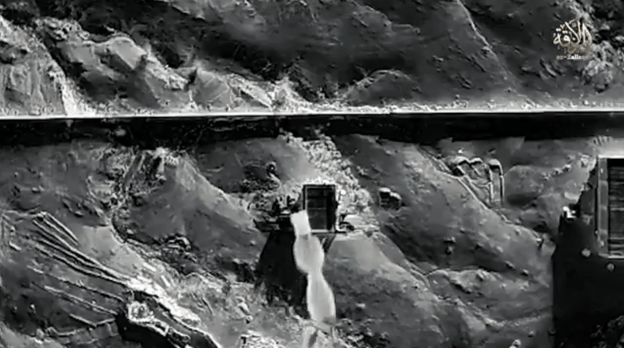
JNIM drone drops a makeshift grenade against a Malian army/Africa Corps position in Kidal, April 25 2026.
The element of surprise these battles carry is notable in itself. Both JNIM and, even more so, ISSP have kept their drone capabilities hidden for years, so when they surface in high-stakes incidents like these the opponent is far less prepared. ISSP had in fact already used drones against Nigerien military camps, namely the Tillia camp in May 2025, where eyewitnesses reported FPV drones - though it remains unclear whether these were the kamikaze or the dropping type. When it claimed the attack, ISSP made no mention of drones at all. In this it follows other Islamic State provinces such as ISWAP, ISCAP and IS-Somalia, all of which have verified armed drone use but have never shown it publicly. This silence is exactly what lets an surprise attack like the Niamey Air Base operation unfold in the first place.
How Government Forces Adapted
Watching this technology spread among separatist and jihadist groups alike, the ruling juntas have begun adapting in turn, with Mali as the pioneer. Newly delivered armoured vehicles ordered from China have been fitted with "cope cages," another borrowing from the Russia-Ukraine war. These cages help reduce the damage from kamikaze FPV drones and shield the more sensitive parts of the vehicle, while electronic warfare (EW) kits to jam incoming drones have been added to the same vehicles. Cope cages have also appeared on some drone relays, which, as noted earlier, are a favoured FLA target. How well they work remains to be seen, but going by the conflict in Ukraine, the tactic should give Malian troops a non-negligible edge if applied more widely, which for now it is not.
The Sahelian regimes have also begun building their own small-drone capabilities, leaning on Russian Africa Corps instructors, the rebranded successor to the Wagner PMC, to provide training in operating mainly kamikaze FPV drones. Although this training has been running publicly since at least early 2025, very little information has surfaced on the actual use of these drones by the government forces of the three states, which indicates a quite slow learning curve when compared to local insurgent groups.
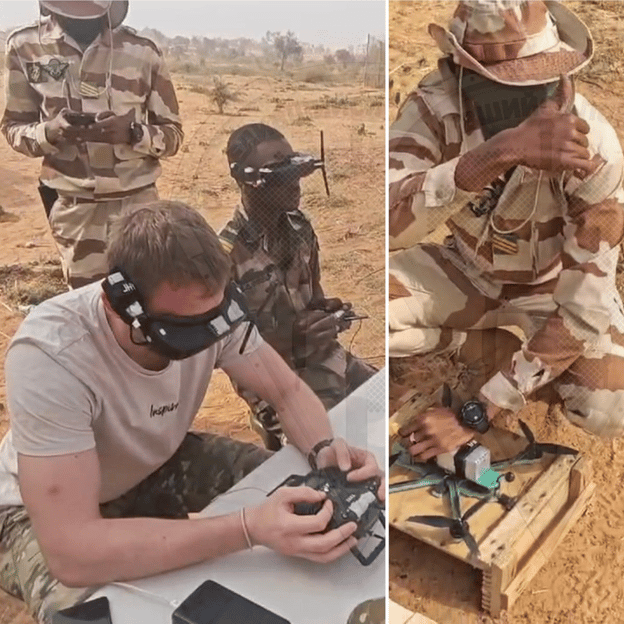
Africa Corps instructors train Nigerien soldiers in the use of kamikaze FPV drones.
The Africa Corps itself has been a far heavier user. It has deployed suicide FPV drones extensively in Mali against insurgents, in strikes that include hits on fuel depots and armed pickup trucks militants rely on across the Malian north.
The Africa Corps and the Malian army were the first in the region to deploy fixed-wing kamikaze drones, a capability witnessed during the renewed offensive launched by the FLA and JNIM on July 4. The strike targeted rebel positions in Anéfis. While the FLA claims to have shot the drone down, this has not been independently verified at the time of writing.
What to Watch Out For
So far every actor has dipped a hand into small drones, and while some have done so less-eagerly than others, the momentum is unmistakable. The scale of their use remains noticeably low compared to other conflicts, yet it could climb quickly once these groups gain experience and the means to produce and assemble the weapons themselves to a higher scale.
The threat is highest on the insurgent side. They already have the experience in asymmetric warfare and ambushes, and once they can reliably fly suicide FPV drones against moving targets, it will mark a decisive shift, especially for tightening the blockades around urban centres, including the Malian capital Bamako. By comparison, even if the juntas reach a solid level of familiarity with FPV drones, the asymmetric nature of the war means the same tools will never hand them an equivalent advantage. They will have to bet instead on hardening their existing defences and cutting the insurgents' supply lines.
Government forces will keep adapting to this insidious threat from above, adding EW defences and cope cages while training to fly the drones themselves rather than leaning on mercenaries. But as the regimes master this first tier of the threat (radio-controlled FPVs countered by jamming) the militants will naturally move to the next: fibre-optic drones, which have already appeared in northern Mali in FLA hands. This type cannot be jammed, though it pays for that immunity with shorter range and a vulnerability to obstacles, the latter much less of a problem across the flat Saharan terrain. Here too the technology was almost certainly passed on by their Ukrainian allies, in anticipation of the very EW systems now being fitted to MRAPs and sensitive sites.
For now, the most significant threat from insurgents getting their hands on drones is not the explosives but the eyes: the reconnaissance and live fire correction that guides mortar attacks and ground assaults. That single use case will remain the decisive one until armed drones scale up to anything resembling what the Russia-Ukraine war has unleashed worldwide. That moment may be years off. Ukrainian support stays limited to the FLA, while JNIM and ISSP still lack any comparable professional training, even if the former might eventually learn from FLA hands and the latter from the wider Islamic State network like ISWAP and IS-Somalia.
What began in the trenches of Ukraine has, in only a few years, found its way to the dunes of the Sahel, and it is adapting fast to a war that looks nothing like the one that birthed it. The drones that drop and detonate will keep grabbing the headlines, but the quieter revolution is the one overhead, watching, and that eye in the sky is not going anywhere.
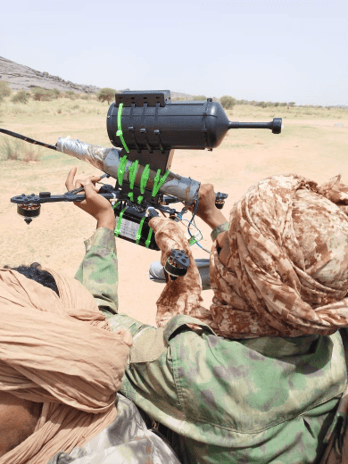
FLA militants holding a fibre-optic drone, July 2025.
Written by
Brant Philip is an independent analyst and expert on African jihadism especially West Africa, and a contributor to the Counter Extremism Project. He regularly monitors the situation on his X page https://x.com/BrantPhilip_
Related articles
Mali's Conflict is Nearing Crisis Point. Here's What Comes Next.
JNIM's capture of Kidal and tightening grip on northern Mali have pushed the junta and its Russian backers toward the brink — but Islamic State Sahel's rivalry may yet decide who rules, and whether the state survives.
Paweł Wójcik · September 29, 2026 · 7 min read
West Africa's Jihadist Groups Are at War. Here's Why.
Brant Philip · September 28, 2026 · 13 min read
Moscow is Struggling to Drum Up Interest in its Africa Summit. Here's What that Means
Casus Belli · September 8, 2026 · 14 min read
Become a Member
Members get full access to premium reporting, in-depth briefings, and subscriber-only analysis.
Insiders Receive
- Full access to all premium articles and briefings
- Exclusive subscriber-only analysis and dispatches
- Support independent conflict journalism
Signed in or already a member, but still locked? Fix an access problem
From $5/month — cancel anytime