
Eastern Europe’s Unique Opportunity for Foreign Influence
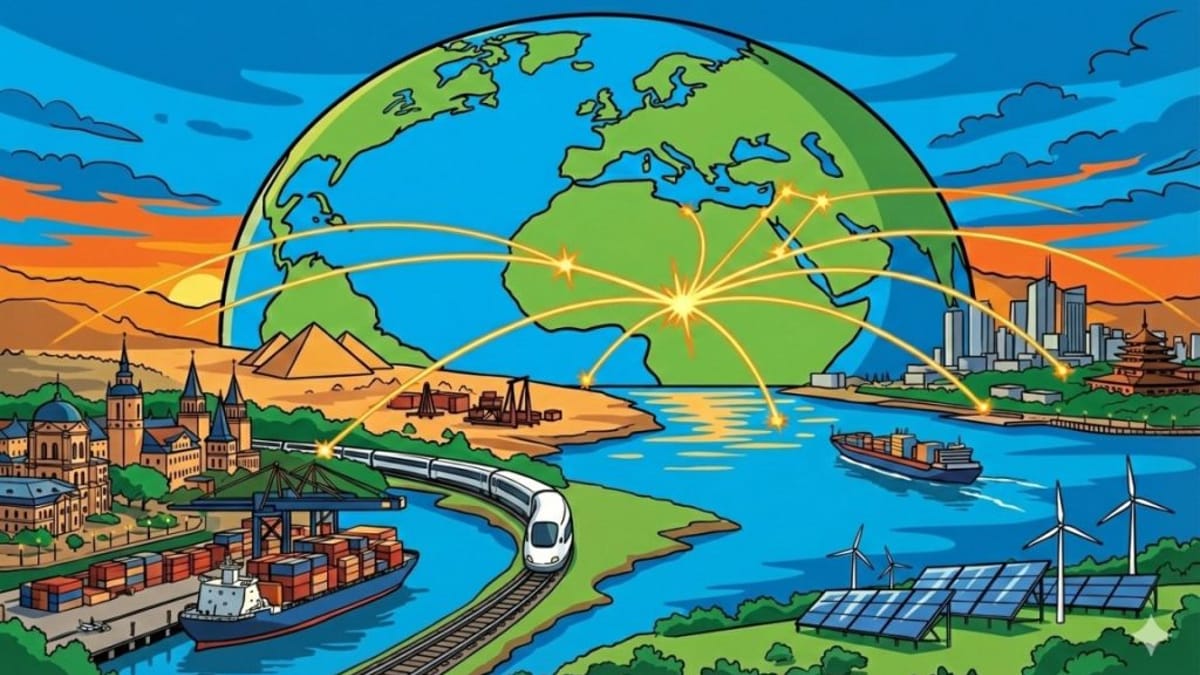
As China's influence expands across the Global South, Eastern Europe has a unique opportunity to leverage the EU's new development cooperation strategy to counter it.
Henrik Hannes Herkel • January 19, 2026
Up next
Europe Has Only Itself to Blame for the F-35's Dominance
Joni Askola · September 17, 2026 · 12 min read
Can Minilateralism Solve Europe's Defense Crisis?
Leo Feypel · September 15, 2026 · 15 min read
The Berlin Attack is Part of a Broader Pattern. Europe Needs to Wake Up to The Growing Threat
Paweł Wójcik · August 7, 2026 · 9 min read
For decades, many in the EU have criticized foreign aid programs as a waste of resources – and they have been mostly right in their assessment. Traditional foreign aid programs have given almost no tangible returns – the aid recipients have had little to no long-term improvements to their quality of life and arguably even worse, the EU itself has gotten no benefits out of it either. To be fair, the West in general has that problem, which at least in part is why the incumbent Trump administration took an axe to its USAID department earlier this year. Now, the moral compulsion to help those in need aside, there wouldn’t be anything wrong with this approach if there weren’t any other geopolitical factors to consider. But there’s at least one and it’s called China. Chinese foreign influence is growing at an alarming pace, while the West’s is at best, stagnating and at worst, declining. And the US completely neutering one of its main soft power institutions most likely only serves to exacerbate this trend.
Thankfully, the EU has a different tactic in mind – the consolidation of its fractured and ineffective foreign aid programs into the more centralised “Global Gateway” (GG) initiative, all the while moving towards a more transactional approach when it comes to foreign aid – or “cooperation development” as it is officially called nowadays. What this means is that instead of giving aid without explicitly demanding anything in return, the EU now aims to make investments – and receive benefits from them.
As the need for greater foreign policy cohesion within the EU seems to be growing by the day, it is important for Eastern Europe to be involved in issues that concern Western Europe, just as they have finally started to understand the severity of the Russian threat. The GG is a good opportunity to demonstrate that Eastern European countries are also willing to look beyond their immediate interests. In this case, there are very real benefits that could be gained from development cooperation with the Global South as well as potential security threats to the EU as a whole that could be prevented.
Chinese influence in Eastern Europe
Until 2019, relations between the EU and China were purely economics-based, as both sides wanted to benefit from bilateral trade. The EU justified the morality of making business with a totalitarian dictatorship by hoping that increased commercial ties would bring about a wave of liberalisation in China. Rather predictably, this “strategy” (if you could even call it that) failed spectacularly – not only with China, but also with Russia.
Meanwhile, the Belt and Road Initiative (BRI) tried to expand its operations into Europe by getting involved in the CEEC 17+1 program (Cooperation between China and Central and Eastern European Countries). Chinese influence crept into European critical infrastructure – for example, China straight-up owned the Piraeus Port in Greece. Thankfully, most Eastern European states quickly realized the predatory nature of the BRI investments and by 2022, most of the EU members in Eastern Europe had abandoned the CEEC 17+1, with the notable exceptions of Hungary and Greece who, along with some of the non-EU members in the Balkans, are recipients of BRI developmental cooperation to this day.
Obviously this was a brazen attack on the EU’s internal strategic interests, but EU-China relations were made even worse by the entirety of the EU’s high-tech industry being dependent on Chinese critical raw materials. Due to this, the EU decided to toughen its stance on China and although they didn’t join in on the US-China trade war, which was beginning to simmer even back then, finding ways of lessening the EU’s dependence on Chinese imports was nevertheless put firmly on the list of priorities.
Why Does it Matter for Eastern Europe?
Eastern Europe as a whole has worked hard to get to where it is. There’s never been more freedom from foreign empires – as a matter of fact, Eastern Europe has never been more well off and more united than it is right now. Even though these countries are still among the “poorest” nations of the EU, they’re pretty rich by global standards. Bulgaria, the least well off nation in the EU, has a GDP per capita of $20,400, while the world’s average is only $13,600. Most of the Eastern European countries have either double or almost triple that, with Slovenia being the highest with $37,100, followed closely by the Czech Republic ($35,100), Estonia ($34,000) and Lithuania ($33,000). Incredible as it may seem to those who still remember the old days of the eastern bloc, the wealthiest countries of Eastern Europe have today surpassed rich countries like Japan ($34,700) and South Korea ($35,900) – at least on a GDP per capita basis.
It stands to reason that Eastern Europe doesn’t want to waste its hard-earned fortune by making the wrong choices. But if there’s a will to truly become equal with the rest of the EU – at least on economic terms – then foreign investments are necessary at some point. The GG is offering Eastern Europe an opportunity to look beyond its immediate vicinity and build its own global business networks and influence. Foreign investments, including those made into Eastern Europe after the collapse of the USSR, are the best economic strategy. Sure, Eastern Europe can sit back and fully concentrate its efforts somewhere else – some of the GG’s profits will trickle back through the EU anyway – but that will also guarantee that it will forever play second fiddle to Western Europe. Actually, if we were to be pedantic about it and count Southern, Central and Northern Europe as their own regions as well, then Eastern Europe would be playing the fifth fiddle.
Although the Global South is important for the EU as a whole, it’s a fact of life that Eastern Europe is less involved with the Global South than the continent’s West. After all, building influence on continents like Africa has historically been the geopolitical goal of Western Europe, while Eastern Europe’s traditional geopolitical role has mainly been focused on deterring the ever-present threat of a Russian invasion. With this in mind, it’s doubtful that Eastern Europe even has the capacity to fully focus on developmental cooperation and the securing of new strategic mineral sources in the Global South. There’s some truth to that – their first priority is the preservation of their independence and that’s not up to debate. Even so, Eastern Europe wouldn’t be starting at square one, as Western Europe has an extensive network of diplomatic and business connections in the Global South, which they are more than happy to extend to the Eastern European countries who wish to participate in the GG. There are also some economic and security indicators that would argue for Eastern European involvement in the GG – perhaps not as its first priority, but with the current geopolitical climate in mind, doing two or more things at once is a matter of survival, not preference.
Economic reasons
The economic reasons are very straightforward – the GG’s more transactional approach promises mutually beneficial business partnerships and if Eastern Europe doesn’t participate in it, then it also won’t get any of the profits. The Global South needs a huge amount of investments in many areas and the Eastern European countries have developed enough capabilities to rise to the occasion.
It shouldn’t come as a surprise that Western Europe is by far the largest contributor to the GG – development cooperation is their area of expertise, after all. A significant number of projects are also headed by the Southern and Northern European countries, while Eastern European contribution has been less enthusiastic. In a way it’s understandable, as it’s still the least wealthy region in the EU, but the GG offers opportunities that will simply disappear if they’re not seized.
For example, Estonian digital capabilities are in demand for building up the digital infrastructure and governance in the Global South. They’re not doing it alone of course, but are partnering with other EU countries on multiple projects – notably with Latvia and Lithuania in Central Asia and with the Czech Republic and Hungary in Sub-Saharan Africa. Estonia also has one of the few factories outside of China that processes rare earth metals – NPM Silmet OÜ. As of 2025, there are only two rare earth processing factories in the EU – one in Estonia and one in France. Being active in the GG projects could open up alternative sources of rare earth metals, which could translate into expanded production for the factory. The point being, that if the GG offers ample opportunities even for a tiny country like Estonia, then it’s almost certain that bigger Eastern European countries could also find a niche to participate in – and many already have.
Lithuania is working on a green industrial project in Brazil with some of the Western European states. Poland is heading an agricultural project in Kenya and Rwanda, and is collaborating with Western Europe on a project to build green ammonia production facilities in Namibia, Morocco and Argentina. The Slovenes and the Czechs are working on establishing a sustainable forestry industry in Mongolia. This list shows that Eastern European countries do have abilities that suit at least some of the GG’s needs. Perhaps these capabilities are still less developed across the board than those of Western Europe, but they’re undeniably there and not taking advantage of them would be foolish.
Lastly, the GG is also active in Eastern Europe’s own neighbourhood, with over €55 billion of GG’s funding having been allocated to projects in the Caucasus and the Balkans, as well as to Moldova and Ukraine. So the very least that Eastern Europe could do within the GG is to invest into the stability and prosperity of its own region. Eastern Europe’s current prosperity was achieved by working together – not continuing to do so wouldn’t make much sense.
Security reasons
The EU’s security interests with the Global South are mostly tied to China and the BRI – if China gains too much influence in Africa, all of Europe will be impacted. Moreover, China has become Russia’s main trading partner, which fuels Moscow’s bloody war of conquest in Ukraine. So it stands to reason that a stronger China would result in more lucrative trade deals for Russia, which in turn would strengthen them – and that is definitely a security threat for Eastern Europe. Russia also has a direct, albeit comparatively small presence and business interests in Africa, which should also be contained – and for Eastern Europe, there’s no better way to do that than through the GG. It is clear though, that the Chinese monopoly on strategic resources is the main security threat and opening new mines in the Global South is the best way to counter it. Sounds really simple, but as always, there’s one little problem – extracting resources from the Global South sounds an awful lot like colonialism, which is an especially touchy subject for our friends in the west.
Imagine a French diplomat waltzing into some African country that used to be a French colony and asking them for their natural resources – it probably won’t end very well. In fact, there’s no need to imagine, as it has already happened in Niger, which was an important source of uranium for France until military officers seized power in 2023 in an explicitly anti-French coup. Nor is it an isolated case – during the past few years, France has lost most of its influence over the Sahel region.
Perhaps, then, negotiations could go a lot more smoothly if the aforementioned diplomat was from an Eastern European country? At the very least, the neocolonial connotations would be a lot weaker. Again, using Estonia as an example, their foreign policy experts have confirmed that once their African counterparts learn about Estonia’s long history of being colonized – most-recently by the Soviet Union – they suddenly become more amenable. It’s hard to resent a continent for its history of colonization when the representatives it sends are themselves from recently-decolonized nations (as many in Eastern Europe are).
This makes sense, as much like most of the Global South, the Eastern European countries have more than enough experience with hostile foreign powers who seek to expand their empires and bleed them dry for resources. As such, there are significant and often overlooked historical parallels between Eastern Europe and the Global South. Perhaps due to this, Eastern Europe has the capacity to relate more to these nations? Afterall, it was only a decade ago when China thought Eastern Europe undeveloped enough to try and extend its BRI activities there, so it’s not like these parallels could only be found in ancient histories. Could it be possible that the issue with Western Europe trying and failing to wield soft power isn’t only found in their naive approach and historical enmity with the Global South? Perhaps it’s compounded by the Western European inability to understand how the oppressed see the world? Isn’t it also one of the root frustrations that many in Eastern Europe have with their Western counterparts? Of course it wouldn’t be a cure-all for the EU’s waning influence in Africa as its problems with the West in general are far too complex – but changing up a diplomatic tactic that has proven to be unsuccessful wouldn’t hurt either.
Finally, if regions like Africa continue to destabilize while growing in terms of population, then it will only exacerbate the current waves of illegal immigration. While we’re not about to fully open the can of worms that is the topic of immigration, it’s a fact of life that the greater the Global South’s stability, the less issue the EU will have with illegal immigration – and conversely, there’ll be more opportunities for trade. The reality is that unless the EU develops a penchant for straight-up shelling the immigrants as they try to cross our borders, we have to at least try to stabilize our neighbourhood. If this doesn’t work and if we do develop the stomach to indiscriminately shell illegal immigrants, then the EU as a whole will have already fallen – at least in spirit.
The Greater Picture
With the world becoming increasingly more hostile by the year, the EU needs to start acting in its collective best interests, especially when it comes to foreign policy decisions. It has become clear that at the end of the day, the only ones we can truly count on are ourselves and that the days of deciding foreign and domestic policies based on ethics and moralism rather than pragmatism are over. The GG will hopefully be a prime example of this historical shift.
The EU can’t be the only great power in the world that fights with one hand tied behind its back. As the past few decades have proven, this modus operandi will only result in a slow decline – things didn’t go to plan at all in those relatively peaceful times and during the current geopolitical chaos, continuing with these old tactics will only result in even greater failures. Eastern Europe needs to collaborate with issues that are relevant for Western Europe, just as those in the continent’s west have slowly come to understand the east’s problems with Russia. We are only strong when we think and act together – it’s for this reason that the US, Russia and China are doing everything in their power to break up the EU. And that’s all the more reason to double down on greater EU cohesion.
Western Europe definitely has a leg up over its eastern counterpart when it comes to both resources and having a diplomatic presence in the Global South. As such, this article isn’t calling for isolated Eastern European action when it comes to the GG. Rather, those in the east should work and coordinate closely together with Western Europe, not only because the results would be more effective in this specific case, but also because greater cohesion within the EU could only benefit both sides – at least when it comes to foreign policy.
Sources
- 1commission.europa.eu/topics/international-partnerships/global-gateway_en
- 2international-partnerships.ec.europa.eu/policies/global-gateway/eu-nigeria-digital-economy-package_en
- 3international-partnerships.ec.europa.eu/policies/global-gateway/north-east-brazil-green-energy-parks-and-gr…
- 4international-partnerships.ec.europa.eu/policies/global-gateway/central-asia-digital-connectivity_en
- 5munkschool.utoronto.ca/belt-road/research/eus-de-risking-strategy-and-its-global-gateway-initiative-two-str…
- 6international-partnerships.ec.europa.eu/policies/global-gateway/transfer-innovative-polish-biogas-technolog…
- 7international-partnerships.ec.europa.eu/policies/global-gateway/large-scale-green-hydrogen-project_en
- 8international-partnerships.ec.europa.eu/policies/global-gateway/implementation-forest-partnership-mongolia_en
- 9etera.ee/zoom/207611/view?page=1&p=separate&search=global%20gateway&tool=search&view=0,1040…
- 10data.worldbank.org/indicator/NY.GDP.PCAP.CD
- 11imf.org/external/datamapper/NGDPDPC@WEO/UKR/EEQ/EST/EUQ/SVN
- 12concordeurope.org/wp-content/uploads/2016/08/AW_Special_Report_2012.pdf?1d6b43
- 13bbc.com/news/articles/cm2zp6m4gy7o
- 14bbc.com/news/articles/czjd70mzge2o
Written by
Henrik Hannes Herkel is a political analyst with a bachelor's degree in history and a master's degree in political science. His work spans geopolitical analysis with particular focus on Eastern Europe and Africa, often through the lens of development cooperation and the right to self determination.
Related articles
Europe Has Only Itself to Blame for the F-35's Dominance
Joni Askola · September 17, 2026 · 12 min read
Can Minilateralism Solve Europe's Defense Crisis?
Leo Feypel · September 15, 2026 · 15 min read
The Berlin Attack is Part of a Broader Pattern. Europe Needs to Wake Up to The Growing Threat
Paweł Wójcik · August 7, 2026 · 9 min read
Continue in
Become a Member
Members get full access to premium reporting, in-depth briefings, and subscriber-only analysis.
Insiders Receive
- Full access to all premium articles and briefings
- Exclusive subscriber-only analysis and dispatches
- Support independent conflict journalism
Signed in or already a member, but still locked? Fix an access problem
From $5/month — cancel anytime