
Europe & NATOInsider article12 min read
Europe Needs to Defend Itself Against Russian Aggression. Here's How.
Russia's potential invasion of the Baltics is closer than ever, with the EU as the weakest link in the West-Ukraine alliance.
Key insights1 of 4 shown
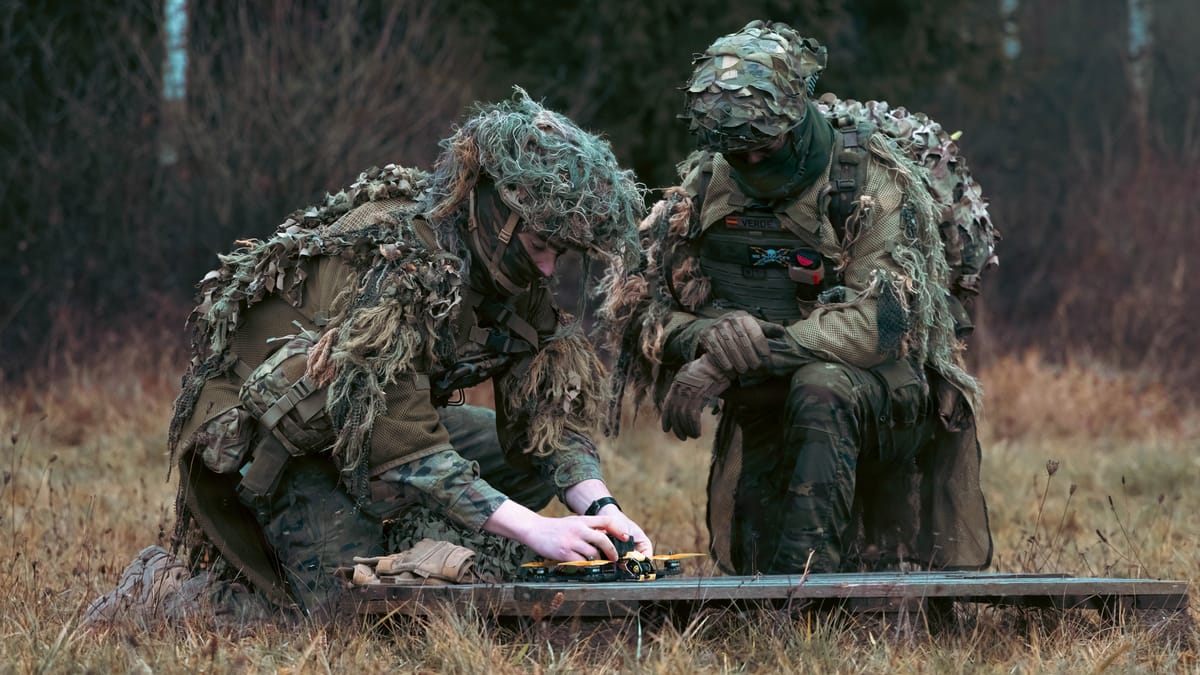
- The Baltic states face imminent risk of a Russian drone blitz that NATO cannot stop without immediately transforming into a drone-centered force led by Ukrainian units.
- Locked: for Insiders
- Locked: for Insiders
- Locked: for Insiders
The Author is a senior advisor to Ukrainian High Command, and a former frontline drone operator.
The possibility of a Russian invasion of the Baltics has never been closer. Frustrated with the expanding drone kill zone that has stalled its advances in Ukraine, Russia today views the EU as the weakest link in the West-Ukraine alliance (which America seems to have voluntarily abandoned during President Trump’s second term). While Ukraine has fully embraced the Drone Revolution, NATO states have lagged behind, preferring to rearm their forces mostly with weapons such as tanks and attack helicopters – obsolete in a drone saturated battle space.
This has created a strategic, if extremely-risky opportunity for Russia – attack while NATO still lacks strong UAS and counter-UAS capabilities. Yes, that would mean a war on two fronts, but from the Kremlin’s perspective, the operational surprise and a crushing superiority over NATO in drone forces could outweigh this strategic disadvantage. With drones now responsible for 80-90% of all battlefield losses in Ukraine, it is in the drone domain that modern wars will be decided, and for the time being Russia holds a notable advantage in this space. Perhaps one comparable to the advantages Prussia’s railway network gave it in the late-19th Century, or Blitzkrieg tactics gave Nazi Germany several decades later.
Accordingly, it is far from impossible that Russia will attack the Baltics, probably first concentrating against their weakest part, Latvia, which it can then use as a springboard for a quick move against Estonia by a northward advance or a southern thrust against Lithuania and then Poland. Indeed, there are already signs of Russia’s intentions: an unprecedented expansion and improvement in the road networks in Pskov, Novgorod and Leningrad oblasts (despite cuts in road maintenance elsewhere), the stockpiling of drones (especially those on fibreoptic cables that are resistant to jamming) in the Baltic theater, and the creation and expansion of new armies of the Leningrad Military District which are built around forces with experience of fighting in Ukraine as part of the Group of Forces “North.” Another worrying tell-tale sign of a potential invasion is that Russia, as opposed to previous years, has not begun its habitual spring-summer offensive (or an intensification of the ongoing offensive actions), which may point to a build up of forces in another theater – essentially to strategically outflank Ukrainian defences by a direct attack against the one Ukrainian base (Europe), which is not covered by a strong protection of a Ukrainian drone kill zone.
Should the plan go ahead, Russia would conduct a type of modern warfare which I call a drone blitz. A drone blitz is very similar to a German blitzkrieg but instead of tanks and airplanes you have unmanned systems (UASs, but also marine drones and land robots) and counter-drone forces (primarily electronic warfare or EW systems) as the main striking power of the offensive. A drone blitz is based on four prerequisites: (1) surprise, (2) concentration of drone and counter-drone forces on a narrow section of the front in order to gain an overwhelming correlation of drone forces and thus attain local drone superiority, (3) favorable terrain and weather, and (4) simultaneous attack to the full depth of enemy defences in order to guard against enemy maneuver of reserves and ensure isolation of the battlefield.
A Russian campaign against initially Latvia and then Estonia, Lithuania, Poland and NATO contingents perfectly satisfies these requirements. Surprise will be achieved as drone forces have already proved to be tactically dispersed and concealed in Ukraine and are difficult to detect (and thus engage) from the air with conventional manned platforms or satellites. Russia will also probably feign a buildup of conventional forces such as armour, artillery and ammunition and POL (petroleum, oil and lubricants) in Belarus in order to attract the attention of NATO commanders, making them either fear an attack on the Suwalki gap on the Belarusian border, or possibly leading them to expect an assault into Western Ukraine. Meanwhile, the real attack will happen elsewhere – probably at the juncture of the Latvian and Estonian borders, where Russian forces can quickly seize the high ground on the path to Riga, allowing their drone operators favorable radio horizons that will ensure drone dominance over the whole of Latvia. This accomplished, Russian forces can move against the left flank and rear of NATO troops positioned to repel the expected attack from Belarus against the Suwalki gap, which in fact may never happen at all.
Accordingly, the first two prerequisites for the drone blitz (surprise and concentration of drone forces) can easily be achieved. Summer campaigning season will add favorable weather while an attack from the high ground in Pskov oblast (at the junction of the borders of Russia, Latvia and Estonia) will ensure advantageous terrain. The small strategic depth of the Baltic states (200-300 km) and the absence of any major rivers flowing parallel to the Russian border (with the exception of Narva river in Estonia and Neris in Lithuania, which will easily be bypassed by an attack against Latvia)– will ensure that any drone-centered mobile force would quickly overrun NATO resistance before the 2nd and 3rd echelons of NATO forces get a chance to intervene. And even if they arrive, unless they are primarily drone-based, they will be unable to stop the Russian drone juggernaut.
Loading…
We couldn’t load the rest of this article just now.
Insider article
You've read the first third. Keep going.
Two-thirds of this analysis is still to come, plus 3 more key insights.
Free, no card
Read this free with a Fronts account
Then one Insider article a month. No card, no password.
- Enter your email
- Read on
- Confirm your email later
The robot check is taking too long.
or email support@fronts.co
The form could not start. Reload the page and try again, or email support@fronts.co.
Make a free accountAlready have one? Sign in below.
Fronts Insider
$5 a month · or $50 a year
- Every Insider article
- 130 exclusive videos
- All 936 WarFronts and HomeFronts videos, sponsor-free
- Cancel anytime. Money back within 30 days.

Already a member? Sign in and you'll land back here.
Insider article
You've read the first third. Keep going.
Two-thirds of this analysis is still to come, plus 3 more key insights.
Your free article
Read this one free
You get one Insider article a month. Use it here?
Fronts Insider
$5 a month · or $50 a year
- Every Insider article
- 130 exclusive videos
- All 936 WarFronts and HomeFronts videos, sponsor-free
- Cancel anytime. Money back within 30 days.
Free to read now
No account needed
The Starshield Debacle Is a Wake-Up Call for Europe
Jakub Janovsky · 8 min read

A Russian Invasion of Latvia is a Terrifying Possibility. We Should Take it Seriously
Illya Sekirin · 9 min read

Polarization in France: An Ideological Cold War That's Heating Up
Fronts Staff · 10 min read