
Exaggerating its Advances is Costing the Russian Army Dearly. Here's How.
When Gerasimov told Putin that Kupiansk had fallen, every Russian decision afterward treated the fiction as fact — and Ukraine now quietly exploits an army that punishes honest reporting.
Phil Cowin • June 29, 2026

Up next
Ukraine's Intervention in the Sahel is Hurting Russia. It's also Destabilising the Region.
A handful of Ukrainian trainers embedded with Mali's Tuareg rebels are fighting Russia's Africa Corps — but their allies include al-Qaeda's JNIM, and Kyiv's drone tactics are already reaching the jihadists.
Paweł Wójcik · September 24, 2026 · 7 min read
When There's Unrest in Russia, Watch the North Caucasus
Neil Hauer · September 7, 2026 · 9 min read

Why Did Russian Democracy Fail? Start With its Minorities
Henrik Hannes Herkel · August 24, 2026 · 13 min read
Deception is a key part of warfare and is utilised across a wide spectrum of military, political and informational activities. It is a fundamental component of strategy, but what happens when attempts to deceive the enemy end up deceiving your own troops instead?
On 20th November 2025, The Russian Chief of General Staff General Gerasimov announced to the public the capture of the Ukrainian city of Kupiansk - a city with a pre-war population of around 25,000 which spans the Oskil river in northeast Kharkiv oblast. The head of the Moscow military district Kuzovlev reiterated this to Vladimir Putin, who asked, “it’s finished, it’s under our control completely?”, to which Kuzovlev answered affirmatively. Videos showing small groups of Russian troops raising flags in several parts of Kupiansk on both sides of the river were subsequently released as evidence of the claimed capture of the city.

(Russian flag raise shown outside medical center in Kupiansk on 21st November 2025) Video Source:[https://t.me/tass_agency/349438 / Geolocations of Russian flag raises: https://x.com/richardzai38580/status/1991741456885903531 ]
The problem? Kupiansk was not, and had never been, fully under the control of the Russian army. The military had bought it ‘on credit’, hoping that reality would soon catch up with their version of events. Instead, the deception would wind up harming their overall effort in wholly predictable ways.
It did not take long for Gerasimov’s claim to run into skepticism. Geolocations of Ukrainian troops operating inside the city were still being found, and the images of Russian flag raises only ever depicted very small groups of troops in isolated areas. By mid-December even _Russian milbloggers Rybar_ were raging against:
“Systematic exaggeration of successes and the transmission of false information to higher command (that) have already led to the dissemination of false information at the highest levels. Due to inaccurate reports of the situation to the higher command, reserves that were "not needed" to take and clear Kupiansk were transferred to other areas.”
By this point, open-source geolocation evidence had made it clear that Kupiansk’s “capture” had only ever been a mirage. Small groups of Russian troops had been infiltrating the west side of the city across the river and from the northeast for many months. Whilst this was occurring, Ukrainian forces held (and still do) the eastern bank, and numerous villages along the eastern side of the river. However the real problem for Russian forces on the ground was not whether Kupiansk was actually captured or not. The problem was that once the report that the city was captured entered the Russian General Staff at that level, every single subsequent decision after that was made as though it had been captured.
It does not take a soothsayer to predict the issues this caused. In order to keep the deception of the captured city up, it became necessary to halt all reports up the chain of command regarding the real situation on the ground. That included a halt to requests for air strikes or the use of massed artillery against Kupiansk, as well as other support actions, including requests for reinforcements. Any junior officer trying to get the facts out risked their career.
Ukraine took full advantage of this lapse, and conducted a small-scale attack with numerous units, including troops from 8th Special Purpose Regiment and 2nd ‘Khartia’ Corps, to cut off the Russian infiltration forces inside Kupiansk. By December 12th, Zelenskyy himself was able to travel to Kupiansk to record a video proving the city was still under Ukrainian control.
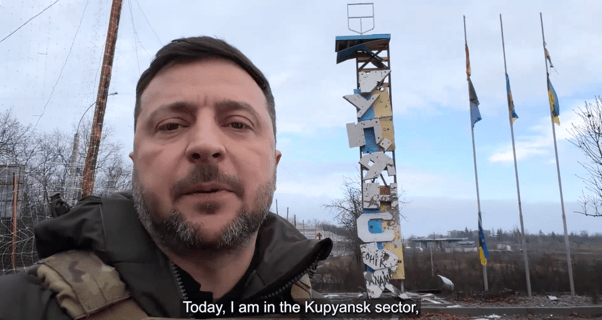
(Zelenskyy at Kupiansk stele on December 12th 2025) (Source: https://x.com/ZelenskyyUa/status/1999473376620937551)
Perhaps the most-remarkable thing about this story is that it still continues to this day. At time of writing in June 2026, the city remains under Ukrainian control, with small-scale manpower infiltrations continuing by Russian units from the northeast. This despite Moscow Military District’s Chief of Staff Kuzolev insisting to Tass news agency on the 16th January that “All the city districts are under control of Russian troops”.
How Little White Lies Lead to Major Problems
While unusual in the brazenness of the lie, the situation that unfolded at Kupiansk was not unique. Nor are such deceptions confined to the Russian side.
Throughout the war, but especially in 2024 and 2025, Ukrainian commanders would often report troops holding a position they had retreated from, to prevent their higher-ups from ordering them to take it back. Combined with poor coordination between units, this often resulted in troops from another unit being attacked by Russian forces from a direction they were not expecting. The nadir of this was likely the loss of Ocheretyne and the surrounding area in 2024, which was caused by the 115th Mechanized Brigade retreating from its positions without telling anyone, a retreat that led to multiple settlements (and many lives) being lost.
To their credit, the Ukrainians have at least attempted to fix this. The Ukrainian Corps reform was intended to allow better coordination between units, with new structures in place that this year are finally having a positive impact. However there are still a lot of ad-hoc command groups dotted around and a very uneven capability of each Corps.
More-importantly, Kyiv has noted Russia’s difficulties with misreporting, and has tried to turn them to Ukraine’s advantage. Due to the perverse incentives in the Russian military, bad news travelling up the chain of command gets punished. While serious setbacks inevitably make their way up, forces on the ground rarely report positions lost if they believe there’s some chance, no matter how small, that they may retake them in the future. After all, why report what you believe is a temporary setback, if the only likely outcome is you getting chewed out and then told to retake the positions anyway?
We can see the effects of this culture of deception on the ground. Towards the end of 2025, Russian forces advanced towards Hulyaipole and further north into Dnipropetrovsk oblast with numerous flag raises from infiltrating troops, only to be quickly and quietly eliminated by Ukrainian Air Assault forces. These Ukrainian teams operated under strict opsec, knowing that while nearby Russian regiments should publish their strikes on advancing Ukrainian forces, doing so would reveal to higher-ups that these regiments did not control villages they said they did. This resulted in Russian troops not getting access to support to hold their positions, and a few hundred square kilometers in Dnipropetrovsk oblast across villages such as Orestopil and Andriivka being cleared with very little fuss or casualties on the Ukrainian side.
Ukrainian Air Assault forces repeated this again throughout April and May of 2026, not committing anything too large, but clearing much of Dnipropetrovsk oblast of Russian presence, and advancing into western Donetsk. The key was the absence of symbolic flag raises and strict opsec - the Ukrainian troops knew they were advancing, but by taking advantage of the Russian reluctance to report this up the chain of command, their work became so much quicker and more efficient. It is no stretch to say that the ingrained culture of deception has already cost the Russian military dearly.
Compounding Costs
This being 2026, another growing feature of the infospace is the widespread use of AI. Creating a realistic-looking video is now little more than a matter of entering a prompt. This has resulted in many Russian flag raises being poorly edited into videos in locations that are quite flagrantly impossible.
For those of us working in the OSINT space, this latest development has been something of a puzzle. These videos aren’t deceiving anyone on the ground, nor are they helping Russian credibility when the use of AI is discovered, and they’re certainly not demoralising the enemy (or, indeed, raising much reaction beyond an ironic chuckle). So, who is the audience for these videos? The intended audience may actually be their own commanders - it only needs to convince Russian higher-ups that yes, the troops are still advancing.
Even discounting the recent tide of slop, infiltration videos remain vulnerable to false reporting. A soldier infiltrates into a village and genuinely has reached that location. However they don’t control any of the nearby approaches to that position, nor can they be easily reinforced. The temptation therefore is to raise a flag and report that they’ve captured the settlement, and be rewarded for their success.
The issue is that, as this news rises up the food chain, it creates compounding problems. Commanders don’t report this untenable position being lost for fear of punishment, so they try and retake it, resulting in heavy casualties. These heavy casualties in turn cannot be reported, so casualty evacuation requests may also not be passed on, and dead soldiers simply marked MIA.
Expand this process out across a battalion, across a brigade, across an army, and it becomes easy to see why this is so detrimental. General Staff might believe from the reports that five brigades are advancing, five are holding, and that casualties are acceptable. The reality on the ground is instead that five brigades are holding, while five brigades are combat ineffective yet still being pushed into combat, resulting in higher casualties with very little to show for it. Offensives can stall out or fail to take their objectives in a timely fashion, as supplies are redirected elsewhere following a prematurely-declared “victory”.
This approach can work while genuine progress is being made on the battlefield because the overall success masks the underlying flaws - if you report a position taken but it takes another two weeks to actually take it, that’s fine. Once an opponent is capable of resisting effectively, however, the gap between reported success and reality becomes increasingly difficult to sustain. This is the position Russia now finds itself in, one in which its entire strategy threatens to slip away and be lost amid these cracks.
Making an Ally of Information
It would be foolish to think this kind of false reporting is restricted to just Russian and Ukrainian forces. Western militaries have done this in the past, and will do the same, so accountability in the future needs to be high. The data is there in abundance now, so governments should embrace it.
One of the areas where Ukraine is well in advance of many countries is in the reporting of casualties. With drone warfare being so rife now, many kills can be confirmed by drone camera, so you are not reliant on reports from troops. Ukraine’s Unmanned Systems Forces have a dedicated verification team that tracks and adjusts their kill board as footage comes in. Perhaps five drone teams separately hit a tank and each claim a tank destroyed - but instead it’s really just one tank, and it’s just been mobility killed. That’s where verification comes in, and the data produced by this process is much more useful when planning operations - you get a fairer idea of the enemy’s strength and have less chance of being surprised.
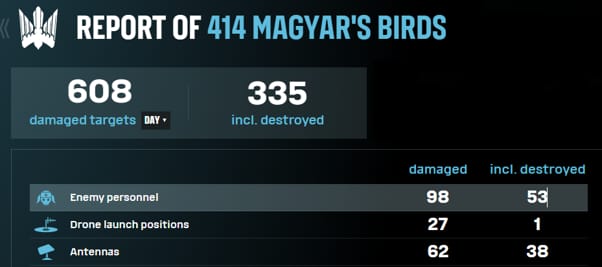
(Ukrainian Killboard example showcasing targets struck per day. Data is verified through drone footage rather than just claims. Source: _https://sbs-group.army/en/subdivision/magyars_birds/_)
Nor is it just drones. The battlefield itself is filled with satellite imagery and strike footage, whilst the infosphere is saturated with unit information, obituaries, wives requesting information on missing soldiers, or even requests for missing equipment. If an attack is claimed with ten armoured vehicles destroyed, you can check the footage to not only ensure it is correct, but also to check exactly what equipment was destroyed too.
The whole idea is that information becomes your ally, rather than something to hide or shy away from. The objective is not to catch people lying - you are simply ensuring you are making your decisions from the best possible data. Ironically, the militaries that stand to benefit most from data-driven verification are often those operating within low-trust institutional cultures. They are also frequently the same organisations most likely to resist such systems, either because they threaten existing power structures or because they are viewed primarily as tools for assigning blame rather than improving decision-making.
Likewise, a more robust and flattened chain of command is useful too. If a soldier can report that they’ve lost a position, knowing that they’ll actually get support if they need to get it back - and that nearby units can now respond to that reported loss of position - is a hell of a lot better for infantry on the ground than suddenly being attacked from behind because someone was afraid of reporting the position lost, or being forced to retake a position with zero support.
Militaries can survive being deceived by the enemy. They cannot survive indefinitely being deceived by their own hubris. As the war in Ukraine grinds on, Russian high command will either need to radically reorganize its reporting culture, or else get used to the idea that disasters like Kupiansk will keep on happening.
Written by
Phil Cowin is an experienced OSINT analyst with a background in aviation and significant experience transforming large battlefield datasets into functional, accessible information. He has contributed to a range of analytical projects, including leading UAControlMap. His work focuses on battlefield analysis, force movements, and the impact of information warfare on military decision-making.
Related articles
Ukraine's Intervention in the Sahel is Hurting Russia. It's also Destabilising the Region.
A handful of Ukrainian trainers embedded with Mali's Tuareg rebels are fighting Russia's Africa Corps — but their allies include al-Qaeda's JNIM, and Kyiv's drone tactics are already reaching the jihadists.
Paweł Wójcik · September 24, 2026 · 7 min read
When There's Unrest in Russia, Watch the North Caucasus
Neil Hauer · September 7, 2026 · 9 min read
Why Did Russian Democracy Fail? Start With its Minorities
Henrik Hannes Herkel · August 24, 2026 · 13 min read
Continue in
Become a Member
Members get full access to premium reporting, in-depth briefings, and subscriber-only analysis.
Insiders Receive
- Full access to all premium articles and briefings
- Exclusive subscriber-only analysis and dispatches
- Support independent conflict journalism
Signed in or already a member, but still locked? Fix an access problem
From $5/month — cancel anytime