
Freezing the War, Not Ending It. Why Trump’s Russo-Ukraine Peace Deal Will Break Down
Trump's proposed Russia-Ukraine peace deal may secure signatures, but with both sides still fighting, the real question is whether it ends the war or merely freezes it.
Yelyzaveta Khomovska • January 12, 2026
Up next
When There's Unrest in Russia, Watch the North Caucasus
Neil Hauer · September 7, 2026 · 9 min read

Why Did Russian Democracy Fail? Start With its Minorities
Henrik Hannes Herkel · August 24, 2026 · 13 min read
What's Really Going On With Fedorov’s Firing? A Former Adviser Explains
Mykhailo Fedorov’s dismissal was officially presented as part of a government reshuffle. The real explanation lies in his growing popularity, his confrontation with Ukraine’s military establishment, and the powerful interests threatened by his defence reforms.
Illya Sekirin · August 18, 2026 · 12 min read
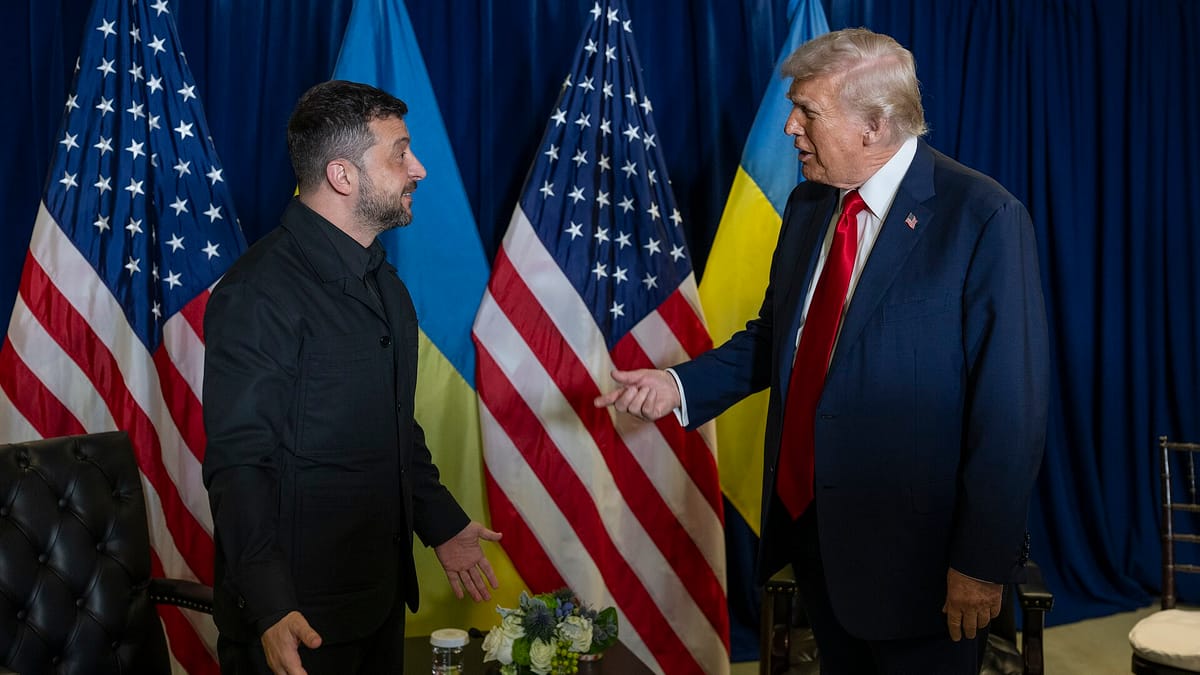
Wars don’t end just because someone in a suit says so. Russia’s full-scale invasion of Ukraine is nearing its fourth year, but Washington acts as if a deadline can dictate the battlefield outcomes. Missiles still hit Ukrainian cities, the line still holds, and the war keeps its own tempo. What has moved is the rate of diplomacy, as envoys shuttle between Mar-a-Lago, Moscow, Paris, and Kyiv with a draft that reads like a settlement, but that meets a war still in motion.
Trump says his deal has “a good shot,” but the weak point is baked in: Russia can say no, or say yes and then test the seams. “Every time one wants to do it, the other doesn’t,” the president has said. The issue isn’t whether Trump can get signatures. The real question, though, is what kind of peace we get from such a deal. Is this the grand finale, or just a timeout before the next round?
Before arguing about whether this can hold, it is worth considering what is actually on the table.
Fast Deals, Furious Reality: Inside the Russia-Ukraine Peace Plan
Building on his past peace deal “wins” around the globe, Trump quickly pivoted to the Russo-Ukrainian war, a conflict he had long vowed to end. By 2025, six attempts at talks had failed, leaving him furious again and again. The seventh, in late 2025, finally produced the most detailed proposal yet. After weeks of backroom drafting, a 28-point plan emerged in mid-November, reportedly drafted mainly by Kremlin officials. The leaked document demanded sweeping Ukrainian concessions: surrendering all of Donetsk oblast, recognising Crimea as Russian, and accepting strict limits on Ukraine’s military and foreign policy. Kyiv rejected these terms outright. Zelensky, backed by Washington, pushed to shrink the list. By late December, the draft was trimmed to 20 points that Ukraine could at least discuss. On December 24, Zelensky unveiled the new version, calling it a step forward but warning that big hurdles remained.
So what’s actually in this plan? In short, it sketches a detailed roadmap for regulating everything from security guarantees to rebuilding shattered infrastructure. The main points of the deal can be grouped into a few themes.
Sovereignty and security. The draft reaffirms Ukraine’s independence and sets out a binding non-aggression pact. The idea is simple: end the fighting and make a second invasion a costly bet for Moscow. The centrepiece is a set of security pledges: “Article 5–style” guarantees without NATO membership, framed as commitments by the US, NATO, and European partners. Zelensky has also indicated that the US security-guarantees track under discussion would run for 15 years, with an option to extend. Alongside the draft, a parallel European track has begun to take shape. On January 7, the UK and France said they had signed a declaration with Kyiv to establish military hubs across Ukraine after a ceasefire and build protected facilities for weapons and equipment. President Macron has described a multinational force: air, sea, and land, with Turkish maritime support, deployed away from the contact line to provide “reassurance.” If Russia crosses the border again, a coordinated military response and global sanctions kick in. If Ukraine attacks Russian soil without cause, guarantees are revoked. In turn, Moscow is meant to put its non-aggression promise into domestic law, approved by the State Duma. NATO isn’t in the text. Instead, the EU is named as a future destination, with near-term perks such as market access. Ukraine keeps an army capped at 800,000 and remains non-nuclear. The deal gives Moscow a NATO-free Ukraine, while giving Kyiv something that is meant to deter a second invasion.
Territories. The draft handles geography the way many ceasefire texts do. It does not try to redraw borders on day one. Instead, it freezes what exists. In Donetsk, Luhansk, Zaporizhzhia, and Kherson, the line of military positions on the day the deal is signed would be recognised as the de facto front line. Both sides are meant to stop trying to move that line by force. It then sketches a way to manage the most contested stretches without forcing an immediate political surrender. Zelensky has said US mediators are exploring a demilitarised zone or * potential* “free economic zone” format. The wording matters, since “potential” keeps them optional and subject to later agreement, rather than locking Ukraine into a specific territorial outcome. Ukraine’s restraint is paired with a precondition on Russia. For the agreement to take effect, Moscow would have to withdraw from any occupied territory in the Dnipropetrovsk, Mykolaiv, Sumy, and Kharkiv oblasts. To police the line, the text relies on satellite-based monitoring and calls for “international forces” to be placed along the front line, but it does not specify who would provide them or what authority they would have. Two unresolved issues sit inside this architecture. In Donbas, Russia wants Ukraine to withdraw from parts of Donetsk that Kyiv still controls, and Zelensky says Ukraine refuses. The Zaporizhzhia nuclear power plant is the other hurdle. Washington has proposed a three-way operating model with equal shares for Ukraine, the US, and Russia, with American oversight. Kyiv rejects Russian control and proposes a US-Ukraine joint venture instead, with half the electricity reserved for Ukrainian-controlled territory. To operate safely, the plant and its surrounding infrastructure would have to be demilitarised.
Economic recovery. The plan’s biggest selling point is the promise of massive reconstruction aid for Ukraine. The US, Europe, and global lenders would coordinate an $800 billion recovery fund aimed at rebuilding cities, infrastructure, homes, and providing humanitarian support. A new “Ukraine Development Fund” would drive investment into tech, AI, and other high-growth sectors. Foreign firms, including American companies, gain opportunities to modernise Ukraine’s energy sector and mine its valuable resources. Meanwhile, talks are underway for a fast-tracked US-Ukraine economic agreement, possibly leading to a free trade deal. Western allies and the World Bank are expected to offer special financing to jumpstart this recovery. The goal is to help Ukraine rebound with security guarantees and an economic revival reminiscent of the Marshall Plan, while gradually reintegrating Russia into the global economy if it cooperates. In other words, the plan uses big money and business incentives to make hard compromises more appealing.
Humanitarian measures. To address the human cost of the war, the draft sets up a joint Humanitarian Committee to resolve ongoing issues. This group would manage an “all-for-all” prisoner exchange, returning every POW and detainee on each side. It also requires the release of all civilian hostages, including Ukrainian children taken to Russia during the occupation. Family reunification programmes will help those separated by the war. The plan also calls for Ukraine and Russia to introduce school programmes to promote tolerance and reduce hatred. Ukraine agrees to adopt EU-standard protections for minority languages and religious freedom, answering Moscow’s long-standing complaints about discrimination against Russian speakers. Politically, Ukraine must restore democracy by holding national elections as soon as possible after the deal is signed. Functionally, it means normalising life in Ukraine is part of the peace dividend. Russia expects its controlled territories to hold local elections or address them in talks, but details remain vague.
Enforcement and oversight. The deal would be a legally binding treaty, not just a handshake agreement. An international oversight body, the proposed “Peace Council” chaired by Donald Trump, would include representatives from Ukraine, Russia, the US, Europe, and NATO. Its job is to monitor compliance and impose penalties, such as snapback sanctions, for violations, such as re-entering forbidden zones or resuming hostilities. Once the deal is signed, a ceasefire begins immediately, with troops pulling back to agreed positions, while details on monitoring and enforcement will be worked out under American supervision.
Still, in Ukraine, a ceasefire would be a reset, not an ending. Guns may fall quiet, but motives stay the same. Russia sees every pause as an opportunity to reposition, test boundaries, and exploit oversight loopholes. For Kyiv, the trade is immediate pressure and tough choices, all for guarantees that only matter if enforced, and enforced fast. So Trump’s deal is not an exit. It’s a different phase of the same contest, with the real test coming well before any signatures are dry.
Trump’s Peace as a Phase of War
At first glance, the 20-point outline appears to be a serious treaty. It starts with sovereignty. It promises a hard non-aggression pact. It sketches NATO-style guarantees without calling them NATO. It offers Europe, money, and a reconstruction architecture big enough to make investors sit up. However, fundamental flaws remain in the draft’s design and assumptions. These range from Moscow’s evident lack of genuine commitment to peace and its history of broken agreements, to weak enforcement mechanisms, absent accountability for aggression, Ukrainian constitutional hurdles, perilous referendum ideas, and unresolved security dilemmas. That is not a minor caveat. They are where each side tests the other’s bottom line. Territory is what Russia uses to assess whether the war paid off. Guarantees are where Moscow learns whether the West will actually fight, not just condemn and sanction. The deal looks coherent until you ask how it behaves under pressure at those three points. Here’s how it plays out.
Let’s start with Russia’s intentions. A core problem is Russia’s apparent disinterest in a fair peace and its pursuit of original maximalist goals. The deal assumes that Moscow is seeking a settlement now. However, Moscow’s public narrative continues to point the other way. Putin doesn’t believe that Ukraine is “ready for peace talks,” while the Foreign Minister’s spokesperson Zakharova says that any peace must address the “root causes” (and goals) of the war. For the Kremlin, these include the so-called “demilitarisation”, “denazification”, and gaining Ukraine’s “neutral status” – in fact, putting it into Russia’s sphere of influence. Apart from grand strategic goals, Russia aims to occupy the entire Donetsk, Luhansk, Dnipropetrovsk, Zaporizhzhia, Kherson, Mykolaiv, and Odesa oblasts. This means denying Ukraine’s sovereignty, not just stopping the firing. And Russia still stays on this track: Putin has bluntly stated that if Kyiv doesn’t accept Moscow’s terms, Russia will achieve its aims “by force.” Such maximalist positions indicate that Moscow views negotiations less as a path to compromise than as another means of securing the gains it couldn’t win on the battlefield.
Second, while peace deals are often built on the assumption that both parties will follow them, in the case of the Russo-Ukrainian war, Russia’s trust deficit compounds Moscow’s maximalist stance after decades of broken promises. The Kremlin’s track record in Ukraine is littered with violated agreements – from flouting the 1994 Budapest Memorandum (which assured Ukraine’s security in exchange for denuclearisation) to routinely breaching the 2014–15 Minsk ceasefire accords. In fact, Russia’s war of aggression has violated at least half a dozen international agreements, including a 2003 bilateral border treaty and a 2010 basing agreement in Crimea. Each betrayal proved that Kremlin “assurances” are not worth the paper they’re written on. That is why “codifying” non-aggression inside Russian law is not the reassurance it sounds like on first read. A centralised autocracy doesn’t become more trustworthy because it passes a law. In a regime where security services sit above formal institutions, law is a messaging layer rather than a binding restraint. The relevant question is not whether the Duma can ratify something. It is whether Russia would face immediate, credible, and unavoidable consequences for violating it. The draft does not yet show that it can deliver those consequences.
This leads to another downside: the enforcement gap buried inside the guarantee. Deterrence requires pre-agreed triggers, rapid attribution, standing force packages, basing rights, and a political commitment to act within days, not weeks. The plan relies on “Article 5–like” guarantees, yet it keeps the promise cleaner than the machinery that would have to execute it. Even with troops on the ground, reassurance is not a tripwire. That may be the politics of the pitch, with maximum reassurance, minimum NATO branding – but it is exactly where the mechanics start to wobble. If the first serious breach ends in procedural fog: thresholds, mandates, “who did what” debates – Russia has already gained what it came for: time to consolidate. What’s also missing is backward-looking accountability: the draft talks a lot about punishments for the next violation, but says little about the last one. A settlement that treats past aggression as a sunk cost doesn’t close the book; it teaches the aggressor that pressure pays, and penalties are negotiable.
Let’s imagine a theoretical demilitarised zone from which Ukrainian and Russian forces would withdraw. In theory, such zones could freeze the conflict and prevent immediate clashes. In practice, it creates a security vacuum that must be governed rather than simply observed. Who patrols it, under what mandate, with what rules of engagement, and with what ability to stop a violation rather than simply document it? Moscow rejects any NATO presence, and a thin observer mission with ground teams, satellites, and drones away from the line of contact does not deter a force prepared to probe at night, through proxies, or under the cover of “local self-defence.” Verification is another challenge, since each side could accuse the other of remilitarising or using proxy forces, with no reliable way to confirm violations. History shows that these pledges often fail: in the 1930s, Germany ignored its commitments to the demilitarised zone in the Rhineland. Today, Russia could keep forces nearby or ready to act. Deterrence only works if everyone can see and respond to violations quickly. If Moscow can delay attribution, debate thresholds, or exploit splits among guarantors, the guarantee becomes reactive rather than preventive. On a live front, monitoring without coercive power is a paperwork trail – and paperwork does not stop a determined battalion.
Another challenge sits where domestic politics meets the end of war. Referendums and elections are often suggested as ways to legitimise peace deals, but in reality, they can create more instability than stability.
Here’s the constraint: credible national votes cannot occur under the threat or reality of ongoing violence. Even with a ceasefire, Russia can manufacture “incidents”, whether missile attacks, sabotage, or information operations, at minimal cost. These disruptions can suppress turnout, intimidate front-line communities, and generate disputes over the state’s ability to safeguard the process. The mere debate over whether conditions were “safe enough” will be weaponised to contest any result. But the problem runs deeper. Referendums shift responsibility for peace or settlement from leaders to society. While this can appear democratic, in wartime it risks fracturing the state along lines Russia has spent years cultivating: fatigue vs. resistance, “peace now” vs. “justice later,” regional trauma vs. national strategy. The objective is to delegitimize the outcome and discredit Kyiv’s institutions, portraying them as coercive or incompetent.
Russia, moreover, has a proven playbook for exploiting contested “votes.” Once voting is agreed on as a mechanism for deciding war outcomes, Russia can press for procedural rules that undermine Ukraine’s sovereignty: who votes, where, whether Ukrainians under Russian control or in Russia itself are included, and how the process is monitored. Each step becomes a potential dispute over legitimacy, providing pretexts to obstruct or refuse implementation.
Ukraine’s own constitution compounds the complexity. Any change to its territory requires an all-Ukrainian referendum, a legal channel that is both narrow and politically combustible. If a settlement entails formal territorial loss, the required constitutional maneuvering risks destabilising the state itself, playing directly into Russia’s strategic aim of domestic collapse. Even revoking the pledge of joining NATO, which is enshrined in the constitution, is problematic. To this end, parliament needs at least 2/3 of the votes, which is unlikely.
The draft is strong where paper is strong and thin where power matters. It sketches obligations, councils, timelines, and votes, but it does not yet show how the bargain holds when Moscow probes, when domestic legitimacy gets contested, and when guarantors face their first real decision. That is why the debate is not just about what is written but what can be executed. And that is the next hurdle the plan runs into.
Can the Deal Be Signed Now?
Not likely. The draft fails to deliver what Moscow wants, and nothing so far indicates that Trump is ready to make a refusal painful for Russia.
Moscow isn’t looking for a ceasefire. It seeks a political outcome that weakens Ukraine while keeping options open. Russian officials talk about “root causes” as a polite way to frame their maximalist goals: neutralising Ukraine, tightening control over key territory, and locking in long-term advantages. When Putin talks about achieving aims “by force,” he signals that talks are just another lever, not a path to compromise. Therefore, the Kremlin is likely to sabotage – again. Russia doesn’t need to walk away: it can stay at the table, praise progress, and stall on crucial points while raising new demands. Even if a document gets signed, Moscow can still work the inside game: discredit Kyiv’s institutions, contest any vote or inspection as “illegitimate,” and frame every dispute as proof that Ukraine is the unreliable party. Disputes over sanctions, assets, language rights, and process can all be used to slow things down, while real movement on territory and guarantees is blocked.
Whether this approach works depends less on Moscow than on Washington. Trump has alluded to Russia’s economic struggles, but that alone doesn’t alter the Kremlin’s calculations. What matters is whether he is willing to keep real pressure on Moscow, not just talk deals. So far, there’s been more talk than action. Treasury threats haven’t yet turned “no” into a costly answer for Russia.
Breakthroughs are unlikely. Moscow is holding out for something closer to surrender, a deal that leaves Ukraine exposed and uncertain. The real question isn’t whether Russia will keep pressing; it’s whether Trump will ever decide that standing up to Moscow is more important than securing a deal for the headlines.
SOURCES
https://kyivindependent.com/zelensky-reveals-20-point-peace-plan-draft-backed-by-ukraine-us/
https://foreignpolicy.com/2025/12/02/trump-foreign-policy-us-ukraine-peace-plan/
https://news.sky.com/story/trumps-28-point-ukraine-peace-plan-in-full-13473491
https://www.pravda.com.ua/eng/news/2025/12/27/8013571/
https://apnews.com/article/a75eca5184bd45acbf9f46ff9822514f
https://www.un.org/unispal/document/security-council-meeting-coverage-17nov25/
https://www.pravda.com.ua/eng/news/2023/12/14/7433014/
https://www.chathamhouse.org/2022/08/russias-longstanding-problem-ukraines-borders
https://euromaidanpress.com/2025/12/26/zelenskyy-referendum-peace-plan-territorial-concessions/
https://zakon.rada.gov.ua/laws/show/en/254%D0%BA/96-%D0%B2%D1%80
Written by
Yelyzaveta Khomovska is a researcher and analyst working at the intersection of war, global security, and politics. She holds a Master's in Conflict Studies from the LSE and has written on everything from the Tatmadaw's strategic thinking in Myanmar's insurgency to Russia's cultural assimilation playbook. Her work has taken her through think tanks and research teams in Canada, the UK, and Ukraine. Still, nothing prepared her quite like navigating a life under a full-scale Russo-Ukrainian war, and her cat staging daily ambushes under the table.
Related articles
When There's Unrest in Russia, Watch the North Caucasus
Neil Hauer · September 7, 2026 · 9 min read
Why Did Russian Democracy Fail? Start With its Minorities
Henrik Hannes Herkel · August 24, 2026 · 13 min read
What's Really Going On With Fedorov’s Firing? A Former Adviser Explains
Mykhailo Fedorov’s dismissal was officially presented as part of a government reshuffle. The real explanation lies in his growing popularity, his confrontation with Ukraine’s military establishment, and the powerful interests threatened by his defence reforms.
Illya Sekirin · August 18, 2026 · 12 min read
Continue in
Become a Member
Members get full access to premium reporting, in-depth briefings, and subscriber-only analysis.
Insiders Receive
- Full access to all premium articles and briefings
- Exclusive subscriber-only analysis and dispatches
- Support independent conflict journalism
Signed in or already a member, but still locked? Fix an access problem
From $5/month — cancel anytime