
Great Power Politics Has Returned. How is Europe Faring so Far?
The first few weeks of 2026 have been a wakeup call for Europe, as the continent grapples with an unpredictable US ally and an unrelenting Russia on its doorstep.
Henrik Hannes Herkel • February 2, 2026
Up next
Europe Has Only Itself to Blame for the F-35's Dominance
Joni Askola · September 17, 2026 · 12 min read
Can Minilateralism Solve Europe's Defense Crisis?
Leo Feypel · September 15, 2026 · 15 min read
The Berlin Attack is Part of a Broader Pattern. Europe Needs to Wake Up to The Growing Threat
Paweł Wójcik · August 7, 2026 · 9 min read
The first few weeks of 2026 have been nothing if not a wakeup call for Europe. Its closest ally, the US, appears to be having the geopolitical equivalent of a nervous breakdown, lashing out and demanding territory be handed over to it. Meanwhile Russia continues to act as if “peace negotiations” are a synonym for “imposing unilateral demands on Ukraine”, all while causing a humanitarian crisis right on Europe’s doorstep.
All this means the EU now has the unenviable task of acting like a coherent power, including making independent decisions on its foreign policy, an area that used to be effectively devolved to Washington. This is a significant challenge for a continent that was intended to be a tightly integrated economic bloc, not a power-projecting country in the classical sense of the word. Nevertheless, the EU has started to put up a fight – Ukraine receives the lion’s share of its funding from the EU, new trade deals are being negotiated with increased urgency, domestic military industry is growing and there are increasingly serious calls for reforms to be made within the bloc.
Of course, serious calls are easier to make than they are to act on. Therefore we can get a rough idea of how successful Europe’s new efforts might be by looking back at the foreign policy announcements it has made since Trump returned to power in January of 2025. Did any of these calls translate to real, effective action? And what should be done differently across the rest of 2026 to ensure Europe remains independent in a newly-hostile world?
Trump’s Humiliation Ritual
It’s safe to say that the last twelve months haven’t been kind to Washington’s global image. By seeming to sympathize with Russia’s maximalist demands, Trump has lost whatever residual goodwill remained among allies going into his second term. The result has been a series of farcical peace talks between Washington and Moscow (and occasionally Kyiv), in which the administration repeatedly seems to side with the Kremlin, only to back off when its allies freak out, promise to get tough with Russia, and then publish a brand new “peace plan” filled with Russian talking points a few months later.
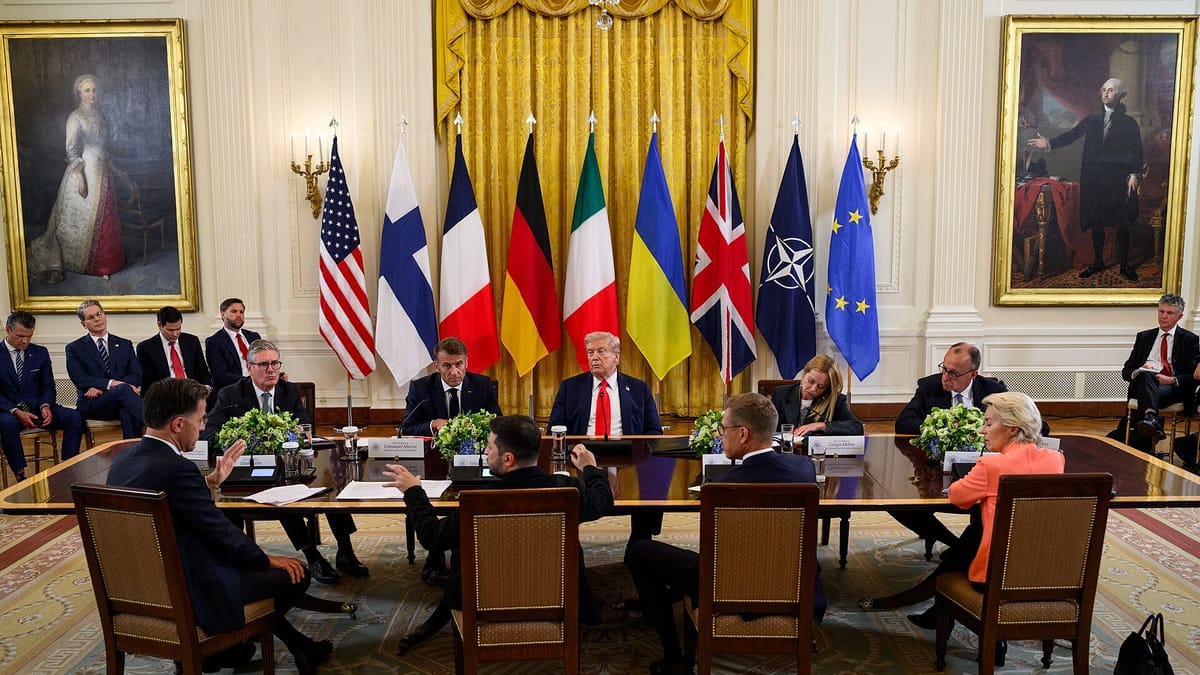
While most of the EU has been involved in this ”peacemaking” farce in one way or another, it has been done to try to create realistic post-war security assurances for Ukraine by assembling the Coalition of the Willing, and to gently dissuade Trump from going along with the most-ridiculous Russian demands. It is also worth noting that while the EU leaders did mediate between the US and Ukraine, they never even entertained the idea of negotiating with Russia – at least not as long as Moscow is demanding concessions that are unproportionally in its favor when compared to the reality on the frontlines.
This is arguably the best foreign policy step that the EU took since the beginning of Trump’s second term – going along with his earliest peace plans would have humiliated the EU even further, and would probably have negatively impacted the morale of the Ukrainians. In this respect, the EU has performed an understated but useful role: that of the quiet mediator behind the scenes, trying to talk the Trump administration down from its most suicidal positions. While this quiet (if somewhat panicked) diplomacy has irritated Kyiv, which would have liked more full-throated backing, it does at least show that the EU has been capable of holding on to its principles at a time when Washington seemed determined to strongarm both Ukraine and Europe into a peace that strongly favored Russia. And while Zelensky’s recent venting about the EU at Davos may have been understandable, the fact remains that without Europe’s desperate diplomacy, Trump would’ve likely hung Ukraine out to dry months ago.
That’s not to say that these last twelve months or so have shown the continent knows how to handle Trump. This chapter is titled ‘The Trump Humiliation Ritual’ because that’s exactly what the president has forced the bloc to go through. The best-known example of Europe’s grovelling is probably NATO’s head secretary, Mark Rutte calling Trump “daddy” – an attempt at humor that both Europe and Trump himself seemed to realize is a perfect, if unfortunate, encapsulation of the relationship.
We can see this by focusing on the initial response from Brussels to Trump’s Liberation Day tariffs, which hit the EU with a flat fifteen percent. Despite talking a big game about trade wars and fighting for European exporters, Brussels ultimately caved and agreed to the deal Trump offered without much of a fight (although the European parliament is currently refusing to ratify said deal). Obviously it’s a given that the EU should treat their most important friend and ally with respect, but since this has not been reciprocated, it raises a question: for how long will this continue? Certainly not forever, as polling shows much of the public has already had enough of endless appeasement, which means that sooner or later, EU leaders are likely to change their tune.
If the lesson of the Ukraine peace talks was that quiet diplomacy and behind-the-scenes pressure can work on the Trump administration, the lesson of the tariffs saga is that Ukraine might be a special case. Possibly because Trump has close allies (Lindsey Graham and Marco Rubio spring to mind) who want to see Kyiv succeed, backchannel diplomacy worked. With trade, though, being quiet and polite seems to have had the opposite effect. And now we can see how things might have gone had the EU taken a stronger tack. The Greenland saga only ended last month when it became clear that Brussels really was going to go all-in on a trade war this time round. A trade war Europe may have lost, but which would’ve been a miserable experience for America as well. Seeing the shifts this was causing in the bond market, Trump backed off his calls for annexation. Whether that will encourage Europe to take a firmer line with the administration in the future, though, remains an open question.
The Frozen Russian Assets
I suppose we should first acknowledge the scant few positives about the December decision to not utilise frozen Russian assets to fund Ukraine – Kyiv will, at the very least, not be left high and dry, and is instead bankrolled by a collective EU loan of around €90 billion. The rationale behind this decision was simple risk aversion – Ukraine is funded and the EU countries with globally important banking sectors avoided any risks that could come with technically breaking international law. Additionally, the decision was good news for EU federalists, who compared the joint EU loan to the American War of Independence, where the Thirteen Colonies took on a joint loan and thus had to implement collective taxation to pay it back, which in turn helped bring about the federal US that we know today. Thus, the joint EU loan should in theory help integrate the bloc even further – which, let’s be fair, is necessary to a degree, whether you are a federalist or not.
This is where any positives related to the frozen assets debacle end. The reality is that there was never any tangible risk associated with seizing the frozen assets of a country breaking international law. In the same way that the US recently showed it could break international law by kidnapping a serving head of state (albeit one who was illegitimately elected off the back of a fraudulent vote), and no other country would do much but grumble about it, so too is the EU powerful enough in the areas of trade and finance to effectively shrug off complaints. The euro, recall, is the world’s second currency of choice after the dollar. The bloc is the world’s biggest free trade zone. EU banks remain a better place to keep assets than any viable alternative. Had the EU seized Russia’s frozen assets, it would’ve caused a diplomatic backlash… but one unlikely to lead to any tangible consequences.
The absolute aversion to acting outside of the rule of law is the most glaring, endemic weakness of the EU, one that is prevalent in its other foreign policy mistakes as well. In a world that’s increasingly ruled by nations willing to coerce and threaten neighbors (China), act unilaterally to remove unfriendly leaders (the US), or just attack sovereign states without cause (Russia), the EU risks becoming too wedded to a fading international system for its own good. In the same way that it seems bizarre today to read about diplomats arguing over arcane points in the League of Nations even as Imperial Japan dismembered China, so today does Europe risk becoming hamstrung by its strict adherence to playing by rules that everyone else is ignoring.
Gray Zone Tactics
Aside from the war in Ukraine, the EU has also been struggling against Russian “gray zone” activities. These include Russia’s famed shadow fleet, which they’ve been using to skirt the Western sanctions, as well as the more overt hybrid attacks – Russian drones getting “lost” on EU territory for prolonged periods of time or Russian ships “accidentally” damaging critical underwater infrastructure. These gray zone tactics have been specially tailored against democracies – transgressions that are definitely not minor, but also aren’t direct acts of war. This often confuses democracies by creating anger or panic in the electorate and hesitation in the leadership. This has played out in all the countries of the EU that have the generational misfortune of neighbouring Russia, but has notably not been limited to them – hybrid attacks in the form of airspace violations were also registered in Belgium, Germany and Denmark for example.
It’s somewhat difficult to grade the EU’s reaction to these challenges – responses to gray zone attacks have to always walk the tightrope between being too mild on the one end and overescalatory on the other. So far there have been no casualties on either side, but NATO jets have been scrambled on multiple occasions and some drones were even shot down over Poland who also initiated NATO’s Article 5 consultations. The EU as a whole responded to these incursions by announcing the plans for building an anti-drone network across Eastern Europe, dubbed as “The Drone Wall”. A stronger response would definitely send Russia the message that the EU is not to be trifled with, but would come with a fair chance of escalation, which no one is overly keen on. A more restrained response would risk the chance of further incursions, but could yield other benefits like not being at war or the huge diplomatic win for Estonia, who humiliated the Russians in the UN after the former violated the Estonian airspace with three fighter jets and denied everything even when faced with indisputable evidence. Polish Article 5 consultations were also a non-violent means of demonstrating NATO’s commitment to defend its Eastern European members – a diplomatic victory for Poland as well.
While the EU has predictably favored a more restrained approach, they’ve so-far walked this line adequately in Trump’s second term. However it’s clear that the same restrained responses cannot continue indefinitely, especially if Russia chooses to continue or even increase these incursions. While shooting down anything that crosses the eastern border would be the first escalatory idea, a potential strategy could be to respond in kind – hitting Russia with the same sort of hybrid attacks it is inflicting on Europe. Again, chances for escalation are high, but so are the potential rewards: should Putin fear serious pushback to his tactics, he may think twice about deploying them.
While Russian hybrid attacks are more concerning simply due to the fact that they’re usually carried out by the military and thus always carry the risk of escalation, its shadow fleet is no less of a headache for the EU in the grand scheme of things. Aside from allowing Russia to skirt Western sanctions and fund its war in Ukraine, the shadow fleet has also been used to carry out hybrid attacks against the EU’s critical underwater infrastructure in the Baltic Sea. In most cases, the perpetrators were identified and investigations were started, but the punishments tended to be far too lenient. “Eagle S”, a shadow fleet tanker that dealt significant damage to the undersea infrastructure between Finland and Estonia in late 2024 was just… released in February of 2025, while only 8 of its crew were arrested, out of whom 5 were also soon released.
Sadly Eagle S wasn’t an isolated case – in this regard the EU has been infuriatingly slow and complacent for far too long. While a small number of shadow fleet tankers were indeed impounded in 2025, the EU did essentially nothing about it in 2024. In any case, it hasn’t been anywhere near enough to meaningfully enforce the sanctions.
While this article hasn’t been overly generous with the US so far, credit must be given when it’s due – Washington has done very well by seizing multiple Russian shadow fleet tankers in the early days of 2026 and the EU would benefit immensely by following suit. If there’s political will then it should be doable – the precedent has already been set by the US, the EU only needs to follow it. Still, there is cause for cautious optimism – France recently seized a shadow fleet tanker near the Spanish coast. One down, but over a thousand more to go.
The Verdict
Although the overall picture on the EU’s foreign policy blunders and successes leans towards the former, we can take solace in the knowledge that the EU has undoubtedly had its fair share of successes. Fewer than could be hoped for, and always with a caveat or two. But even this is better than the alternative. While the EU could do with much greater cohesion and boldness in this new age of Great Power politics, it has at least managed to avoid the series of disastrous foreign and domestic policy decisions that seemed all too plausible around the time of Trump’s Liberation Day tariffs. It may be too early to say that Europe is at last standing up for itself, but at least it’s no longer completely supine.
Unfortunately, Brussels seems poised to retain its reactive approach to geopolitics across the rest of 2026, as being active/seizing the initiative is nearly impossible when you’ve got a list of growing problems that have been largely ignored for decades. Not to mention the fact that the EU is made up of 27 sovereign countries, so any kind of decision making is a much more painful and tedious process than it would be for a normal country. So unfortunately there will likely be no action from the EU to handle less immediate concerns like the supporting of Iran’s waning popular revolution.
Washington seems to be hell-bent on forcing the EU towards a path of complete autonomy – if that happens, it’ll either break apart or become a global power. Exactly why the US is trying to push its once servile allies into potentially becoming a great power is unknown – probably even to them. Nevertheless, unless you’re from Troy, then sometimes it’s best not to look a gift horse in the mouth. Until recently, it was easy to just maintain the status quo and enjoy all the benefits that NATO and the EU had to offer without committing to further integration, but that time ended when Russia invaded Ukraine. Or, depending on who you ask, it ended when Trump started his second term.
To retain its position at the top (or at least around it), the EU can’t be content with only staying united at the level it is currently – fortunately for the EU federalists and unfortunately for everyone else, the EU has to become even more united to succeed. The road to complete EU autonomy and unity has been – and will be – slow and difficult, but that‘s hardly a surprise for anyone. What matters is that the EU is nevertheless moving in the right direction and will continue to do so for as long as outside powers try to bend the bloc to their will. It cannot be predicted what awaits the EU at the end of this road, but one thing is certain – the entire world trembled the last time the Europeans went to war and history usually tends to rhyme.
Written by
Henrik Hannes Herkel is a political analyst with a bachelor's degree in history and a master's degree in political science. His work spans geopolitical analysis with particular focus on Eastern Europe and Africa, often through the lens of development cooperation and the right to self determination.
Related articles
Europe Has Only Itself to Blame for the F-35's Dominance
Joni Askola · September 17, 2026 · 12 min read
Can Minilateralism Solve Europe's Defense Crisis?
Leo Feypel · September 15, 2026 · 15 min read
The Berlin Attack is Part of a Broader Pattern. Europe Needs to Wake Up to The Growing Threat
Paweł Wójcik · August 7, 2026 · 9 min read
Continue in
Become a Member
Members get full access to premium reporting, in-depth briefings, and subscriber-only analysis.
Insiders Receive
- Full access to all premium articles and briefings
- Exclusive subscriber-only analysis and dispatches
- Support independent conflict journalism
Signed in or already a member, but still locked? Fix an access problem
From $5/month — cancel anytime