
Why Did Russian Democracy Fail? Start With its Minorities
Henrik Hannes Herkel • August 24, 2026
Up next
Ukraine is also Running Out of Armour. Here's Why.
Jompy · October 6, 2026 · 17 min read
“A Gun to Go and Die With”: How Russia Recruits in Africa
Casus Belli · October 1, 2026 · 11 min read
Ukraine's Intervention in the Sahel is Hurting Russia. It's also Destabilising the Region.
A handful of Ukrainian trainers embedded with Mali's Tuareg rebels are fighting Russia's Africa Corps — but their allies include al-Qaeda's JNIM, and Kyiv's drone tactics are already reaching the jihadists.
Paweł Wójcik · September 24, 2026 · 7 min read
The West has often lamented the fact that after the USSR collapsed, Russia “failed” in becoming democratic. The blame has been spread around to all involved parties - beginning with greedy Western capitalists who “robbed” Russia due to unfair market advantages to bad leadership on Russia’s part, whose elites were more concerned with securing their own piece of the “corruption pie” than actually fixing the country. While neither of these explanations are completely false, they also don’t leave much room for nuance.
More informed opinions on this matter claim that Russia’s road to democracy was over before it could begin, since the authoritarian Soviet regime didn’t fall completely, but was instead severely weakened. The West, drunk on the optimism brought about by the idea of “the end of history”, confused this with a democratic transition. Some of the more "russophobic" people even claim that democracy is simply incompatible with the Russian imperialist culture which, while often phrased in a deliberately demeaning way, also has some elements of truth to it.
The real reason why democracy failed in Russia was never due to one easily explainable factor - it’s a mix of all of the above and more. One of the lesser known reasons that chronically hamstrings the development of Russian democracy is its minority “problem”, or rather Russia’s historic aversion to giving its native ethnic minorities any kind of rights to self-determination.
What is self-determination?
The right to self-determination is a relatively old term, having its roots in the Era of Enlightenment - along with other similar ideas that are now collectively known as civil and human rights. As such, there have been many interpretations of this term throughout history, but the most widespread definition can be found in the UN’s International Covenant on Civil and Political Rights (Part 1, Article 1):
“All peoples have the right of self-determination. By virtue of that right they freely determine their political status and freely pursue their economic, social and cultural development.”
In other words, the right to self determination states that all distinct ethnic groups should be free to govern and develop their land, society and culture as they see fit. It’s also worth noting that this doesn’t necessarily mean that every ethnic group around the world should have their own sovereign country. They do have the right, but it should also be kept in mind that if it were to happen in excess, the resulting geopolitical fragmentation would do more harm than good. For example, if Bavaria were to secede from Germany, they wouldn’t only have to contend with deep economic troubles, but would also lose all the benefits that come with being a member of the EU. Instead, the right to self-determination often means greater local autonomy or expanded cultural and economic rights.
It is hardly a secret that the Russian regime violates this right - not only for its minority peoples, but also partially for the Russians themselves, as while their social and cultural self-determination is more-or-less allowed (though less and less recently), they hardly have the right to freely determine their political status. So, while no group in Russia lives freely, the ethnic minorities are often treated worse - as secondary citizens at best. Although considering that their numbers have been on a slow, but steady decrease for centuries, there’s an argument to be made that historically, the Russian government simply sees them as undesirables. And seeing how radically the Russian political situation has varied over the last few centuries, that’s impressive dedication.
The Prison of Peoples
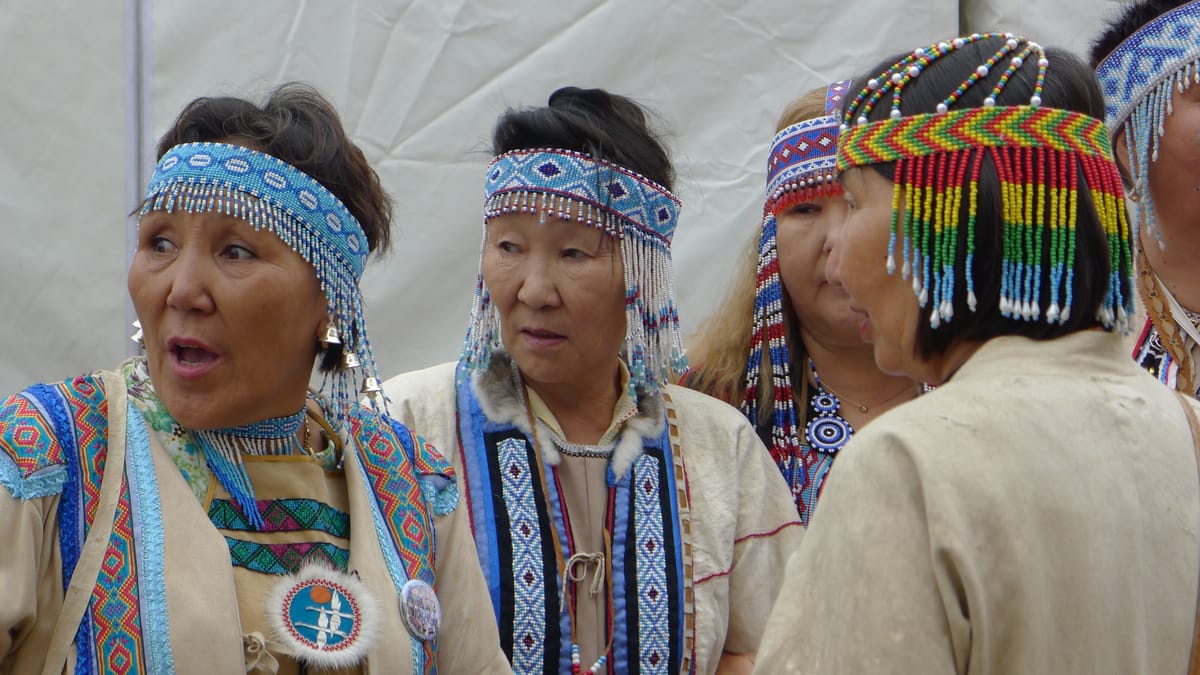
Russia is home to around 145 million people, out of whom over 40 million didn’t identify themselves as “Russian” in 2021. Sixteen million of those refused to identify their ethnicity at all. The rest belong to the country’s kaleidoscope of ethnic minorities. The largest of these are the Volga Tatars (4,7 million), the Chechens (1,6 million), the Bashkirs (1,5 million), the Chuvash (1 million) and the Avars (1 million). The rest of the ethnic minorities are made up of hundreds of smaller groups of varying sizes, most of them being unrecognised by the Russian state, while many of them are teetering on the verge of extinction. All of them have been suffering for centuries under what can arguably be characterised as Russia’s oldest continually pursued policy - russification.
For those who are blessed enough to be unfamiliar with this term, russification essentially means forced assimilation. There’s an argument to be made that forced assimilation isn’t always a bad thing - when it comes to immigrants, many in the West would probably support it. However, when forced assimilation is utilized against an ethnic group on their own native land, the morality of this policy changes drastically.
While it’s natural that some cultures blend, wane or even disappear with time, the sheer amount of endangered or essentially dead peoples in Russia is staggering. Some of them, like the Votians (around 100 left), started dying out during the Soviet persecution, while some, like the Vepsians (around 4,000 left in Russia) faced a sharp decline after the collapse of the USSR. In 2002 there were still over 8,000 Vepsians living in Russia, but by the 2020s, their numbers had shrunk by half - even allowing that some may have simply chosen not to state their ethnicity on the census, this is not a natural decline. And these examples have only been taken from the Finno-Ugric ethnic “umbrella” group who mainly inhabit the northwestern part of Russia, and may be deemed the ‘lucky ones,’as at least a part of the Finno-Ugric peoples managed to create their own nation states in Finland and Estonia.
There are many other ethnic groups in Russia, who are in an equally desperate position or even worse. Just take a look at the Samoyedic ethnic group (located in northern Russia). On paper, it is not doing too badly - the Nenets have grown from roughly 35,000 in 1989 to nearly 50,000 today. However, this has been accompanied by what can only be called a linguistic collapse. Of those 50,000 Nenets, only around 38,000 speak Nenets. Of the 3,500 Selkups roughly 600 speakers remain. There are about 690 Nganasans left and perhaps 30 people who speak Nganasan fluently. The Enets number a couple of hundred, with maybe 119 speakers among them. Russification, in other words, isn’t about ethnic cleansing. It’s about assimilating indigenous peoples so totally that their very language can disappear. By these numbers, it is - unfortunately - a roaring success.
This is made even worse by Russia’s ongoing war of conquest in Ukraine, where the same minorities are among the first that get sent into the meatgrinder. In a macabre way, it’s a win-win strategy for Russia - if they manage to survive, they’ll capture Ukrainian territory and if they die, then there's one less pesky minority to worry about.
Unfortunately, while this whole issue of repressed minorities seems morally very clear-cut, the war has muddied the waters significantly. Many of the same ethnic minorities are also guilty of war crimes committed against the Ukrainians. In fact, generally coming from the most destitute areas of Russia, they often have extra motivation to loot and pillage everything they happen upon. Not to mention the motivation to accept Putin’s ruble in the first place.
What About the West?
Russia having native ethnic minorities isn’t a problem by itself. It’s very common for bigger or even medium-sized countries to have indigenous groups who are distinct from the majority - the US with its indigenous Native Americans is perhaps the most well-known example, but even medium-sized countries like Spain or the UK still have a couple (mostly related) ethnic minorities. The problem isn’t even how these minorities have been historically treated, as the awful treatment of at least some of the conquered peoples is one of the commonalities that unites virtually every empire across space and time.
Where Russia’s ethnic minority situation diverges from the West is that their suffrage started grinding to a halt with the abolition of serfdom during the 19th century. It didn’t slow down because the minorities didn’t want equal rights, it happened because the Russians didn’t want them to be equal - and they still don’t.
To be fair, there was a brief period after WW1 when there was a possibility for change. While Lenin wasn’t a saint by any measure, he did have plans for greater self-determination for Russia’s ethnic minorities. And to give credit where it’s due, the USSR initially granted limited cultural and political autonomy to its minority peoples during the 1920s, including the right of schools to teach in local languages. It didn’t last for long though, as it was largely reversed during Stalin’s rule and his purges and deportations completely overshadowed any progress that was achieved before. It kind of makes sense though, since giving the right to self-determination to minority groups costs nothing if you put a couple of bullets in the backs of their heads as well.
That’s not to say that the West today treats their ethnic minorities with complete fairness - as is evidenced by Australia’s treatment of its aboriginal peoples or the Native Americans in USA and Canada, both of whom still have serious issues with environmental conservation and discrimination. Even Spain, which prides itself on being “super liberal”, has forcefully blocked Catalonian attempts at statehood, while Denmark is only today facing up to the forced sterilization of Greenlandic women during the mid-20th Century. Due to stories like this, it doesn’t take much to convince people with little knowledge on this topic that Russia treats its minorities no worse than the West does. However, when compared to similar cases in Russia, the difference becomes so stark that they can hardly be even compared, let alone equated.
The Plight of the Crimean Tatars
Compiling an overview of all the recent crimes committed against Russia’s ethnic minorities would constitute a hefty book in its own right - albeit one that would be extremely difficult to research. Non-Kremlin facilitated communication with minority representatives (increasingly difficult even before 2022) is now all but impossible. There was, however, a brief period during the 1990s and early 2000s, when direct communication with these minorities was possible - many even joined international organisations like the UNPO (Unrepresented Nations and Peoples Organisation), in a bid to achieve greater autonomy or even independence through peaceful means.
Most of these movements were eventually throttled by Russia, but some, such as the Crimean Tatars (around 280,000 of whom live in Crimea), are active even today. They weren’t chosen randomly - the Russian annexation of Crimea in 2014 put a spotlight on the indigenous Crimean Tatars, who consequently received much greater international support and attention than the other minorities in Russia. Moreover, before 2014 they had been a part of Ukraine for over two decades, during which they also got more breathing room to organise and recover from previous waves of extreme persecution under the USSR. That’s not to say that Ukraine didn’t discriminate at all against the Crimean Tatars - there was a firm glass ceiling on how far a Crimean Tatar could rise in the Ukrainian government.
Unfortunately, that would prove to be child’s play compared to what happened after Russia “liberated” Crimea. The Crimean Tatars described widespread ethnically targeted campaigns of repression in the post-annexation era, including physical abuse, imprisonments and even murders. The local media was also put under a censorship regime, with some Crimean Tatar platforms such as the ATR forced to relocate to Kyiv to continue their work in exile. Perhaps more concerningly, many Crimean Tatar cultural sites were destroyed, and education in Ukrainian and the Crimean Tatar language was banned. While this sounds the least bad of the bunch, language is the bedrock for any culture. Total, continuous restrictions for education in the people’s native language can easily result in cultural erasure within a few generations - just look back up this article at the figures on the Nenets and others. Moreover, hundreds of thousands of Russian settlers moved into Crimea after the annexation, a process which can only be described as colonization. It’s worth hammering home that these atrocities happened in the 21st century in Europe, while the leading NATO countries did absolutely nothing to stop it - and now we’re paying the price for this failure.
The Connection
So, Russia treats its minority peoples barbarically, but how is that connected to its chances of hopefully becoming democratic at some point? After all, there's a long history of discrimination in nearly every democratic country and they’re doing fine for the most part. The difference here is that these democracies have always allowed at least gradual suffrage - as time went on, most of the discriminated-against groups have managed to better their situations or have even become fully accepted.
Well, some quasi-democratic apartheid states exist, so democracy without respecting the right to self-determination should still be possible, right? I’d argue that it’s not as simple as that. To begin with, let’s clarify the relationship between democracy and the right to self-determination. The aspiration towards equal rights between citizens - and by extension the right to self-determination - is the natural evolution of contemporary democracies. After all, elections are, at their very core, the realization of the citizen’s free agency - or in other words, the practical application of the right to self-determination. To put it simply, democracy is a form of governance and the right to self-determination is one of the things that keeps it functioning day-to-day.
Without this fundamental component, democracy can’t work as intended. Just as a car without brakes will crash and burn sooner or later, so will a democracy without equal citizens. After all, “partially democratic” apartheid regimes aren’t exactly known for their stability. Pre-1994 South-Africa is a good example, especially considering that their apartheid regime eventually collapsed, following a long period of riots, repression, and growing tensions between groups. And it’s not for nothing that Yugoslavia’s collapse was preceded by a gradual erosion of minority rights at the expense of the dominant, Serbian, group.
…
All historical and contemporary evidence points to the fact that even if Putin’s regime were to completely collapse tomorrow and democratically aligned forces miraculously came to power, it wouldn’t last long at all - just as it didn’t last in 1917 or 1991 (if the latter can even be described as “democratic”). If Russia was to become a true, stable democracy, they’d first have to allow free and fair referendums for their minority ethnicities. Yet the Russians will never allow that to happen, no matter who holds power in the Kremlin. It’s worth keeping in mind that Russia’s democratic opposition still keeps to the imperialist mindset, though they’re much less extreme than Putin’s clique. Let us not forget that in principle, Navalny supported Russia’s invasion of Georgia in 2008 and said he would not reverse the annexation of Crimea in 2014. More specifically, he referred to Georgians as “rodents” who deserved to be bombed and when asked about returning Crimea, he replied with his own question: “Is it a sandwich or something that you can take and give back?”. Paradoxically enough, he strongly condemned the occupation of Donetsk and Luhansk, so if he had his way, Russia “only” would’ve annexed some of its neighbouring territories. Not exactly what one would expect out of an internationally recognized democratic dissident.
Of course, Russia can keep continuing the same old cycle of rebellions, wars, mass repressions and eventual collapses - to the detriment of the Russians themselves, and their minority peoples, as well as everyone around them. But without a fundamental shift in the Russian cultural psyche, especially as it pertains to viewing neighbouring ethnicities as well those in their own territories as somehow “lesser”, a free, fair and democratic Russia is simply a pipedream with little to no basis in reality.
Written by
Henrik Hannes Herkel is a political analyst with a bachelor's degree in history and a master's degree in political science. His work spans geopolitical analysis with particular focus on Eastern Europe and Africa, often through the lens of development cooperation and the right to self determination.
Related articles
Ukraine is also Running Out of Armour. Here's Why.
Jompy · October 6, 2026 · 17 min read
“A Gun to Go and Die With”: How Russia Recruits in Africa
Casus Belli · October 1, 2026 · 11 min read
Ukraine's Intervention in the Sahel is Hurting Russia. It's also Destabilising the Region.
A handful of Ukrainian trainers embedded with Mali's Tuareg rebels are fighting Russia's Africa Corps — but their allies include al-Qaeda's JNIM, and Kyiv's drone tactics are already reaching the jihadists.
Paweł Wójcik · September 24, 2026 · 7 min read
Continue in
Become a Member
Members get full access to premium reporting, in-depth briefings, and subscriber-only analysis.
Insiders Receive
- Full access to all premium articles and briefings
- Exclusive subscriber-only analysis and dispatches
- Support independent conflict journalism
Signed in or already a member, but still locked? Fix an access problem
From $5/month — cancel anytime