
Southeast Asia is Tilting Towards BRICS. What Does It Mean for the Global Order?
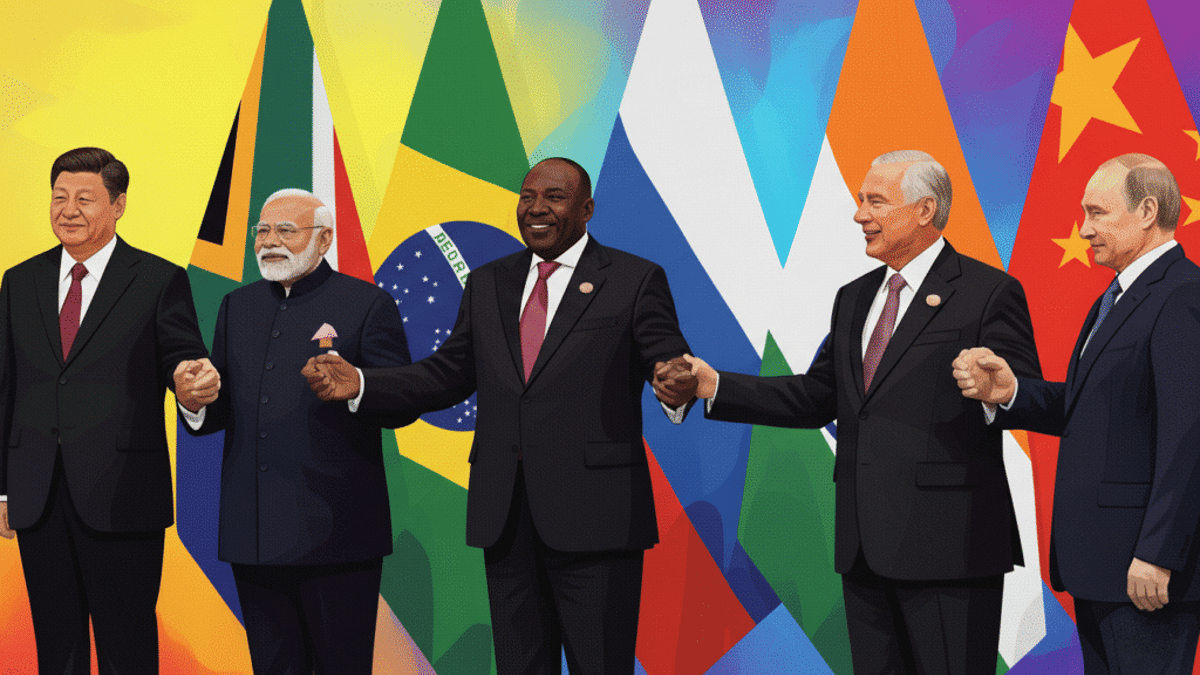
With Indonesia joining BRICS and six more ASEAN nations following, Southeast Asia's tilt toward the emerging-economies bloc marks a notable shift for a region that has traditionally maintained neutrality between the US and China.
Yelyzaveta Khomovska • November 17, 2025
Up next
The Taliban Won Afghanistan. Now They're Fighting Each Other
Paweł Wójcik · August 27, 2026 · 11 min read

No-One Knows How Many Have Died in Myanmar's Civil War
Evan Moloney · August 13, 2026 · 12 min read
Myanmar’s Resistance is Fracturing. Here’s What that Means
Under pressure from advancing junta troops and a growing Chinese role in the conflict, Myanmar’s many resistance groups have been increasingly at odds with each other, sparking fears the united front against the coup is starting to crumble.
Thomas van Linge · July 27, 2026 · 14 min read
In January 2025, Indonesia joined BRICS, the group of emerging economies led by Brazil, Russia, India, China, and South Africa. Soon after, Malaysia, Thailand, and Vietnam became partner countries. Myanmar, Cambodia, and Laos are reportedly considering joining as well. If all proceed, seven of ASEAN's ten members would have formal links to BRICS. This would be a notable change for a region that has traditionally maintained neutrality between the US and China.
This strategy, known as hedging, has let Southeast Asian nations handle geopolitical risks, stay flexible, and keep their neutrality. But the room for doing so is narrowing. Washington, under Donald Trump's return to the Oval Office, has slapped tariffs on Southeast Asian exports and opted for transactional diplomacy. Beijing, meanwhile, grows more assertive in the South China Sea and more impatient about Taiwan. Between a prickly America and a more assertive China, Southeast Asia has started looking for other options.
And BRICS has offered itself as one.
The New Courtship
On June 19, 2025, under the tricolours and chandeliers of St. Petersburg's Constantine Palace, Indonesia's President Prabowo Subianto met with Vladimir Putin and thanked him for supporting Indonesia's entry into BRICS. Later that day, Jakarta announced a strategic partnership with Moscow, including cooperation in energy, nuclear power, and a $2.2 billion joint investment fund. This move was more than just business. By choosing to attend the BRICS meeting instead of the G7, Prabowo took Indonesia's long-standing 'independent and active' policy in a bolder and more visible direction.
July 20, 2025. Having freshly joined BRICS as a partner state, Vietnam sent its ground troops northeast to Guangxi province for the first-ever exercises with the People's Liberation Army. Ten days in, the military command on both sides affirmed that these exercises mark one of many future steps to bolster military cooperation and friendship as 'both comrades and brothers'. For a nation that was once at war with China and is now at odds over the South China Sea, while keeping ties with Washington, the drills came as a surprise.
August 02, 2025. As Ferdinand Marcos Jr.'s personal jet took off from Manila to New Delhi, the Philippine and Indian navies conducted their first-ever joint exercises in the South China Sea. A few days later, he and Indian Prime Minister Narendra Modi unveiled a strategic partnership set to last until 2029. The core of this agreement is defence cooperation. Manila and New Delhi plan to work together on developing submarine infrastructure and defence equipment, while India has supplied the Philippines with supersonic BrahMos missiles. That same week, President Marcos announced that the Philippines was open to exploring a potential membership in BRICS.
BRICS isn’t just watching from the sidelines anymore. It’s right in Southeast Asia’s living room, bringing money, infrastructure projects, military gear, and a seat at the table.
So why is BRICS, often seen as anti-Western, getting so much attention in a region that prides itself on staying neutral? Is ASEAN just looking for more partners, or is something bigger going on?
The implications matter far beyond Southeast Asia. If the region moves closer to BRICS, it could change the US–China rivalry, affect Taiwan’s security, and maybe even shift the rules of the global order.
Hedging As a Way of Life: Historical Context
BRICS didn’t just show up in a neutral room. It entered a region that’s spent decades learning how to take the deal, not pick a side. To see how we got here, let’s rewind the clock to the Cold War.
As World War II came to an end, newly independent Southeast Asian states were quickly pulled into a US–China tug of war. Beijing, newly communist and initially isolated, leaned on Moscow and fueled insurgencies across Southeast Asia, with Vietnam as its main battlefield. In 1973 alone, China shipped more than 233,000 guns, 9,900 artillery pieces, 120 tanks, and 36 aircraft to North Vietnam, and rotated some 320,000 People’s Liberation Army personnel through support roles. Washington, meanwhile, responded by forging alliances wherever it could. A 1951 defence pact with the Philippines secured American access to Clark Air Base and Subic Bay, Thailand joined Washington’s new SEATO alliance, and Thai airfields soon served as hubs for the US bombers in Indochina.
Welcoming China, the USSR, and the US wasn't on the itinerary for Southeast Asian governments, nor did they want to slide back into colonial-era dependence. Their leaders drew a clear red line: safeguard sovereignty at all costs. This resolve was enshrined in regional diplomacy – from the 1955 Bandung Conference to ASEAN’s founding in 1967 to the 1971 “Zone of Peace, Freedom and Neutrality” (ZOPFAN) declaration. In effect, the region’s grand strategy became hedging.
So what is hedging? It is a strategy where a country picks different, and sometimes even conflicting, policies toward rival powers. The idea is to get the best deal from both, without getting too close to either one. Think of it like a horse race: instead of betting on just one horse, you place your bets on two favourites. This way, you have a good chance of winning no matter who comes out ahead. Unlike bandwagoning or balancing, hedging does not mean choosing a side. Instead, it’s about staying flexible and keeping your options open.
Nearly every Southeast Asian country uses hedging, but each does it differently. Ultimately, some are closer to the US, while others lean more toward China, and others stay in the middle. Several reasons shape these variations.
One of the defining drivers is regime legitimacy and coalition management. For example, Vietnamese leaders count on economic growth and national sovereignty to stay in power, so their hedging strategy is built to protect both. Hanoi’s 'three nos' policy – no alliances, no foreign bases, no taking sides – remains in place. Still, in 2023, Vietnam deepened ties with Washington, signing a Comprehensive Strategic Partnership and hosting US carriers in Da Nang. The aim is to keep threats at bay without being locked into treaties, and to keep the economy moving without relying solely on one partner. Thailand’s path has been different. After the 2014 coup brought US restrictions, Bangkok turned to China for military gear like VT-4 tanks and an S26T submarine, while hosting multilateral exercises like Cobra Gold. Now, with civilian politics back in play, Thailand is shifting toward the West again. It’s applying for OECD membership, wrapping up an EFTA trade deal, and negotiating another one with the EU. When a regime’s legitimacy is shaky, leaders often look for any partner that can help stabilise their posture at home. For governments just trying to survive, the options become even more limited. Myanmar’s junta leans on Beijing and Moscow for weapons and diplomatic cover. Laos, weighed down by debts, is closely tied to China through the $6 billion China–Laos railway. Cambodia has shown its alignment by blocking an ASEAN statement on the South China Sea in 2012 and by upgrading its Ream naval base with Chinese help. In these cases, hedging begins to resemble dependence, as domestic politics leave little room for manoeuvre.
Security risks and geography force countries to make tough calls. When threats are close and physical, they prompt governments to take stronger security steps. The Philippines, for example, has faced steady pressure from Beijing in the South China Sea, especially near Second Thomas Shoal. In response, Manila has expanded US military access under EDCA and bought BrahMos missiles from India. Trade with China goes on, but the US alliance remains the main safety net. When risks are less direct, countries often turn to legal moves and quiet backup plans. Malaysia, for instance, challenges China’s maritime claims through legal filings at the United Nations while maintaining security ties under the Five Power Defence Arrangements with Singapore, the UK, Australia, and New Zealand. Still, Kuala Lumpur keeps China as its largest trading partner. Singapore takes it a step further, offering steady access and logistics to the US, sticking to its FPDA commitments, and keeping strong trade with China. Overall, when maritime tensions rise, countries reach for hard security tools. When disputes are contained, they prefer legal strategies, discreet exercises, and a mix of partnerships.
Economic development and keeping more value at home also shape countries’ strategic calculus. Indonesia, for example, treats foreign policy like managing a portfolio to support its industrial goals. In 2020, it banned raw nickel exports, which led to investment in local smelters and battery plants. Over $15 billion flowed in, much of it from Chinese partners, helping Indonesia keep more economic benefits at home. In 2023, the Jakarta–Bandung high-speed rail opened in October, following a $7.3 billion build led by a Sino-Indonesian joint venture with financing from China Development Bank. To avoid becoming too dependent, Indonesia also diversifies its security ties. It runs the Super Garuda Shield exercise with the United States, receives C-130J airlifters, and has an F-15 deal in progress.
Taken together, how leaders secure legitimacy at home, how close they sit to coercion risks, and how they finance growth sort the region into three broad tendencies. At one end are the US-tilters: the Philippines and Singapore, where Western security and financial access remain the backbone even as trade with China grows. At the other end are China-reliant or China-constrained regimes, such as Myanmar, Laos, and Cambodia, where debt, diplomatic cover, and elite ties narrow room to manoeuvre. In between are the portfolio hedgers – Indonesia, Malaysia, Thailand, and Vietnam, who mix suppliers, lenders, and forums to keep options open. This middle is where BRICS has the most pull, because it offers another lane for capital and markets without asking them to choose a flag.
Hedging worked for Southeast Asia because it turned great-power rivalry into a menu rather than a simple either-or. China offered speed and investment, while the US provided capital and security. This mix supported growth and flexibility. Now, with Trump back in office and China more ambitious, staying in the middle is harder than ever. The next steps will show if this strategy can last.
Navigating the Giants: Why the Middle is Narrowing
This new chapter of Southeast Asia as the stage for superpower rivalry feels different. With Trump back in office and China more assertive, ASEAN has less room to stay neutral.
Let’s start with Washington. On April 2 – known as the “Liberation Day”, conveniently just after April Fools’ – the White House unveiled “reciprocal” tariffs. In July, it followed with threat letters to Asian capitals on tight deadlines. The signal was clear: market access can change fast. Vietnam’s scramble told the story: a 46% headline rate was announced, then Washington outlined provisional terms: 20% on most exports and 40% on goods it deems “trans-shipped.” Hanoi hasn’t published a final text. Companies can live with high tariffs, yet they struggle with moving targets. The Indo-Pacific Economic Framework still lacks market access, and its trade pillar remains unresolved, so it can’t cushion tariff shocks. The net effect: ASEAN leans more on Chinese demand – at least until a steadier US administration returns.
Security ties are more stable, but they have their limits. The 2024 Balikatan military exercise was the largest yet and included a live-fire sinking drill off Ilocos Norte on Luzon. US destroyers still conduct freedom-of-navigation operations near disputed areas of the South China Sea. While this is reassuring, it does not solve trade or economic issues. As long as trade policy remains unpredictable, countries will continue to seek stable sources of income, even if that means doing more business with China.
Now on to China. The South China Sea dispute is legal and practical. In 2016, an international tribunal ruled out the legal basis of China’s “nine-dash line”. Meanwhile, Beijing rejected the ruling and normalised a coastguard–militia presence. In August 2023, it issued a new “standard map” with a ten-dash claim that neighbours promptly rejected. At sea, the pattern is familiar: near Second Thomas Shoal, Chinese ships have used close passes and water cannon against Philippine resupply, pushing Manila to double down on external security ties.
Economically, China’s influence is strong. In 2023, China-ASEAN trade reached over $900 billion, making China both a major customer and supplier for the region, from Indonesian nickel to Vietnamese factories. When US tariffs increase, it is often easier for ASEAN countries to turn to Chinese markets. However, this interdependence gives Beijing leverage, which it can use to expect silence on issues like maritime disputes or Taiwan.
In short, US tariffs and a more transactional approach are pushing ASEAN to rely more on China for growth, at least until the US becomes more predictable. But leaning on China brings its own problems. Both the US and China are squeezing ASEAN’s room to hedge, which is exactly what the region wants to avoid. Stuck between a tougher Washington and a bolder Beijing, ASEAN is looking for other options. That’s where BRICS offers a third pill.
Mapping BRICS' Appeal in Southeast Asia
Over the past 16 years, BRICS has had a solid glow-up. What began as a crisis-era club of emerging economies wary of leaning on Western lenders now spans 10 members and 10 partner nations. Together, BRICS+ now represents about 45% of the world's population, 35% of global GDP, and 30% of oil production. Its main goal is still to offer an alternative to the IMF and World Bank. However, as criticism of Western influence has increased, some worry that BRICS could become a full-fledged anti-Western bloc.
Therefore, it might seem odd that ASEAN is getting more interested in BRICS. Why would a group known for staying neutral – and with some members even clashing with Beijing –want to get closer to BRICS? Why risk giving China more influence and upsetting Washington?
A few capitals have more to lose than gain from a BRICS badge. Singapore is already integrated into global markets and Western institutions, so membership would bring few benefits and could draw unwanted attention from the United States. As a major trade hub with established links to the US, China, and the EU, Singapore prefers to maintain its current position rather than join another bloc. The Philippines has a defence treaty with the US and faces pressure from China in the South China Sea. While President Marcos Jr. has expressed potential openness to BRICS, Manila recognises that closer ties with the bloc could complicate its alliance with Washington. For both countries, the practical approach is to maintain existing partnerships and engage with BRICS only when it does not risk key security or economic interests.
On the other flank sit governments that already depend on Beijing or seek support from Moscow. Cambodia has often sided with China in ASEAN meetings, especially during disputes about the South China Sea. Laos is closely tied to China through a $6 billion railway project and growing external debt. Myanmar’s junta, cut off since the 2021 coup, turns to Russia and China for weapons and diplomatic backing. For these governments, BRICS is not a new direction but another source of money and recognition.
The most important group in this story is the hedging quartet. Indonesia has now joined BRICS, while Vietnam, Malaysia, and Thailand are moving forward as new partners. Together, they are exploring whether BRICS can expand financial and market access without touching their security alignments.
BRICS appeals to countries that want a stronger voice. ASEAN’s consensus model can be slow, especially during crises like the one in Myanmar. Larger members want forums where they do not have to pick sides. Indonesia uses BRICS to represent the Global South and discuss energy, commodity prices, and development in ways that connect with people at home. Thailand also wants more influence, but for different reasons. Joining the OECD is a big step, but it takes years and is hard to explain to voters. BRICS is easier to join and easier for people to understand. Malaysia finds it simpler to balance major powers when it has more seats at the table. In the end, domestic politics drive these choices. Leaders who are active abroad often have more room to act at home.
Finance is another factor. Countries in the region need steady, long-term funding for railways, power grids, and ports. Most deals still use US dollars, even when both sides are local, which adds conversion costs and can cause delays if tariffs or sanctions change. The BRICS New Development Bank (NDB) offers funding and can lend in local currency, which helps keep budgets stable. Vietnam’s north–south corridor needs track upgrades, more passing loops, and extra grid capacity to support factory areas. Borrowing in dong keeps costs steady over the long term and protects the budget from currency swings. Malaysia is testing alternative payment systems and limited renminbi settlement, so not every payment must go through the US dollar. Putrajaya is also looking at NDB as another lender for infrastructure, alongside Western and Japanese sources.
Partnering with BRICS opens commercial opportunities in fast-growing markets that are often hard to reach. India, for example, is the world’s largest buyer of edible oils, importing about 16 million tonnes each year, with palm oil making up around 60%. This demand offers stability for Indonesian and Malaysian producers, and BRICS relationships help keep trade flowing even when prices change. The Gulf region connects Asia, Africa, and Europe, and the UAE’s push to sign bilateral Comprehensive Economic Partnership Agreements (CEPA) has turned Dubai into a key centre for non-oil trade. In 2024, UAE exports to CEPA partners rose by about 42% compared to the previous year. This group now includes Indonesia, giving Jakarta direct access to a major re-export hub and to buyers across the Middle East, South Asia, and other regions. BRICS links also expand trade routes beyond East Asia. Brazil and Vietnam are strengthening their partnership: Brazil has encouraged Vietnamese investment and invited Vietnam to deepen ties as a BRICS partner, while top Brazilian companies in aerospace and food are looking for ways to increase trade in both directions. The focus is on building steady, diverse demand for machinery, food, and consumer goods, rather than relying on the US-China trade relationship. In Eurasia, Indonesia is exploring a tariff-cutting agreement with the Russia-led Eurasian Economic Union, which could open another large market for Indonesian goods without disrupting existing Asian supply chains.
For BRICS, Southeast Asia is leverage and logistics rolled into one. It is China’s single largest trading partner bloc with two-way trade of around $900 billion in 2023, and a manufacturing and shipping node that sits astride the Malacca Strait chokepoint, through which a major share of global seaborne energy and container traffic moves. Folding more ASEAN economies into BRICS formats deepens supply-chain redundancy, adds mineral and food-system resilience (nickel in Indonesia, palm oil in Indonesia and Malaysia, electronics packaging in Malaysia, and consumer-goods scale in Vietnam), and gives BRICS a louder voice inside Regional Comprehensive Economic Partnership (RCEP), the world’s largest trade area by GDP, where ASEAN is an institutional hub. It also expands the NDB’s pipeline in a region forecast to outgrow much of the world, giving the bank credible projects and the bloc a development story beyond rhetoric.
BRICS-ing the Indo-Pacific Wall: What's Next?
So what does all this mean? If you’re expecting a dramatic shift, you’ll be let down. What’s happening is a practical hedge, sharpened by a Trump White House that’s no longer a steady economic partner. That’s making ASEAN economies lean more on China for growth. But getting too close to China is risky – the South China Sea disputes aren’t going away just because of new trade deals. So, capitals are trying to keep both giants at a distance, find space to manoeuvre, and line up backup plans.
BRICS is one of these options – not a banner to rally behind, but rather a toolbox. It offers access to long-term loans, new payment systems, and more markets. For governments focused on building their economies and infrastructure, this kind of diversification just makes sense. ASEAN countries keep economic and security ties separate, so working with BRICS on trade doesn’t mean changing their security stance. They can get loans and boost trade with BRICS while still running military drills with the US.
Could BRICS expansion turn hedging into a real shift? Only if the bloc starts acting more like ASEAN – with non-interference, clear rules, and real economic integration. Right now, it’s not there. As BRICS grows, its members want different things. China and Russia might push for a tougher anti-Western line, but India and Brazil probably won’t go along if it puts their US ties at risk, especially with a sceptical US administration in place.
A NATO-style security pact isn’t likely. The political costs are too high, and members have different priorities. Beijing hasn’t picked sides in Russia’s war on Ukraine, and neither Russia nor China has run to the rescue of Iran in a war against Israel. India works with China in BRICS, but still has border disputes and is building defence ties with the Philippines. Just being in the same group doesn’t mean everyone acts together.
Written by
Yelyzaveta Khomovska is a researcher and analyst working at the intersection of war, global security, and politics. She holds a Master's in Conflict Studies from the LSE and has written on everything from the Tatmadaw's strategic thinking in Myanmar's insurgency to Russia's cultural assimilation playbook. Her work has taken her through think tanks and research teams in Canada, the UK, and Ukraine. Still, nothing prepared her quite like navigating a life under a full-scale Russo-Ukrainian war, and her cat staging daily ambushes under the table.
Related articles
The Taliban Won Afghanistan. Now They're Fighting Each Other
Paweł Wójcik · August 27, 2026 · 11 min read
No-One Knows How Many Have Died in Myanmar's Civil War
Evan Moloney · August 13, 2026 · 12 min read
Myanmar’s Resistance is Fracturing. Here’s What that Means
Under pressure from advancing junta troops and a growing Chinese role in the conflict, Myanmar’s many resistance groups have been increasingly at odds with each other, sparking fears the united front against the coup is starting to crumble.
Thomas van Linge · July 27, 2026 · 14 min read
Continue in
Become a Member
Members get full access to premium reporting, in-depth briefings, and subscriber-only analysis.
Insiders Receive
- Full access to all premium articles and briefings
- Exclusive subscriber-only analysis and dispatches
- Support independent conflict journalism
Signed in or already a member, but still locked? Fix an access problem
From $5/month — cancel anytime