Skip to content
Fronts.co

Ukraine's Long-Range Strikes are Hurting Russia. Now it Needs a Plan to Retake Territory

In recent weeks, it has become a familiar sight: the lone Ukrainian drone, cruising at low-altitude across Russia’s skies before nose-diving onto a target and.

Illya Sekirin • July 11, 2026

Ukraine's Long-Range Strikes are Hurting Russia. Now it Needs a Plan to Retake Territory

In recent weeks, it has become a familiar sight: the lone Ukrainian drone, cruising at low-altitude across Russia’s skies before nose-diving onto a target and sending flames into the sky. These long-range strikes on refineries, airbases, logistics nodes and industrial targets have demonstrated remarkable ingenuity and reach. Some observers have even begun to argue that Ukraine is now winning the war.

That conclusion is premature. Wars are not won by long-range fires alone. The Anglo-American bombing of German cities during the Second World War devastated Hamburg, Dresden and other urban centres, but it did not, by itself, defeat Nazi Germany. The war was ultimately decided when Allied armies broke through on the ground, destroyed German field forces and occupied territory.

Ukraine faces a similar problem today. To win the war — which in practice means forcing Russia into a negotiated ceasefire on favourable terms — Ukraine must do more than damage Russian refineries or strike targets deep inside Russia. These attacks are valuable, but Russia will adapt. It will disperse facilities, strengthen air defences, relocate production where possible and shift greater industrial capacity farther east. Completely destroying Russian industry, or even degrading it decisively, will become harder over time.

The central question, therefore, is not whether Ukraine can hit Russia at long range. It clearly can. The harder question is whether Ukraine can restore operational manoeuvre on the battlefield.

For the past several years, I have argued that Ukraine needs to reorganise its drone forces into a concept I call the “drone blitz”. The idea is simple: instead of dispersing drone forces across a broad front, Ukraine should concentrate the majority of its unmanned systems — including aerial drones and ground robots — against an unexpected weak point in Russian defences. The aim would be to create overwhelming local superiority in unmanned systems, rupture the Russian defensive system, exploit the breakthrough and encircle a major Russian grouping.

This concept does not mean concentrating large numbers of tanks, artillery and infantry in one place, as in twentieth-century offensives. That would be too visible and too vulnerable in the age of drones. The point is to concentrate drones. Human forces would follow only after unmanned systems had broken the enemy’s local drone-defence network and created a temporary corridor for exploitation.

A partial version of this idea has been attempted in the Ukrainian counteroffensive around Huliaipole, which began in early February and continues today. The operational logic was sound. As Russian forces tried to envelop Orikhiv from the north on the way to Zaporizhzhia, they overextended their right flank, creating an opportunity for a Ukrainian counterattack.

Ukraine committed strong forces to the operation, including elite assault formations and significant drone assets. Yet these forces were spread across a wide frontage of roughly 70 kilometres. That decision reduced the chances of achieving a decisive breakthrough. A narrower main effort — perhaps no more than 10 kilometres wide, protected by a broader drone umbrella and supported by longer-range systems isolating the battlefield — would have offered a better chance of rupturing Russian defences.

This is the key operational lesson. Breakthrough is not achieved by pushing everywhere at once. It is achieved by concentrating combat power at a decisive point, overwhelming a limited portion of the enemy’s defence, and then exploiting into the rear. If an attacker defeats the enemy on a 10-kilometre sector and then rolls up the rear of a 100-kilometre defensive line, it may only need to physically defeat a small part of the opposing force. The rest can be paralysed, isolated or encircled.

By contrast, if the attacker advances across most of the enemy’s frontage, it must defeat most of the enemy’s forces directly. The return on breakthrough is greatly reduced. What should have been a rupture becomes a bulge.

The reason both Ukrainian and Russian commanders often prefer broad-front attacks is understandable. In the current battlespace, concentrating armour, artillery and infantry in one place makes them easier to detect and destroy. Drones, artillery, glide bombs and loitering munitions punish visible mass. Commanders therefore try to infiltrate across wider frontages, probing for weakness and avoiding obvious concentration.

But this logic mistakes the problem. In the drone age, the answer is not to abandon concentration. It is to change what is concentrated.

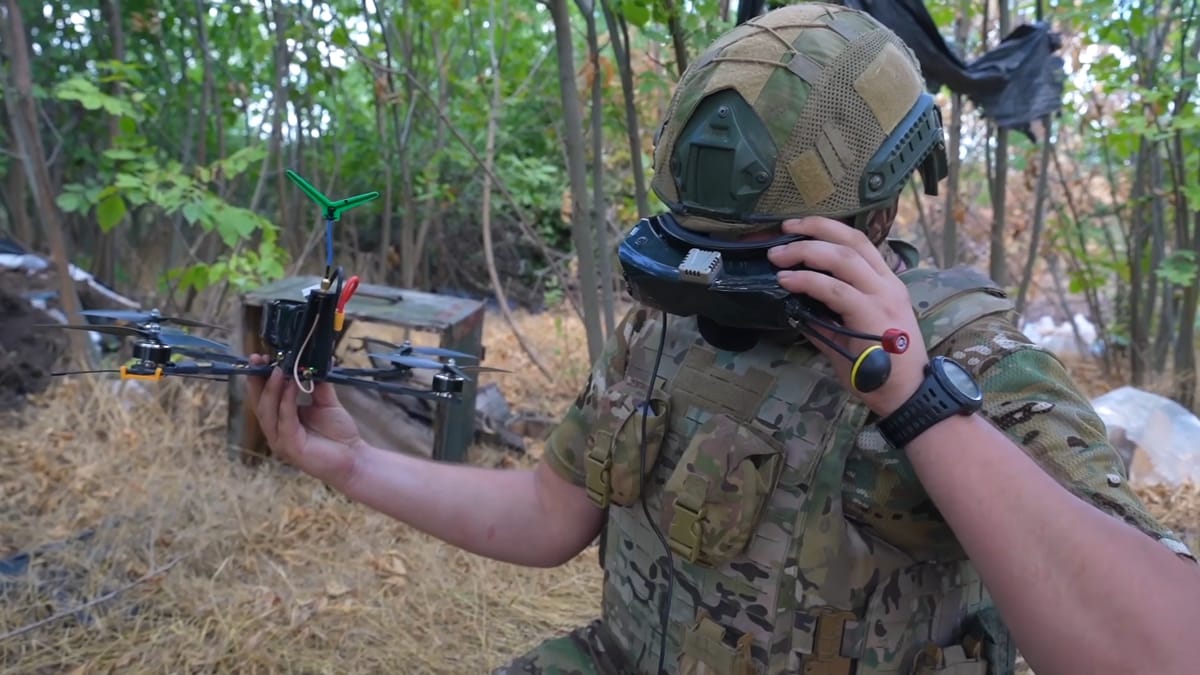
The drone blitz concentrates unmanned systems rather than human assault forces. Imagine a force package of large numbers of FPV drones, reconnaissance drones, electronic warfare assets, counter-drone teams, and thousands of unmanned ground vehicles armed with machine guns, automatic grenade launchers or explosive charges for breaching and assault missions. Human infantry, mounted on ATVs, motorcycles, IFVs or light vehicles, would remain in reserve until the enemy’s local drone system had been exhausted or suppressed.

The operation would begin by establishing a drone umbrella over a wider operational box, while massing the heaviest drone density over a much narrower breakthrough sector. The primary target would be enemy drone operators, launch sites, relay points, observation posts and command nodes. These are now among the most lethal elements of the battlefield. If they are not suppressed, no ground attack can succeed.

Most enemy drone teams operate close enough to the line of contact to influence the immediate tactical fight. That makes them vulnerable to a concentrated unmanned assault. Under drone-blitz conditions, Ukrainian aerial drones would hunt Russian drone crews and fire-control nodes, while unmanned ground vehicles would move forward in waves to occupy treelines, buildings, trenches and other key terrain features. Wherever Russian defenders revealed themselves, aerial drones would strike them. Wherever mines or obstacles blocked movement, ground robots would absorb the risk.

This would create a new form of combined arms: air-ground unmanned assault.

The purpose would not be to avoid losses. Losses would be heavy. The difference is that the losses would fall mainly on machines rather than people. Hundreds of ground robots and tens of thousands of FPVs might be expended in a single day. But if this substitutes drone losses for infantry losses, it is a favourable exchange. Ukraine’s problem is not a shortage of courage. It is a shortage of manpower. Drones are replaceable in a way trained soldiers are not.

Once the first echelon of robots and drones had exhausted the enemy’s local FPV stocks, destroyed many of its operators and pinned down surviving defenders, small assault groups could enter the area to clear positions and consolidate gains. They would not be storming blind into intact Russian defences. They would be following unmanned systems through a battlefield already mapped, struck and partially occupied by robots.

The aim would be to capture the breakthrough zone quickly — ideally within hours, not days. Speed matters because the enemy must not be given time to seal the rupture with reserves. Once the first defensive belt is broken, Ukrainian drone-control teams, launch sites and support elements would move forward. The drone umbrella would then be pushed deeper. Surviving ground robots, assault infantry and mechanised groups could exploit into the rear before Russian forces from adjacent sectors could reorient.

This is where the operational effect becomes decisive. The point of the drone blitz is not merely to seize a few villages or create another shallow salient. It is to collapse a section of the Russian front by rupturing the drone-based defensive system that currently prevents manoeuvre. If successful, the breakthrough force could drive into the rear, sever logistics, isolate reserves and encircle a large Russian grouping.

This is fundamentally different from the slow, grinding advances now common on both sides. A broad-front attack produces incremental movement. A drone blitz seeks violent rupture.

Ukraine already understands the logic of saturation in deep-strike operations. When it sends hundreds of long-range drones against Russian targets, it accepts that many will be intercepted. The aim is for enough to get through to overwhelm the defence and create strategic effect. The same logic should be applied where the war will ultimately be decided: on the battlefield in Ukraine.

The drone blitz would not be easy. It would require planning, secrecy, large stocks of drones, robust communications, electronic warfare protection, decentralised control and commanders willing to think beyond the habits of artillery-war attrition. It would also require accepting that unmanned systems must be treated not as supporting assets, but as the primary means of achieving breakthrough.

Yet this is precisely the transformation Ukraine needs. Long-range drone strikes can hurt Russia. They can impose costs, disrupt logistics and damage infrastructure. But they cannot, by themselves, destroy Russian field armies or liberate occupied territory. For that, Ukraine must restore operational manoeuvre.

The future of offensive warfare will not belong to the side that simply has more tanks or more shells. It will belong to the side that learns how to mass unmanned systems, break the enemy’s drone shield, and exploit before the defence can recover.

Ukraine has already shown the world how drones can change strategic strike. It now needs to show how drones and robots can restore breakthrough on the ground.

FAQ

Why aren't long-range strikes alone enough to win?
Wars are not won by long-range fires alone. The author cites the Anglo-American bombing of German cities in World War II, which devastated urban centres but did not by itself defeat Nazi Germany.
What is the 'drone blitz' concept?
The author argues for concentrating the majority of Ukraine's unmanned systems against an unexpected weak point in Russian defences to create overwhelming local superiority, rupture the defensive system, exploit the breakthrough and encircle a major Russian grouping.
Why concentrate drones instead of tanks and troops?
In the drone age, concentrating armour, artillery and infantry makes them easier to detect and destroy. A drone blitz concentrates unmanned systems rather than human assault forces, with human infantry following only after unmanned systems have broken the enemy's local drone-defence network.
Where has Ukraine already tried a partial drone blitz?
In early February 2025, Ukraine launched a counteroffensive around Huliaipole. Russian forces overextended their right flank while trying to envelop Orikhiv from the north, creating an opportunity for Ukrainian counterattack.
What went wrong at Huliaipole?
Ukrainian forces were spread across roughly 70 kilometres. A narrower main effort of perhaps no more than 10 kilometres, protected by a broader drone umbrella, would have offered better chances of rupturing Russian defences.
Why trade machines for soldiers?
Ukraine's problem is not a shortage of courage but a shortage of manpower. Drones are replaceable in a way trained soldiers are not. Hundreds of ground robots and tens of thousands of FPVs might be expended in a single day.
How fast must a drone blitz move?
The aim is to capture the breakthrough zone quickly, ideally within hours, not days, before the enemy can seal the rupture with reserves. The point is to collapse a section of the Russian front by rupturing the drone-based defensive system.
What makes a drone blitz difficult to execute?
It requires planning, secrecy, large stocks of drones, robust communications, electronic warfare protection, decentralised control, and commanders willing to think beyond the habits of artillery-war attrition. Unmanned systems must be treated as the primary means of achieving breakthrough, not supporting assets.
IS

Written by

Illya Sekirin

Illya Sekirin is the author of Rise of the Machines: Drone Warfare in the Russia-Ukraine War – Tactics, Operations, Strategy (2026). In addition to advising several senior members of the Ukrainian High Command since early 2024, he has also worked as a researcher and translator for the General Staff of the Armed Forces of Ukraine. He has also served as a front line drone operator in 2022 and 2023. Here’s the link to get his book: https://www.helion.co.uk/military-history-books/rise-of-the-machines-drone-warfare-in-the-russia-ukraine-war---tactics-operations-strategy.php

Related articles

Continue in

Insider access

Become a Member

Members get full access to premium reporting, in-depth briefings, and subscriber-only analysis.

Insiders Receive

  • Full access to all premium articles and briefings
  • Exclusive subscriber-only analysis and dispatches
  • Support independent conflict journalism

From $5/month — cancel anytime