
Ukraine’s Mid-Range Strikes are Wrecking Russian Air Defense and Logistics. Here’s How
Cheap repurposed drones flying 50 to 200 kilometers behind the front are destroying SAM launchers faster than Russia can replace them — and turning supply roads to Kherson and Crimea into kill zones.
Jakub Janovsky • June 1, 2026

Up next

Ukraine is also Running Out of Armour. Here's Why.
Jompy · October 6, 2026 · 17 min read

“A Gun to Go and Die With”: How Russia Recruits in Africa
Casus Belli · October 1, 2026 · 11 min read

Ukraine's Intervention in the Sahel is Hurting Russia. It's also Destabilising the Region.
A handful of Ukrainian trainers embedded with Mali's Tuareg rebels are fighting Russia's Africa Corps — but their allies include al-Qaeda's JNIM, and Kyiv's drone tactics are already reaching the jihadists.
Paweł Wójcik · September 24, 2026 · 7 min read
**If you follow the Ukraine War closely, you have likely noticed the recent spike in reports of Russian air defenses and logistics coming under fire, especially along the roads resupplying the occupied southern regions of Ukraine. These reports are among the clearest indicators of Ukraine's unfolding mid-range strike campaign.
While various drone strikes have long been a staple of the Ukrainian Unmanned Systems Forces, a lack of resources meant that such mid-range strikes hitting Russian targets in operational depth used to be relatively rare. Today, though, these drones are multiplying in number and now pose a significant threat to Russian forces in and around Ukraine. What follows is a quick primer on this new Ukrainian capability... and the danger it might pose to the Kremlin's overall war effort going forward.
What are “mid-range strikes”?
The so-called mid-range strikes represent the systematic use of assets capable of hitting enemy targets farther than the reach of long-range artillery (around 40-50km) and less than long-range strike capabilities (usually 200-300 km or more, historically the territory of cruise and ballistic missiles), and they usually target enemy critical support assets like air defenses, logistics, unit HQs, etc.
The Evolution of Ukrainian “Mid-Range Strike” Capabilities
When Russia started its 2022 invasion of Ukraine, the Ukrainian military only had a relatively small number of Soviet-era Tochka ballistic missiles that were capable of mid-range strike. While they were able to achieve some successes with them, it was clear that launching old out-of-production missiles wouldn’t help Ukraine much with hitting Russian targets beyond the range of its artillery - especially since the Air Force needed to focus on survival and supporting air defense.
Fortunately, the Russian military was still employing Soviet-era practices that had become dangerous in the era of mass-manufactured long-range precision munitions, such as deploying large ammo depots close to the front. By the summer of 2022, the US government had started supplying Ukraine with HIMARS rocket launchers and a significant number of GMLRS rockets. GMLRS rockets have a range of around 85km, which enabled the first true Ukrainian ”mid-range strike” campaign, famously destroying many of these large Russian ammo depots (likely containing millions of pieces of large-caliber munitions) and thereby significantly reducing Russia’s artillery superiority.
Since that time, the battlefield in Ukraine has become so drone-infested that systems like HIMARS have had to pull back farther from the frontline, while valuable Russian targets have also largely disappeared from the immediate vicinity (but not before taking significant losses from large numbers of drone-adjusted HIMARS strikes). Ukraine has also had to struggle under restrictions placed by donor nations on how and where weapons like HIMARS can be used. So, a new, local solution was needed.

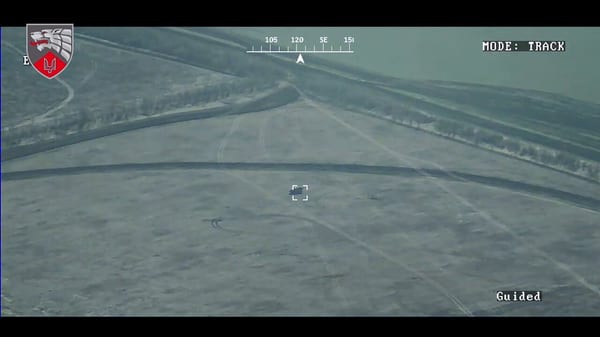
Fortunately, by 2025, the Ukrainian arms industry and military had already become experts at quickly evolving strike drone platforms, and some of the existing strike drones required only relatively minor changes to be repurposed for the new “mid-range strike” campaign. The problem for most of 2025 was a lack of resources that prevented the Ukrainian Unmanned Systems Forces from ordering and using these drones at scale. But shortly after the required resources were allocated, these drones began wreaking chaos on Russian logistics.
Mid-Range Strike Drone Designs
Since the majority of them will be shot down by Russian air defense, in order to be effective, mid-range strike drones need a combination of significant range, reliable long-range communications (which is critical for manual guidance against mobile targets), and as large a warhead as possible… all while staying reasonably cheap.
These requirements mean that mid-range strike drones are usually modifications of existing fixed-wing drones powered by small internal combustion engines. At the high end, some utilize designs based on long-range strike drones (for example, the well-known FP-2, which is a derivative of the FP-1 long-range strike drone) - with the modifications largely focusing on the capacity to carry significantly larger warheads, at the cost of reduced fuel load and thus shorter range. But on the lower end of the scale, you can also find dirt-cheap upsized versions of fixed-wing FPVs. Drones that are intended to be used in occupied parts of Ukraine often use Starlink terminals as a reliable means of long-range communication (the service doesn't work in Russia).
Drones used for mid-range strikes are usually split into 2 categories. The first is drones going after stationary targets like logistics bases, structures hiding valuable military equipment, or mobile targets that might be hardened, where the priority is delivering as large a warhead as possible. Meanwhile, the second is drones targeting logistic vehicles and other mobile soft targets (like pickups with AA guns that are used by mobile air defense groups) - drones for this purpose tend to be smaller and cheaper, but have the ability to loiter in the target area, looking for targets.
Of course, none of this is static. Ukrainian strike drone designs are continuously being improved - with the FP-2 from company FirePoint being a good example.


The Campaign against Russian air defenses
The first targets of the Ukrainian mid-range strike campaign that started in late 2025 have been Russian air defenses - both the SAM launchers and radars. Attacking them was difficult, both due to their mobile nature and their ability to defend themselves against drones - but elimination or degradation of these air defense assets has ultimately brought many benefits.
Firstly, it pushed the Russian air defense coverage even further from the frontline - reducing the risk posed to the Ukrainian fighter jets conducting airstrikes, and allowing them to operate more effectively by not having to fly close to the ground. Secondly, destroying radars and SAM launchers created holes in the Russian integrated air defense system coverage. Those holes have allowed other Ukrainian drones and missiles to reach their targets without being intercepted.
Finally, SAM system crews who think they might be attacked by the Ukrainian drones are more likely to expend valuable missiles against all kinds of drones, and by doing so, further deplete the shrinking Russian SAM stockpile. Given that Russia is the largest operator of SAM systems in the world, this has been a very ambitious goal, but partially due to the Ukrainian successes earlier in the war (notably using HIMARS), Kyiv appears to have made impressive progress.
Based on available data, this effort to eliminate or suppress Russian air defenses, especially in occupied parts of Ukraine, so far appears to have been a success. Visually confirmed losses of air defense radars and SAM launchers have significantly increased - likely surpassing the Russian capacity to produce replacements. And the real losses are likely higher still. We have also seen indications of the Russian SAM stockpile being reduced, and at least localized complaints from Russians about SAM shortages (notably in the “Crimean shooting gallery”).
(The source for the data in this graph is the Oryx loss list)

Russia appears to have so far reacted to this Ukrainian success by deploying more decoys, but otherwise it has struggled due to the fact that its drone interceptor program is far less advanced and operating on a much smaller scale than Ukraine’s.
A major sign of the success of this campaign is the apparently increasing percentage of other Ukrainian mid and long-range drone strikes that have recently been reaching their target, often with devastating effect.
Russian Military Bases in and Around Ukraine
Another major set of targets for the Ukrainian mid-range strike campaign have been various military bases that Russia has in relative proximity to the frontline - especially those in occupied territories (Crimea has essentially become a shooting gallery in this regard). These range from improvised hiding locations for heavy weapons, logistics hubs, and other valuable military equipment to army barracks, unit headquarters, and airbases.

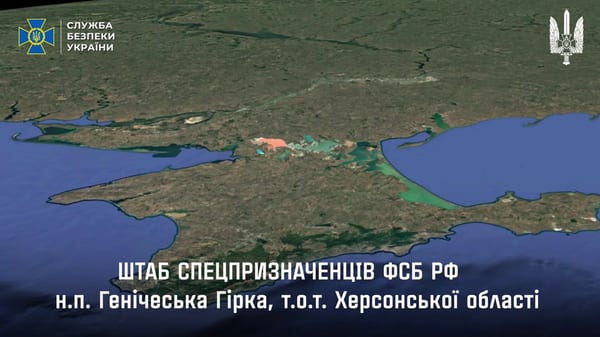
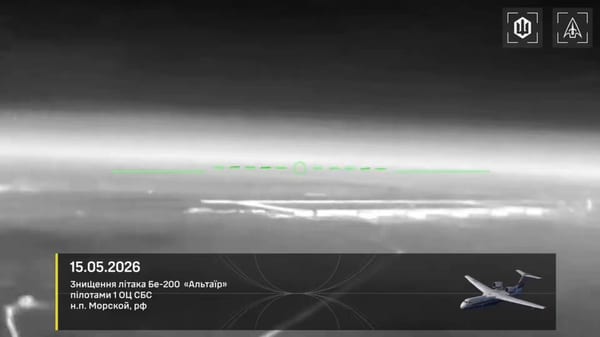
Besides destroying valuable equipment and complicating Russian operations, these strikes are also trying to complicate the Russian use of Iskander ballistic missiles and helicopters. Deploying these beyond the reach of mid-range strike drones would limit their usefulness, and by forcing them to constantly relocate or hide, Ukraine is reducing their ability to act quickly.
Logistics
Since waging a conventional war is extremely demanding on logistics, the ability to disrupt or even completely block the enemy in this area is a surefire way to degrade an opponent's effectiveness on the battlefield. Add to this the fact that logistics is usually based on (sometimes ex-civilian) vehicles that lack meaningful (or any) armor, and which are carrying cargo that is often explosive or flammable, and it becomes clear that destroying them is more a matter of distance and accuracy than pure firepower.
Strikes against cargo vehicles also complicate and delay moving units from one place to another, which can be important when the Russians want to concentrate forces in a new area or react to Ukrainian local offensives.
Based on these requirements, Ukrainian mid-range strike drones tasked with hunting Russian logistics vehicles often have a relatively small warhead that is just good enough to destroy a truck engine, prioritizing having extra fuel over a larger payload, so they can fly along the major logistics routes and look for targets.
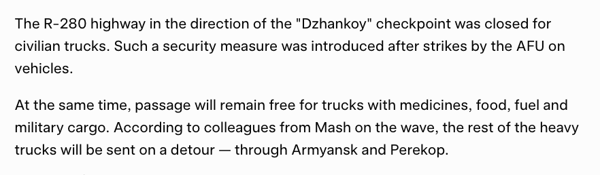
Despite being relatively recent, this campaign against logistics vehicles, which in its current form focuses on the use of mid-range drones, has already started showing signs of complicating life for the Russian military in Ukraine. First, by destroying valuable supplies, and second, by delaying or complicating the delivery of necessary military supplies of all kinds to entire areas of the frontline. The resulting logistics problems have already started to be significant in Kherson, Zaporizhzhia, and Crimea oblasts, with some roads already being closed to non-military traffic due to how dangerous it is to travel there. Comments from Russian Z-bloggers about burning trucks along roads reminding them of the Soviet-Afghan War further indicate the impact these strikes are having.


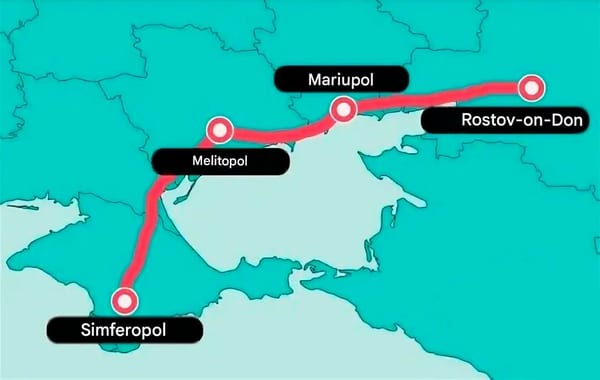
Due to the targets (mostly trucks) being so vulnerable to damage, Ukraine can also reduce the cost-per-strike by sending a fixed-wing drone to deploy relatively cheap FPVs (for which the larger drone would serve as a communications relay). These FPVs then strike the trucks, allowing the larger (and more expensive) drone to return to base and be used again and again.
While the loss of logistics vehicles is less “exciting” than seeing Russian air defense go up in flames, this aspect of the strike campaign is arguably the most important. If Russian logistics are degraded far enough, it could prove to be incredibly damaging to the Kremlin’s war effort.
Targets of Opportunity
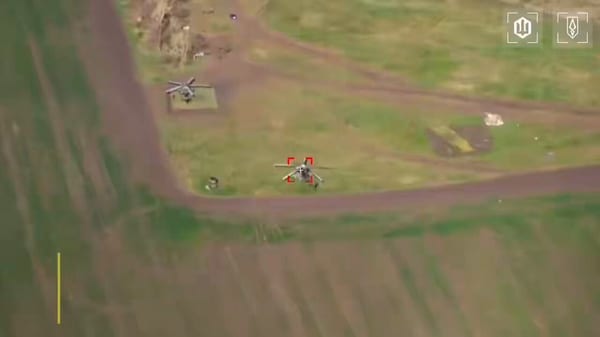
Since the drones used in this campaign usually have a direct connection and can be remotely piloted, this provides an opportunity if, on route to the planned target, the operator spots or receives intel about more important time-critical targets in the area. If the targeting cycle is fast enough and the drone operators have sufficient authority to change target, this allows them to occasionally bag some unexpected prizes like improvised enemy helicopter staging areas, concentrations of enemy forces, etc.
Current status and What Happens Next
The Ukrainian mid-range strike campaign has had a promising start, but it is still being conducted at a relatively small scale. Russia has not yet implemented significant measures to reduce its effectiveness. This gives both sides an opportunity - if Russia can improve and scale up its drone interceptors and mobile drone hunting teams, and if Ukraine doesn’t improve and/or scale up its effort, then this campaign could end up being useful but not changing the battlefield.
On the other hand, if Russia reacts too slowly to it and Ukraine significantly scales up the campaign, it could both cause major material damage and greatly complicate the Russian military efforts on whole sections of the frontline. Not only that, but it could even improve the effectiveness of other strike campaigns - in the most-extreme optimistic outcome, it might potentially enable Ukraine to retake some of its occupied territory. To be clear, neither of these extreme pessimistic or optimistic outcomes is all that likely, but the potential is there, especially if bureaucracy on either side is slow in distributing accurate battlefield information and /or slowly reacts to recent developments.
Given what we know so far about the relatively low cost of the drones involved (thousands or tens of thousands of dollars per drone), the high value of many targets in the areas of the mid-range strike campaign, data indicating the success of the campaign so far, and the potential effects it can have, it would make sense for Ukraine to invest necessary resources and scale up the mid-range strike campaign as fast as possible. This strike campaign is one of the tools that both directly increases the cost of the war to Russia and indirectly helps slow down the Russian advance - and the slower the Russian advance, the less attractive to Moscow the prospect of continuing the war will become.
No single action will force Russia to give up on its plans of subduing Ukraine, but if Kyiv manages to scale up its successes, the Ukrainian middle and long-range strike campaigns might end up being important factors in ending this war. As such, it’s imperative that Kyiv commits to this as wholeheartedly as possible.**
Written by
Jakub Janovsky is an experienced OSINT analyst and telecommunications engineer who has done extensive work documenting and analysing the Syrian Civil War and the 2022 Russian invasion of Ukraine. He is currently running the Oryx Blog.
Related articles
Ukraine is also Running Out of Armour. Here's Why.
Jompy · October 6, 2026 · 17 min read
“A Gun to Go and Die With”: How Russia Recruits in Africa
Casus Belli · October 1, 2026 · 11 min read
Ukraine's Intervention in the Sahel is Hurting Russia. It's also Destabilising the Region.
A handful of Ukrainian trainers embedded with Mali's Tuareg rebels are fighting Russia's Africa Corps — but their allies include al-Qaeda's JNIM, and Kyiv's drone tactics are already reaching the jihadists.
Paweł Wójcik · September 24, 2026 · 7 min read
Continue in
Become a Member
Get full access to premium reporting, in-depth briefings, and subscriber-only analysis.
From $5/month · Cancel anytime
Already a member? Log in · Fix an access problem
Insiders Receive
- Full access to all premium articles and briefings
- Exclusive subscriber-only analysis and dispatches
- Support independent conflict journalism
- Sponsor-free WarFronts & HomeFronts backlog