
How Washington Could Abandon NATO.
The US-NATO alliance is facing a crisis as tensions rise between Washington and its European partners over the war in Iran.
Evan Moloney • April 6, 2026
Up next

We Spoke to One of Britain's Top Generals about Drones. This is What He Had to Say.
Fronts Staff · September 21, 2026 · 12 min read
Tanks are Not Dead. They Do Need to Change
Jakub Janovsky · September 14, 2026 · 11 min read
Governments are Scrambling for a Starlink Alternative. Does One Even Exist?
Jakub Janovsky · August 17, 2026 · 13 min read
On July 12, 2023, then-US Senator Marco Rubio (R-FL) introduced a joint resolution to the 118th Congress with Sen. Tim Kaine (D-VA). That resolution expressly banned any US President from unilaterally withdrawing the United States from the NATO alliance, without approval by a two-thirds vote in the United States Senate, or an Act of Congress. Five months later, the resolution passed in a bipartisan vote: eighty-seven votes in favor, thirteen opposed.
More than two years later, Marco Rubio serves as Secretary of State, under a commander-in-chief who told Britain’s Daily Telegraph that he is strongly considering a withdrawal from the alliance.
Despite Rubio’s change of heart, his 2023 resolution stands. Donald Trump and his administration face major hurdles in any attempt to withdraw from NATO, and it is highly unlikely that Trump could secure sufficient support for the move. Barring a constitutional crisis, Trump lacks any other means to abandon NATO outright.
In practical terms, however, Trump can render Washington’s NATO membership meaningless, without any need for a formal withdrawal. Instead, Trump may opt for an act of geopolitical quiet-quitting, abdicating the United States’ role in the bloc and nullifying its value as a strategic tool for either the US or Europe.
For Washington’s partners in Ottawa and across the Atlantic, a sudden US disengagement would amount to a geo-strategic crisis, even as the alliance carries out a longer-term transition to a more European NATO. Facing pressure in Iran, however, and seeking any means to preserve his political power in Washington, Trump’s breakup with the alliance may be inevitable.
US-NATO Tensions.
Donald Trump’s generally adversarial relationship with the rest of the North Atlantic Treaty Organization is a well-known reality in modern global affairs. On the campaign trail, prior to his second-term election in 2024, Trump vowed not to protect “delinquent” NATO members who failed to meet non-binding spending commitments, and stated that his commitment to NATO’s Article 5 guarantee of collective defense “depends on your definition”.
During his second term, Trump has de-prioritized spending for Ukraine, lambasted European governments in his administration’s 2025 National Security Strategy, and, most significantly, engaged alliance members in a showdown over the Danish autonomous territory of Greenland. All this, after NATO leaders committed to more-than-double their defense spending commitments within the next decade, and demonstrated a 20% spending increase across the alliance, year-over-year in 2025, excluding US spending.
The joint US-Israeli war against Iran, however, has spiked intra-alliance tensions to new heights. NATO nations have refused to take part in the conflict directly, in what Trump called a “very foolish mistake” in comments to reporters in mid-March. Several NATO member states have barred the US from using their airspace or air bases to prosecute the war effort, including Italy, Spain, and, for a time, the United Kingdom.
Trump has responded with outrage, imploring the nations of NATO to open the Strait of Hormuz, and directing NATO member states to secure their own access to oil and petrochemical products from the Persian Gulf. In recent statements to The Telegraph, Trump expressed a belief that an allied NATO response to the Iran conflict should have been “automatic”.
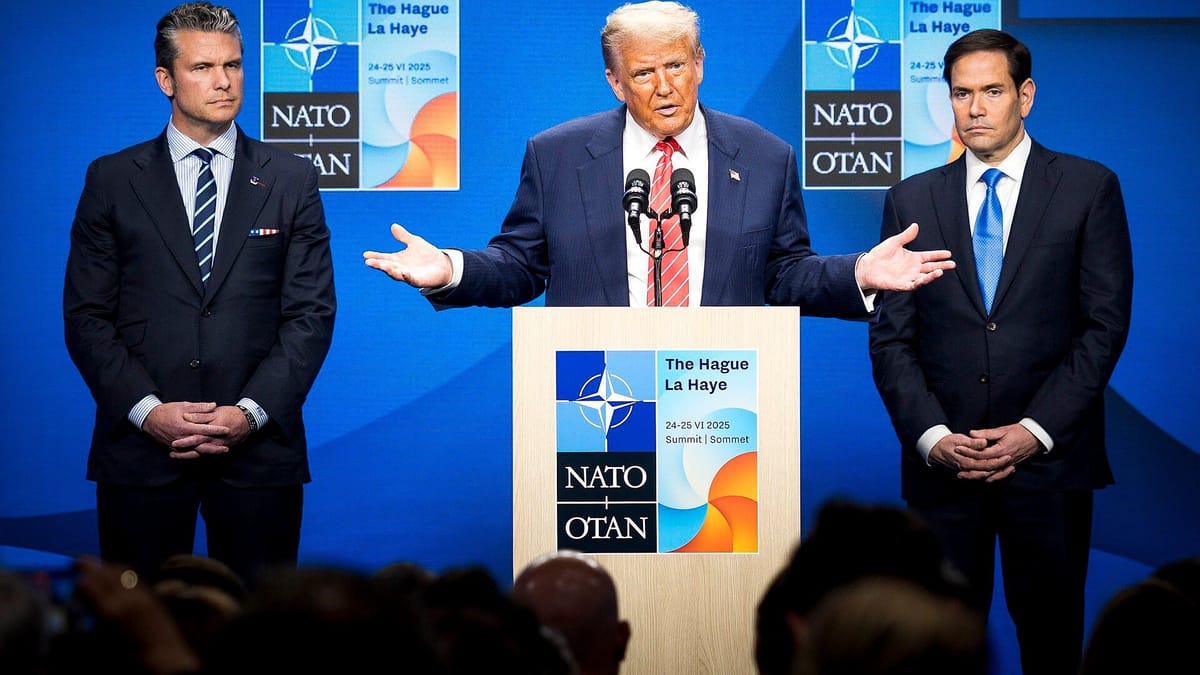
As the conflict continues without European engagement, Washington has made clear that NATO partnership is not beyond reconsideration. Speaking to Fox News on March 31, Marco Rubio stated that the US will “have to re-examine the value of NATO and that alliance for our country”. US Defense Secretary Pete Hegseth was more blunt, calling for US allies to either support Washington’s war effort, or “start learning how to fight for yourself. Go get your own oil.”
Trump’s European allies have responded, nearly uniformly, with defiance. Among other rebukes, NATO heads of state have offered:
“I’m not here to comment on an operation that the Americans decided on with the Israelis, on their own. They can later complain that they aren’t being supported in this operation that they decided on alone. It’s not our operation.” – French President Emmanuel Macron.
“Whatever the pressure on me and others, whatever the noise, I’m going to act in the British national interest in all the decisions that I make. And that’s why I’ve been absolutely clear that this is not our war and we’re not going to get dragged into it.” – British Prime Minister Kier Starmer.
"I'm just not convinced that what's happening right now – what Israel and America are doing – will actually lead to success. […] I have great doubts that there is a strategy." – German Chancellor Friedrich Merz.
The war has also stoked frustration among NATO leaders with Mark Rutte, NATO’s Secretary-General, who has held firm to a strategy of appeasement when dealing with Trump. NATO members have been working to take matters into their own hands, most notably with a UK-led coalition of roughly forty nations (both NATO and non-NATO) that are considering operations to re-open the Strait of Hormuz. Any coalition operations, however, would only begin once the conflict has de-escalated.
The Quiet Quit.
With NATO members at an impasse over Iran, the United States’ future in the alliance has never been in greater doubt. While Iran has forced intra-alliance disputes to a new level of intensity, the war has also reaffirmed deeper concerns among NATO member states: that friction with the alliance is not a passing phase, but a fixture of Donald Trump’s presence in global affairs.
Thanks to the aforementioned 2023 resolution in the US Senate, Trump lacks the means to legally, unilaterally withdraw from the alliance outright, unless he were to invite a constitutional crisis on the issue. With the current balance of party loyalties in both houses of the US Congress, and with the political pressure of the United States’ 2026 legislative elections, Trump has no realistic path to formally disengage from the bloc.
Yet Rubio’s 2023 legislation was, in essence, a firewall, creating a direct prohibition on a single, hypothetical action by the US executive. That firewall may be a response to the will of Trump, or future US leaders who may pursue a similar objective, but it fails to address the extent of a US president’s practical authority to shape US-NATO interactions.
While Trump may lack the sole authority to withdraw from NATO outright, the US presidency and its associated executive agencies—Department of State, Department of Defense, etc.—are broadly entrusted with the United States’ handling of foreign policy and global military affairs.
As it relates to NATO specifically, decisions to base troops abroad, participate in military exercises, or pledge and enact support for multinational initiatives, all rest with the US presidency and its associated government departments. While the US Congress has the authority to approve or block arms exports, those exports are managed and proposed by the State Department.
The White House is ultimately responsible for both US nuclear doctrine, and any potential use of American nuclear weapons, granting the president ultimate leverage over the US nuclear umbrella—long extended as an absolute deterrent, for the benefit of Washington’s NATO allies.
NATO’s own charter is similarly vulnerable to willful misinterpretation by member states. The alliance’s vaunted Article 5 commits allies to the support of an attacked NATO member that invokes the clause, but NATO members are not technically obligated to support that ally militarily. While Article 5 is ambiguous in many ways, three specific ambiguities are especially dangerous:
- The clause grants total discretion to individual member states, in choosing the limits of their participation in an Article 5 response. A member state may respond through economic sanctions, diplomatic measures, humanitarian relief efforts, or other non-military initiatives, as it sees fit.
- The clause does not define the parameters for an “armed attack” on NATO member states, instead leaving the term to interpretation. While this can function as a credible extension of NATO’s Article 5 deterrent power, to ward off small-scale, hybrid, or unconventional threats against member states, it also allows member states to dispute the claim that an “armed attack” mandates an alliance-wide response.
- An invocation of Article 5 requires unanimous consent from all NATO members. As a result, a single member state’s reticence can paralyze NATO’s strategic leadership apparatus, and force other alliance members to avoid using NATO’s defensive architecture to respond to threats, even when most NATO members agree that a defensive response is necessary.
Trump cannot technically withdraw from the NATO alliance, but he does hold the broad authority to turn the United States into a non-participating alliance member. The strength of NATO’s nuclear deterrent, and the promise of its readiness to respond to threats against member states, are dependent on US military assets and capabilities. Washington can withdraw its warheads from Europe, it can close down its European bases, and it can withhold arms transfers, cancel sales, or place its own demands on current or future sales, when dealing with its NATO allies.
Just as important, Trump can publicly shift the United States’ posture on the alliance, and openly acknowledge the US’ new unwillingness to come to NATO’s aid. NATO’s deterrent value depends partially on strategic realities, but partially on geopolitical consensus; NATO’s adversaries are deterred from making any challenge to the alliance, because of the alliance’s open commitment to collective defense.
Trump has already undermined that geopolitical consensus, through years of denigration of NATO member states, and threats against both member states and the alliance itself. If the US were to publicly commit to a comprehensive strategic shift away from the alliance, its remaining deterrence credibility would disappear.
Neither Trump, nor any other US president, would need to formally withdraw the US from NATO, if their ultimate objective is to disengage the US from the NATO alliance. The sweeping powers granted to the US presidency allow Trump to abandon Washington’s allies in Europe and Canada, while nominally retaining Washington’s status as a NATO member.
Tough Love, Too Early.
Despite the ongoing confrontation between Washington and NATO over Iran, a de-facto American snap withdrawal from the alliance is a remote possibility. According to ”NATO diplomats, congressional aides and defense officials” speaking to Politico, there are currently no signs that Washington intends to radically shift its position within NATO in the near term.
Nor has Trump meaningfully demonstrated that his outrage over NATO’s Iran response is anything more than political theater. Critically, Trump has not attempted to invoke NATO’s Article 5, to formally request a response by the alliance. He has not called for Article 4 consultations, mandatory discussions that any ally can trigger as a response to “any issue of concern”, as described by NATO’s own materials on the clause. Speaking to Reuters, European leaders privately acknowledged that Washington has not made any specific requests for maritime assets.
This raises a possibility that NATO members may find uncomfortable, but that would ultimately be more palatable than a US disengagement. If Trump’s true objective is to use alliance members as a rhetorical and political punching bag, to bring some perceived political advantage at home, then the alliance may weather this storm, as it’s weathered the near-breakdown over Greenland, and other internal disputes of the Trump era.
Nonetheless, Trump has demonstrated a willingness to leverage US-Europe military collaboration in private, as well as in public. In April, the Financial Times reported that Trump had threatened to stop supplying weapons to Ukraine in March, unless European allies joined a “’coalition of the willing’ to reopen the Strait of Hormuz”. Recently, former NATO Secretary-General Jens Stoltenberg acknowledged in a memoir that Trump nearly left the alliance in 2019; “We saw clear signs that Trump was preparing to act on his threat”.
As some NATO heads of state have acknowledged, Trump’s desire to draw down US participation in NATO is not a surprise in itself—and, under the right circumstances, a carefully managed transition to a more European NATO may be in all parties’ mutual interest. Finnish President Alexander Stubb explicitly promised that transition to Trump in early April, in a phone call hours before Trump’s address to the United States.
Partially in response to Trump’s prior challenges, Europe is well on its way to a full-scale military rearmament. After decades of stagnation, NATO heads of state are ordering urgent overhauls to defense infrastructure, adjusting to a new era of global warfare, and considering Europe-led coalition operations outside the confines of the NATO alliance itself. Early this year, the US began to hand NATO command roles over to European partners, breaking many years of tradition with the US at the alliance’s head. France is even working to extend its nuclear doctrine to provide its own strategic umbrella, for its European allies.
Under different circumstances, a gradual, well-managed transition to European leadership could be in the mutual interest of all NATO members, including the United States. The Europe of 2030, let alone 2035, is expected to be far more militarily capable than it is today. Trump and his allies in Washington are well-positioned to initiate a managed transition, and could draw a political benefit, arguing that a continuity of Republican leadership in Washington is necessary to ensure that the transition goes as planned.
After years of turbulence with Trump, NATO heads of state are no longer surprised by the idea that the US could quiet-quit the alliance. Instead, NATO is working to facilitate that disengagement on a mutually agreeable timeline, on the assumption that Trump is not an aberration, but a new normal, in US politics.
The danger for Europe is that Washington’s disengagement would come rapidly, and by surprise, without ensuring that Europe could guarantee its own security in the immediate aftermath. Fail to manage the transition, and Europe would face a critical window of vulnerability against its global adversaries, primarily Russia.
In the longer term, the manner of a US disengagement by or before 2028 may set the tone for subsequent decades of US-Europe relations. With Europe’s growing awareness that another Trump-style leader could govern the United States in the future, the continent is unlikely to simply return to the pre-2025 status quo, if a more pro-NATO President were to be Trump’s immediate successor.
But while Europe is now on track to break itself from its dependence on the United States in the coming years, the continent could alternately view Washington as a convenient and collaborative partner, or a threat to be mitigated. A rapid, poorly managed, or even surprise shift in Washington’s strategic posture will lend itself to the latter, forcing Europe to consider measures that would not just preserve its strategic autonomy, but insulate Europe from US influence—positive or negative—in future decades.
Washington, Obstructionist.
Under any circumstance, a rapid US disengagement from the NATO alliance would come with grave near-term implications for the alliance’s remaining members. Some scenarios, however, are more troubling than others.
While the US may choose to simply create strategic distance between itself and other NATO members, Washington’s continued membership within the bloc could backfire on the intent of the US lawmakers that voted in favor of constraints on the US presidency. Washington’s status as a NATO member grants it veto power over all major decisions by the alliance, opening the possibility that Trump or a successor could weaponize veto power to Washington’s advantage, against the interests of any or all other alliance members.
There is recent precedent for NATO membership to be leveraged in this way. Hungary, under Viktor Orban, has been a persistent obstructionist within the alliance. Budapest temporarily blocked Sweden’s NATO bid, consistently opposes or opts out of Ukraine aid packages and cooperative agreements, and most recently, has been accused of leaking sensitive European Union information directly to Russia.
Less recently, Turkey has wielded its veto power in a similar way, vetoing NATO membership for both Sweden and Finland until its preferred conditions were met, and otherwise leveraging its veto power—or the threat of its use—to advance its own geopolitical goals.
Due to the centrality of the United States to today’s NATO, the consequences of an overtly obstructionist Washington could be exponentially greater than what either Budapest or Ankara could achieve. Through its veto power, the United States could render NATO practically inconsequential as a geo-strategic bloc, either preventing the alliance from taking any action not explicitly approved by Washington, or simply preventing any NATO functions that would require unanimous consent on principle, even when Washington’s interests might be advanced.
Where Washington’s veto-power leverage may not extend, its role as a critical strategic leader for NATO, its nuclear guarantor, its arms dealer, its rapid-response capability, and its guarantor of space-based, intelligence, and logistical functions can make up the gap. Without unanimity, NATO members can still establish smaller coalitions of the willing, share intelligence, and coordinate continental defense, among other critical functions.
Washington’s central role in European defense provides a functional veto in these areas, where Washington’s formal veto is irrelevant. For decades, Washington has made its continued support of NATO nations contingent on goodwill, shared values, a shared strategic vision, and a mutually beneficial geopolitical arrangement with other alliance members.
Under different circumstances, and at the direction of a certain type of US leader, Washington can make its support contingent on NATO subjugation. That leader could assure NATO members that critical support from the US will be withdrawn, within and beyond the explicitly defined architecture of NATO itself, for any US ally—NATO or otherwise—that is deemed not to be compliant with Washington’s will.
In ten years, or perhaps even in five, Europe may possess the defense-industrial base, the European nuclear umbrella, and the other geo-strategic assets required to stand on its own. When that time comes, threats like these from Washington could be rendered toothless, after the generation-spanning problem of US dependence has been addressed.
Right now, however, the non-US nations of NATO do not possess that power. Instead, they remain dependent on Washington’s continued goodwill, at a time when Washington has very little goodwill to spare for its NATO partners.
Trump cannot formally abandon NATO, at least not unilaterally. Instead, he can undercut NATO, he can surgically remove NATO’s strategic backbone, he can neuter NATO, or, in a worst-case scenario for the alliance, he can subjugate it. No option would be without cost, and every option carries geo-strategic costs for every member of the alliance, including the United States.
In the White House, those geo-strategic costs appear to be a problem for tomorrow, whereas NATO is a problem to be solved today.
References: Not Included Above
- 1apnews.com/article/nato-trump-iran-israel-war-hormuz-eu-4674aca45519c441fc42beac482180bc
- 2reuters.com/business/energy/dozens-countries-discuss-coalition-secure-passage-through-strait-hormuz-2026-04-02
- 3france24.com/en/americas/20260401-trump-strongly-considering-pulling-us-out-of-nato-says-britain-s-telegraph
- 4nytimes.com/2026/04/01/world/middleeast/trump-europe-nato-iran.html
- 5politico.eu/article/donald-trump-anger-nato-allies-europe-united
- 6foreignpolicy.com/2026/04/01/trump-nato-iran-war-paper-tiger-starmer-strait-hormuz
- 7thetimes.com/world/europe/article/what-would-russia-do-us-trump-leave-nato-xbj076qjr
- 8theguardian.com/world/2026/apr/01/trump-says-he-is-absolutely-considering-withdrawing-us-from-nato
- 9latimes.com/politics/story/2026-04-02/trump-speech-on-iran-war-recent-remarks-on-oil-nato-daycare-costs-lan…
- 10bloomberg.com/news/articles/2026-04-01/can-trump-pull-the-us-out-of-nato
- 11chathamhouse.org/2026/02/what-should-more-european-nato-look-us-and-europe-disagree
- 12axios.com/2026/04/03/nato-trump-iran-war
- 13politico.com/news/2026/04/03/nato-mark-rutte-donald-trump-meeting-00858701
- 14france24.com/en/tv-shows/spotlight/20260402-europe-nato-under-pressure-over-iran-war-trump-strong-with-the-…
- 15theguardian.com/world/2026/apr/01/trump-nato-explainer
- 16time.com/article/2026/04/01/trump-considering-pulling-us-out-of-nato-iran-war-legal-options
- 17theguardian.com/us-news/2026/apr/02/republicans-trump-leave-nato
- 18nbcnews.com/world/middle-east/live-blog/live-updates-iran-war-trump-address-nation-rcna266149
- 19thehill.com/homenews/4360407-congress-approves-bill-barring-president-withdrawing-nato
- 20reuters.com/world/europe/france-tells-us-nato-serves-euro-atlantic-security-not-hormuz-offensive-missions-2…
- 21cnn.com/2026/04/01/politics/can-donald-trump-withdraw-the-us-from-nato
Written by
Evan Moloney is Head Writer at WarFronts and HomeFronts, and contributes analysis regularly to Fronts. Evan leads ongoing coverage of global conflicts and other rapidly evolving stories. Evan also authors the twice-weekly email newsletter WarFronts Weekly
Related articles
We Spoke to One of Britain's Top Generals about Drones. This is What He Had to Say.
Fronts Staff · September 21, 2026 · 12 min read
Tanks are Not Dead. They Do Need to Change
Jakub Janovsky · September 14, 2026 · 11 min read
Governments are Scrambling for a Starlink Alternative. Does One Even Exist?
Jakub Janovsky · August 17, 2026 · 13 min read
Continue in
Become a Member
Members get full access to premium reporting, in-depth briefings, and subscriber-only analysis.
Insiders Receive
- Full access to all premium articles and briefings
- Exclusive subscriber-only analysis and dispatches
- Support independent conflict journalism
Signed in or already a member, but still locked? Fix an access problem
From $5/month — cancel anytime