
Why Taiwan May Reverse its Nuclear Phase-Out
Taiwan just shut down its last nuclear power station, marking the end of a decades-long fight to abandon atomic energy. But a growing energy crisis may force the island to reverse course.
Alexander C. Kaufman • October 20, 2025
Up next
The Taliban Won Afghanistan. Now They're Fighting Each Other
Paweł Wójcik · August 27, 2026 · 11 min read
No-One Knows How Many Have Died in Myanmar's Civil War
Evan Moloney · August 13, 2026 · 12 min read
Myanmar’s Resistance is Fracturing. Here’s What that Means
Under pressure from advancing junta troops and a growing Chinese role in the conflict, Myanmar’s many resistance groups have been increasingly at odds with each other, sparking fears the united front against the coup is starting to crumble.
Thomas van Linge · July 27, 2026 · 14 min read
May was a month of miracles in Taiwan. For opponents of atomic energy, that came in the form of a historic milestone. On May 17, the shuttering of the island’s last-remaining nuclear power station marked the victorious end to a decades-long fight to abandon a technology they saw as a lingering threat of a radiation disaster and a symbol of Taiwan’s past dictatorship.
For Tsung-Kuang Yeh, however, the miracle came at the end of the month in the form of something simpler: the lights stayed on.
“It’s lucky,” Yeh, a nuclear scientist and power-grid expert at the National Tsing Hua University, told me.
Three or four times throughout the month, he said, Taiwan’s demand for electricity came close to eclipsing the available supply.
“That means the electricity is still barely sufficient right now,” he said. “What I’m concerned with is the next two months, when the weather will be even hotter than it is now. I don’t think we’re ready.”
Since Taiwan’s ruling Democratic Progressive Party started phasing out nuclear power in 2018, power outages have grown more frequent and prices have surged. Had the roaring air conditioning this summer triggered another islandwide blackout, Yeh believes it could reverse the nuclear industry's fate. Now, he warns, next summer could be worse.
Taiwanese voters went to the polls in August to cast ballots in a referendum on whether to reopen the last nuclear plant. In a sign of the shifting politics on the energy source, a clear plurality of voters approved the proposition – but turnout wasn’t high enough for the plebiscite to count.
It was the culmination of shifting opinion in recent years as demand for electricity from the nationally-prized semiconductor industry grows and as Taiwan’s reliance on foreign imports for nearly all its energy poses an increasing liability to the self-governing island’s de facto independence from China. While the Chinese Communist Party has never ruled in Taiwan, Beijing claims the island as a breakaway province. And the risk of Chinese blockade that could prevent shipments of the fuel Taiwan needs to run its power plants is mounting.
The threat isn’t theoretical. When then-U.S. House Speaker Nancy Pelosi visited Taipei in defiance of the Chinese government in August 2022, the People’s Liberation Army responded by launching missile tests around the Strait. Fearing becoming floating fireballs, tankers carrying shipments of liquefied natural gas (LNG) veered away, causing delays in deliveries of the fuel. Taiwan has just a few weeks’ worth of storage capacity for LNG.
While Taiwan has no capacity to enrich its own uranium, its nuclear reactors can run for two years or more without refueling – offering the island far more time to resist a blockade if China chooses to follow Russia’s model in Ukraine of waging war through blackouts.
More immediately, however, Taiwan has relied for years on the concept of its “silicon shield” – a term that describes the theory that the island’s semiconductor fabs are too important to the global economy for China to risk an invasion. For that shield to remain effective, however, Taiwan’s microchip factories need to maintain their advantage over rivals. And that depends on steady access to the electricity needed to run the plants’ high-tech equipment.
That supply already looks at risk. Last year, the Taiwan Semiconductor Manufacturing Company – the national champion – warned that the power prices it paid in its home market were now the highest in the world as the supply of electrons dwindled in the face of growing demand.
In May, Jensen Huang, the chief executive of the American chipmaker NVIDIA, returned home to Taiwan and made an unusual intervention in local politics by calling for Taipei to embrace nuclear power yet again.
“It feels like we’ve had so many things break our way. Public opinion is breaking our way. New, unexpected load growth is breaking our way,” Angelica Oung, a pro-nuclear advocate with the Clean Energy Transition Alliance in Taipei, told me. “Now Jensen Huang, the hometown hero that everyone in Taiwan loves, is speaking up for nuclear. Europe, which is influential, is breaking for nuclear. And Japan, which is so influential, is breaking for nuclear.”
Yet nuclear power remains tightly entwined with Taiwan’s ferocious partisan politics.
On the one hand, President Lai Ching-te of the DPP is showing signs of a softening stance on nuclear power. On the other hand, some party faithful remain stridently opposed to atomic power, despite growing support for the energy source among DPP voters.
“There are still strong arguments that nuclear power plants are not safe for Taiwan,” said Pin-Han Huang, a senior program manager at the Mom Loves Taiwan Association, a rebranded climate group that previously campaigned against atomic energy under the name Moms Overseeing Nuclear Power Plants Alliance.
Taiwan’s Nuclear Rise And Fall
Taiwan was among the first countries in Asia to embrace nuclear energy. To understand why, it helps to review how Taiwan ended up a de facto independent country.
Populated by Austronesian Indigenous people but dominated by mostly Han Chinese settlers since medieval times, the island spent centuries under on again, off again rule from mainland China, punctuated by periods of hosting European trading outposts. A roughly six-month period of formal independence as the Republic of Formosa in 1895 came to an abrupt end by a Japanese imperial invasion.
Bent on transforming the island into a full-fledged province at what Tokyo saw as the tail end of the Japanese archipelago, the imperial rulers invested heavily in science and mathematics curricula in public schools. After Japan’s World War II defeat in 1945, the victorious allies debated Taiwan’s fate but ultimately decided to return sovereignty to the Chinese nationalists the U.S. and Britain expected to control Beijing, restoring the territorial integrity of what was once the Qing dynasty.
Soon after the war’s end, however, the Chinese Civil War that paused to fight off the Japanese resumed. Facing defeat on the homeland, the nationalists, known as the Kuomintang, evacuated roughly 2 million of their ranks to Taiwan in 1949.
To many Taiwanese whose families dated back centuries on the island and originally migrated from southern China, the arrival of nationalist leader Chiang Kai-shek and his army seemed like another invasion. The Kuomintang instituted marital law and one-party rule, repressing the local population in what became known later as the decades-long “White Terror.”
For much of the first two decades, the KMT dictatorship under Chiang took little interest in developing what they expected to be a launchpad for an eventual invasion to reunify Taiwan with mainland under nationalist rule. But as the Chinese Communist Party entrenched its rule over the mainland, the KMT’s hopes dimmed and the party turned instead to developing Taiwan.
The country had a strong scientific base – but limited energy resources to turn that into industry. So Taipei embarked on a civilian nuclear program, starting construction on its first commercial atomic power station in 1971.
By the 1980s, Taiwan had transformed into a manufacturing titan, powered mostly by splitting atoms. With new prosperity came defiant yearning for democracy. That came to a head in 1986. Two milestone moments came that year. On April 26, 1986, an experimental reactor melted down at the Chernobyl nuclear plant in Soviet Ukraine, spurring the world’s worst and the industry’s only major deadly meltdown. Months later, in Taiwan, pro-democracy protesters formed an illegal political party that eventually became the Democratic Progressive Party.
Not only did the DPP fear Taiwan’s three nuclear power plants were radioactive catastrophes waiting to happen, the new party saw the facilities as symbols of the KMT’s authoritarian rule. In its founding charter, the DPP vowed to shut down all of Taiwan’s nuclear plants.
Yet as the years went on, that zeal faded. By 1999, Taiwan was a democratic country starting construction on its fourth and most advanced nuclear power plant. When Chen Shui-bian won the presidential election the next year and became Taiwan’s first DPP head of state, his administration continued work on the plant. His vice premier, Tsai Ing-wen, even visited the site of the fourth nuclear plant and offered help to expedite construction in any way.
The DPP’s traditional anti-nuclear stance reemerged again amid the global panic over the 2011 meltdown in Fukushima, Japan.
In 2014, anti-nuclear campaigners successfully pressured the ruling KMT administration at the time to halt construction on Taiwan’s fourth plant. The DPP won the following presidential election. Soon after Tsai Ing-wen took office in May 2016, she set Taiwan on a course toward a “nuclear-free homeland policy” of shutting down all of its three operating nuclear plants by 2025.
The Tsai government had initially pursued a more aggressive timeline, but attempted closures of reactors in 2017 caused electricity shortages. The administration fell short of its targets for offshore wind turbines, the generating source expected to provide an alternative to zero-carbon power lost when the nuclear reactors shuttered. Despite touting its plans to reach net-zero emissions by 2050, Taiwan – whose coal-fired plants consistently rank its economy among the world’s top 25 biggest emitters of carbon dioxide pollution – expanded its coal fleet and undertook a large-scale buildout of gas-fired power plants and infrastructure to import liquefied natural gas.
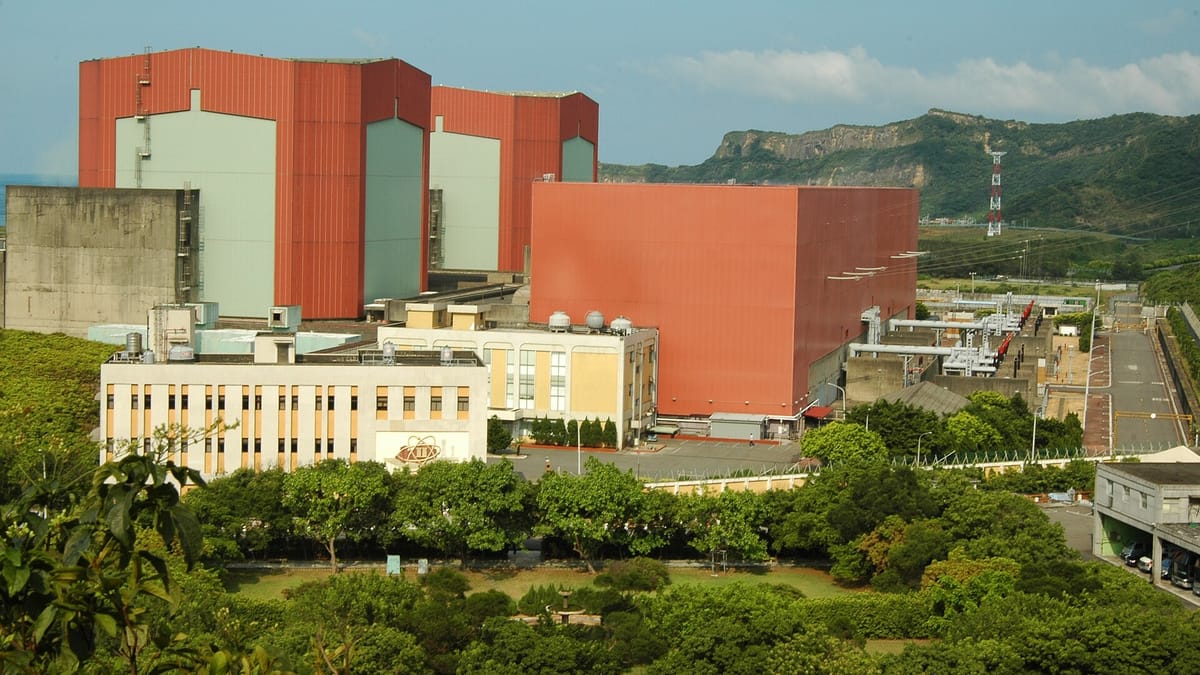
Still, the phaseout went ahead according to schedule. At Jinshan nuclear power plant, the country’s debut facility located at the northern shore of New Taipei City, the first reactor closed in 2018 and the second shuttered the following year. A 20 minute drive southeast along the coast, Guosheng nuclear power plant, Taiwan’s No. 2 facility, permanently powered down its first reactor in 2021, followed by its second in March 2023.
The third and final plant’s first reactor shut down in July 2024. The final unit went offline in May.
Shifting Politics
Known for his vehement opposition to reunification with the mainland, Lai Ching-te, who served as Tsai’s vice president, signaled on the campaign trail in 2024 an openness to keeping the nuclear plants open as a matter of national security.
Since taking office, Lai has said little about nuclear power, instead promoting alternatives such as geothermal energy, which taps into the Earth’s molten heat. But close allies have made public statements that supporters of atomic energy interpreted as subtle expressions of the president’s will.
Just before the final reactor shut down in May, Tong Zixian, the chairman of the Taiwanese electronics manufacturing giant Pegatron and a member of Lai’s national climate advisory committee, described the nuclear phase out as “contradictory to Taiwan’s progress, security and energy resilience.’
It’s a popular position with voters.
A 2024 poll by the consultancy Radiant Energy Group found that Taiwanese adults had some of the highest net support for using nuclear power out of any of the 31 countries surveyed.
Among DPP voters, 68% backed keeping existing nuclear plants open, while 30% called for a phaseout. Among KMT voters, support for nuclear came out to 94%, with just 4% opposed to continued operation of the country’s reactors.
In total, the Taiwanese public supported keeping nuclear plants going by a margin of 56% to 22%.
“What struck me was how high the support was in Taiwan,” Richard Ollington, a London-based partner at Radiant Energy Group, told me. “That’s higher than a whole number of countries that are building nuclear, let alone tearing it down.”
Yet even among supporters of nuclear power, doubts linger about how to move forward.
For Daniel Chen, a Taiwanese nuclear engineer studying for his Ph.D in Canada at Ontario Tech, the argument that atomic energy preserves his homeland’s energy security is undermined by the United States’ grip over the island’s fuel supply.
Before the U.S. agrees to work with any country on nuclear technology, that nation must first sign onto what’s known as a 123 Agreement, a special kind of treaty ultimately approved by the U.S. Senate. Most of these pacts last a set period of time, and force the partner country to forgo enriching its own fuel – part of Washington’s bid to control the proliferation of weapons.
Traditional nuclear fuel is only enriched to about 5%, while some novel types of fuel go as high as 20%. A warhead requires uranium enriched to upward of 90%. But the centrifuge machines that turn mined uranium into its fissile material can, in theory, crank up the enrichment.
From the 1960s until the 1980s, Taiwan ran a secret weapons program in hopes of building a bomb that could either help launch an invasion of the mainland or dissuade the People’s Liberation Army from landing amphibious troops on its shores. While many details remain classified, what’s known is that a high-ranking scientist working on the warhead, Chang Hsien-yi, defected to Washington and helped the Central Intelligence Agency thwart the program as a means of maintaining peace with China.
The U.S. has since maintained tight control over Taiwan’s nuclear activities. When Taiwan’s previous 123 Agreement expired in 2014, the KMT government renewed its pact with the U.S. with the only such deal that lasts in perpetuity – essentially agreeing to never enrich its own uranium or recycle its own waste. While Taiwan could, in theory, buy nuclear fuel or new reactors from France or South Korea without violating its U.S. pact, the island’s existing reactors are based on American designs. And given that Taiwan’s defense strategy counts on the U.S. to help repel any potential Chinese invasion, embracing technology to reprocess its nuclear waste risks inviting Washington’s wrath in a repeat of the CIA plot decades ago.
“From a technological perspective, Taiwan is actually capable of doing a lot of interesting and innovative things with the nuclear fuel cycle, should it want to do it and should it be willing to take risks associated with geopolitics,” Chen told me.
The current deal gives the U.S. too much control over the resource that is supposed to secure Taiwan’s sovereignty at a time when Washington’s foreign policy looks increasingly fickle and chaotic, he said.
“The strategy of Taiwan against China is essentially to hold out for as long as necessary but hopefully as shortly as possible for foreign aid to arrive. There isn’t any guarantee that foreign aid is going to arrive. There is no treaty between Taiwan and the U.S. saying that under these circumstances, the U.S. will come to Taiwan’s aid,” Chen said.
“If the U.S. isn’t feeling up to it, then the fact that they control Taiwanese energy resources is a big lever that they can pull on to stop Taiwanese political leaders from stepping out of line. I don’t like that.”
The nationwide referendum on August 23, 2025, asked voters whether they would support restoring operations at the third nuclear plant. Despite a clear majority of voters who cast ballots supporting the proposal, the share of participants fell short of what was needed for the vote to count.
The rules were clear: If 50% eligible voters didn’t turn out, the referendum was automatically invalidated, even if a majority of ballots cast were in favor of reopening the plant. A month earlier, in July, Taiwanese voters were set to go to the polls for an unprecedented series of recall elections looking to oust dozens of KMT lawmakers from office.
It was an audacious plan that could have changed the partisan balance in the unicameral Legislative Yuan. While initiated by civil society groups in response to what they said were the KMT’s attempts to weaken Taiwan and force reunification negotiations with China, the DPP backed the recalls.
As a result, DPP voters activated to vote out the opposition lawmakers may have shied away from voting in a pro-nuclear referendum organized by legislators from the party they just voted to oust from power. But that didn’t happen. The recall referendum failed to remove any KMT lawmakers, seeming to bode well for the nuclear vote the next month.
Yet the political malaise that settled over Taiwan ultimately thwarted that vote, too. Even if it had passed, the nuclear referendum would have been nonbinding, so it would’ve been up to the Lai administration to decide whether to act on the results.
“It’s been hard to not be very cynical about the referendum,” Oung said before the vote. “The problem is the referendum is quite politicized. You might have a lot of DPP people who are either nuclear-curious or straight-up pro-nuclear but they might not necessarily vote for the referendum because it’ll give a win to the KMT.”
She added: “I hope they can overcome their partisanship, but traditionally the referendums have become more and more politicized over the years.”
Taiwanese have long seen themselves as more cosmopolitan than their mainland cousins after centuries of mixing with aboriginal peoples, Japanese, Filipinos, Dutch, American and Portuguese – who gave the island its former name of Formosa. As such, they’re aware of shifts in the broader world. For anyone keeping a close eye on the war in Ukraine as a sign of how a Chinese invasion could go, it’s impossible to ignore Europe’s embrace of nuclear power as a tool for energy security. Switzerland voted to keep its four reactors online last August. Belgium just reversed its own nuclear phaseout policy. Even Germany, the world’s leading anti-nuclear nation, is now considering turning its reactors back on as energy prices crush the country’s industry. Spain, one of the few countries still scheduled to shut down its atomic power stations, is thinking twice following the great Iberian blackout in April.
Yet Yeh said the heaving grid may deliver the final blow to Taiwan’s anti-nuclear policy. If voters’ minds are changed, he said, he’s confident a major outage will force Lai to side with his advisor, Tong.
“What will it take?” he said, and sighed. “If there’s another islandwide blackout… he’ll do it very fast.”
Written by
Alexander C. Kaufman is an award-winning reporter and writer who has covered energy and climate change for more than a decade. His reporting has traversed four continents, with dispatches from the Brazilian Amazon to Greenland's ice sheet, Mongolia's frigid steppe to the Philippines' mothballed nuclear plant. A fourth-generation New Yorker, he lives in southern Brooklyn with his wife and daughter. Reach him via his website www.alexanderckaufman.com, follow him on X at @AlexCKaufman or Bluesky at @alexckaufman.bsky.social, and subscribe to his newsletter at kaufman.substack.com.
Related articles
The Taliban Won Afghanistan. Now They're Fighting Each Other
Paweł Wójcik · August 27, 2026 · 11 min read
No-One Knows How Many Have Died in Myanmar's Civil War
Evan Moloney · August 13, 2026 · 12 min read
Myanmar’s Resistance is Fracturing. Here’s What that Means
Under pressure from advancing junta troops and a growing Chinese role in the conflict, Myanmar’s many resistance groups have been increasingly at odds with each other, sparking fears the united front against the coup is starting to crumble.
Thomas van Linge · July 27, 2026 · 14 min read
Continue in
Become a Member
Members get full access to premium reporting, in-depth briefings, and subscriber-only analysis.
Insiders Receive
- Full access to all premium articles and briefings
- Exclusive subscriber-only analysis and dispatches
- Support independent conflict journalism
Signed in or already a member, but still locked? Fix an access problem
From $5/month — cancel anytime