
global
We Spoke to One of Britain's Top Generals about Drones. This is What He Had to Say.
September 21, 2026 · 42m
Transcript
Note: this transcript was generated by AI and may contain errors or inconsistencies.
So i'm here with brigadier general ed cartwright of the british armed forces brigadier general if you could please introduce yourself and kind of tell the audience a bit about who you are and what you do of course evan so first of all good evening from the uk so my name is brigadier ed cartwright and i command 16 air assault brigade combat team so i'm a
Brigade commander which is a in the british army a unit of between sort of six and seven thousand soldiers and we are the uk's high readiness land brigade and we have a basis of our global response force thank you very much and so we a bit of background for the audience we first met at a british military exercise in canada called rhino biz so during that
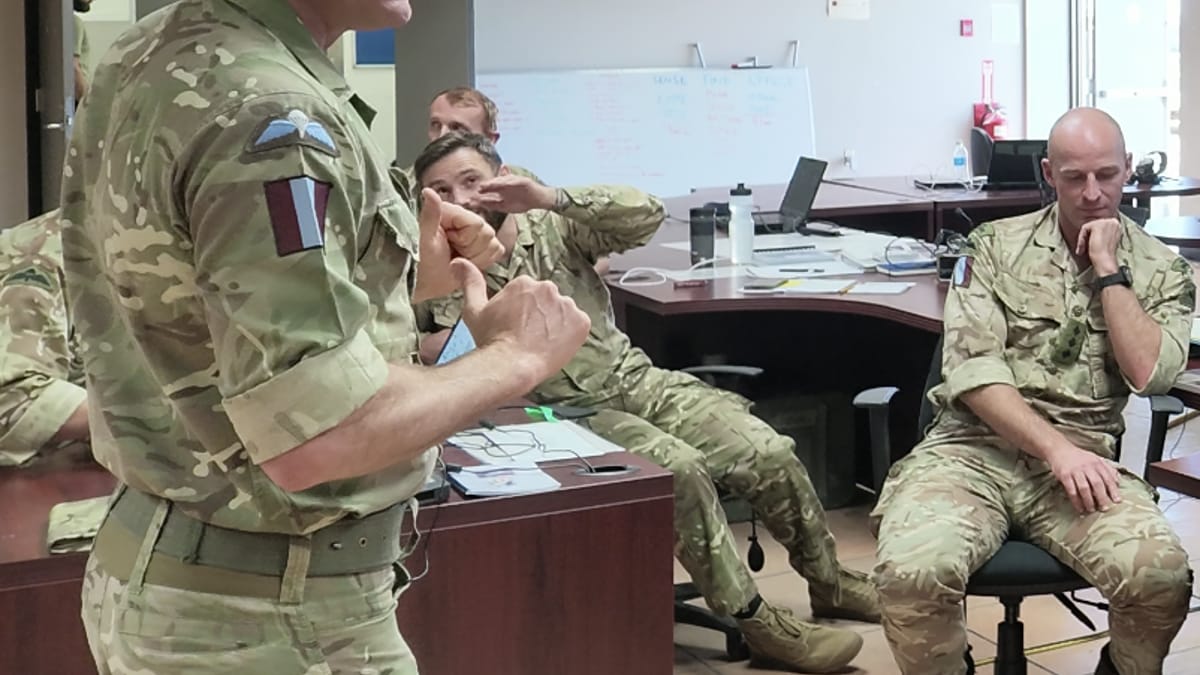
Exercise you were in command of the two narrow group kind of learning to integrate drone technology with their cardinal serving as a paratrooper force for the uk so could you speak a little bit to what that exercise was like and what it was like to be a part of that exercise hope to achieve and then what your role day-to-day was overseeing those exercises
For those forces sure so rhino biz was part of a process of learning and adapting to how we're gonna think and fight differently in an era of uncrewed systems you know clearly the advent of drones and much to its throne was uncrewed sisters more broadly and the proliferation of sensors on the battlefield are changing the sort of the character of land combat
The nature of land combat doesn't change very much it's kind of visceral it's violent it's full of friction but the character changes and drones uncrewed systems software particularly artificial intelligence they are trying those changes so rhino biz was an exercise where we took what we call a vertical slice so a bit of brigade headquarters a bit of battle
Group headquarters and then a load of battle group assets including standoff weapons support weapons like machine guns and obviously uncrewed systems to go and learn how to find those systems more effectively so a form of experimentation and trialing but those words have quite specific meanings in military terms but it's really in plain english it's about
Learning to adapt to and adopt uncrewed systems in our way of war and obviously a lot of those lessons and adaptation are drawn directly from the observations of the uk and many other nations have had looking at the war in ukraine so our listeners are probably familiar with the basics that this is a drone saturated battlefield in a way that really hadn't
Been seen anywhere on earth prior to that time and is now being proliferated to other battlefields we could talk about sahel myanmar so on and so forth looking at your involvement specifically in rhino days as you say the nature of land warfare really hasn't changed too much but the systems through which it's it's been fought are obviously maturing rapidly
And kind of evolving in different directions so can you speak to the specific sorts of technology and drone technology or otherwise that it's really really important that your soldiers are able to adapt to okay yeah so i think there are two big buckets driving change or two big buckets of change being driven by two things the first is artificial intelligence
And the way that software is changing how we fight and the second is the advent of uncrewed systems and key of the two are connected but they are sort of two distinct things and i think there are sort of you can draw from your crane three broad areas of change the first is this idea of persistent sensing or persistent observation around the battlefield
Obviously it's more than just observation it is broader senses but the persistence is what assistance of those senses what's changing i was recently talking to a very well-placed source who reckons there's about a million different sensors on the battlefield in ukraine all the time i have no idea if that number is accurate but if you add the satellite to the
Drones the ground sensors the radars you can see how it might add up to an incredible number like that and that means that so much more of the battlefield is kind of visible more of the time in whichever spectrum you're analyzing at that field whether it's on the electronic section or visually through the other drone for example so a much more and a much
More people use the word transparent it's probably the wrong word because you can't see on the ground you can't see into people's minds but no doubt there is far greater sensing across the whole battlefield so a much more visible battlefield that's going to change number one change number two is this huge increase in cheat precision so particularly in drones
And that's driving lethality up and you know the numbers as well as i do but i gather that ukraine is aiming to build something between eight and nine million fpv drones this year russia probably seven seven and a half million ukraine in the region of 50 000 crew ground vehicles and we think that's probably in the in the ballpark of around 20 000 fps being
Blown every day by the russians so incredible numbers of cheap systems that can now be masked and they've got a long range and they're pretty accurate so that kind of increasing ever cheaper precision is big change number two and big change number three is the speed of which adaptation is occurring i think the first commercially mass-produced fpv was
Produced in about march of 2023 and yet here we are talking about maybe seven to ten million being produced by each side over the next 12 months so that incredible speed of adaptation just last week i was listening to the ceo of brave one ukraine's during producing sort of conglomerates and he was saying that he thinks that next year most strikes will be
Autonomous and that is an incredible change even from where we are now so those i think are the kind of three big things that are changing persistent sensing increasing precision ever cheaper and then increasingly rapid adaptation and that's what's driving change in the land force and how we fight and that's what we were trying to get after on rhino beers
How do we as a tactical bank formation how do we adapt to that situation and let's dive in on persistent sensing because prior to the adam ball's technology and you can please correct me if i'm wrong my understanding of course is that units in the field right units kind of operating in frontline areas really don't have a ton of access to broader awareness of
The environment around them they might have the information relayed to them from a command center but they really don't have the ability to either gather information themselves or to receive high volumes of information that i have to imagine can be overwhelming can be overly noisy so what are you doing what is the british military doing to equip its
Frontline soldiers to be a able to manage that noise and see their way through a battlefield so evan there's lots there's lots in that question i mean in the last let's say ever since the second war we have been gradually aiming to absorb more information more data and share that data so you know soldiers they does have a greater more dates than they used to
Be produced and unsurprisingly but there has been a sudden increase in the amount of data that we now have available and to digress on a very quick note i was in normandy for the 82nd anniversary of d-day only a few months ago and i went to braycourt manor which as you may recall is where pete windsor's you know the character in 101st airborne and played by
Damian lewis it's where they identified the german guns that were firing on i think it was on to omaha beach and he basically sent a record patrol which he led crawled through the bushes identified the guns and then assaulted those guns so they identified a gun and assaulted it with their own hands effectively and we were still fighting like that you know
I've run record patrols on exercises and operations still using your eyes and assault your position if you if you if you see it we wouldn't do that anymore we would if we had to but we would try not to we would try and do most of that with uncrewed sensors whereas from the second world war right through to about three or four years ago we were still doing
Human reconnaissance as one of our principal means of finding the enemy systems now it is largely and not automated but it's largely conducted through uncrewed systems so that is a huge change quite quickly but what that means is you've got now a ton of data you've got to manage so to sort of to come back onto your question what we need is really good
Mission management software that enables us to sort that data identify what's important and where decisions need to be made so that is all about you got all these sensors you then need good software that integrates all that once you make decisions that's the essence of command and control is making decisions and with a ton of data you need good software to
Help you filter that data and make those decisions and we are developing that software and we're developing how you then employ that software plenty of companies making that software we're developing how you refine it to suit us and how you then actually fight it and then how ai dependent is that software how much of a space is there for humans and lube
Still oh so huge i mean there's a space practically in the sense that we don't yet have ai of that quality to make all those decisions for us and there's a space aesthetically in that we still believe that we need a human if not in the loop probably on the loop you know i think there may well come a time in the future where that's no longer felt to be well
Not i think it maybe felt to be necessary it's no longer possible because of the way our enemy fights but that's you know that's for others to debate but right now we firmly still have a human at very least on the loop if we're using force you know particularly for force obviously so there's huge space for ai we are using some ai not enough and we are
Developing the ability to employ more and more yeah you say not enough where would you like to see better ai integration in the near term so kind of taking into account where technological capabilities are right now okay so i think the obvious and i'm talking to a very taxable level the obvious example for me is as we grow more and more sensors what we need
To do is filter that data and prioritize it so i think that's where ai can play almost the most important role for me so give you an example of that if we are surveilling a let's say 100 square kilometers of battlefield and i use that number completely arbitrarily and there will be a significant number of enemy items people formations in that area i need ai
To be able to identify all of those process what they are categorize them prioritize them and help me decide how to apportion munitions to get the right and telling match that's the sort of thing which we have traditionally done through pencils and spreadsheets and we want to be done by ai but we still need at the moment we still want humans to be the ones
That are taking the decision to then cause some kind of effect particularly the next effect have you seen in your exercises as that latency time kind of shrinks down between gathering this information processing and being able to put into effect have you seen soldiers be substantially more effective kind of in a lower to lower sense but we are still in the
Flip hills of this process you know we're learning fast you were with us out in canada you know we were able to identify and target and engage it within about 12 minutes now that is not very fast but it was quite far away and we were deliberately it's the first time we've done it and we think we could do it much faster you i've heard several particular
Israelis who say you know target time can now be seven seconds and at least possibly if you've got loyalty munitions and you've got isr possibly on the same platform in position but from actually finding a target and then engaging with the systems we had as a launcher trying to do it that took a bit longer so i have seen an acceleration but we have you know
We've got some way to go i would say and thinking about the point of view of soldiers in the field there's obviously the proactive side of this where you'd like to be able to synthesize data and launch attacks and do what you need to do in a much quicker time line at the same time these are soldiers in a constantly monitored battlefield in battlefields that
Are observed at such greater penetration as you were saying than really any battlefields has been able to be surveilled prior to this point in history what impact does that have on soldiers that are learning to deal with the battlefield they're kind of always being watched does that result in really significant training changes or how does a soldier process
That environment so i think it has a huge impact on soldiers that are learning to deal with the battlefield are kind of huge impact professionally in terms of how we conduct ourselves i put some massive emphasis on camouflage concealment deception and dispersal what we call c2g2 so it means that wherever you are on the battlefield you are now vulnerable you
Are at risk and therefore your perfect your stand of your soldiering particularly in terms of camouflage concealment dispersal and deception needs to be significantly higher because it puts a premium on survivability so we have got to be more survivable everywhere on the battlefield and there's a danger that our conversation is always about people in what we
Used to call the kind of the combat zone they the combat units who are driving tanks assaulting positions flying helicopters you know this obviously applies to the depth of the battle states because drones have such greater reach both in terms of surveillance and strike and so now you have whether you are a what we used to what we still do classify as a
Combat soldier in a combat arm like i was in the parachute regiment or you might be a tank commander or whether you're a logistician a medic an engineer everybody now needs to be as survival as is humanly possible which means a fundamentally different approach to coming past concealment deception and disposal and it means you've got to have counter uas
Systems in depth to deal with both sort of quad copters and fpbs at the front but also to deal with the fixed swing observation uas a deeper in the rear so there is a now on surviving i think that's a that's quite a big shift because the way that goes not just at the front line where that's always been the case not just in the range of indirect weapon
Systems like artillery against being the case since the first world war this now goes deep into the rear hundreds of kilometers as we're learning in ukraine so i think that's a really big shift in terms of our professional conduct and then i think there's also a big sort of psychologically where people now feel at risk everywhere now you know clearly i've
Not fought in ukraine as you'd expect and the british army doesn't have experience soldiering in ukraine so i don't know yet what that feels like but i can imagine what it feels that i know what it feels like at the front being in jeopardy and so having that feeling throughout your death has a significant psychological and moral impact on your people so we
Need to prepare and train our soldiers not only to survive in on their eye literally to stop yourself getting killed but also to be able to endure that persistent threat in debt so that's about moral and psychological resilience and those are two different elements of our training that we are attending to you know in the brigade i command and in the army
That must be an incredibly difficult thing to simulate in training is over at so yes and no it's not actually that hard to simulate having drones in the sky because we've got some drones so you can stick drones up in the air and then soldiers know that wherever they are the battlefield they're being observed and you can hear and see drones so you can achieve
That effect i think it is therefore a much harder thing to do than simulate this idea of you know your life is constantly at risk particularly when you're clearly on exercise and that's certainly about using the experience of our ukrainian comrades and using the experience of what we're seeing on even on social media you know you are getting a sense of the
Battlefield there a way you never used to and we need to inoculate our soldiers to a more lethal battlefield and that is something you know we are putting support into how we'll do that using ukraine as an analogy we've seen the nation kind of disperse its drone control into these backline bunkers where people can operate either fpv drones or longer range
Drones throw a fire and keep themselves safe versus these frontline positions where soldiers are expected to operate drones and death surveillance conduct short-range strikes while also managing the moment-to-moment needs of any soldier in front my area at rhino biz we saw really elite british soldiers kind of put this to practice in the field can you speak
A bit to the way that specifically talented frontline operators need to incorporate drones into their moment-to-moment understanding of how they move through battlefield yeah so i think you know drones are now the most ubiquitous weapon system on the battlefield so if you take the conflicts in ukraine i don't know the exact numbers that i there's probably in
The region of six seven eight hundred thousand ukrainians fighting in what we call the combat zone and there's probably in the region of up to 1.6 million russians per century and those are all public you know public available figures so let's say for the sake of argument you've got a couple of million people in the combat zone so that's not just the front
Line that's the whole area those areas that are in range of their weapons systems and they are combatives so not civilians in range combatants and i just told you earlier that i think the ukrainians are going to build something like seven million drugs a year so there are now more germs than there are people therefore there are more drones than there are you
Know ak-47 clash across and there are more drones even than our artillery shells as i understand from open source the russians expected to make about three and a half million artillery next year and about seven and a half million drones just fbv drones so that is a significant shift so we have to change how we fight so to your question about how are our
Soldiers adapting to this we are having to rethink the tactics we employ and advise to offer you a characterization of how and this is a personal opinion about how i think that is changing we have traditionally educated and trained our people with the sort of organizing principle that we will see these terrain through mass and maneuver we'll concentrate
Force we'll bring together men and women armored vehicles combining fire maneuver and we will kind of break through breakout and exploit and we'll do that with some heavily protected systems that are as mobile as possible and you know highly lethal systems that was our that was our traditional model of how we fight and that is not wrong anymore but there is
A shifting emphasis towards using you know uncrewed systems to do much more of our killing through targeting so this idea of find and fire is becoming like the organizing principles around what we're doing so using the kind of sense integrate the side execute the recce strike we call it that cycle that is how we are identifying targets and striking them and
We're trying to rapidly accelerate the speed of execution so you're seeing this idea of shifting from massive maneuver towards kind of targeting as an organizing principle and we might shift again towards our autonomy and we should talk about our autonomy later but what you're seeing then is rather than privileging these things of your lethality mobility and
Protection in our systems what we need to privilege now is affordability scale and speed so you need to have stuff that's cheap there's a lot of it and it can be produced or replaced so this replacement speed really quickly because it's going to break or get used and there's a balance because you still need armor you still need indirect fire but you now need
A ton of uncrewed systems and sensors so i would say we you know we're shifting away from being organizing ourselves around these ideas of mass and maneuver lethality protection mobility towards finding fires targeting killing that range and you do that with systems that are affordable scalable and that they can be procured at great speed so that's i think
The shift that's happening and you've seen nato member militaries kind of struggle with this shift over to more expendable more traditional systems how much of a paradigm shift has it been for the units that are under your command to now shift to as you say arm is still important indirect fire is still important but ultimately the primary munition if you
Will in the battlefield is this expendable high volume of drone systems whether it's for strike or also for reconnaissance drones that are going to be lost constantly has that really been a big shift to get people's heads around no we're dealing with systems that are going to be used and thrown away and we're not sure when they'll be thrown away but we can
Assume that they're going to be thrown away and replaced constantly yeah it's a really big shift and you know as i said at the start i know i won't speak on behalf of the british army but as a british army officer our chief of general staff you know his kind of vision the way he articulates i think is very clear is in terms of how the army generates its
Combat power this idea of the total means of its destructive or destructive power that can be time that's what combat power is we think in the future about 20 of that will come from what we call our survivable systems things like tanks artillery pieces helicopters these are generally crude systems generally armored generally lethal and those are survivable
Systems that we want to use and reuse and we want to protect them that'll probably generate about 20 of our combat power and about 40 will come from our attritival systems i.e these are largely uncrewed systems which might be an observation drone or could be a dropper drone but you want to use it and you want it to come back and you want to reuse it but it's
Probably not crude it's not crude and if it gets shot down you know it's replaceable at speed my point earlier about affordability scale and speed and then the remaining 40 is of that combat power comes from what we call consumable systems which are effectively firing for game so like an fpv or a long-range missed zone drone so something which you are going
To extend and not get it back so we think that is quite a big shift because if you think only five years ago i would argue that about i don't know 90 70 percent of our fighting power or combat power rather came from those survivable systems you know our platforms our helicopters we still need those systems they're all part of this mix of combined arms
Maneuver the integrated force but there is now a shifting emphasis in what is doing the killing and it's now we call it 20 40 40. and i think that's a really clear and neat way to explain the kind of the vision the british army's got of how we think we're going to fight so often when we're presenting our content we discuss how essentially it's very different
The way that russia and ukraine have chosen to go about the idea of highly excitable war fighting but there's really no way around highly expendable war fighting if one side has chosen to fight a war in that way it's very difficult to kind of greet an opposing force that's chosen to use again these mass attributable systems to come and attack you without
Falling back to the use of massive triple systems yourself now for nato militaries and for ukraine as well we've seen such a prioritization and for all the right reasons of the lives and the safety of from my troops we've seen a very different approach to russia where you have i believe the latest assessments from the uk just last week or 500 000 russian
Soldiers killed a little bit worse than this conflict so far along with another million captured missing wounded so the uk obviously has a fairly small force size it also is a force that has a very long tradition of prioritizing well being the safety of its troops whenever possible and obviously moving into an attributable war fighting method with human
Lives is not something that the uk is willing to consider that's not necessarily the case for the uk's adversaries how do you try and cope with that difference and make up the gap that a nation like russia could achieve by throwing these young men into the meat grinder in a way that the uk certainly seems and hopefully would never even consider doing yeah
And i don't think that's new and i think it is the second world war u.s region i can't remember who it was but he sort of used to say that we're gonna fight with steel not flesh this idea of not using our humans as an extendable resource now how the russians choose to fight clearly up to them and if you're in a war with russia and they are using humans as an
Extended resource well then they will be extended because we have a pretty lethal military what we've got to do is protect our people because people are not a finite resource even in russia with 142 million people you know they are still not a finite resource and i you know i would argue western way of war from my western perspective that's no way to fight a
War because you know you'll lose your the support of your people use a moral component and you might ultimately extend all of your all of your fighting people so i would like to argue while our way of war is both more moral but also more effective because we want to use the machine to do the killing and protect the people and i think that's the way of war
That we're designing now clearly we're learning from ukraine and they have done the incredible job with the population something like 30 million now and as i said earlier probably less than a million in the combat zone they've done an incredible job of extending russian life and protecting ukrainian life and they've done that through the employment of our
Crew systems and through the creation of this idea of a death zone or gray zone and the drone wall they'd built i mean if you do the maths now and i haven't done it exactly but it's a roughly a seven eight hundred kilometer front if you take out water and the debt they call it the death zone the gray zone is probably up to 20 kilometers deep on each side so
That's an area that's something bigger than wales and smaller than scotland and those are sorry those are uk reference points but you'll know what i mean but that is a big area that there is now very little movement in and if you do move you're probably going to get struck and killed that's an incredible thing ukraine has done in order to protect their
People and we i think there are elements of the ukrainian way of war that we would want to adopt and learn from and that's an element we might do differently but the idea of preserving your people and using machines to do the killing that is the way of war that we need to get better at and this might be a perfect moment timbering in the idea of autonomy as
You mentioned earlier ukraine as you said is looking to potentially shift to overwhelmingly autonomous drone systems as soon as next year where do you see the need for expanded autonomy and in which systems at the british military disposal yeah there's five things to say i mean there was there was a media theorist i can't remember when he was writing a guy
Called marshall who wrote that we shape our tools and thereafter our tools shape us he was talking about about i'm sure he's talking about that certainly sure isn't it and i think the same is true of you know unconsistent and autonomy we've invented these sensible drones but they are now going to shape how we fight and i'm sure that autonomy is going to be
The next bound and as i mentioned you know brave one andre head cook i think he's called the ceo brave one saying that next year as many as half the strikes could be autonomous and i think that is you know that's a way of war we have to adopt and i think you can cat i heard david portray us characterize it really well recently where he sort of said there's a
World in which it is human intent which has been absorbed by llms and then processed and put into the machines it is a genetic orchestration this idea of a genetic ai will make decisions for itself and it's a genetic is going to orchestrate the employment of uncrewed systems and it's machine execution so they're going to machines are going to go forward and
Do the killing but there'll be a human on the loop you know we think and we want to keep a human on the loop for moral reasons we can debate whether or not that's going to last but this idea of human intent a genetic orchestration and machine execution i think is a really good way to describe and understand how we would like to employ autonomy and the move
As i talked about earlier that shifting emphasis these organizing principles going from massive maneuver fine and fast and into autonomy i think that's what certainly might what it will look like and obviously this technology will all become available at once so as you see these concepts coming down the pipeline where would you like to see autonomous
Capability integrated first in the role that you're sort of serving interesting well hey look i mean i'm a tactical commander so of course i'd say i can see you know the most obvious instance of the use of autonomy is in the use of lethal force against the enemy because that minimizes the risk to humans but i also look at the problem of sustaining the fight
And i can see a significant role for uncrewed autonomy in logistics because then you take a whole slice of the battlefield you know out of harm's way which i think is really important so i think those are the two kind of obvious areas for me so it's the employment relief also putting drones and munitions forward into the enemy and then it's how you then
Achieve resupply to therefore removing humans from some of those logistic roles and removing the risk that is inherent in extended resupply lines and therefore for something i had those are two areas like that you could easily see autonomy making make a huge difference and then you could probably add a third area which is around the decision the plan making
Sorry planning the decision making because that way if you can accelerate all of that then actually can get it get ahead of your enemy the old rudeness people used to say that's best for i'm sure there's a role for autonomy there so there's three areas off on my head where i think you could see in the future how do you feel the response of soldiers at this
Point as autonomy is beginning to be discussed is this something that soldiers are looking forward to incorporating or kind of reserved about i don't know i haven't had lots of deep meaningful conversations with soldiers but i think there is a there's a realization that you know the character of land warfare is changing and you know we're professional
Soldiers you want us fed in that change you want to adapt as fast as possible so i'm sat here tonight in the royal military academy sandhurst in the midst of what we call the army drone wars today is our first sort of full day or not sure today's our second full day of the army drone wars but this year is our first full army drone wars competition we've got
Teams across the army competing in competitions with uncrewed systems you know if i'm the first one i'm not going to be the first one i'm going to be the first one i'm going to be the first one and you know absolutely we can see in the future that some of these missions that are currently being blown by drone pilots you know hiding in bushes or hiding on the
Ground on joysticks could well be flown by software defined but permanent machines where you're simply plugging in a grid in the laptop or simply drawing a box on that and telling the machine to go and kill in that zone so we talk about that and we know that's coming and we want to make sure that we're as adaptable as possible i think as i to go back to my
Point at the start the three things that have changed this speed of adaptation the only way to prepare the force to deal with a battlefield that changes so fast is to be an inherently adaptable force so we recognize that we can't afford to become wedded to particular weapon systems or particular software systems we've got to be able to change all the time
Which requires real kind of agility in your people so breeding a force that is agile and adaptable is just as important as training a force that is really good at flying drones because we may not need to fly as many drones in the future because they will be autonomous so i think it's all about you know inculcating this sense of adaptability and yeah the
Abilities change fast rather than becoming wedded to a single system or whatever so let's go back to the idea of these crude armored systems because there's a big debate right now i'm sure you've consumed plenty of media on this topic about whether or not tanks are survivable and in model one for whether infantry fighting vehicles are survivable whether they
Become obsolete now that's gonna be an ongoing debate that we've posted a bit of on our old platform and we've been avid consumers of just based on your experience as a commanding officer where do you see the role for crude systems if at all these large heavy slow moving armor pieces in these battlefields of the future okay so i think we should start with
The fact that humans will still be involved at in combat and humans will still be at risk and therefore we will need armor and armor to protect humans that's the sort of start point so there is still a role for armor to protect humans we will still need to maneuver and move people at some point because you will want to seize and hold terrain now some terrain
Could possibly be held by machines in the future but particularly if terrain is occupied by civilians and that is you know that is the case in war then you need to put soldiers into those civilian communities that are being liberated to look those people in the eyes and to reassure them so there is absolutely a role for humans on the battlefield because
Remember the battlefield is not always highly contested and lethal you know war is a takes a long time over huge areas of ground so we still need protected mobility so armor of sun saw to move people into harm's way in order to achieve their mission be their mission to seize and hold terrain or be their mission to engage with and meet and reassure civilian
Populations that are being liberated and we still need crude lethality you know tanks and those sorts of things because when you are moving people they need to protect themselves and you protect yourself both with armor and with weapon systems so we still need crude lethality but we probably need to employ it in a different way back to my earlier argument we
Used you know our doctrine in some degrees is still but certainly used to be the idea of how do you mass armor people and armor in order to seize terrain exploit breakthrough and breakout and that's how you shatter the enemy's will and cohesion and that is going to be harder to do on today's battlefield so our armor needs to be more dispersed and probably
Used in smaller quantities possibly to penetrate rather than to hold and you know other friends of mine have done great work on this idea and attrition and how you can then isolate an enemy formation rather than having to simply seize it with armor so i think there's still a role to armor i think that's indisputable there is still a role for crude lethality
Things like i think they will be more dispersed and employed in smaller numbers probably over shorter periods of time than we have traditionally used them for but the balance of therefore what needs to be doing most of the killing if you like a lot of the conceptual maneuver i achieving a resistant advantage that is done by on-crew systems principally
Nowadays i would argue it's really to not just the technologies but the wars of the future for the british military the uk obviously is a reorienting toward the future of the british military and i think that's a really good point the rest of the nato alliance and kind of looking to fight future wars as i understand it and please correct me if i'm wrong in
Tandem with nato allies whether that is the united states whether it's european allies especially any future confrontation should it ever appear with russia so how much of your work with your troops and your training work with your troops is focused on the idea of the british military kind of operating on its own versus being part of a yeah and that's really
Easy you know nato is the cornerstone of our national security because we're part of a defensive alliance in europe and we envisage ourselves you know always fighting with partners you know it's a truism in life that you never want to fight alone if you can avoid it and you know we're part of a very sort of cohesive continent and we're part of a defensive
Military alliance that is nato and so we want to be part of a military coalition based around if we are to promote europe and based around nato numbers and that might be part of the joint expeditionary force which is you know not strictly part of nato but it's clearly all mostly nato nations or whether it's actually financing as part of nato we fight with
Our allies and i think it was mentioned the only thing worse than fighting with your allies is fighting on your own and so we need to be always part of alliance so then looking at the ways in which the british ground forces are being served themselves into whether it's truck line whether it's rear line whether it's these kind of larger gray zone frontline
Areas do you look at this in terms of okay so we'll be assigned territory for example that is ours we need to monitor we need to operate on as a larger coalition dictates or is it we need to cultivate specific capabilities that we can offer as part of a kind of dispersed presence across a wider front line to augment the larger coalition that's quite a hell
Of a question i think the answer is a bit of those because you know the army and deepening the air force you know we exist to offer our government choice and so we want to be as useful as possible and therefore we need to have as much as great utility as possible so whether that is as you describe holding a piece of front line or we're in defense because
Bear in mind europe was formed to defend the take the territory of the nato nation in europe so nato was formed to defend the territory of european nations and it may be that we are holding a piece of real estate forward or it may be that we're used in a more dispersed fashion as you decide as the british army we have to be able to offer the government the
Choice of using us as borderland forces which is what you know we've got elements of british army doing today or using us in response to something which is what we've got the strategic reserve accord potentially to restore the territorial integrity of a nato nation so we have to offer both our options evan we are i don't think designing ourselves as an army
Does one or the other we want to offer maximum utility this is obviously a very long list of adaptations that troops need to make can you speak to how the troops arise into the occasion because we had spoken about this a bit at lanovis and you would express then that the troops on the front lines kind of learning and taking to be situations have done a very
Good job of rocking you speak a little bit to the points of either greater tension and or then you take some more time to work out or the areas that they've done a really fantastic job adapting quickly to this distant environment yeah and it's a it's a opposite question because i'm sat here at the army drone war so i would say i mean i can only well i can
Talk about my brigade most easily obviously you know i think our units have embraced the opportunity and the potential of uncrewed systems remarkably you know we have got you know drone subunits within our within our battle groups and our logisticians our engineers our medics they're all doing incredible work in terms of how we can use uncrewed systems to
Make ourselves more survivable and more lethal and ultimately to simplify things that's what we've got to be able to do and so that's that's remarkable but look there are challenges and we have the british army has this regimental system and that regimental system creates an identity around the role and actually as uncrewed systems come on we are thinking
About well do we need the same mix of infantry engineers artillery logistics have we got that mix right in light of big changes in the character of war that's happening and we have a regimental system that slightly locks in that mix and so that's a really interesting and highly contentious subject that we need to have a really hard think about so it's hard
To re-roll soldiers once they've got a they're trained in a particular profession they've joined a particular regiment or a particular corps it's you can't just re-roll you can't say you were an infantry and now you're an air defender there's a training built to that there's an equipment built to that so that's the bit that we're finding hard is how do we
Restructure re-equip and adapt our armies fast enough for the changes that are happening on the battlefield in ukraine for example but there is no lack of war there's no lack of enthusiasm and there's no lack of purpose in that it is crystal clear why we need to adapt because we need an army that is increasingly lethal and increasingly survivable if we're to
Be sort of competitive on the contemporary battlefield and you know no army ever arrives in the perfect place you should always be improving you can always be better and that's the journey we're on as the british army and indeed as the six narrow soul brigade thank you very much and one final question because i know we're running up on time this obviously is
Such a huge adaptation and shift to make in your role as a as a commanding officer i have to imagine there must be a lot of diversions between the lessons that you were taught as you were coming up and kind of lessons that you're adapting to now as we see warfare shifts so across everything we've discussed today across autonomy across the use of uncrewed
Systems across this transition to a persistently sensed battlefield what do you wish you had either no sooner have been able to implement sooner or technology you would have sooner what do you wish you would have sooner to make the right changes to be ready for a moment like this yeah it's a great question and the answer is really obvious to me you might
Expect me to say i need more drones actually what i need is a really robust and resilient digital network because the way we want to fight is all about shifting data really fast around the battlefield so you can identify targets prioritize it and then affect it as fast as possible that requires a really robust network and by network i mean obviously the sort
Of physical hardware the radios the service stacks all that sort of stuff but also you know the data layer the transport layer the application layer all these other elements of a network that mean you can move information and make decisions and then create effects really really fast so if i could ask for one thing i would ask for a i said resilient robust
Incredibly kind of data rich huge capacity network that we can fight on that's our that's what i really need and we're in the process of developing that but it's not easy we're going to general court right thank you very much for your time and for being with us at funs.co thank you evan it's a pleasure good to talk
Free newsletter
WarFronts Weekly
A free briefing on conflict, defense, and security. Delivered Tuesdays, with the Blitz on Fridays.
Membership
Fronts Insider
Enjoy benefits with your membership including:
- Premium reporting & briefings
- Insider videos & visual analysis
- Key Insights summaries