
Is Niger the Islamic State’s New Target? And More.
Islamic State fighters are escalating attacks as Niger's junta struggles to hold the tri-border zone, and the group's center of gravity may be shifting toward Niamey. Plus the week's other stories.
Simon Whistler • August 6, 2026
Transcript
Note: this transcript was generated by AI and may contain errors or inconsistencies.
Welcome to The Briefing Room, the weekly show where we dig into the most important stories that slipped under the news media's radar. I'm Simon, and this week, many of the most overlooked stories revolve around terrifying advances made by terror groups. So, living up to their name, then.
In Niger, the Islamic State seems to be embedding itself with all the danger that implies. Meanwhile, in Kenya, a cross-border raid by Somalia's al-Shabaab may point to a growing threat in the whole nation.
Finally, away from terrorism, we'll also be covering Myanmar, where Aung San Suu Kyi has finally resurfaced years after the junta detained and disappeared her.
As always, thank you for subscribing. It's your membership that helps pay for this content, covering less-sexy geopolitical topics, as well as allowing us to cover niche stuff over on the main channel as well. And now, let's start by getting stuck into the growing threat of Islamic State.
What is it? 2015? First up, we're traveling to the embattled Sahel state of Niger, where twin threats are rising to encircle and infiltrate the nation. But this time, those twin threats aren't the Al-Qaeda-linked insurgency Janim, allying themselves with Tarek separatist groups alike in neighboring Mali.
Instead, they're two different franchises from the same globally despised organization, the Islamic State, setting their sights on Niger together. The two groups in question are the Islamic State Sahel province, referred to in this episode as Ayas Sahel, and the Islamic State West Africa province, referred to as ISWAP.
The former group, Ayas Sahel, is in its element in Niger, as well as in the two neighboring states run by military regimes that align with Niger to make up the alliance of Sahel states.
Across Niger, Mali, and Burkina Faso, ISWAP operates largely on the fringes, but it's been immensely successful in doing so.
It's been able to launch frequent mass casualty attacks on government forces and allied militias, take advantage of Janim and Tarek offensives to capture territory on the periphery, and even make its case as the Sahel's superior jihadist organization, calling out Janim and its leadership for their perceived lack of adherence to ultra-fundamentalist Islam.
ISWAP, by contrast, is active mostly in the Lake Chad basin and northern Nigeria, but the group has recently started expanding into Niger and the wider Sahel.
Unfortunately for the Nigerian government, the group has reason to believe that it might do well there given Ayas Sahel's brazen January attack on the nation's primary international airport.
ISWAP generally fights across very different sorts of territory, but it commands the fighting strength to pose a real threat to the Nigerian military, especially since Niger has to deal with Janim and other threats beyond just the Islamic State.
Quoting a PBS analysis, "...analysts warn that ISSP and ISWAP are attempting to use the Niger-Nigeria border as a bridge between the two groups, connecting two of Africa's most powerful and violent extremist groups across a wide swath of territory, a move Janim opposes." But while regional experts have been trying to sound the alarm over ISWAP's growing
Threat to Niger for months, the events of the 31st of July were a demonstration that the threat has truly arrived.
That morning, a Nigerian army unit came under attack in Niger's southeastern Diffa region, not far from the Lake Chad basin. At Diffa, an ISWAP unit managed to draw troops into an ambush, ultimately slaughtering 17 of them and wounding several others.
While the group didn't formally claim the attack, according to regional expert and Front's contributor Bran Phillip, ISWAP was almost certainly behind the assault.
But the real indicator that something might be changing came later that day when, in the country's southwest, a suspected band of ISWAP fighters attacked a different military outpost. According to Phillip, some 21 soldiers were killed in the attack, including an officer.
As the time of writing, it's not known for sure whether the two groups were able to coordinate their activities.
It's entirely possible, of course, that the ISWAP attack earlier in the day might have created panic or confusion that ISWAP just so happened to exploit or that the ISWAP and ISWAP attacks were fully distinct, carried out by groups that weren't even aware of each other. But while that's possible, it's not likely.
ISWAP and ISWAP are part of the same interconnected terror network, where the Sahel and the Lake Chad basin form the crux of Pan-African smuggling and trafficking routes and allow for freedom of movement for fighters from both groups.
The two organizations rely on the same funding and intelligence networks, they're advised and guided by the same leadership councils, and they likely share fighters and ground-level connections who fought in both groups at varying points.
In short, it's much more likely that they were aware of each other's plans and activities, either through official means or through the informal jihadi grapevine, than that they simply had no idea what the other was up to.
The news comes as ISWAP is quite clearly gaining ground across Niger, including with a June series of simultaneous attacks on Nigerian military bases in the region of Tillerberry.
There, ISWAP overran a pair of bases, killing at least 85 soldiers in total, and probably quite a few more. In those attacks, ISWAP looted the bases in question and took dozens of vehicles, along with weapons and ammunition stockpiles.
By mid-July, meanwhile, ISWAP had started a campaign in and around the city of Dosso in the southwest, where they've targeted civilians with all the fierceness that you would expect.
According to local sources, some of those attacks have left dozens dead. The Nigerian government, meanwhile, has been utterly unable to respond, even against attacks that have come during peak farming season, when Niger's scant agricultural wealth is at risk of being looted or just destroyed outright.
As of the time of writing, some 450,000 Nigerians have been internally displaced by jihadist violence, with tens of thousands of others fleeing across the border, even though the situation in Mali and Burkina Faso is hardly any better.
And speaking of Mali, the latest attacks would seem to confirm what's been an emerging divide between the Islamic State, regardless of the branch in question, and Janim.
The two groups despise each other, of course, and Janim is stronger overall, both because it's a larger force with better weapons and more vehicles, and because it counts on the supply chain. support of local populations in a way that the ultra-hardline Islamic State simply can't.
But Janim appears to be at its strongest in Mali, especially when it can work with the Tarek militias that control most of the nation's northeastern population centers.
The Islamic State, meanwhile, appears to thrive especially well in Niger, a place where Janim has success, but nothing close to what it can do in Mali. Both Janim and the Islamic State have their long-term ambitions.
Given time, troops, and finances, the two groups are likely to try and set up a caliphate in their own time, assuming that all goes according to plan.
But right now, with Janim and the Islamic State at each other's throats, each group will constrain the other at a time when each of them simply has bigger problems to handle.
With the Islamic State seeming to expand its operations in Niger as Janim continues its campaign in Mali, it's worth asking the question, what does the Sahel look like in a world where Janim and the Islamic State can each concentrate their attention on a regional government that is especially vulnerable to their influence?
For our next story today, we turn our attention to the East African nation of Kenya to discuss a recent attack by the Somali-based terrorist group al-Shabaab that could be a warning of worse things to come.
On Tuesday, the 28th of July, al-Shabaab ambushed a group of Kenyan police officers who were patrolling near Wanti Dam, a remote watering point located about six kilometers from Lafay police station along the Kenya-Somalia border.
While most Kenyans, let alone most people outside the country, wouldn't be able to find Lafay on a map, it's extremely important to the nation's security. A report submitted to Kenya's parliament just last November identified the corridor around Lafay as one of the main routes that al-Shabaab militants used to infiltrate the country.
The officers who were ambushed were members of the Special Operations Group, an elite counterterrorism unit that has previously clashed with al-Shabaab along the border. According to a police report, five officers were killed in the attack.
Reinforcements were immediately dispatched to the scene, where one armored vehicle triggered the detonation of a roadside bomb.
According to the police, while the vehicle was destroyed, no one in it was injured, which, if true, would be nothing short of a miracle. Al-Shabaab, however, have a computing version of events. They claimed that they killed 13 officers, wounded 12, and seized weapons, equipment, and a motorcycle.
The fact that al-Shabaab and the Kenyan government are reporting different numbers is almost expected at this point. Al-Shabaab has spent a decade exaggerating the number of officers that has killed in such raids because a bigger number plays better with their fighters and financiers.
On the other hand, Kenyan officials have spent nearly as long rounding casualty figures down because higher figures would make the government look weak and incapable of protecting its citizens.
More important than the numbers, however, is the reason this attack happened in the first place. Because, from the level of planning and premeditation, this doesn't seem like an opportunistic attack. The most obvious explanation is revenge.
On the 13th of July, Kenyan forces raided a suspected al-Shabaab camp near the border, killing 11 fighters. 7 and disrupting what officials said was a plan by around 30 militants to attack a nearby village two weeks later five kenyan officers were dead near the same stretch of border while this would make for a very tidy story and it is probably at least
Partly true it ain't the full picture to get the full picture we need to mention the fact that kenya has long been a target for al shabab because of its actions in somalia kenya sent troops into somalia in october 2011 following an incursion by al shabab linked militants in the dada refugee camp where they kidnapped aid workers the au and un later invited
Kenya to join the african union mission in somalia usually abbreviated as amazon and since then nairobi has been a major player in somalia's security and in response al shabab has launched multiple cross-border attacks into kenya samira gade a regional security analyst at barkis insights told al jazeera that al shabab was not trying to hold territory inside
Kenya the way it did in somalia instead it was using these cross-border attacks to quoting i hear coerce kenya into withdrawing troops from somalia by raising the domestic cost of intervention end quote now with this in mind the wanty dam ambush looks less like retaliation for one raid and more like a continuation of al shabab's broader pressure campaign
Against nairobi however while this is a compelling reason analysts at the conflict monitoring firm aklad believe that the wanty dam ambush has less to do with al shabab's broader ambitions and more to do with the recent wave of attacks by jubiland forces and somalia's denab commandos in the afmedal district that are squeezing al shabab out of territory that
It's held for a really long time to avoid being wiped out in these attacks al shabab militants are escaping toward the porous kenyan border turning the region into a secondary battleground if this is the case then things are looking much worse for nairobi because it means such attacks will become a lot more common as al shabab militants try to set up
Operational bases after losing their strongholds now it's entirely possible that the attack happened because of only one of these reasons or some combination of all three short of tracking down the actual attackers and interviewing them an extremely terrifying prospect given how unpopular the warfront team is in somalia we will never know what we do know is
That somalia is about to become a lot more dangerous at least in the short term because the u.s recently announced that it would end all financial and logistical support for the un support office in somalia or unsoss by the end of the year a decision that seems driven by washington's frustration with mogadishu's slow-moving security sector reforms and
Chronic political disputes the decision means that without an alternative source of funding the african union support and stabilization mission in somalia awesome the peacekeeping force currently in the country it's operationally unsustainable the countries that have contributed troops to the mission have requested that the un security council support the
Mission for up to two years to ensure an orderly transition of responsibilities to mogadishu however washington has said it would also oppose any further UN support to Orsum, which means the fate of the mission is currently very much up in the air.
Without an orderly transition, we might be looking at a repeat of what happened in Afghanistan when US troops pulled out in 2021 and the government collapsed. If the government in Mogadishu collapses, then what happened at Wanted Dam will become a lot more common for nations bordering Somalia and the death toll of such attacks a lot higher.
And finally, today we turn to the nation of Myanmar, where, after years out of contact with her family and her legal team, former head of state and Nobel Peace Laureate Aung San Suu Kyi has finally been confirmed alive.
But while the proof of Suu Kyi's survival was a welcome surprise for our supporters in Myanmar and beyond, it served only as a brief reprieve from the actions of a regime that still fully intends on ruling with an iron fist.
Suu Kyi has been held in state custody since her ouster in 2021 when she and her civilian government were deposed in a coup d'état by the nation's military.
Since that time, she's faced numerous charges that most of the world openly regard as illegitimate, and she's been found guilty and sentenced to a lengthy prison term.
Age 81 today, Suu Kyi's health has been the subject of intense concern across recent years, partially due to the influence of her family members who have raised concerns over heart problems, dental issues, and more.
Suu Kyi's health was questionable even prior to her incarceration, and due to the military regime's consistent refusal to provide clear, reliable proof of life, her family has repeatedly raised the concern that she may already have died in custody.
So Suu Kyi's recent meeting with a Red Cross representative came as a very positive sign, especially when a photo depicting her was released and seemed to indicate that she's in relatively good health. In the photo, Suu Kyi is standing on her own with no visible marks, lesions, or other acute cause for concern.
And the representative she met with has since confirmed that the meeting did take place, as described by Ma Ma's government.
Unfortunately, Suu Kyi was not granted a meeting with a physician during the course of the visit, and as such, she could not be evaluated by a professional. Nor was she allowed to meet with her family or her legal team.
Nonetheless, it was unlikely enough that Ma Ma's leaders would provide any proof of life, and Suu Kyi's appearance has allayed some of the concerns around her well-being, at least for now.
Broadly, the decision by the Ma Ma regime was interpreted as being in line with an ongoing effort to sanitize Napador's image, reframing a brutal military dictatorship as a civilian-led, reasonable, trustworthy international partner.
Over the last several months, both before and after military dictator Ming Aung Hwang replaced himself in a sham election to the civilian presidency, Napador claimed that Suu Kyi was moved to house arrest, albeit without providing any proof.
The government has also knocked years off her sentence, although her remaining term, approximately 13 years, signals that she is likely to die in state custody at some point.
Elsewhere, Ma Ma is engaged in limited amnesty releases of political prisoners and taken other steps to signal its willingness to comply with international pressure as it works toward reconciliation with the wider world ultimately marmar's fate will likely be decided by the association of southeast asian nations or asian a regional blog that the rest of the
World tends to follow on southeast asian affairs but like its treatment of su ki marmar's other efforts to reconcile with asian seem calibrated toward an absolute bare minimum of compliance rather than working toward genuine reconciliation within manmar itself there the nation civil war still rages with civilian killings indiscriminate bombings forced
Disappearances and extrajudicial executions all being common the government held a sham election in which it made practically no attempt to even imitate free and fair state legitimacy and cancelled its amnesty program after only a relatively small handful of releases rather than trying to allay the concerns of skeptical asian nations marma has leaned hard on
Neighboring thailand which wheels outsized influence in the bloc and can push nations to comply with my and mars wishes even when they otherwise might not in that light some experts have interpreted napador's treatment of su ki including the seemingly positive encounter with the red cross as a sign of something darker as hunter marston of the laoi institute
Explained in the new york times the visit was quote a sign that ming on hang and his government feel more confident now and can dangle this proof of life as a way to show what they're capable of end quote in other words suki's red cross visit should be read as a threat and perhaps even a death threat demonstrating that marmar's leadership is willing to use
Suki as a puppet and showing that even if mama provides proof of life it feels no obligation or burden to actually release the former head of state in fact although this is only a hypothetical example to illustrate our point it's worth considering what the government could achieve for itself if it chose to hold the red cross meeting and then summarily
Executed suki behind closed doors the move would allow mama to permanently dispose of potential threat but after establishing a precedent in which suki's family would expect to wait years for another meeting napador probably hasn't done that but it's worth emphasizing anyway to understand the full scope of what the nation's leadership is capable of this is a
Regime that has made a habit of massacring its own people with gusto and a regime that has consistently demonstrated that it is only interested in complying with other nations or with international norms and expectations when compliance will allow the regime to get away with worse at a later date sushi is alive for now but mama's regime doesn't seem to be
Going anywhere and at this point it's highly likely to outlive her thank you for watching and supporting fronts appreciate you
Related videos

Go deeper
Read the analysis on this topic
The US Has One Last Option in Iran (Opinion)
August 5, 2026
The World's Top Sudan Expert Sees No End in Sight to the War
Alex de Waal traces Sudan's collapse to the broken promises of South Sudan's secession — and warns that profit-seeking patrons and glory-hungry peacemakers have made real diplomacy impossible.
August 3, 2026
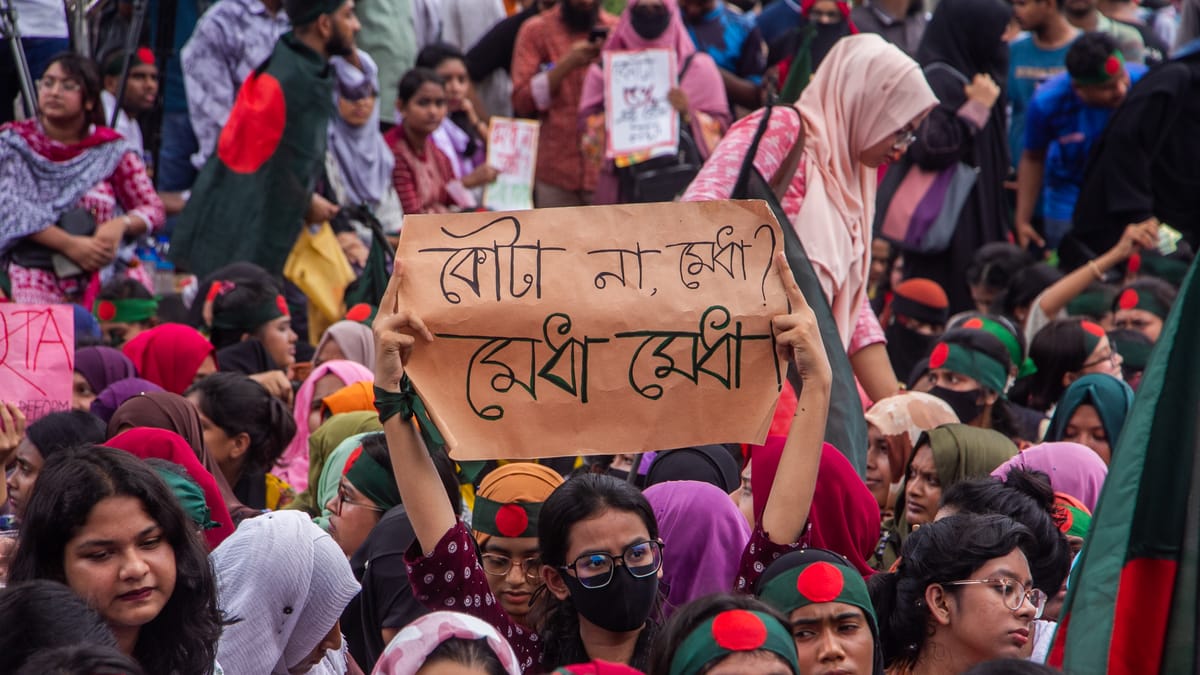
Gen-Z Revolutions are Sweeping the World. How Should the West Deal With Them?
From Nepal to Serbia, youth-led uprisings keep toppling governments without securing lasting change — and the West's Arab Spring record shows how easily outside help can make things worse.
July 30, 2026
Stay in the loop
Get the briefing that goes beyond the video
Free, no-spam analysis on the stories that matter — delivered straight to your inbox.
Prefer an account? Create a free account