
Skip to content
Fronts.co
WarFrontsSingle topic

A Warlord Is About to “Reunify” Libya.

Simon Whistler • September 7, 2026
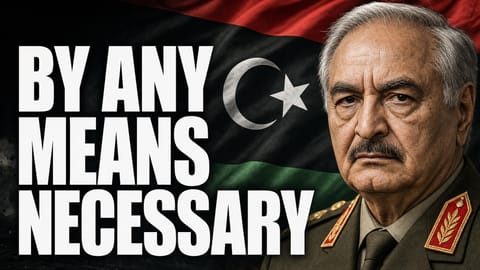
A Warlord Is About to “Reunify” Libya.

Members only

Note: this transcript was generated by AI and may contain errors or inconsistencies.

For the last 12 years, the nation of Libya has been split into two.

In the West, a fragile government rules over the city of Tripoli, received as Libya's rightful leaders by the international community, but propped up at home by militias and gangs that could turn on them in an instant. the East, a warlord named Khalifa Haftar rules with an iron fist from the city of Tobruk, where he, his son, and their inner circle control a

Shadow network of international influence.

But finally, after a years-long civil war and the standoff that came after, Libya's leaders say they're ready to come to terms.

At the end of August, representatives of both rival factions signed an agreement in Tripoli to hold nationwide elections within the next two years or sooner. The nation's institutions will be unified, its splintered leadership will find a way to work together, and after the carnage and chaos that followed the Arab Spring, Libya will finally be made whole.

But look a little closer at the push to reunify Libya, and you might spot a second plan in action hidden just below the surface.

Across the last several months, the country's breakaway government in Tobruk, the one controlled by the warlord Khalifa Haftar and his family, has seemed to be growing in power at a rate that far outpaces his rivals. The United States, Russia, Turkey, and other powerful backers all seem to be coming around to their side.

They've secured the release of an American missionary and dodged UN embargoes to gather weapons from Beijing, Ankara, and Islamabad.

And even though, on its face, this integration deal would unify the Haftar family with the other most powerful family in Libya, well, once they've shaken hands and signed a new constitution, the internal power struggles will begin and Haftar is in a perfect position to come out ahead.

There's a lot of time left for this process to play out, and hopefully for analysts like ourselves to be proven wrong. But right now, the writing is on the wall.

After 12 years divided, the world is preparing to deliver a unified Libya to Khalifa Haftar. A Tale of Two Libyans Okay, so technically Libya is divided in two.

But like all things in the Middle East and North Africa, there's an added layer of complexity that we have to account for. the West, there's the internationally recognized government in Tripoli, known as the Government of National Unity. in the East, there's the breakaway faction under Haftar, based in the city of Tobruk, named, rather strategically, the

Libyan National Army.

But each of those rival governments secures its legitimacy by relying on another faction. The Tripoli government, the Government of National Unity, relies on the High Council of State.

Basically, a legislative body that's supposed to give legitimacy to the Tripoli government, because in essence, the Tripoli government functions as a dictatorship. the East, there's a similar organization, the Libyan House of Representatives, which, through a convoluted series of events, was first elected in a horrifically low turnout election in 2014, then

Migrated to Tobruk under the control of Khalifa Haftar, and has since then existed to rubber stamp his decisions. basically, Libya has two dictators, who each enjoy a thin veil of state legitimacy from their respective, not-so-legitimate legislatures.

One Libya, two rival factions, four ruling entities. was the basis for the series of talks that led to Libya's reunification agreement, a drawn-out affair in which the so-called 4+4 group, with two representatives from each of the four ruling entities, hammered out an arrangement to bring the country back together.

The deal they ultimately reached is defined more by its endpoints than by the progress to get there: nationwide elections to identify both a new legislature and a new president within the next two years.

Those elections will follow a process to restructure the Libyan Electoral Commission, plus a series of reforms that should make the whole process a bit easier.

The UN will organize a series of dialogues, with the hope that those dialogues will help ease the two sides toward a consensus on economic issues, security, and the highly delicate matter of reconciliation.

But we're going to develop a theme in this episode: there's the above-board, globally-recognized diplomatic effort to reconcile Libya, and then there's the real process playing out behind the scenes.

To understand the latter, we've got to introduce one Mossad Boulos, a Lebanese-American businessman who's become Donald Trump's advisor on all things Middle Eastern Africa.

He also happens to be the father-in-law of the younger of Trump's two daughters, Tiffany. Boulos is the man behind Libya's new reunification deal, and he's been working on this arrangement with Washington's backing since he first brought the two sides together at a secret September 2025 meeting in Rome.

Since then, Boulos has managed to create some genuinely impressive progress between the two sides, join military exercises between their respective armed forces, and, much more impressively, Libya's first unified state budget in over a decade.

Agreed in April of this year, that budget arrangement saw the Tripoli and Tobruk governments agree on what to do with the equivalent of over US$30 billion. Boulos and his allies have also managed to shift the status quo on the way that global business is done around Libya.

Where, in the past years, world governments have engaged with one of Libya's rival governments while ostracizing the other, that situation has changed now that the global momentum seems to favor a deal where both sides of the divide are given a stake in Libya's future.

But the thing we have to really emphasize about Boulos' approach is that it prioritizes all of Libya unified under a single government more than it prioritizes building a government that would serve the Libyan people. Take the two men at the head of the Libyan factions: Khalifa Haftar, of course, but also his rival, Abdul Hamid Dubeba.

Haftar's reputation is notorious internationally, and for good reason.

He and his Libyan National Army have routinely engaged in atrocities, including severe torture of dissidents and enemy fighters, extrajudicial executions, indiscriminate attacks against civilians, and the abuse and even enslavement of migrants who travel north through Libya to reach Europe.

Dubeba, meanwhile, has also been credibly accused of the routine use of torture and extrajudicial killings, as well as the exploitation, mistreatment, and starvation of migrants, and the suspicious deaths of political opponents and journalists.

Both men and their respective insider networks are incredibly corrupt and kleptocratic, each suspected of siphoning off the equivalent of billions of US dollars over time to make themselves rich.

But the Boulos scheme doesn't even pretend to address those concerns or work toward a for Libya that Dubeba and Haftar are not a part of. Instead, this new deal would essentially unite the two men's inner circles, installing vital insiders from both groups in key positions across the Libyan government, its economy, and its military.

For example, Saddam Haftar, the most prominent son of Khalifa Haftar, would be installed to lead Libya's presidential council, despite also being the frontrunner to inherit his 82-year-old father's empire.

Dubeba's cousin, Ibrahim Minwar, is likely to take over as prime minister.

Regional expert Riccardo Fabiani of the International Crisis Group described the arrangement as a "big pact between the two families," noting that for the Libyans and the Americans, "there is a lot of money to be made upstream from more oil exploration." Or as a former senior Western official explained anonymously to the Middle East Eye, "all of the outside

Powers, including the US, have basically given up on democratic elections in Libya.

Their preference is to work with the entrenched families and carve up the goodies among the two most corrupt." Now, that's a fairly common assessment among experts on post-war Libya.

The UK's Chatham House, for example, has been warning for months that a deal like the one Boulos is pushing would simply divide the state's resources, officially, among rival actors.

Before quoting Kareem Mezran, an expert at the Atlantic Council: "In throwing its weight behind an elite accord that commands no genuine popular consent, save from those who profit directly from the status quo, Washington is making a dangerous bet." So, this deal to reunify Libya is seeming, more and more, like a deal that would actually chop up Libya's

State assets and distribute them between two rival families.

Khalifa Haftar, chosen one.

So the United States and Libya's two factions, Tripoli under De Beba and Tobruk under Haftar, appear as if they'd like to entrench the status quo instead of overturning it. As for why the US would support such a thing, well, we really can't neglect oil as a likely motivating factor, can we?

According to OPEC, Libya holds the eighth largest proven oil reserve on Earth, and already in 2026, we've seen the US take action against the other two relatively weak, fractured and internationally ostracized countries in the global oil reserve top ten: Venezuela, which holds the number one spot, and Iran, sitting at number three.

Beyond Washington's potential interest in that oil, Boulos and the broader Trump administration seem to follow a line of thinking where it's better, or at least easier, to entrench corrupt national elites than it is to try and push for Western-style reforms in other nations.

Take what Washington's done in Venezuela, or its push for elections amidst a security crisis in Haiti, or its trumpeting of a peace deal between the Congo and Rwanda, despite a very active ongoing conflict, these are just a few other examples.

But in Libya's case, this deal comes with another catch: the fact that by integrating the two rival governments, Washington can't necessarily force those governments to play nice with each Remember, this is a nation divided by more than half a decade at war, plus the following several years of deep, pervasive, and often deadly rivalry.

The De Beba government relies on the support of powerful militias across Western Libya, who tolerate De Beba's presence and enjoy the fact that he generally doesn't bother them as long as they keep him in power. But those militias have no loyalty to the Triple E government and would very easily burn the whole thing down if it were to serve their interests.

Haftar, meanwhile, is despised across much of the West, especially by the families who've kept their place in Libya's wealthy elite.

Even the Haftar and De Beba families aren't internally unified. Saddam Haftar, in particular, is his father's heir apparent, but is deep into a bitter rivalry with his brothers.

So, by making a deal between Libya's two dominant families, Washington doesn't just risk ignoring the will or the rights of Libya's people, it also risks creating a Libyan power structure where, even if they're willing to engage in nominal cooperation, these two rival sides will have their rivalries baked into the new government.

If past action tends to predict future decisions, then the logic is obvious. The De Beba and Haftar families are both extremely corrupt, and they're both ruthless in their pursuit of wealth and resources that they covet.

They have no great incentive to collaborate under this deal and raise each other up, but they do have a vested interest in each taking everything the other has, which is exactly what they've both been trying to do as they've pushed for advantages in Libya's frozen conflict.

And to be clear, the conflict isn't that frozen. In mid-August of 2026, the Haftar government confirmed that its head of military intelligence was killed in the city of Benghazi in a car bombing outside a mosque.

Publicly, the rival Tripoli government condemned the killing and decried it as an act of terrorism, although the attack's sophistication and the ability of the attackers to infiltrate Benghazi would suggest connections and access on a level that would be unusual for a third-party terror group.

But, whereas they've both been kept relatively safe because the Libyan divide basically locked each family out of each other's government apparatus, this new deal would place all of their assets and allies into a single, unified administration where everything is up for grabs.

To quote Atlantic Council expert Karim Mesram once more, "The deal's many structural contradictions will surface soon enough, and when they do, they risk bringing the whole edifice down in violence." Or as analyst Hamish Kinia told Euronews, "A new, destabilizing power struggle could soon emerge." Instead of a deal that guides Libya toward a brighter future,

This deal puts the Haftar and Debeba families into their long-awaited cage match for a knockdown, drag-out, no-holds-barred contest to see which of them gets to plunder a unified Libyan state.

And when that cage match finally begins, it seems that the United States will have already picked a winner.

Even though he comes with the aforementioned reputation of an incredibly corrupt, murderous, atrocity-prone warlord, and even though he's got long track record of working hand-in-glove with American adversaries worldwide, Khalifa Haftar appears to have Washington's backing.

In part, that decision may be thanks to a group called Ballad Partners, a lobbying firm staffed by a who's who of former Trump administration officials.

Partners enjoys deep ties to the current leadership in Washington, and according to disclosure documents reviewed by the Washington Post just this March, the lobbying group is now acting as public relations representation for Khalifa Haftar and his son.

By then, the Haftar family was already deeply involved with Mossad Boulos and the negotiations process, but Ballad Partners signed the deal before the most recent evolution in the Haftar-Washington relationship, where the Haftars have evolved from a shadow partner to an emerging White House ally.

All this, despite the fact that the U.S. has been the forum for several legal cases against the Haftar family for human rights violations.

That includes one civil lawsuit where Khalifa Haftar and Pavel Prigozhin, the son of the now-deceased Farkner Group mercenary leader Yevgeny Prigozhin, on the hook for at least $80 million of damages due to alleged war crimes.

This is a family-led regime where, according to one report from Human Rights Watch, quote, people who disagree with the Haftar clan have been unlawfully killed, arbitrarily detained, tortured, ill-treated, and forcibly displaced. But then again, perhaps it shouldn't be a surprise at all.

Haftar and his family have had a decades-long relationship with the American CIA to the extent that he and several hundred of his fighters at the time were granted U.S. citizenship and covert support in a 1990s effort to bring down Muammar Gaddafi.

As recently as the early 2020s, the Haftar family owned more than a dozen properties across the U.S. state of Virginia. this current U.S. administration, where new-generation neoconservatives and intelligence spooks appear to be covertly active from Afghanistan to the African Horn to Latin America, stands to reason that a bit of extra lobbying Greece might

Have gotten the Haftar family past its remaining obstacles.

And over the last year or so, the Haftar government has been stepping into the spotlight across the wide world of international affairs. As one example, take the release of an American missionary named Kevin Rideout, who was taken hostage by the Islamic State in the Sahel in October 2025.

According to several regional sources speaking to Reuters, Haftar was instrumental in Rideout's release, and one source from within the Haftar government even claimed that Rideout was freed by Haftar's commandos. The return of Rideout was a major gift to the U.S. government, but it's not just to Washington that Haftar's been looking to appease.

Also in August, the younger Sadam Haftar secured the release of two Russian mercenaries who'd been taken captive in 2024 by Tarek separatist rebels in Mali.

While Haftar's internal state media claimed that their return was the result of combat operations, the reality appears to have been a multi-million dollar payout. But either way, it was a major victory for Sadam Haftar, who, by the way, was thanked personally by the American missionary in a video after he was read.

Meanwhile, the Haftar family has come into possession of new weapons that, according to UN sanctions, they really shouldn't have.

In April, Reuters reported that Haftar had acquired several combat drones sourced from both China and Turkey, even though arms sales to Libya have been embargoed for many years.

That came on the heels of a $4 billion deal with Haftar in December, when Pakistan agreed to provide 16 copies of its JF-17 fighter jet, made jointly with China, and a dozen trainer aircraft that can also be fitted out as attack planes.

That airpower might not sound like much, but it's more than enough to give Haftar a categorical edge over the internationally recognized government under Debeba.

Meanwhile, satellite imagery suggests that Haftar is hard at work building or refurbishing at least 11 airports and airbases across Libya, including five that he seems to be building from scratch.

And while the Pakistani deal for Haftar and possibly those base constructions are rumored to be financed by Saudi Arabia, it's Turkey, the third member of the newly announced Mecca Mutual Defense Pact with Saudi Arabia and Pakistan, that's really evolved its position.

For a very long time, Turkey regarded Haftar as a rival and supported the internationally backed government.

In 2019, Turkey intervened directly to stop Haftar's ultimate advance on Tripoli, which appeared likely at the time to result in Haftar taking control of the nation. Recently, though, Turkey's been pushing a, quote, one Libya policy that, according to the nation's foreign minister, quote, makes no distinction between Libya's west, east, and south.

The Turkish foreign minister has met personally with both Khalifa and Saddam Haftar, as well as the other Haftar sons.

The Emirates have long supported Haftar, and they rely on Haftar's control of Libya's east to smuggle weapons and logistical support into Sudan to help the paramilitary rapid support forces. Egypt, too, has worked closely with Haftar for a while, seeing him as a bulwark against Islamist and terrorist threats to Egypt from elsewhere in Africa.

Finally, Haftar has been getting closer and closer with China, just through the procurement of drones and jets, but according to other investigative reporting, through alleged plans to provide far more significant military support to Haftar in exchange for shipments of crude oil.

At this stage in the reunification talks, Haftar appears to have the support of just about everybody with the greatest influence over Libya—the US, China, Russia, Turkey, Egypt, and the Emirates.

While other countries might look at Haftar and his son's track record, their corruption, or their incredible proclivity towards war crimes as reasons to raise an objection, none of those countries have the diplomatic clout to actually get in the way.

And once Haftar is locked into that cage match that we mentioned before, in a direct contest with the De Beba government where all of Libya's resources are up for grabs, well, the outcome is practically predetermined.

As we've mentioned before, De Beba doesn't even have the ability to directly control security in his own capital. He's got few allies outside the militias that back him up.

And in fact, it would be entirely fair to say that Haftar controls the only real military force in Libya right now, while Western Libya, Dubeba's territory is home to the majority of Libyans.

The majority of Libya's oil wealth is concentrated in the east, where the Haftar family is at its strongest.

Whereas Haftar's closest allies, including his sons, are fiercely loyal to the Tobruk government, Dubeba's allies can be bought far more easily either to secure their direct support or otherwise to encourage them to sit on the sidelines. for the man himself, Dubeba's despised across Libya for a wide variety of reasons, including, but not limited to, his

Corruption and repression, and after Haftar gains control, it'll be all too easy to run him out of town.

Or worse. for what a post-reunification Libya would look like, it's not so simple as just calling Haftar the second coming of Burba Gaddafi. one thing, Haftar is simply a very different flavor of dictator than Gaddafi ever was, and for another, he's already in his 80s.

His sons are more likely to rule Libya than he is, and even if he does get a few years, his sons are likely to undo a fair portion of his early work through power struggles of their own. a Libya under the Haftar family's control, with so much oil wealth and so little oversight, would be a nation primed to spend the next few decades under dictatorship.

Biggest difference between that situation and the Gaddafi's dictatorship of old is that now Libya's new autocrats get a sign-off from the rest of the world.

Insider access

Watch with Fronts Insider

Fronts Insiders get every video, the complete archive, and private sponsor-free playback.

Insiders Receive

  • Every WarFronts, HomeFronts, and Insider video
  • Complete sponsor-free video archive
  • Support independent conflict journalism

Already a member? Log in →

Signed in or already a member, but still locked? Fix an access problem

From $5/month — cancel anytime