
China is Preparing a Mass Mobilization. Why?
Simon Whistler • September 17, 2026
Members only
Note: this transcript was generated by AI and may contain errors or inconsistencies.
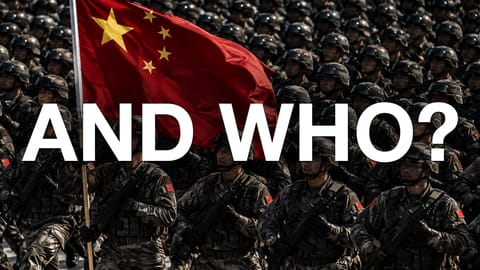
On the 1st of September, 2026, the Chinese government announced a new approach to wartime mobilization. For the first time in 16 years, Beijing decided to overhaul the law that would allow Chinese paramount leader Xi Jinping to place his country onto a war footing, basically with the press of a button.
When the new law goes into effect on the 1st of October, it'll allow Beijing to begin a total mobilization of its society, but not just to defend its own sovereignty or its territorial integrity.
Instead, Xi can rally the whole of China and harness industry, communications, energy, healthcare, the media, and the lives of its ordinary citizens to pursue the, quote, historic mission of national unification.
Those five words weren't really reported across the Western world, but they were all Xi needed to lay the legal justification for all-out war over Taiwan.
With Chinese military activity, propaganda, and geopolitical attention all escalating toward the Taiwanese government, and with Taipei struggling to win the war, the Chinese government will not be able to win the war.
Beijing's timing is hardly an accident. But, as if that weren't troubling enough, this new mobilization law goes a step further, allowing China to mobilize its society for all sorts of other missions unrelated to its own survival, potentially signaling an era of far greater Chinese military action on the global stage.
Full-Scale Mobilization For a nation at war, a full-scale mobilization of society is a last resort, and one that nations have only leveraged in the most dire scenarios.
It's an accident that requires putting the regular affairs of an entire country on hold, grinding its civilian institutions and industries to a halt, and completely disrupting the sense of normalcy that ordinary people rely on.
Large shares of the working-age population are told, not asked, to take on new roles, whether they're donning a uniform and picking up a firearm, or headed to work in munitions factories and behind the wheel of supply trucks. Not just individual factories, but entire industrial sectors are repurposed to serve the war effort.
Private property, food, and infrastructure could be taken back by the state. Transportation and energy infrastructure could be repurposed away from civilian use.
And even a nation's legal system shifts its focus from protecting the rights of individuals and organizations to ensuring that the nation and its people are leveraged to their maximum possible extent.
In the modern day, powerful countries tend to avoid full-scale mobilization whenever possible. America never even came close during the War on Terror, and Russia has managed to shift over to a war economy without mobilizing the whole of society.
Ukraine, too, has avoided a full mobilization, although the people of, say, Ethiopia during the Tigray War or Mar-Mar during the Civil War there haven't been so lucky.
But if any advanced nation on Earth were to try to mobilize for war, then China would easily be the most obvious candidate.
Generally, authoritarian states have an edge anyway when it comes to mobilization, both because they've already gotten their society accustomed to a very firm-handed approach from their government and because the government has more levers and tools of enforcement when the order comes down.
But China's social controls, even if in peacetime, are deeper and better thought-out than just about anywhere else on Earth.
From its highly standardized process to move people through its education, housing, and healthcare systems, to the normalization of mass surveillance and internet censorship, to its overt use of mandatory social tracking and compliance systems, China has built substantial infrastructure around the everyday lives of its people.
Past periods of state-enforced cultural mobilization, like the Cultural Revolution or the imposition of the one-child policy, only reinforce China's state power even further. So, what do you think?
Let us know in the comments below. Oh, it should be no surprise that ever since 2010, when China first passed its national defense mobilization law, the country has given itself full and explicit permission to monopolize the lives of its citizens in wartime.
Under the law in its original form, China enjoyed the right to mobilize all working-age men between age 18 and 60, and all working-age women between 18 and 55, to undertake so-called national defense duties as Beijing saw fit.
Individuals with special expertise, say a retired nuclear scientist or an elderly person with niche experience on a given topic of strategic importance, could be recalled without any concern for age restrictions.
Under the law, China maintains that, quote, any organization or individual has the obligation to accept being mobilized, which is, to be clear, a common expectation for full-scale mobilization in any country.
Already, China granted itself broad latitude to punish citizens, institutions, and enterprises that failed to comply or that undermined or obstructed mobilization more broadly.
But the changes that China made to its law, first and only revision of the document to cross 16 years in its effect, are all about the circumstances in which China is allowed to leverage its mobilization law.
In the past, China could only use the law, technically speaking, in response to a threat to Chinese national sovereignty, its territorial integrity, or its overall national security.
Of course, it should go without saying that, in practice, any nation may try and push the boundaries of what a law like this would allow, let alone a country like China, where those aforementioned social controls in peacetime might allow Beijing to push further and get away with more.
But the new changes allow China to mobilize, again, the whole of society, for two other reasons. Unity and development interests. Of the two, national unity is the easier addition to understand.
In short, this means Taiwan. China, now as ever, regards the island government of Taiwan as a rogue province and prioritizes reunification with Taiwan as an urgent national concern. Under Xi Jinping, Taiwanese reunification has become a bigger and bigger problem.
China, now as ever, regards the island government of Taiwan as a more salient issue, and it's been used internally to help justify massive military spending, anti-corruption purges of the military and civilian leadership, and more. Until now, however, the people of Taiwan could at least maintain some zealots of hope.
War with the islands would be very costly for China, and because China seemed unwilling to risk putting its entire society onto a war footing, there was a chance that Beijing would still back down.
Granted, there is still a chance that Beijing won't invade, but the decision to put Taiwan so squarely in the crosshairs of the national mobilization law, is an ominous signal. Then again, it might be China's other new scenario for mass mobilization that's the more interesting of the two.
According to the new law, China can mobilize in response to threats to its, quote, development interests, which is a very vague term that could, in theory, mean quite a few things.
China maintains development interests all across the world, from Asia to Latin America to Africa and beyond. And while it's not likely that China would mobilize its entire society to, let's say, protect its Peruvian deepwater mega-bomb, there are a few key development interests that China would be loathe to lose.
The most obvious among them would be the sort of infrastructure China maintains in Myanmar, where the ongoing civil war has posed a dire threat to the rare earth mines that harvest minerals for Chinese processing, maintaining China's dominance of the rare earths market, as well as a threat to China's key Indian Ocean oil pipeline, which runs across Myanmar's
Territory.
Similarly, China places major strategic emphasis on its development projects in place of places like Pakistan or Central Asia. And if we really wanted to be literal about what China might mean, we would also emphasize China's decision to name development interests rather than ongoing or completed projects.
Hypothetically speaking, China could then justify mass mobilization to acquire anything China might want to develop, whether it's, say, the estimated 11 billion barrels of untapped oil in the South China Sea, or all the minerals currently locked up in the Russian Far East, where China has been very conveniently building a case for its own territorial claim.
Beyond the new parameters in which China could order full-scale mobilization, the changes to Chinese law also grant Beijing the latitude to expropriate or confiscate civilian resources, potentially including everything from China's civilian energy supply to its high-end technology to even its water or its citizens' bank accounts.
The expectation on Beijing's end is that Chinese citizens and institutions will display absolute and unconditional compliance, similar to what's expected under China's existing counter-respionage law.
China could even use those provisions to go after foreign firms operating in China, as well as to demand direct support from the Chinese diaspora abroad, where Beijing spying and policing operations are an open secret across most of the world.
Decipher the Purpose With these specific changes to China's mobilization law, it's easy enough to narrow down the possibilities that Xi Jinping might be considering. It's substantially more difficult, however, to try and predict precisely what China wants to do.
If one thing is crystal clear at this stage, it's that China is either preparing for a major war in the near future or otherwise wants to give that impression to the rest of the world.
Suffice it to say that a legal revision this big wouldn't have been passed just by accident.
Speaking to the Taipei Times, a Taiwanese official claimed that the move is in line with Xi's focus on military dominance and his fixation on achieving reunification as soon as possible, with minimal involvement from other Indo-Pacific rivals and no or minimal Western sanctions.
If Beijing really does want to invade Taiwan in the near future, the threat of national mobilization would help to signal to countries like the U.S., Japan, or South Korea that China is serious about taking its offensive all the way.
A China that could credibly signal that it might mobilize, or even a China that chose to mobilize at the start of an invasion or even before, would show the rest of the world that they should either sit out of the conflict or be prepared to compete directly with a nation of 1.4 billion people operating a high-tech, incredibly high-volume manufacturing sector
With a massive military, a controlling power, and a large-scale military.
This is the kind of military that the Chinese would control over critical supply chains in an all-out, society-wide effort to take Taiwan. As it threatens to display that level of sheer commitment, Beijing may be hoping that it can dissuade its rivals from getting involved at all.
That's a particularly appealing way for Beijing to approach the problem right now, as the defense of Taiwan starts to look more and more like a losing battle. The U.S. and its Indo-Pacific allies are running critically low on air defense interceptors and are redeploying aircraft carriers and missile defenses away from the region.
Taiwan is struggling to seriously expand its investment into its military, and Japan, an old Chinese rival that's now openly discussing remilitarization, is still too early in its remilitarization process to actually rival China head to head.
Just as important, 2027 has long been regarded in some circles as Xi Jinping's all-important deadline for reunification. 2027 will mark one century since the founding of the People's Liberation Army, and it's the deadline Xi has set for his military to be prepared to carry out large-scale military operations.
It's also the year when Xi will try to secure a fourth consecutive term as paramount leader, a tough task considering the growing desire for change and exasperation with Xi in some parts of Beijing, but a hell of a lot easier if Xi can either tout Taiwan as a key achievement or use the bogeyman of war in the Indo-Pacific to scare up a bit more support.
That being said, there are legitimate reasons to believe that Xi isn't going to order an invasion of Taiwan, at least not in the near future.
For one thing, Taiwan will hold elections on the 28th of November on the local level, and if the nation's opposition party, the KMT, does well, then China may decide to wait for the next presidential elections in 2028. The KMT have become very close with Beijing over time, while Taiwan's current president supports rearmament as an existential priority.
If the KMT are victorious in 2028, then China may believe it can take Taiwan peacefully either by engineering a soft takeover similar to its actions in Hong Kong, with the KMT's direct support, or by playing up the threat of a ruinous invasion so that the KMT could justify capitulating with a war without a fight.
Moreover, all that talk about Xi Jinping and his 2027 fixation is just that. It's just talk, with no assurance that Xi will actually follow through on it. Between his military's enduring challenges and the impact of his constant purges of Chinese leadership, Xi may have already shot himself in the foot.
So we can't definitively say that this new law will be used, or that it was amended just to clear the way for a Taiwan invasion. But we also can't rule out that China's real priority is its development interests.
If that were true, then China's willingness to endorse the idea of national mobilization, to protect far-flung Chinese assets across the globe, could also be taken as something much deeper.
China hasn't gotten involved in a kinetic military conflict for decades now, either as a primary participant in a war, or from its position as a global power. From a strictly military perspective, that's a massive blind spot.
Chinese troops lack combat experience, its military leaders haven't had to keep control in a crisis, and on the whole the Chinese military has not been able to keep up with the current situation.
The Chinese military has not proven to be any good. It's got all the fancy new toys that a dictator could ask for, and more, but it might not have the ability to actually wage war when it counts. International Chinese deployments, however, could change that equation.
Chinese troops could play a vital role in protecting, say, China's infrastructure in Pakistan against attacks from the Pakistani Taliban, or the separatists of its impoverished Balochistan region.
They could help to stabilize crises in, say, the Middle East, or Somalia, or Mozambique, where ongoing conflicts, such as the U.S. and China's, could pose more than enough of a threat to Chinese interests to justify involvement.
They could also take on roles in Latin America and elsewhere, helping to secure these countries from organized crime and instability before their internal crises spiral out of control.
All the while, Chinese troops would gain real-world experience, engaging adversaries in combat, projecting power, and testing the strength of its command-and-control infrastructure. But that in turn raises the question of why. Why mobilize?
Why get the whole of Chinese society involved in what deployments abroad? All of these and more are questions that we're not yet able to answer. All we know for now is that China is laying the foundation for something big: either an all-out diplomatic effort to show that it would be lethal to incur China's wrath, or the decision to commit to an all-out war.
Either way, this is a development that the world simply can't take lightly, and the U.S. and its allies would do well to react as quickly as possible. Thank you for watching. you
Watch with Fronts Insider
Fronts Insiders get every video, the complete archive, and private sponsor-free playback.
Insiders Receive
- Every WarFronts, HomeFronts, and Insider video
- Complete sponsor-free video archive
- Support independent conflict journalism
Already a member? Log in →
Signed in or already a member, but still locked? Fix an access problem
From $5/month — cancel anytime