
How Costa Rica Became as Violent as Mexico
Simon Whistler • August 31, 2026
Members only
Note: this transcript was generated by AI and may contain errors or inconsistencies.
There are some comparisons in geopolitics that end up telling you lot about the country being compared. So-and-so has more oil than the Saudis. Another has higher gun ownership than the United States.
Another is almost as insufferable as the French. You get the idea. For a long time, one such comparison, when discussed in Latin America, would have been such-and-such a country is as safe as Costa Rica.
In 2026, though, the comparison is more likely to go the other way. Judging by the local homicide rate, Costa Rica is now as violent as Mexico. That's right, Mexico, one of the more violent nations in the region, one that has now been fighting cartels for decades.
A fight that Costa Rica now seems destined to join. The new president, Laura Fernandez, has promised to bring a so-called iron fist down on the cartels to restore peace to her country. with gang violence spiking across much of the region, it's an open question whether or not she can actually succeed. Mismanagement.
Now, if you were a bit surprised to see us discussing Costa Rica, we can't blame you. The country that was well known for having no army at all might not seem like it's exactly picture-perfect material for war fronts. After all, it's more associated with tropical landscapes, sloths, and backpackers who are really into ecotourism.
And it's earned that reputation in part through its own merits, but also partially because the rest of Central America looked like a basket case. The last few decades were a nightmare for the region. El Salvador went through a vicious civil war before later becoming murder capital of the world.
Honduras was wracked by gang violence both before and after a military crew. Guatemala was, well, it was Guatemala. And while Nicaragua emerged from its own civil war to eventually become relatively safe, it also became an oppressive left-wing dictatorship that no longer even bothers holding elections.
Against these neighbors, Costa Rica looked like a chilled-out paradise. They abolished their military in 1948 and spent the following years pouring money into education, healthcare, and civilian institutions, while more or less opting out of even worrying about, much less acting on, things like national defense. And for a time it paid off.
Prior to the 2020s, Costa Rica and stability were practically synonyms. Now, that's not to say that the region's drug trade didn't touch the country at all. But for many years, Costa Rica's role was basically just logistical.
Move the cocaine through, and as long as you get the whole gang violence thing to a minimum, the state wasn't going to interfere. Over the course of the 2010s, though, that balance started to become increasingly difficult to maintain.
Cocaine production in South America was rising to levels that would make Pablo Escobar blush, and that meant more blow moving north.
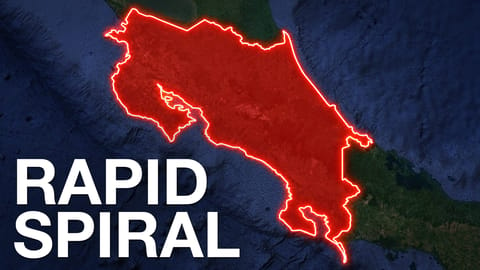
And if you look at a map, you can quickly see how that spells danger for a country like Costa Rica, a country close to Colombia with both Atlantic and Pacific coastlines, and no military or experience fighting cartels like neighboring Panama.
As the years went on, the cartels figured out that it would be cheaper, and better for business to pay their Costa Rican transit partners in cocaine rather than in cash. left locals with mounds of the stuff that they'd have to sell to locals, it was all downhill from there.
Domestic markets brought groups setting up street-by-street operations for sales, which inevitably brought crashes between them.
In other words, by the late 2010s, it was clear Costa Rica's time as a chilled paradise was coming to an end. By the time Rodrigo Chavez was elected president in 2022, the warning lights had been flashing for quite some time. Homicide numbers were increasing steadily year over year, peaking in 2023 at 906, nearly six times higher than that of El Salvador.
And that's when you know you're completely f***ed when the former murder capital of the world is looking at you and saying, wow, thank God we're not those guys. we don't want to overdo this.
While Costa Rica today has a murder rate roughly comparable with Mexico, we're still not talking total chaos. 2025 saw slightly under 17 homicides per 100,000 people. that's still high, the FBI estimates that the United States had a rate of around 4 per 100,000 last year, so it's not astronomically high.
Ecuador's dissent, by contrast, saw its murder rate leap from around 7 in 2020 to an eye-watering 51 in 2025.
So while homicides are surging in Costa Rica, things are far from apocalyptic. But that doesn't mean there's no cause for concern. For Chavez's entire presidency, Costa Rica living through violence that would have been unthinkable even a few years prior.
The overwhelming majority of these cases trace back to the drug trade, with investigators attributing nearly 70% of homicides to the industry. Part of this was out of Chavez's control.
The opening of the Moeen container terminal just outside of Limon back in 2019 opened up a huge new avenue for container traffic through which cartels could smuggle their goods to Europe.
Within a year, the State Department had designated the country as the leading point for cocaine moving out of South America, a huge shift for a little country that had spent decades largely watching the drug wars from the sidelines. While Chavez might have inherited a bad situation, his government also made a number of incredibly unhelpful decisions.
They had already lost roughly 1,300 Fuerza Publica officials between 2018 and 2023 due to financial constraints.
And during his term, they were pulled out of ports, airports, and border crossings. You know, the exact places through which the country's cocaine problem was flowing. By the end of his term, the guy who had campaigned on security above all else has had precious little to actually show for it and left one hell of a mess behind for his successor.
Whether she could clear that up is a question upon which the country's fate may now hang. Regional Playbook Despite his rather disastrous legacy, President Chavez actually remained quite popular. So, what gives?
Well, part of the answer seems to be that Chavez successfully convinced a lot of Costa Ricans that the security crisis was fighting rather than something he had exacerbated with poor decisions. already climbing before he took office in 2022, spent the next four years loudly presenting himself as the one guy trying to jumpstart a state whose resources to
Actually fight the problem were far from ideal.
Whether or not you buy that is ultimately down to you, but it wasn't all talk. One of his biggest claims to fame was pushing a mega prison modeled after El Salvador's seacock complexes.
It took a lot of time to get started, only breaking ground in January this year, but by the time the election rolled around, Reuters was finding this common sentiment in the country that Chavez's approach simply needed more time and more power to work. however, a pretty obvious weakness in that argument.
Chavez had an entire term in office to try and stop the slide. Instead, he left office with homicides still near record highs, to state that, despite some attempts at reforms, remains poorly equipped for the scale of the problem it's facing.
Still, Chavez is not the current president of Costa Rica. would be Laura Fernandez. his handpicked successor, having served as his chief of staff, whose campaign consisted of basically doubling down on Chavez's security-focused policies.
Electorally, it paid off. beat her opponent by double digits, and unlike her predecessor, she also took a majority in Congress. It's pretty clear how Fernandez intends to use this power.
She has repeatedly championed what she called a mano dura, or iron fist, to crack down on the Kangs, although she has pushed back against accusations that Costa Rica is undergoing an all-out bukeleization. be a harder sell, given that she has been pursuing policies that have a lot in common with her Salvadoran counterpart.
But while such a formulation might worry liberals, it also creates an unhelpful comparison point for those who support her approach. all, whatever you think of bukele, his approach did work.
Salvador today is safer than it's been for generations. means Fernandez, who's been in office for a bit over 100 days now, is going be under pressure to show similar results.
Yet, when you look at how the rest of the region has been handling the security approach, it's a mixed bag. Mexico, it was very much the case that the Washington-inspired kingpin strategy of decapitating Cardale leadership only made the situation worse. But Calderon was up against a different beast.
He was decapitating enormous organizations, many of which had thousands of members that presided over huge parts of the country. Given that narco-trafficking gangs aren't exactly known for their well-thought-out succession plans, the splintering, as a result, was catastrophic for the country. Ecuador, too, saw something of a similar situation.
Their criminal world for some time started and stopped with Los Gneros. leader, Jorge Luis Zambrano, was killed in 2020, the group basically split off into dozens of smaller groups.
Ackled reported that there were at least 37 active gangs last year, which continued to kill one another for territory and spoils ever since. short, El Salvador has so far been the exception. rather than the rule. And while the mega prisons get all the attention, Pekeli was also helped by the nation's specific circumstances.
He has a completely plant political class and judiciary, the overwhelming backing of Salvadorans, and importantly, was fighting gangs that have far fewer resources than the transnational cartels that control the cocaine trade.
Fernandez, meanwhile, faces a different situation in Costa Rica, one that could help make her task a little easier, or which could make it nigh on impossible. The Hanjid dealt.
If Fernandez wants to push further than Chavez did, then she's going to need a lot of manpower to back it up with, and that's one of the largest obstacles facing her administration.
When it comes to what Costa Rican authorities are actually up against, they estimate that roughly 260 separate criminal organizations are currently running around, many of whom are actively fighting rivals at any given time.
And when you take into consideration that the country is smaller than West Virginia, it really underscores just how decentralized these guys are.
And for the sake of it all, it sounds like a nightmare. There's no single organization that Fernandez can target with maximum pressure to dismantle. But the extreme nature of the decentralization here, and the tiny nature of some of these groups, could actually give San Jose a bit of an upper hand.
Many of these groups have only a few dozen members, many of whom are not Latin America's finest in terms of highly trained operatives. That doesn't make them harmless by any stretch of the imagination, but it does mean that Fernandez is facing a much weaker enemy at the individual level than that initial statistic of 260 might suggest.
So, when we come back to the gangs of a couple of dozen guys that Costa Rica is staring down, it's almost impossible to see a Mexico-style fracturing.
Whether that makes them easier to eliminate or not, however, that's another matter entirely. long as enormous quantities of cocaine continue to pass through Costa Rica, there is going to be plenty of money available for whoever decides to set up shop in the industry.
Fernandez has been pushing police recruitment higher, but even if those numbers start moving in the right direction, building a competent police and investigative force takes time, which is rather inconvenient when you're promising visible results almost immediately.
Another thing that she has going for her is considerably more political wiggle room than her last several predecessors.
Her party, which is separate from Chavez's, controls 31 out of the 57 seats in the legislative assembly, giving her the ability to pass legislation without a coalition. But honestly, that might not even be needed in the current political atmosphere.
Costa Rica needs more cops is pretty close to a consensus view at this point, with a divergence coming with what they'd actually do with them.
In the presidential election earlier this year, Fernandez's social democrat opponent, Alvaro Ramos, also ran on pretty security-centric platform.
He opposed the Bekele-style megaprison proposal and wanted to pursue policies that would include more generous spending and alternatives to the drug trade, but also championed boosting police funding and expanding conventional prison capacity to allow for more arrests. so much of the political class having come around to things needing to change, Fernandez
Has been able to reverse some of the more unusual decisions of her predecessor.
She wasted little time ordering the drug control police back into the country's airports, ports, and border crossings after Chavez pulled them out, which was in and of itself a remarkable move in a country where the security crisis revolves around cocaine moving through these exact points.
Things get more difficult once you move beyond giving the state more resources, though, especially when you look at Fernandez's fight with the judiciary.
She has repeatedly blamed judges for allowing repeat offenders back onto the streets, accused organized crime of penetrating the judicial system to the bone, and suggested that throwing more money at courts that just end up handing down bad results is pointless. Now, Costa Rica is no stranger to corruption, and Fernandez isn't simply making this stuff up.
The country has uncovered serious cases of the judiciary working with criminal groups, including the now infamous former Supreme Court magistrate and Security Minister, Kelso Gamboa, who was ultimately extradited to the United States on drug trafficking charges.
More broadly, there have also been multiple cases of judges and prosecutors being accused of tipping off gangs to raids and working with them to avoid prosecution. Where Fernandez gets onto much shakier ground is turning those cases into an indictment of the judiciary as a whole, especially because she's going to need them to oversee the coming crackdown.
The Supreme Court has basically said exactly this, telling her that if she has evidence of systematic infiltration, she needs to produce it, while also taking the opportunity to point out how many executive branch officials have themselves been caught cozying up to the gangs. Sadly, this now seems to have turned into a political fight.
Fernandez's administration is pushing for a roughly $52 million cut to the judiciary, with the OIJ, the investigative police responsible for building many parts of the organized crime cases Fernandez once prosecuted, set to take the biggest hit.
That's a big cut to any institution. But keep in mind, Costa Rica. OIJ officials are warning that the cuts would directly reduce their ability to carry out investigations against trafficking organizations at precisely the moment the government is trying to crack down on them.
And unlike hiring more cops or expanding prison capacity, there really isn't a way for Fernandez around this one. So where this leaves Costa Rica is a question mark. Their homicide rate has gone from being one of the lowest in the region to one on par with Mexico or Guatemala.
And while taking the fight to the gangs is one thing, this is now two administrations in a row that have advertised security crackdowns while simultaneously picking fights with the very institutions that are key to intercepting and disrupting cocaine shipments.
That said, Costa Rica is such an unusual case that it's very hard to say one way or the other whether Fernandez is likely to succeed or fail.
If she could take advantage of the fact that most of these groups are fragmented and individually pretty weak, then there is at least a plausible path towards something closer to the Salvadoran story, likely without the levels of mass incarceration that Bekele presides over.
But if the state ends up bogged down in infighting between the executive and the judiciary, going to send a very loud message to the region. president might talk a big game, but doesn't have much to back it up with at all.
And if that happens, then we're likely to see the killings continue and the last remnants of Costa Rica's peaceful reputation go up in smoke. Thank you for watching.
Watch with Fronts Insider
Fronts Insiders get every video, the complete archive, and private sponsor-free playback.
Insiders Receive
- Every WarFronts, HomeFronts, and Insider video
- Complete sponsor-free video archive
- Support independent conflict journalism
Already a member? Log in →
Signed in or already a member, but still locked? Fix an access problem
From $5/month — cancel anytime
