
Skip to content
Fronts.co
WarFrontsSingle topic

Is War Between Turkey and Israel Inevitable?

Simon Whistler • August 26, 2026
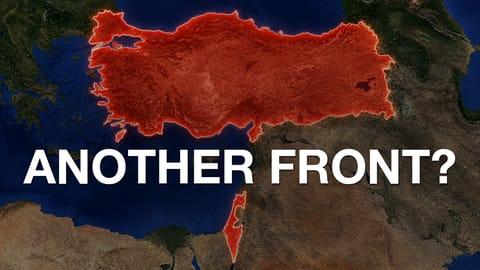
Is War Between Turkey and Israel Inevitable?

Members only

Note: this transcript was generated by AI and may contain errors or inconsistencies.

Late last month, We Are All Front ran an episode arguing that the growing hostilities between Israel and Turkey had not just reached the point of being a Cold War, but that they were increasingly risking it going hot in one very specific country, Syria. And what can we say? We did not miss.

Last week, Israel bombed the Abu al-Duhur air base in Syria over what it believed was an impending Turkish military deployment there, something that Ankara firmly denies. Regardless of who's telling the truth, the potential for escalation is hard to ignore.

Turkish forces saw Israeli aircraft heading due north, and had they determined the aircraft to be inbound toward Turkish airspace, they could have scrambled fighters to intercept them.

Both sides walked away from this incident this time, but the fact is that two of Washington's closest partners in the region are showing less restraint than ever before. And that means that a full-on military clash between Turkey and Israel may now just be a matter of time.

Toward the Precipice The Abu al-Duhur air base in Syria is, on the whole, not the type of place that typically makes international headlines.

And for good reason. It was technically operational, but only under the most generous interpretation. It sits in the eastern Idlib province, around 70 kilometers from the Turkish border, and after years of war, it was crumbling in around itself.

The runway was damaged, the buildings were falling apart. You get the idea. On August 18th, Israeli jets arrived over the base and put it out of its misery via a series of eight separate strikes.

Somewhat unusually, we actually found out about this via the U.S. ambassador to Turkey, who also serves as Washington's special envoy to Syria and several other critical positions in the region, Tom Barrack.

He posted on X, announcing that the strikes had taken place, and expressed Washington was, quote, deeply concerned that the airstrikes constitute an unnecessary escalation that does not advance regional stability, adding, al-Shara government has neither adopted a predatory posture, it has, in fact, repeatedly indicated a preference for de-escalation with

Israel.

End quote.

Netanyahu's office weighed in later that day, confirming that the strikes had taken place, and explained why. According to Jerusalem, Syria had been on the verge of violating a security status, quote, by allowing Turkish forces to deploy there.

Israeli intelligence suggested that Ankara intended to move troops, radar systems, and possibly air defense systems farther south than Jerusalem was willing to accept, and thus bombs away.

Turkey, for its part, threw its hands up and said, she said, look, man, you got the wrong guy, insisting that they were not eyeing a base there at all. Damascus weighed in on this, saying that the Turks had deployed to the base, but only to help with plans to revitalize it for the Syrian air force.

When you throw in the fact that Barack said U.S. intelligence agencies backed the Turkish version, that there was no buildup set to take place, and that Jerusalem has stood by its assessment that the threat was real, you basically get a classic, he said, she said.

Really, though, the question of whether Ankara was or was not going to set up a base is almost secondary to the actual bombing that took place.

That point raises the question of why Israel would care about this random base. even if it was in the process of being handed over to the turks to answer that you have to zoom out and look at the bigger picture israel wasn't really bombing abu al duhur because it was particularly worried about syria instead this is just the latest chapter of the cold war

Taking place between jerusalem and ankara that honestly seems to be progressing to the hot stage really bloody fast syria has the geographic tragedy of being directly between these two turkey to the north israel to the south and while under the reign of former syrian dictator bashar al assad syria was able to keep both out of the country that has not been

The case since his fall in 2024 ankara in particular has been the biggest winner from assad's ouster they were early backers of hayat tahrir al sham or hts which was the first to march into damascus and set up shop to the winner go the spoils and turkey has won itself enormous influence ever since israel meanwhile has been trying to make sure that none of

That influence results in turkish troops or military hardware showing up somewhere that could pose a threat to its security and this isn't the first time that divide turned violent either when we last covered this showdown turkey had already made clear that it was looking to set up shop in syria and israel was doing its damnedest to make sure that plan never

Got off the ground for a quick reminder we last saw fireworks here back in spring of 2025 in a similar situation turkey had been looking to get a foothold in the country at a separate syrian military bases that damascus was willing to turn over including t4 palmyra and hamar israel responded the same way by bombing the runways before the turks could arrive

In one instance just hours before they did syria of course never agreed that israel gets a veto over who it can cooperate with militarily whatever jerusalem security concerns damascus is still a sovereign government well within its right to cooperate with ankara and that's where barack's account of the tale gets considerably more concerning according to him

Turkey was not warned that israeli aircraft were coming and turkish forces saw the jets moving through syria without knowing what they were actually doing in an interview the jerusalem post he said quote turkish forces were not aware that the israeli aircraft were on route to specific syrian base nor of their intended purpose and therefore could potentially

Have been inclined to scramble their own jets in the belief that they themselves were under attack end quote so there are fundamentally two problems here israel and turkey are increasingly starting to treat each other as actual security threats and syria has become the place where that clash has most clearly shown up assessment now until recently the growing

Rivalry between israel and turkey could still be chalked up to two governments who absolutely hate each other but were mostly confined to a war of words the situation in syria was concerning for sure but neither side had much to gain from an actual clash when you take into consideration that both men are staring down elections are not looking too favorable

For them and domestic populations that can't stand each trading verbal barbs you're literally worse Hitler and you're an Islamist terrorist can be the path to boost support.

Increasingly, though, the dynamic seems to be shifting. rhetoric each side is using about the other has shifted from being what they'd like to do to largely being about what they're actually doing, with each side seeing the other's actions in the Middle East as a genuine security threat. the Israeli side, parts of its political and security establishment are

Beginning to discuss Ankara in strikingly similar language to the way that it once talked about Iran.

Naftali Bennett, a leading opposition figure in Israeli politics, has outright said that Turkey is the new Iran, full stop. ominously, Defense Minister Israel Katz warned Turkish President Erdogan not to down the same path Iran did regarding opposition to Jerusalem, warning that if it did, Ankara would meet a conflict with his country similar to the one with

The Islamic Republic.

I guess there's nothing more scary than someone threatening to lose a war with you. is very much a two-way road, by the way.

Turkish Foreign Minister Haqqan Fidan recently called Israel a burden that humanity can no longer bear, while Erdogan has reputedly described Israeli counterparts as having long since surpassed Hitler regarding their war in Gaza. are still words, though. if that was all we had, we'd basically just be able to say, hmm, politicians continue to say inflammatory

Things, exhibit A, President Trump.

But, dear viewer, do we ever really let you down like that?

Oh, no, no, no. Increasingly, those words are being said not in response to some speech from the other side, but instead actual military campaigns that one side believes to be a direct security threat to itself. such case is that of Somalia, which, despite not even being in the Middle East, finding itself dragged into this clash.

Turkey has spent years building a close military relationship with Mogadishu, and even built its largest overseas military base there to boot.

Israel, on the other hand, has been a vocal backer of the Somalilanders, who broke away from Somalia in 1991 and have run their own de facto state ever since. Jerusalem even recognized Somaliland late last year, the first nation in the world to do so, has since expanded into training Somalian security forces.

Naturally, Turkey had to respond somehow, so they doubled down on backing Somalia's territorial integrity to the extent that Ankara even backed a new breakaway state that's loyal to Mogadishu within the territory claimed by the breakaway state of Somaliland.

Ankara is also said to be planning another military facility along the Gulf of Aden. Another good example is little old Lebanon, which sits sandwiched between Syria to its north and east, along with Israel to its south, and has recently seen large swaths of its southern territory occupied by Israeli forces.

In June, Erdogan explicitly said that Israeli operations in Lebanon, along with Syria, had reached the point where they threatened Turkey's security, arguing that a permanently weakened Lebanon would leave Israel increasingly playing the role of hegemon across the Middle East.

Ankara seems willing to put some actual muscle behind this. UNIFIL, the peacekeeping mission originally set up in 1978 to keep southern Lebanon demilitarized, but which, for 48 years later presides over a demilitarized zone with more rockets than some NATO members set to expire soon, Turkey has openly floated the idea of stepping in to fill the gap.

And, well, you know, actually delivering this time around.

Erdogan has repeatedly pitched this directly to Lebanese President Joseph Oun, while also promising additional military assistance. Beirut wouldn't even actually have to accept that offer to make Jerusalem nervous. Just flirting with the idea of an expanded Turkish presence in Lebanon would be seen as a direct threat to Israel.

And we've not even touched on other flashpoints like Turkey's increasing alignment with the emerging bloc headed by Saudi Arabia, Pakistan, and Egypt, while Israel increasingly aligns itself with an opposing bloc headed by the UAE. In short, this isn't just talk anymore.

These divisions are going to play themselves out across the Middle East and beyond in the months to come.

But all of it keeps coming back to one country that just can't catch a break. All about Syria There's more than just geography as to why Syria is so central to this showdown. Increasingly, Ankara and Jerusalem seem to have wildly different views about what Syria itself should actually look like.

And for Israel in particular, that's tied to the security doctrine that it's been pursuing post-October 7. In the years before the 2023 attack, Jerusalem tolerated, very unhappily but still tolerated, hostile forces existing around the Jewish state. This was mostly out of a lack of alternatives.

But Hamas, Hezbollah, and Ba'athist Syria nevertheless carried on all around Israel. in spite of many Israeli interventions, it seemed pretty clear that none of them were going anywhere. It's genuinely difficult to overstate how much October 7th upended that old order.

Ever since, Israel has increasingly operated on the basis that it simply cannot allow another hostile force to exist along its border full stop.

And it's made good on that through the numerous, numerous other conflicts that Jerusalem has been bogged down in since. When Assad fell in late 2024, Israeli troops moved in quite literally the same day. The occupation area was admittedly tiny, but it does go to show that they were not waiting around.

Later reporting from the Washington Post also showed that Jerusalem began backing militias in Saweda, the home of Syria's Druze minority, shortly thereafter.

That investigation, largely sourced to past and present Israeli officials, claimed that Jerusalem covertly armed Druze militias with all sorts of explosive goodies, which expanded to even monthly payments to some 3,000 fighters. Those officials were crystal clear on their intentions, too.

According to the Post, this was part of an effort to weaken the country's national cohesion and thus complicate Shiraz efforts to unify the country after its long civil war. Now, to be fair, there is a sizable Druze population living with Israel as well, who do have a deep loyalty their brethren across the border. And they're active on this, too.

When reports emerged of the massacre of some 1,700 people in Saweda, many of whom were civilians, Israeli Druze actually stormed Syrian border to go to help. So this wasn't exclusively a cynical divide and conquer scheme, it also does not erase the broader strategic benefit Israel gets from keeping southern Syria outside of Damascus' control.

Meanwhile, Ankara has been doing its own thing, including helping the new Syrian government defeat Kurdish forces in the field and compel them to sign up with the national army.

And it's probably worth mentioning that, unlike the Israeli intervention, Turkey's moves have been at the invitation of the Syrian government.

This always deserves a heavy asterisk, given that Shara has never won an election before, so he can't exactly describe him as a tribune of the people. was a controversial figure from the outset, too, given that he spent years as a senior operative in al-Qaeda, first in Iraq and then Syria via their offshoot Jabhat al-Nusra.

He did, however, break with al-Qaeda nearly a decade ago and has spent the years since trying to turn HDS into more of a Syrian-focused political and military movement. not that transformation is completely genuine is a legitimate question to ask, but he is the head of the internationally recognized government of Syria, and the international community has

Been moving full speed ahead with normalization of ties with Damascus.

Just yesterday, the United States removed Syria from the list of state sponsors of terrorism, where it had remained for nearly 50 years. But whether not Turkey has been invited in, this, by definition, puts Jerusalem on a direct collision course with Ankara.

Turkey's entire role in Syria can more or less be summed up by pursuing the complete opposite of Israel's goals.

They're pushing for an integrated, unified, and centralized Syria run out of Damascus, not various semi-autonomous regions largely broken down by ethnicity. They've had a fair amount of success on this front, too.

From the outset of Shiraz government, they pushed hard for integration of the Syrian Democratic Forces, the Kurdish-led U.S.-backed force that had long controlled much of northeastern Syria.

Ankara has always viewed the SDF's main Kurdish militia as effectively an extension of the PKK, which fought the Turkish state for decades before finally disbanding last year, and has been dead set against allowing a semi-autonomous Kurdish military zone to survive along its southern border.

Ankara's policy has always been one state, one army, with numerous Turkish officials saying there was no other option than integration.

Ankara has also taken a more active role in helping to train Syrian forces, advising Damascus on rebuilding the armed forces along with other institutions that are currently shells of their former selves after the decade-plus of civil war.

More generally, they've been helping their new Syrian friends put together something that can pass as a real military rather than a post-Civil War band of rebels with hastily printed ID cards. The views for Syria's future, held between Israel and Turkey, are fundamentally incompatible.

You simply cannot have a strong centralized government in Damascus, and a loose federation with the Kurds doing their own thing, and Soweda barely even a part of the country.

And that's why, on top of all the other conflicts that the two are currently sparring over, is the epicenter of it all and where one mishap could spark a serious military clash for now both sides still have plenty of reasons to avoid that outcome so we're not predicting israeli jets over istanbul tomorrow or anything like that while erdogan would never admit

It he has precious little to gain from an all-out war or even a sustained back-and-forth exchange with israel turkey has a huge military on paper and a damn good arms manufacturing sector to back it up with but it still lacks israel's long-range strike capacity air defense systems and stealth aircraft all of which ankara knows would be ruinous in a serious

War israel meanwhile might be slightly better equipped and their f-35s from uncle sam would certainly help them against turkey's f-16s but as we've described they're also bogged down in a myriad of conflicts themselves and have been going on for three years now the country is a tiny fraction of the size of turkey and has been relying heavily on reservists so

Adding a war with the second largest military in nato whilst still in a state of unresolved war with iran lebanon and gaza isn't exactly a bright idea the issue with that though is just how temporary it is israel ostensibly isn't going to permanently be bogged down in this many fights and turkey's punching way above its weight in both drones and

Counter-drone technology something that will only ramp up with time and something that has proven to be a struggle for israel all that is why danny citronovitz a former head of the iran branch and israeli military intelligence and a current researcher at israel's inss think tank has gone considerably further than just warning about a deterioration of

Relations given the way things are going an all-out military clash between israel and turkey is in his view now imminent if not inevitable is he right well we can't say for sure nations that have seemed on the brink of war in bygone eras have pulled back or even become friends remember that as late as the 1930s the us was planning for war with great britain

And what was the cold war in the end if not a decades-long exercise in restraint by both the us and the ussr but would also be foolish to write off the possibility of armed conflict between israel and turkey in the new middle east multiple powers are hoping to become the local hegemon and two of them right now are convinced that the other having their way in

Syria would be an existential threat one that would have to be responded to with unrelenting force

Insider access

Watch with Fronts Insider

Fronts Insiders get every video, the complete archive, and private sponsor-free playback.

Insiders Receive

  • Every WarFronts, HomeFronts, and Insider video
  • Complete sponsor-free video archive
  • Support independent conflict journalism

Already a member? Log in →

Signed in or already a member, but still locked? Fix an access problem

From $5/month — cancel anytime