
Just How Weak are the Taliban?
Simon Whistler • August 27, 2026
Members only
Note: this transcript was generated by AI and may contain errors or inconsistencies.
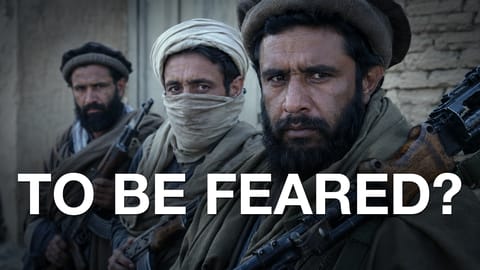
For a group that managed to kick the United States of America out of their territory, it's a little bit surprising that the Afghan Taliban aren't stronger. years after the fall of Kabul, the ruling Taliban government is in rough shape, but its military is in complete shambles.
Rusted Soviet hand-me-downs, captured American hardware that they can't maintain, and a near-complete lack of international partners who are willing to help.
We can forgive landlocked Afghanistan, of course, for not having a proper navy, but this is a military without air defenses, without any meaningful logistics, and with no ability to project power across its own territory.
Put the Taliban into any conventional fight against any conventional military larger than tiny Uruguay, and they're going to have a serious problem surviving. In 2026, the Afghan Taliban are under threat from all directions.
Parallel factions of freedom fighters are gaining strength in the north and the south, while the Islamic State sharpens its fangs, and some of the Taliban's own commanders contemplate going rogue.
Neighboring Pakistan has proved again and again and again that it can treat Afghan airspace as an open door. it's time that we take a closer look at the Taliban military, and get a sense of just how weak they really are, so that we can ask the more important question. How the hell have these guys kept control?
Taliban Now, at the top of today's episode, we've got to give a couple of key caveats about the subject matter that we're going to discuss.
First things first, today's episode is going to be mostly about the Taliban itself, instead of the many groups inside and outside of Afghanistan that are trying to dethrone them. If you'd like to know more about the Taliban's enemies, we've published two recent episodes on that very subject.
The Taliban are losing control of Afghanistan, which is about the most recent threat to Taliban rule, and Afghanistan is turning against the Taliban, about all of the myriad organizations that want to bring the Taliban down.
If you'd like to know more about the subject, we'll link to those episodes in the description below.
Second, and just as important for today's purposes, we should emphasize that the Afghan Taliban does not supply an accurate, externally verified count of its weapon stocks, its military capabilities, or its anticipated imports and exports on the global arms market. you ask the Taliban, then the Taliban military is, of course, very strong, with
State-of-the-art equipment and world-class strategy and tactics. we're not just speaking in hyperbole, either.
During the last few times that tensions have flared between Afghanistan and Pakistan, Taliban have claimed that their, quote, air force had launched strikes on Pakistan. practice, though, it seems that most of the times they've made that claim, they hadn't actually done anything at all.
And when they had, they'd just launched a kamikaze drone or two across the mostly empty areas of the Pakistan border.
So, for the rest of this episode, please bear in mind that we will not be taking the Taliban at their word, and instead, we'll be relying on a combination of reliable reporting by foreign bureaus, open source intelligence analysis and observable instances where the Taliban have bought or sold equipment or demonstrated their capabilities directly. judging by
All available credible sources, the Afghan Taliban military is shambolic. start with a simple question of size, where although it's impossible to get the exact count of the population living in Afghanistan at any given time, the nation is estimated to be home to some 40 to 45 million people.
The Afghan armed forces, meanwhile, under Taliban rule, well, those comprise an estimated 150,000 to 170,000 troops, depending on the estimate you go by.
Again, this is one of those situations where we really shouldn't take the Taliban's word for it. But although that military isn't terribly small on the raw numbers, similar to the active duty numbers for Italy, Taiwan, Israel, or Poland, for example, and significantly more than the UK or Spain, those other militaries have a very important edge.
They can outfit their troops with solid equipment, vehicles, aircraft, and the other support they'd need to actually be effective.
Taliban, however, yeah, not so much. The Afghan army is actually the strongest of Afghanistan's armed forces, and after the US withdrawal in 2021, the Taliban got their hands on some very impressive American hardware.
In fact, just about all of the US equipment supplied to the Afghan National Army ended up in the Taliban's hands, including the vast majority of small arms, utility vehicles, and other hardware that was procured in massive numbers before being distributed across the country.
Those include M4 and M16 rifles, M2 machine guns, night vision goggles, radios, Humvees, mine-resistant armored vehicles, and more. According to an analysis by the US Department of Defense in 2022, over 40,000 military vehicles and more than 300,000 weapons were ultimately left behind.
The really advanced or high-powered staff, like the fighter jets, tanks, and other armored hardware, was moved out, but the rest just couldn't be recovered in time.
That equipment is paired with the pre-Taliban Afghan National Army's other warfighting stock, including Soviet-era main battle tanks and infantry fighting vehicles, mortars and field artillery, at least one adorable copy of an Italian tankette, the pre-World War II L335, seen in operation with the Taliban as recently as 2022. Pre-World War II.
But those military assets, especially the bigger and more expensive pieces, are breaking down.
The Taliban captured lots and lots of equipment that the US would rather have kept safe, but what they didn't capture was access to the endless supply of replacement parts and updates from America's military-industrial complex.
When, for example, an American soldier in Afghanistan wore out a Humvee till it broke down, they could count on that Humvee being refurbished. New ball joints and axle shafts for the suspension, on rough mountain terrain, or new brake pads, batteries, and other key equipment that tended to wear out especially quickly.
Every replacement part put the vehicle back in service, but the Taliban don't have that option. Every time the air fighters get in a Humvee and take it for a joyride, they're running down the miles and the minutes until it needs to be fixed. The Taliban can fix that Humvee.
They can cannibalize replacement parts for another vehicle and leave their other vehicle useless but they can only keep on going for so long until there just aren't enough replacement parts to sustain an army-sized humvee fleet now repeat that process with everything the u.s lost to the taliban in 2021 from the guns to the radios to even the mres and as for
The taliban's burn rate the sheer speed with which the taliban seems to have run through their spare equipment well we've got to adjust for lots of celebration and partying after the u.s withdrew then several years of fighting overlapping insurgencies across the country plus the fact that the taliban aren't really known for their mastery of military
Logistics and supply chains they also seem to have sold some of their hardware on the black market as early as 2022 perhaps failing to anticipate just how hard it would be to replace those weapons later in effect afghanistan does still have some heavier fighting equipment and even some american hardware but the precise number is always in flux consistently
Shrinking and probably not even a number that the taliban are able to keep track of when the taliban have had to fight especially in border confrontations against pakistan they've been able to move handfuls of those soviet tanks to the front lines and drive in mixed convoys of hunvees and pickups toward the combat zone it's a similar situation when they've
Had to rush reinforcements to areas where insurgents are active like they did in the north this summer when a tajik taliban commander went rogue but in both cases it appears the taliban can only use their more modern equipment in relatively small numbers or for relatively limited periods of time and once they arrive at the fight well they seem to be the very
Same taliban as ever small arms handheld explosives very limited body armor and a dream in the air the situation is even worse maintaining say a humvee is already a frustrating task just ask any of the u.s or coalition troops who were saddled with mechanic duty during the war but maintaining an aircraft is a whole different story both because of the sheer
Complexity of the systems involved and because of the sky high stakes in the event that something does go wrong as of the time of writing afghanistan has only been confirmed to fly one fixed wing combat aircraft since the taliban takeover a copy of the light attack propeller plane called the super tacano on the outside it's got more in common with a world
War ii fighter than anything you'd find in a 21st century arsenal and it's one of several that were in afghanistan prior to the fall of kabul in 2024 pakistan claimed to shoot down a super tacano although it's unclear or whether there may have been others in decent condition in the taliban arsenal several other super tacanos were flown out during the
Takeover along with modified cessnas known as combat caravans although a couple of combat caravans are rumored to still be in afghanistan in maybe flyable maybe not flyable condition though taliban issued images showed one of the planes flying as recently as last year the organization has also flown some of the helicopters the u.s left behind including black
Hawk helicopters although there's video of one of those helicopters tumbling out of the sky in spectacular fashion again these are thought to have been targeted by pakistan during the recent conflict so not only is it unclear whether any of them are in maintainable shape but it's also unclear clear how many of them have or haven't been blown up.
And speaking of blowing them up, at least one Taliban chopper is known to have been shot out of the sky this summer when a trio of the craft raced toward a northern mining town to try and deal with that rogue Tajik commander that we mentioned a moment ago.
Alongside American helicopters, Afghanistan flies a couple of Soviet-era models, which it seems to have a much easier time refurbishing.
Big thanks to Moscow for that one. Several others, however, were smuggled out of the country before the Taliban could get to them, including four Soviet attack helicopters that ended up in Arizona in late 2021.
What the Taliban has is mostly not fit for any operation more complex than just dropping barrel bombs out the side or shooting small arms from a higher vantage point.
But in asymmetric guerrilla battles in the Afghan countryside, we'd rather be the guy who has a helicopter than the guy who doesn't. Unfortunately for the Taliban, that's basically the extent of their combat arsenal. But that means it's time to ask a question.
How in the world have the Taliban managed to keep control of Afghanistan if that's all they have? A matter of relativity. So why does the Taliban still control Afghanistan if it's got virtually no state-level fighting ability to its name?
And to be clear, the situation we've described includes basically no combat capacity at all on par with any other nation state that attempts to build a meaningful military. Although they technically possess helicopters and tanks, the Taliban haven't graduated from an insurgent-level fighting force.
A really big one, fair enough, but still an asymmetric, unconventional insurgency.
Even countries like Iran or North Korea, crippled by many decades of sanctions, have a hell of a lot more than the Taliban. And what so many tiny militaries of the world lack in numbers they make up for with equipment that puts the Taliban to shame.
But the most important secret to the Taliban's success is that those comparisons do not actually matter as long as the group can pick its battles carefully.
They don't need to be strong on paper, or at least not exactly, as long as they can be stronger than whoever they're fighting. And in the vast majority of cases, the Taliban still manage to meet that benchmark.
All of their internal enemies, from the freedom fighters to the splinter groups to the Islamic state, are asymmetric guerrilla groups that rely on small units equipped with small arms.
The Taliban also rely on asymmetric guerrillas equipped with small arms, but instead of fighting in small units, they fight in large units, or at the very least, larger than their adversaries. 150,000 to 170,000 ragtag militants may not be a head-to-head threat against, say, the US or China.
But most of the time, 150 to 170,000 militants will beat 1,000 militants on the opposite side, or even 10,000. Even when Afghanistan does occasionally face a more powerful enemy like Pakistan, they do alright because they pick their battles.
They don't provoke Pakistan enough to face a full-scale invasion, and they certainly don't attempt a full frontal assault on Pakistani territory.
Instead, they do their best to stick to the border zones where they can take advantage of terrain, confusion, fog of war to fight battles relatively close to their own terms and when the taliban do get to fight an asymmetric conflict they're actually very good at what they do remember these are the same guys who spent 20 years fighting a western coalition
Whose fathers fought the soviets when they're fighting a guerrilla they are fully in their element and even their guerrilla adversaries struggle to compete the worst thing you could do against the taliban as an insurgent faction within afghanistan would be to mass your fighters gather heavy equipment or try to capture and hold villages do that and you are
Inviting a nationwide army of over a hundred thousand guerrillas to do exactly what they do best running circles around you and picking you off till they win even worse they've built a robust secret police system that works extensively with local informants meaning that they'll notice quickly when you start causing problems and they'll be there to stop you
Much sooner than you might expect moreover it's not as simple as to say that the taliban just haven't built up their military they haven't focused on expanding their conventional military other than picking up refurbishment contracts with russia to keep their existing hardware running but they have worked with the russians as well as unofficial partners and
Black market sellers to invest in the kinds of technology that will make their asymmetric style all the more effective they've invested in the refurbishment of tens of thousands of assault rifles sidearms carbines and sniper rifles as well as heavy machine guns and anti-aircraft guns all of which can be widely distributed and easily transported by small
Bands of fighters it's very much old-school taliban style they've also sought to accumulate rocket-propelled grenades and guided anti-tank missiles as well as shoulder-fired air defenses to shoot down low-flying aircraft finally they've gotten surprisingly proficient in the use of drones including quadcopters and other small models for reconnaissance as well
As small medium and even long-range kamikaze drones the group was experimenting with explosive drone technology even before the fall of kabul but during the war against pakistan they revealed that they could fly what appear to be china-made one-way attack drones with wingspans of up to two meters those drones seem to be assembled locally using largely
Commercial sources so the afghan taliban still haven't even started the process really of growing up and evolving into a nation-state military force but their tactics their procurement decisions and their wish list for foreign partners like russia all indicate that they aren't really trying to evolve either instead the taliban are so militarily weak because
They've almost got a peter pan quality about them a boy who never chose to grow up the taliban would have a very hard time squeezing their way through international sanctions and picking up sophisticated military hardware no matter how hard they tried but they haven't tried instead they seem to have decided what they think they're good at and they seem to be
Trying to make those same guerrilla tactics work for them as long as possible of course there's a reason that other global militaries don't do that and more and more it's seeming as if the taliban might be about to find out why they're the only national military on Earth that's chosen to follow this path.
Watch with Fronts Insider
Fronts Insiders get every video, the complete archive, and private sponsor-free playback.
Insiders Receive
- Every WarFronts, HomeFronts, and Insider video
- Complete sponsor-free video archive
- Support independent conflict journalism
Already a member? Log in →
Signed in or already a member, but still locked? Fix an access problem
From $5/month — cancel anytime
