
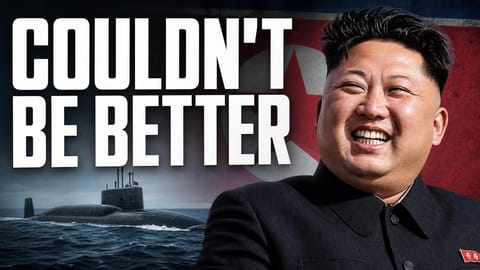
North Korea is Having a GREAT 2026
Simon Whistler • September 17, 2026
Members only
Note: this transcript was generated by AI and may contain errors or inconsistencies.
For the great mass of people, 2026 has been one of those years. A year in which nations or blocs like Iran, Venezuela, Greenland, Yemen, the Gulf States, Lebanon, the USA, Canada, the EU, Israel, Afghanistan, Pakistan, Russia, and Ukraine have all faced attacks, threats, tariffs, crumbling alliances, or simply watched their war plans blow up in their faces.
But you know who is having a great year?
North Korea. By its own standards, Pyongyang is booming. The capital is transforming, the whole nation is enjoying its third straight year of economic expansion, Trump is cancelling military exercises with the DPRK's old foe, South Korea, and Russia is funnelling the regime money and technology in return for weapons and troops.
In short, 2026 is a great year to be Kim Jong-un. But while we wish the residents of North Korea well, such a banner year for the regime raises a whole other set of concerns. Because what's positive Pyongyang may wind up being a disaster.
For the rest of the world. Lights on. Back when COVID was ramping up, six and a half years ago, Jesus Christ, I feel old.
North Korea followed a similar path to the rest of the world. They locked down, cut international travel, and so on. Unlike the rest of the world, though, they never really opened back up.
Despite the minuscule amount of visitors pre-COVID, the existence of any cross-border movement nevertheless provided what amounted to the only window into the country. So when the lockdown happened, it was really a near-total blackout of foreign workers, diplomatic presence, and Chinese students who previously opted for a study abroad opportunity.
For over half a decade, the international community was reduced to going off of satellite imagery, the occasional defector's testimony, and whatever tiny bits of information we're able to actually get out of the country.
It's only been relatively recently that those windows have begun to open again. Russian tourists were the first outsiders allowed in back in 2024, and 2025 saw the first internationally attended country open again.
And so, as a result of the lockdown, the country's economic recovery has been significantly better than it has ever been since the lockdown started.
And thanks to a relatively rocky rollout, it's only really been this year that any significant number of people have been able to get back into the country. Well, turns out that the country they've come to is barely recognizable compared to the one the world bid adieu to back in early 2020.
Pyongyang today feels, for lack of a better way of describing it, a whole lot less like it just stepped into a time machine back to the era of peak communism.
The city has a new Uber-like app that residents can use on their phones, and it's a great way to get back into the country. The app also hails Chinese-made electric taxis, which now absolutely flood streets that used to be known for just how empty they were.
Pyongyang has always been a city reserved for the country's elites, those regarded as being most loyal to the regime, which is heavily determined by the role that a citizen's ancestors played back during the revolution, as well as their family members' perceived loyalty.
North Korea has been on a building boom to fit as many people as the population in the country. In fact, in the last decade, South Korea has built 50,000 housing units over the course of five years. They appear to be on track to hit that, too. 10,000 or so units went up in 2025 alone.
Now, we do want to remind everyone that some of the figures here rest on official DPRK releases, which do not have the greatest reputation for reliability. Nonetheless, there has genuinely been a ton of construction going on. Today, there are entire neighborhoods that didn't exist a few years ago, all easily visible on satellite imagery.
There's also evidence on the economic front, independent from government propaganda, and there's also evidence that the economy is genuinely expanding.
South Korea's central bank estimates that the North Korean economy grew by 3.1% in 2023, 3.7% in 2024, and another 3.5% last year, which would be a banner year for many economies, but is truly extraordinary for North Korea. Keep in mind, this is an economy known for its status as an international basket case under the world's most intense sanctions.
Historically, it would contract by a few percentage points one year, perhaps rebound by less than a percentage the next, and so on and so forth. Three years above 3% growth just doesn't normally happen. Of course, all of this is coming from a very low baseline.
In the same way that not getting high three days in a row is only an achievement if you spent the last few decades huffing glue below an overpass, these three years of growth are only remarkable because of the DPRK's recent habits. And yet, this is still undeniably a success.
As recently as 2023, the BBC was reporting on Pyongyang residents starving to death due to a lack of food.
To go from barely eating to riding around in high-tech Chinese taxis in just three years would be perhaps the greatest leap forward. Now, before you accuse me of having drunk the Kim Kool-Aid, I should emphasize that this is still North Korea. Malnutrition remains endemic across the country.
And while the elites in Pyongyang are no longer starving, they are significantly less well-fed than working-class people. So, I don't think it's a good idea to go back to South Korea.
In fact, this has been compounded by their currency, the won, losing whatever was left of its value against the US dollar, meaning that even where wages have gone up, much of that extra purchasing power has simply been eaten away.
But the fact that there has been so much progress in such a short space of time does raise an interesting question: just how was Pyongyang able to go from Stalinist relic to something resembling an actual modern capital in so little time?
To understand how Pyongyang's transformation got underway, you have to understand the relationship that the DPRK has historically had with two of its neighbors, and the closest thing that it had to allies: Russia and China. After the Soviet Union collapsed, North Korea lost access to all sorts of basic essentials.
Without that outside largesse, the contradictions of their economic model became too big to sustain, and the entire thing imploded. But while the collapse of the 1990s led many outsiders to believe it was only a matter of time before we saw a North Korean revolution, the regime managed to stagger on.
Partially that's due to the ruthlessness the Kim family displayed in order to stay in power, but it's also at least partly due to Chinese nervousness about a reunified Korea bringing South Korean, and thus American, influence right up to its doorstep.
So, while Beijing and Moscow agreed to sanctions on Pyongyang due to its nuclear weapons testing, China was also careful to ensure the North did not outright collapse. The war in Ukraine, though, transformed everyone's calculations. After Russia's special military operation proved to be a bit less successful than Moscow had hoped for, Pyongyang stepped in.
By July 2026, South Korean military intelligence estimated that Pyongyang had shipped the equivalent of more than 15,152mm artillery shells to Russia, along with ballistic missiles and all sorts of other goodies.
That, on top of some 15,000 or so soldiers that they sent directly to fight alongside their Russian allies in Kursk, with at least 2,000 of them coming home in a body bag. The boost that this provided to Russia is something that we have discussed here on Warfronts, but what's really central to today's story is the benefit that this had for the DPRK.
Estimates vary wildly because, unsurprisingly, neither government is publishing invoices, but OSINT data indicates that the total value of North Korea's arms sales, troop deployments, and other military support to Russia is somewhere around $20 billion or so. Now let's put this injection of cash into the context of the North Korean economy.
The entire country's GDP was only around $34 billion annually, so even conservative estimates of how much Pyongyang has made from this war would be enough to supercharge their anemic economy.
Things really start to get interesting when it comes to how the payments were actually made. Given just how intense international sanctions are, it's not quite as simple as Venmo-ing Pyongyang the balance due. So, Moscow, which is itself under less intense international sanctions, found alternatives.
A lot of this has taken the form of bartering of sorts. Moscow started to send refined petrol alongside food, all sorts of industrial goods, and other imports that Pyongyang has long been cut off from receiving through more legitimate channels. That's been chiefly responsible for kick-starting the boom in Pyongyang and beyond.
But now, in the back half of 2026, we have to say that this is only one piece of the puzzle. Russia's embrace of the North appears to have changed the calculation of China as well. Sort of like if someone in a relationship who is "taking a break" sees another dude hanging out with their not-quite-ex.
China still accounts for the majority of North Korea's ordinary trade. But for a while there, Beijing appeared to be losing ground exchange between the two actually fell in 2024, as Kim was increasingly hitting up his long-lost partner in Moscow. That has been reversed since, though.
Two-way trade jumped some 25% last year between China and the North, more or less returning to where it was pre-COVID. It's unlikely to stop there. Kim Jong-un might be annoying to deal with, but Beijing very much wants to keep its influence over their ally on the Korean Peninsula.
And Chinese President Xi Jinping made Pyongyang his first foreign trip this year, in a clear message that he wants to shore up ties. This would probably be too much to be described as an all-out battle for Kim Jong-un's affection. But again, North Korea is simply starting from such a low place that on some level, it doesn't need to be.
With things looking uncharacteristically rosy, we have to wonder just what Kim is planning to do next. The Balls in Kim's Court As impressive as those new apartment towers may be, Kim hasn't been spending all of his cash on improving the lives of his own citizens.
Increasingly, some of the most impactful changes are showing up in the military, especially in areas where Pyongyang has lagged behind the rest of the world.
First and foremost is the Navy, which had long been seen as more a collection of floating museum pieces. In just the last few years, though, they've commissioned two separate Choeh-Huan-class destroyers, with two more currently under construction. When compared to their old Narjin-class ships, these are a world apart.
They're considerably larger and noticeably Russia-inspired. While nobody knows exactly how much help Moscow provided, North Korea's previous stagnation on this front has led many to believe that it was significant. Oh, and in case that isn't enough, Kim has publicly called for an even larger ship to be built, and a roughly 8,000-foot-tall ship to be built.
Or, to put it simply, an 8,000-foot-tall ship to be built. The 700-ton nuclear-powered submarine is currently under construction to boot. None of this means that North Korea has suddenly made itself into a major naval power.
Far from it. These ships have never seen combat, and there are genuine questions as to how well their crews would be able to operate them. This has already proven to be an issue, given that the Kang Kong's launch from dry dock went disastrously wrong.
The bow got stuck on the slipway, which partially capsized the thing. They got it back up and running, but it was not a great first impression. That aside, none of this really changes the general direction here.
These new capabilities give Pyongyang significantly more room to make life difficult for everyone around it. There are a number of fronts that might interest Kim there, but the first that comes to mind is the so-called Northern Limit Line in the Yellow Sea.
North Korea has never accepted the maritime border, has started multiple rounds of clashes that resulted in casualties for themselves and the South, and Kim has already been talking about what he calls "intermediate line waters" as part of a push to erase it altogether.
The more he's able to build up his navy, the more he'll be able to escalate things while staying well shy of all-out war. And there's now the added worry that the Kim of 2026 is operating without the shackles of pre-pandemic Kim. Back then, China and Russia did occasionally pressure Pyongyang towards restraint.
It was never as forceful as what came out of Washington, of course, but when the North was really going rogue, the two would usually tag along with the rest of the international community in saying, "Yeah, dude, you need to stop doing that." This could take in the form of directly threatening to reduce or cut aid, condemning Pyongyang's perennial missile
Tests, and even voting alongside the rest of the United Nations Security Council for resolutions that tightened sanctions on the Hermit Kingdom.
Those days are now functionally over. Kim is back to being able to play one of them against the other, and neither Moscow nor Beijing are particularly inclined to increase pressure on North Korea anymore.
Russia has taken more of an outsized role here. They used their permanent Security Council seat to kill the UN panel of experts monitoring sanctions violations back in 2024. China didn't support killing the panel outright, but they did abstain from the vote, so they clearly weren't too sad to see it go either.
So, if Kim does ultimately decide to keep expanding his arsenal, pushing various international boundaries to test South Korea's willingness to respond, or decides that this is a great time to do something truly dangerous, there really isn't any unified international pressure that the UN could bring to bear.
Now, none of this means that North Korea is preparing, much less interested in, something on the scale of World War III.
For all the ridiculous rhetoric that comes out of Pyongyang, much of which in years gone by was designed to escalate tensions so that it could be rewarded when it reeled itself back in, the regime's behavior has followed a relatively rational approach.
They are focused on survival at all costs, above all else. Their entire nuclear program was built around the idea that having nukes was the only way to ensure this, and from Pyongyang's perspective, that strategy has worked. While other rogue states, that tried to get nukes and failed, like Libya, have collapsed, North Korea has kept marching grimly on.
While the United States has recently decapitated the leadership of two pariah states, Venezuela and Iran, Trump has gushed that "I get along with Kim Jong-un very well." And rather than sanction him, he's instead canceled joint military drills with South Korea in a show of friendship that got a little less than sweet F.A. in return.
And so we return to the theme of 2026 being Pyongyang's year. Not, only is the economy booming as Russia scrambles for wartime material, and China tries to woo Kim back into its orbit, but diplomatic isolation is fading as even the president of the United States sings Kim's praises.
American commitment to South Korea is fading, and the quagmire in Iran is now the perfect warning for why a future US administration shouldn't go in heavy against Pyongyang. The best part from Kim's perspective? All this looks set to continue.
Russia's war shows no sign of ending, China is playing the long game, and the Trump administration is doing everything it can to weaken its alliances in Pyongyang's neighborhood. Forget a great 2026. It may yet turn out that Kim is going to have a great decade.
That leaves Kim in a position his father and his grandfather never had, with enough security to genuinely believe the regime is safe from imminent attack and strong enough to start asking what else it can get away with. How Kim chooses to answer that question could soon have consequences for us. Thank you for watching.
Watch with Fronts Insider
Fronts Insiders get every video, the complete archive, and private sponsor-free playback.
Insiders Receive
- Every WarFronts, HomeFronts, and Insider video
- Complete sponsor-free video archive
- Support independent conflict journalism
Already a member? Log in →
Signed in or already a member, but still locked? Fix an access problem
From $5/month — cancel anytime