
Skip to content
Fronts.co
WarFrontsSingle topic

Russia Wants to Mobilize Half a Million Men. Here’s What You Need to Know.

Simon Whistler • September 3, 2026
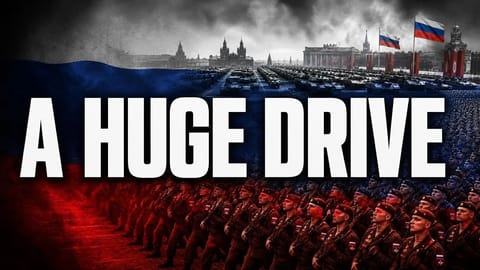
Russia Wants to Mobilize Half a Million Men. Here’s What You Need to Know.

Members only

Note: this transcript was generated by AI and may contain errors or inconsistencies.

Everybody knows about Vladimir Putin's big red button, the one that he absolutely must not press or else he might end the world. But right next to the nuclear launch switch on Vladimir Putin's desk, there's another red button that Putin's been very nervous to activate.

On the one hand, he does, then Russia might win the war in Ukraine, sweeping in from all directions and finally crushing Kiev under Putin's boots.

On the other hand, instead of destroying Ukraine, there's a very good chance that this big red button will destroy Russia. It'll turn the country's elite against Putin for good, prompt a massive public revolt, and ensure that Putin ends his presidency, or possibly even his life, by going the same way as the Tsar of old.

Press that big red button, and Vladimir Putin triggers a society-wide mobilization authorizing the forced transcription of some half a million men or even more.

It's a nuclear option that Putin's avoided thus far, because the risks of a potential failure are so incomprehensibly high. But Western onlookers have suspected for the last several months, and Ukrainian intelligence now claims to confirm that mass mobilization is coming to Russia in the near future.

Putin's cronies deny it, and his enforcers on the ground have clearly been told not to admit it.

But already, young Russians are being whisked off the streets in cities that hadn't yet been touched by the country's conscription machine.

Across this autumn and winter, it seems that mass mobilization is coming for the Russian population, kicking off a process that could see the Russian trickle or fly over Kyiv, or one that could see Vladimir Putin himself banished from Moscow.

Times, Desperate Measures After four and a half years of Russia's bungled invasion in Ukraine, the idea of Vladimir Putin's ideal three-day special military operation has become one of the most famous memes of this war.

That's not because Putin ever personally promised to capture Ukraine within three days, which to his extremely limited credit, he didn't. Instead, the meme has stuck around for so long because it's a shorthand way to describe a difficult truth. Russia never expected its war to go anything like this.

From captured invasion plans, to attempted decapitation strikes, to Russia having packed its initial convoys with all the necessary gear to stage military parades in Kyiv, it's well understood that Moscow wanted the whole affair wrapped up quickly.

It was quite literally unthinkable that after four and a half years, Russia would still be crawling through the Donbass, let alone that it would have to think seriously about the idea of a total mobilization of society to achieve victory.

Putin and his allies understand the limits of what the Russian people signed up for, not least because that they've tried so hard to ensure that the Russian people lack a complete or accurate understanding of this conflict.

They're keenly aware that even if Russians understand that there's a large-scale military operation going on, ordinary people are willing to tolerate those sorts of things going on in places far away from their own communities. That is Vlad's Putin's social contract.

After all, Russians can expect safety, security, and for their basic needs to be met by an iron-fisted autocrat, and in exchange, they butt out politics.

Putin, of course, troops to fight this war, and at the rate that Russia's been burning through the lives of its soldiers, he's needed many more troops than were willing to enlist under normal circumstances. over backwards to avoid breaking the social contract with the people who matter most, relatively wealthy, relatively elite Russians who live in the

Country's largest population centers, especially Moscow and St. Petersburg.

Instead, Russian conscripts have come from poorer, more remote, or minority areas of the Russian homeland. They've been forcibly conscripted both from those poor regions and from occupied Ukrainian territory.

Tens of thousands of Russian soldiers and paramilitaries have been recruited out of prisons, including many who had been convicted of horrific crimes in their own communities.

Russia has tried convince thousands of foreigners to come and enlist, mainly from Africa, and it's relied on support from North American troops to relieve Russian troops in the rear so that they could be sent into the meat grinder.

All of that in the name of avoiding an outright formally announced mass mobilization so that the people who support Putin relies on remain blissfully unaware of the damage this war is doing to Russia.

Now, however, Putin's all-important calculus has apart.

Across 2026, Ukraine has done an excellent job at, "should we say, informing the Russian public about the costs of this war, using long-range strikes to deepen fuel shortages, destroy e-commerce warehouses, and otherwise create consequences that ordinary Russians have had to feel." The illusion that this special military operation could be contained to

Ukraine has now been shattered, with regular Ukrainian drone and missile strikes across the country, including on high-profile occasions like Putin's prized economic conference in St. Petersburg.

At the same time, Russia and Ukraine are deeply engaged in a cycle of mutual degradation where each side is grinding the other down on the front lines and through long-range strikes, but neither seems to stand a chance at breaking through and causing the other side to fold in the near future.

Russia can make this winter incredibly difficult for Ukraine, amidst a critical air defense shortage, Ukraine can continue to devastate Russia's logistical supply chains and interrupt its attempts to push forward.

But barring some massive new capability introduced by either side, this war certainly won't end before mid-2027, and quite possibly not for a long time after. So, from Russia's perspective, mass mobilization is looking more and more tempting by the day.

For one thing, despite the risks, it would almost be easy, in a way. Russia never technically ended the partial mobilization it declared in 2022. All the infrastructure required to keep young men in the country and then force them into compliance still exists.

Russia, meanwhile, can't really compete with Ukraine on military R&D. Russia could build its existing warfighting equipment in bulk, but it won't be introducing new advanced systems at the pace Ukraine can.

Russia's solutions will need to be a bit more old school, and so there is nothing more old school than gathering an overwhelming number of troops to throw at an adversary.

Mass mobilization would also be an easy way to escape the time crunch that Russia faces, to find a way to turn the tables before Ukraine does. And finally, if recent reporting by The Economist is accurate, then Putin suspects that his own time may be running short.

According to that article, Putin decided, after several weeks of contemplation this summer, that his only path forward is to escalate the conflict further, particularly because he fears that if he ends this war without at least capturing the entire Donbass region, his life could be in danger.

Quoting that article now: "They will hang me," he told some of his cronies at one point in the war, according to an insider." So despite the immense risks, the Russian leadership has reason to consider mass mobilization in the very near future.

Ukrainian intelligence agrees, with Kyiv releasing an assessment from its main intelligence directorate and its foreign intelligence service in late August, claiming that Russia has already decided to call up 300,000 additional soldiers by the year's end. They'll be joined by another 300,000 in 2027.

And of course, we can't simply take the word of Ukrainian intelligence here. These are wartime agencies trying to win the war by any means necessary, and it wouldn't be out of the question for Ukraine to exaggerate, misrepresent, or even fabricate findings for the sake of the war effort.

But in general, Ukrainian intelligence has proven quite reliable throughout this conflict.

According to their analysis, Moscow is facing a complete collapse in voluntary recruitment of soldiers, meaning that it can't afford to keep losing soldiers on the battlefield at its current pace without finding a way to replace them.

So mass mobilization would fix that problem for the Kremlin, injecting some 600,000 troops into the war effort over the span of about a year or less. But according to the office of Ukrainian President Volodymyr Zelensky, Putin's plans actually go a step further.

According to the head of Zelensky's office, Pavlo Polisa, Russia's military command has been charged with preparing several scenarios to launch a full-scale offensive against northern Ukraine, including at least one scenario that would include a direct, large-scale march on the capital city of Kyiv.

Polisa specified that, as of now, there haven't been any observable Russian movements that would indicate a troop build-up, but that, quote, "our top priority is to prevent the conditions from emerging that would allow Russia to launch any offensive operations at all," end quote.

In essence, Russia would use its new conscripts to replace more experienced troops in the Russian rear and in homeland defense roles, with those troops most likely being assigned to a new offensive, even if some conscripts would probably find themselves thrown into the meat grinder of a Kyiv advance as well.

A direct attack on Kyiv, of course, would also require troops to either start a campaign from far away in Russian territory or to approach more directly through Belarus. But to that end, Belarus is building new railways to areas near Kyiv designed to carry military equipment while working on a large training ground near the border.

So, you can make of that one. you will.

Preparations underway. Now, as we've already mentioned, all of this talk about a potential mass mobilization is, at this very moment, just talk. We can't see into the mind of Vladimir Putin.

We don't have any inside connects at the Kremlin. And we're sharing an assessment with you today based on anonymous sources close to Putin and Ukrainian leaders with a vested interest in sharing information that helps them win the war.

But even if we can't say for sure a mobilization will happen, we can tell you that ordinary Russians seem to believe mobilization is coming.

Just ask the 113,000 of them who crossed Russia's southern border last week, heading into Georgia, which is one of the only countries left where Russians can travel visa-free without a plane ticket.

The Georgian government has seen a wave of border crossings like this before, that was back in September 2022, when Putin first called for his partial mobilization. There hasn't been any other mass crossing like that before or since on the roads leading into Georgian territory.

Apparently, the demand is high enough that housing costs have spiked in both Georgia and nearby Armenia. Nor are the Georgians the only ones seeing an uptick from their Russian neighbor.

Alexei Tabalov, the founder of a human rights organization called School of the Conscript, Politico that his own organization has noted a spike in requests for legal assistance from military age men.

Those men appear to be responding to Russian authorities who have, quoting Politico directly, adopted increasingly aggressive recruitment measures, ramped up data collection on reservists, and expanded the National Guard's remit, all fueling talk of another call." End quote.

Among those who are thought to be at particular risk are reservists who've already completed a year of obligatory military service. If they're under age 55, they're likely to be called up first, with Russian authorities leaning on their status as listed reservists, even if they're part of Russia's wealthier communities.

Recruiters are tracking down potential targets with increasingly overt aggression, and they've been helped along by the passage of laws this year, including one calling for Russians to receive a summons digitally instead of waiting for one on paper.

But all of that would still just be a series of warning signs if Russian authorities were not already starting to scoop up fighting age men in unprecedented ways.

Take what happened in the city of Penza, one of the poorest cities in the European part of Russia, but still a European Russian population center, as opposed to the minority areas where recruitment typically takes place.

This June, authorities in Penza carried out comprehensive forced recruitment raids, setting up checkpoints, pushing men onto minibuses, and making at least some of them sign enlistment contracts against their will. Towns nearby, including Kamenka and Kuznetsk, have also been swept up.

Elsewhere, locals report shadowy recruiters skulking around communities, never making too much of a scene, but choosing under-resourced or vulnerable Russians, or those who were simply in the wrong place at the wrong time, so that they can be functionally disappeared into the moor of Putin. war machine of course russian leaders insist that none of this is

Happening at all when asked the authorities denied the raids in penza and elsewhere kremlin spokesman dmitry peskov has accused ukraine of planting the rumors of mass mobilization and russia's ambassador to the united nations has called the idea quote neither planned nor expected even putin himself has had to personally deny the idea when western officials

Described the situation to the wall street journal in late august they specified that although the idea was being hotly debated inside moscow putin and his allies hadn't yet made a final decision instead that decision will most likely wait until after elections for the russian duma scheduled for late this month those officials in question by the way spoke to

The wall street journal after they concluded tracking russian military exercises in the exclave of kaliningrad where they quote oversaw readiness planning and procedures for immobilization of the region's residents with details on how to house feed and arm them as for russia's timing at this stage it's unlikely that moscow would be planning to rush any of

Those conscripts to the front lines before winter in this part of the world the winter months tend to be relatively quiet and bitterly cold slowing down the pace of offensives on both sides by necessity during that time russia is likely to focus on its long-range air campaign against ukrainian energy and water infrastructure while its military officers will

Have several months to provide basic training as many conscripts possible and then move them into forward operating positions or shift them to places where they can reduce pressure on experienced troops that way russia could conceivably take advantage of the first few weeks of spring when the battlefield begins to unfreeze and a major attack on kiev or a

Swell of troops into the ukraine-held donbass could be feasible but we have to be really really clear as we wrap up today's episode this would be a desperation play by vladimir putin and his allies and if attempt goes sideways then it could very well bring the entire russian state toppling down putin has avoided mass mobilization for this long because he

Remains keenly aware that he would risk destabilizing russia itself and finally turning the population against him once and for all add to that risk the fact that this will be the first winter of this war wherein russian cities will be just as vulnerable to ukrainian attacks on energy infrastructure as ukrainian cities are to russia's mass mobilization will

Take hundreds of thousands of workers out of the russian economy twisting the knife even further into the oligarch class that chooses to stand by putin as he leads the country taken together those factors make russia a powder keg this winter and trying to rip so many fighting age men the streets in the span of just a few months would risk public anger on a

Scale not seen in a generation we've said it before on this channel and we'll say it again russia doesn't revolt against its leadership very often but when it does the russian people don't mess around so a few short months before winter vladimir putin is weighing the ultimate gamble for the future of his regime If MassMobile, goes well, if the public could

Be placated or ignored, and if the Russian military can get his hands on those conscripts before they flee across the border, then Putin really could set the conditions for a rapid expansion of Russia's war effort.

Perhaps that means surging into the Donbass, or perhaps it means marching on Kiev and putting a permanent end to Ukraine as a sovereign nation. If Russia really could rally hundreds of thousands of troops with the proper equipment and supply chains, then there may not be much that an overstretched, exhausted Ukrainian military can do to stop it.

But if mass mobilization starts to come off the rails, then Putin will be operating on exceedingly thin margins, where a few missteps or unforeseen complications could be enough to place Putin himself in jeopardy.

It's a do-or-die choice for a man and a regime facing a do-or-die situation. And if Vladimir Putin has made one thing clear across his time in power, it's that he will take the ultimate gamble if he believes there's even a chance a victory.

Insider access

Watch with Fronts Insider

Fronts Insiders get every video, the complete archive, and private sponsor-free playback.

Insiders Receive

  • Every WarFronts, HomeFronts, and Insider video
  • Complete sponsor-free video archive
  • Support independent conflict journalism

Already a member? Log in →

Signed in or already a member, but still locked? Fix an access problem

From $5/month — cancel anytime