
Skip to content
Fronts.co
WarFrontsSingle topic

The Sahel Kicked Out the West. Now it's Falling Apart.

Simon Whistler • September 5, 2026
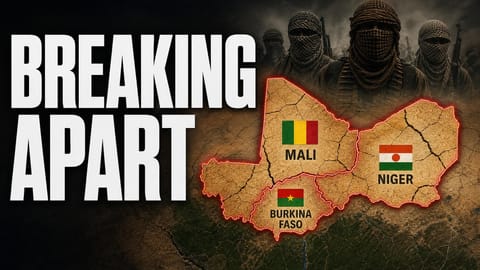
The Sahel Kicked Out the West. Now it's Falling Apart.

Members only

Note: this transcript was generated by AI and may contain errors or inconsistencies.

Ever since the rise of a trio of military regimes in Africa's Sahel region, in the countries of Mali, Niger, and Burkina Faso, the entire Sahel has been coming apart at the seams.

Those military governments claimed a mandate to rule, in part because they wanted to throw off the shackles of the neo-colonial West, and because they claimed that they could do better for their people than European and North American military advisors, especially the French, ever could.

But since the Sahel regimes gave Paris the boot and extended their warm welcome to mercenaries sent by Moscow, their countries have gone completely off the rails. is being slowly disassembled by a combination of the Al-Qaeda-linked jihadist group Jinnim and an alliance of separatists from the Taureg ethnic group claiming more and more territory in the north.

Niger has found itself in both Jinnim's crosshairs and the crosshairs of the Islamic State, specifically a franchise that wants to build a caliphate across the Sahel.

And despite the rhetoric and propaganda of the young dictator Ibrahim Traore, Burkina Faso can hardly control its own territory, where recently the jihadists are fighting massive battles against each other.

So a group of young military officers in Niger chose to rise up last weekend and very nearly overthrow their own commanders, it was not surprise. was the latest in a long series of predictable, avoidable internal crises impacting all three of the Sahel nations that chose to throw their lot in with Moscow.

And although the regime in Niger appears to have survived the mutiny of its soldiers, the latest shock has left the country even weaker, even more vulnerable to the insurgents than it already was. Niger, Mali, and Burkina Faso insisted that with Russia's help they could take better care of themselves than the global West ever could.

Now their countries are falling apart and Niger is looking more and more like it'll be the first domino to fall.

Mutiny Now look, as we begin today's episode, we've got to make ourselves absolutely clear our intention is not to sit here and claim that the global West, especially the French, did a particularly excellent job in the Sahel when it was their turn.

In fact, the people of the Sahel had plenty of reasons to be upset with Western militaries, not least because, under their watch, terror attacks became more common and more people were displaced.

Anti-Western critics in the Sahel who lambasted Europeans and North Americans for meddling in their governments and extracting their natural resources made some very accurate points.

Instead, the difference between the Sahel when the global West was involved and the Sahel today is sort of like the difference between being aboard a sinking ship trying to get to a lifeboat and trying to blow up a sinking ship while you're still on board. The French did not do a good job with the Sahel, and not by a long shot.

But the Sahel's military dictatorships and their Russian backers have managed to do exponentially worse.

And we need only look as far as the last 10 days or so to find a catastrophe that puts everything into perspective. That catastrophe would be Niger's attempted military coup, where on Saturday, the 29th of August, a cadre of junior military officers and their men decided to mutiny.

Those officers weren't motivated by vanity or greed or any outlandish revolutionary ideas.

They were motivated because their the guys getting shafted, watching their troops be slaughtered by jihadists on the front lines. officers who chose to revolt came mostly from two key areas, Dosso, southeast of the capital, and Tilibari, northwest of the capital, near the exceptionally dangerous tri-border region shared with Mali and Burkina Faso.

Dosso and Tilibari are the hotspots in Niger's internal crisis, where under-resourced military units are under constant threat of attack by Janim, the al-Qaeda-linked jihadist group, and the Islamic State's Ayas-Sahal branch.

These are soldiers and officers in a profoundly unenviable position, fighting against massive, roving groups of insurgents who swarm in on motorcycle with explosive-modified quadcopters overhead and deliver unpredictable, heinous violence before disappearing back into the landscape.

Niger claims that its troops in Dosso and Tilibari have support both from the rest of the military and from Russia's paramilitary Africa Corps, that just is not the case.

Moscow stations only around two to three hundred Africa Corps personnel in Niger, far fewer than it has in neighboring Mali, and the paramilitaries who are based in Niger typically don't go out to the front lines if they can help it. they do show up in places like Dosso and Tilibari, it's in areas where local troops have already cleared out the insurgents so

That the Africa Corps can help prey on civilian communities, conduct brutal interrogations and extraditial killings, and coach impressionable Nigerian soldiers on how to do the same.

The national military, meanwhile, suffers from chronic problems with military logistics and support operations due to a combination of bad roads and vehicles, supply bottlenecks, corruption, and the constant threat of hit-and-run tactics by the jihadists.

So when these junior officers decided in late August that they'd finally had enough, it didn't seem to take all that much convincing to get their troops to come along and mutiny with them.

The coup attempt was set in motion on the prior night, when military units left their posts in Dosso, Tilibari, and the wider conflict zone, and started roughly equidistant, hours-long drives from either direction toward the centrally located capital city of Naame.

When they arrived in the early hours of the morning, they set their sights on several critical targets at once, including Niger's presidential palace and its central state broadcaster.

But their ultimate target was Naame's International Airport and the key military airfield that sits right beside it, known officially as Air Base 101. That's where Niger keeps its rather dismal air force, but it's also where the country hosts the largest troop contingent from the Russian Africa Corps.

They were especially important for the mutineers to deal with, or at least try to constrain, because even though the Africa Corps is officially in Niger to provide security support, the organization is really there to guarantee regime protection.

After Russia's agreement with the Sahel's military regimes, the Africa Corps is there to guard over the leadership so that the leadership can continue to send their wealth to Moscow, both in the form of financial compensation and in an endless stream of natural resources.

And speaking of natural resources, there was one other target at Air Base 101 that we should mention: roughly 1,000 metric tons. of yellowcake uranium seized from a French nuclear firm and eventually expected to travel on to Moscow. Unfortunately for Niger's military mutineers, their coup d'etat simply wasn't to be.

But, at least in the early hours, it wasn't the Africa Corps that got in their way. Instead, Russia's paramilitaries appeared to spend hours basically waiting on the sidelines, almost as if they wanted to see how the mutiny shook out.

They defended their position at the airbase, of course, after they came under immediate fire, but it was Niger's elite presidential guard that was able to prevent a total collapse of the country.

Compared to the rest of Niger's military, the presidential guard is an elite force with the right combination of specialized training, powerful weaponry, and financial and personal incentives to maintain loyalty to the president of the military regime, Abdurrahman Chiani.

Despite being outnumbered by the mutineers, the presidential guard sprang into action, fending them off at the presidential palace, the state media broadcaster, and elsewhere. The mutineers managed to capture the early support of elite special forces troops, who reportedly made a substantial impact during the intense street battles across Niamey.

But it wasn't enough. few hours, the crisis had evolved into a standoff, with the mutineers still in control of some areas.

But the presidential guard and the begrudging Russians were able to hold them off. hours, the two sides attempted to secure the support of other key factions within Niger's military, and at least one high-ranking commander did defect to join the mutineers.

But ultimately, after pleas and official requests from Niger's leadership, the Africa Corps joined the presidential guard in putting an end to the uprising.

By the end of the day, on Saturday the 29th, dozens of soldiers had been shown surrendering on state television, with dozens more, some of them wounded, shown after they looked to have been taken prisoner.

According to sources on both sides, the death toll from the day's events is suspected to have climbed into the dozens at least. defense minister, initially rumored to have been killed in the uprising, instead took to state television and applauded the response of his loyal soldiers.

A small detachment of Italian soldiers, also stationed at Air Base 101, were confirmed to all be unharmed, and a military statement explained that captured portions of the base had been taken back, despite the mutineers holding some of the other soldiers at the base hostage in their barracks.

According to the Africa Report, foreigners were also taken hostage, although it's not clear whether those were Russian Africa Corps fighters, Italians, the Turkish maintenance staff who work on Niger's drones, or others.

Those 1,000 metric tons of uranium were ultimately secured, and Niger even earned a rare show of support from its northern neighbor, Algeria.

It is extremely rare for Algeria to deploy troops abroad for any reason, but in response to the coup, Algeria sent a group of four fighter jets and an air-to-air refueling tanker to help maintain security across the country.

Despite an unnervingly close call, Niger's military regime still stands, at least for now. and Break Now, if you happen to have only a cursory knowledge of the ongoing Sahel crisis, then we could certainly understand how you might look at Niger's ability to defeat this mutiny and conclude that the country will end up stronger now that it's purged a disloyal

Element in its own ranks.

But what While we would probably grant you that the military government is now in less danger, specifically of being overthrown from within, that's where the good news ends for the regime. because even before this uprising, Niger's military was already on very shaky ground. Air Base 101, where Niger and the Africa Corps stand watch over the nation's capital.

This wasn't the first time Air Base 101 has been the site of an intense ground battle just this year.

It's the third time after a January attack by over 30 fighters from the Islamic State and a June attack by the insurgency Jinnim. mutineers, neither jihadist group managed to capture the airbase. not really the point. 101 should be the most secure place in Niger, both because it's the base location for more concentrated air power and more Russian

Paramilitaries than anywhere else, and because it's an exceptionally valuable target. has to defend the airbase to keep its military aircraft safe to prevent its only regularly functioning international airport from falling under rebel control and to protect those thousand tons of yellow cake that we mentioned before. fact that Niger has had to fend off

Direct jihadist assaults on the base twice this year and it was still vulnerable enough that the mutineers could partially capture it is a searing indictment of Niger's military command. only that, but the mutiny creates a wide range of problems that Niger just doesn't have the tools to solve.

For one thing, the mutineers were the very same soldiers who've been on the front lines for years trying to keep Janim and Aya Sahel in check.

They were experienced troops and officers, unlike many of their comrades, were willing to fight even under adverse circumstances. those same officers and soldiers are going to either rot in prison or be executed while less motivated, experienced troops try to take over their role in the countryside. worse, Janim has already demonstrated that it took full

Advantage of the coup to move its fighters closer to the capital.

On Wednesday, Janim attacked a security post within 10 kilometers of the capital, while the impact of the attack hasn't yet been disclosed publicly, fact that it took place at all is a sign that Janim sees the mutiny as an opportunity. regime's leader, President Chani, still hasn't made a public appearance, and his government is focused on an internal purge,

Trying to stamp out disloyalty instead of focusing on national security. top of everything else, this mutiny worsens a fundamental issue that Niger just doesn't have enough troops to go around.

Now, with hundreds or possibly thousands of their relatively decent troops labeled as mutineers, military is in dire straits. across the rest of the Sahel, clear that the jihadists are utterly unbothered by what's taken place.

Wednesday, the same day that Janim launched that attack outside Niger's capital, group also carried out a mass ambush in Mali, attacking an army convoy just outside their capital city of Bamako.

And both of those attacks came only one day after what was, according to local sources, massive battle in the Mali-Bakina Faso border region between Janim and their adversaries in Isahel. those local reports are to be believed, then Isahel staged a huge, attack against Janim positions in that area, causing hundreds of casualties and taking a vast swath of

Territory.

But even though this might seem like an incident to be happy about, one of those situations where the worst people you know are fighting each other, the situation just isn't that simple.

Firstly, if Janim and Asahel are engaged in power struggles amongst themselves on this scale, it's because neither group feels any real pressure from regional militaries or the Africa Corps. They can handle their inter-jihadist business in territory they totally control without fear of interruption or of handing their other rivals an advantage.

And secondly, Janim lost all that territory, lost all those fighters, and still managed to carry out attacks against military targets in both Mali and Niger, just outside both nations' capitals, the following day.

That should be a terrifying prospect for regional militaries that Janim is now so strong it can take an attack like that on the chin and just keep on moving forward. It's the strength of the Sahel's jihadist groups at this exceptionally fragile moment for Niger that should be the most concerning.

It's hard to really blame Niger's mutineers for causing this problem.

After all, they were in a situation to choose between continuing to lose to the jihadists, extremely painfully, or taking a gamble and trying to depose the people who'd been ordering them to their deaths. But in any case, Niger is now even weaker than it was before, with too many troops simply erased from frontline areas.

And while Janim and our Sahel have their own beef with each other, they've also gotten a little bit better about splitting territory. groups carry out attacks in all three of the Sahel's military-led nations, and when they want to battle each other, they tend to do it in Burkina Faso.

But Janim and their local insurgent partners in the Taureg separatist movement seem to be at their strongest in Mali, where this year they've launched multiple large-scale offensives, engaged the Afrika Korps in drawn-out battles and sieges, and seem to only be getting stronger.

Niger, on the other hand, is in the crosses of the Islamic State, the same Islamic State that took over part of and Syria in the 2010s, and that carries out acts of incredible violence across several continents today.

Janim hasn't simply decided that Aya Sahel can have Niger, but Aya Sahel has proven especially capable of running circles around the Nigerian governments even before this recent mutiny took place.

The group's strength is unknown, but across the Sahel, it's estimated to have at least two to three thousand fighters, most of whom are highly motivated, highly mobile, and now quite experienced. Sahel was already closing in on Niger before this most recent catastrophe for Niger's leaders.

Quite frankly, we can expect them to respond to the mutiny by doubling down.

And all the while, Niger remains reliant on Russia's Afrika Korps, two to three hundred mercenaries content to hang out on their bases or arrive as late to a fight as possible, following orders from a government that promised regime protection, but that now seems willing to hesitate when the moment of truth arrives. the Africa Corps did intervene to save

Niger's leaders.

But those same leaders have been shown that the Africa Corps' commitments are a convenience in the eyes of Moscow. taking over an entire country, after years of loyalty to Putin and cooperation with Putin's mercenaries, Niger's dictatorship has nothing to show for its efforts.

Russia has delivered a less stable, less secure Niger by far than the version of the country that existed before the Russians showed up.

Say what you will about the global west, and especially the French in Sahel security deployments that were far from perfect. But whatever else went wrong under their watch, Niger never came half as close to the precipice as it is at right now.

Give the dictatorship in the Africa Corps a few more months to work, and at this rate, they might hand Niger to the Islamic State on a silver bloody platter.

Insider access

Watch with Fronts Insider

Fronts Insiders get every video, the complete archive, and private sponsor-free playback.

Insiders Receive

  • Every WarFronts, HomeFronts, and Insider video
  • Complete sponsor-free video archive
  • Support independent conflict journalism

Already a member? Log in →

Signed in or already a member, but still locked? Fix an access problem

From $5/month — cancel anytime