
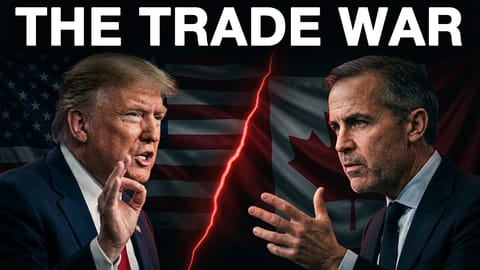
The US and Canada are Fighting an Economic War
Simon Whistler • August 25, 2026
Members only
Note: this transcript was generated by AI and may contain errors or inconsistencies.
What do hockey sticks, Christmas decorations, and milk all have in common? get three guesses. And if you said all three are set to become more expensive for American consumers because of a trade war between the U.S. and Canada, you're absolutely right. Ten points to your Harry Potter house of choice.
Just before midnight on Friday, the 21st of August, a much-vaunted trade deal between Washington and Ottawa collapsed. fell apart despite the best efforts of American and Canadian negotiators who had spent the better part of a week locked-in high-stakes negotiations on everything from tariffs to dairy quotas, along with constant calls between American
President Donald Trump and Canadian Prime Minister Mike Carney.
The deal wasn't always destined to collapse. In fact, at one point, the two nations seemed so close to an agreement that President Trump was already boasting about it on social media, writing, and we'll quote him here, Canada and the USA, subject to the finalization of documents, have a deal.
All caps. However, the deal collapsed, and in its place, the U.S. placed 50% tariffs on more than $20 billion worth of Canadian products. But Canada isn't taking this lying down.
Prime Minister Mark Carney announced that Ottawa would match America's tariffs dollar for dollar, the latest salvo in the ongoing trade war between the two nations, war that now seems destined to destroy America's relationship with one of its closest allies.
Deal or no deal? lot of trade flows between Canada and the U.S., and even saying it's merely a lot does feel like an understatement. Canada is America's second-largest trading partner, only behind Mexico, with trade between the two nations reaching $872.3 billion last year.
While this was down 4.6% from 2024, it still surpassed America's trade with China, its third-largest trading partner, by over $350 billion. According to Statistics Canada, in 2025, Canada exported 73% of its goods to and imported 46% of its goods from the United States.
Additionally, Washington was the largest source of foreign direct investment, or FDI, in Canada, providing about $459.6 billion in 2024, while Canada was the second-largest source of FDI into the United States, providing $732.9 billion.
But perhaps most importantly, Canada is the largest supplier of U.S. energy imports.
In 2025, Canada exported 1.4 billion barrels of oil to the United States. it's not just imports and exports. two nations' vehicle manufacturing industries are so closely intertwined that a single engine might cross the U.S.-Canada border eight times before it ends up in a vehicle. it's not just complex equipment like engines.
Relatively simple stuff like capacitors can also cross the border multiple times before finally being slotted into place. we're highlighting all of this, not just because I get my kicks saying really big numbers, but to show how deeply interconnected the American and Canadian economies are and what was at stake going into these negotiations.
Now, before the negotiations, Washington had spent months accusing Canada of discriminatory trade practices various markets, including vehicles, dairy, and alcohol.
Washington seemed particularly angry that Canada limited the amount of American dairy products that could get into its territory through quotas. above those quotas faced prohibitively high tariffs, which effectively restricted additional dairy sales.
Given how important farmers have been to Trump's political success, this was something that Washington wanted to address during the talks.
However, it was the other issues that Washington wanted to address, some of which were only added during the final hours of negotiations, that apparently tanked the deal. first was about trucks.
Washington offered relief on tariffs for cars and SUVs, but refused to extend the same treatment to medium and heavy trucks, several of which are built in Canada by American companies. read this as an attempt to protect American assembly jobs while leaving Canadian ones exposed.
Second, according to Carney, Washington wanted to restrict Ottawa's ability to make trade deals with other countries.
This was unacceptable Ottawa because it would have been an infringement on its sovereignty. not the first time the Trump administration had tried to restrict Canada's ability to make independent trade deals.
January, Carney struck a preliminary trade deal with Beijing that cut China's tariffs on Canadian canola in exchange for letting tens of thousands of Chinese electric vehicles into the Canadian market. announcing the deal, Carney said that Ottawa's relationship with Beijing was a lot more predictable than its relationship with Washington, a statement that
Seems both true on the merits and also guaranteed to make Trump see red.
Trump responded by calling Carney Governor Carney, a reference to a long-standing threat by the administration to force Canada into becoming the 51st American state and accusing Canada of becoming a drop-off pour for China to send its products to America.
He also threatened levy 100% tariffs on Canadian exports to the United States.
While this issue seemed to have been resolved at the time after Canada's finance minister clarified that Ottawa wasn't pursuing a free trade agreement with China, it seems that Washington wanted to be able to prevent such deals from happening. final demand from the American negotiating team was for Canada to loosen a Quebec law requiring French to appear on
Packaging alongside English, which the Office of the US Trade Representative flagged as a trade barrier in 2025 because it increased the cost of doing business for American companies.
Ottawa claimed that it had already told its American counterparts that French language protections were off the table before the talks began and that attempts to bring it up despite this were meant to chip away at Quebec's culture, the French language, and by extension the country's own sovereignty.
For its part, Washington disputed that it had tried to weaken protection for the French language and culture, with US Trade Representative Jameson Greer telling the press that this was a funny fake story. insisted that the sticking point was regulations affecting tech companies and Canadian content requirements.
Another American official later told the press that the deal had collapsed because Canada wanted concessions that the US was not prepared to give. Regardless of which version of events is true, the outcome was still the same.
The trade deal fell apart, mostly because Canada refused to capitulate to what it saw as American bullying.
Since President Trump came back, to power he has pursued a foreign policy towards u.s allies that you might charitably call aggressive he has threatened greenland with annexation suggested he might use military force against panama hit europe and the uk with tariffs pulled u.s troops out of europe and just recently cancelled military exercises with south
Korea before praising kim jong-un nor has canada escaped unscathed the president has called for canada to become america's 51st state multiple times claiming that it only survives because of leeching off of the united states but it hasn't just been mean tweets and calling prime minister cardi governor in december last year the trump administration unveiled
Its national security strategy document which outlines how the administration would relate to the rest of the world it revived the monroe doctrine a foreign policy principle introduced by america's fifth president james monroe which stated that america wouldn't allow any power to exert its influence in the western hemisphere when the monroe doctrine was
Initially proposed back in 1823 washington's main concern was european colonial powers who had interests in latin america now washington's main concern is china which has gained a lot of influence in the region through trade and investments washington added the trump corollary to the monroe doctrine creating the donro doctrine committing washington to
Denying rival powers control over strategically vital territory ports and infrastructure anywhere in the hemisphere and that explains why washington was royally ticked off after canada made the trade deal with china that we mentioned earlier washington expects canada to fall in line with its demands and to ask how high when washington says jump and yeah
Canada isn't having that one reason why mark carney and the liberal party won the 2025 elections having trailed in the polls right up to the moment trump was re-elected was because canadians expected him to stand up to trump and his bullying and so far he's doing just that the question is whether he and canada will actually win the coming trade war and
According to most experts they won't david heddick the director of the uk trade policy project told dw that while ottawa does have alternatives in china europe and the rest of the world it ultimately can't replace the large market that is on its doorstep which is so deeply intertwined with the canadian economy he told the outlet and we'll quote him here they
Are in a no-win situation however this doesn't mean that washington is going to get everything it wants hennig said that trump is under pressure as well because mid-term elections are coming up the economy isn't doing too well and washington is paying a lot for government borrowing over five percent and it's not like ottawa doesn't have levers it can pull
Some 60 of america's energy imports come from canada as does a significant chunk of potash for fertilizer the u.s might be the bigger partner but if canada really went for the nuclear option it could make the united states feel the pain all of this taken together means that there is a lot of economic pressure for both sides to make a deal however whether
They actually do is an open question especially with the bad blood between the two leaders beyond economic pressure one Washington has a powerful incentive to make a deal, because the longer this fight drags on, the more it risks pushing one of America's closest allies into the waiting arms of its geopolitical rivals.
Friends For decades, Canada treated its close ties with the U.S. as one of the few certainties in geopolitics.
While the two nations did occasionally differ, they agreed on most points, and their foreign policy was often aligned. In fact, Canada sent more than 40,000 troops to support the U.S. during its war in Afghanistan after the 9-11 attack, a testament to how close the two countries were.
President Trump has shaken the foundation of that relationship, and Mark Carney has spent the better past year and a half trying to find more solid footing for his nation.
April, he said that Canada had signed 20 new deals on four continents as part of its efforts to diversify away from Washington. of that diversification is happening close to home.
In September 2025, Carney signed a comprehensive strategic partnership with Mexican President Claudius Scheinbaum, which covered a vast array of areas including trade, energy, ports, and rail.
Observers saw this as an attempt to strengthen Mexico and Canada's bargaining position ahead of a review of the United States-Mexico-Canada Agreement, or USMCA, a free trade agreement between the three nations which was scheduled for later that year. from Mexico, Carney has also made stops in India, Australia, and Japan, signing trade deals meant to further
Cement Canada's strategic independence.
On their own, none of these deals could come close to the volumes of trade that Canada did with the United States, nor do they give Ottawa the same level of access to advanced technologies and manufacturing capabilities.
However, they all add up, and they give Canada an option when selling to the US becomes too expensive. signing trade deals, Canada has also been shoring up its defense arrangements with other countries to reduce its reliance on the US.
In June 2025, Canada signed a security and defense partnership with the EU in Brussels, which was the first step towards Canada participating in the continent's new defense procurement program known as Rearm Europe.
December, Canada likewise signed a bilateral agreement with the EU, allowing Ottawa to join SAFE, the Security Action for Europe program, a $175 billion defense instrument which supports EU member states that want to invest in defense industrial production through common procurement.
Canada became the first non-European nation to participate in the initiative. This move doesn't just see Canada cooperate more closely with Europe on defense.
It also means that less Canadian money will be going to American defense contractors as they buy more from Europe. mean, it's not for nothing that European leaders today, half jokingly and half hopingly, suggest Canada should consider joining the EU. there's China. the trade deal that we mentioned in the previous chapter, Canada has been working hard to
Improve its relationship with Beijing.
In January this year, Mark Carney visited China, becoming the first Canadian prime minister to do so since 2017 and announced a series of agreements designed to rebuild economic relations. announced that Canadian lobsters, crabs, and peas would no longer face certain anti-discrimination tariffs beginning in March of this year.
In exchange, Canada extended tariff relief for some Chinese steel and aluminum products that it says are in short supply.
China's foreign minister, Wang Yi, later visited China in June this year, the first trip to Canada by a Chinese foreign minister in more than a decade.
Beijing claimed that the meeting was highly productive, adding that the two sides had agreed to enhance coordination across multiple fora and to jointly reform and improve global governance, a not-so-subtle dig at America, which is widely seen as abdicating its global leadership role.
It's widely expected that Chinese President Xi Jinping will visit Canada in September as part of his trip to the US, which would be the most significant step in repairing the relationship between the two countries.
Now, we have to be clear here that none of this means Canada is abandoning the US for China.
Carney outright said that his government wasn't trying to get a free trade agreement with China, and more importantly, Canada is bound by the terms of the USMCA, which stipulate that it cannot pursue free trade agreements with non-market economies such as China without notifying other members.
Nor should you expect Ottawa to suddenly pivot towards Beijing, where geopolitics and values are concerned.
There's no version of this that ends with Carney declaring "Taiwan is a part of China," putting on a t-shirt and celebrating the Nine Dash Line, and then prancing off to Xi Jiang to oppress some Uyghurs. However, none of this is really the point.
As with all the other deals that Canada is making, the point is not free trade, or to upend Ottawa's foreign policy.
It is to reduce the reliance on the US and to ensure that Washington has as little leverage over it as possible. In 2024, trade between China and Canada stood at around $94 billion, about a tenth of Canada's trade with the US in the same period. If this grows while trade with the US continues to decline, then that will be a potential issue for Washington.
All of that brings us back to Don Roe Doctrine: Washington's commitment to ensuring that its geopolitical rivals, mainly China, Russia, and Iran, and to lesser extent the European Union, do not get a foothold in the Western Hemisphere. And I mean, just wait until Trump discovers French Guiana.
Now, the easiest way to do this would be to ensure that Washington has a positive relationship as possible with its Western Hemisphere neighbors, because good neighbors become good friends.
However, Washington has decided to pursue a different route, one that sees it antagonizing its neighbors at nearly every turn.
By threatening to make Canada the 51st state, calling Prime Minister Mark Carney governor, putting punitive tariffs on Canadian goods, Washington is pushing Ottawa towards alternatives like Beijing, not because it wants closer ties with China, but because it can't afford to be as dependent on the US as it has been in decades past.
And that's really bad for the US, because Canada is the only other NATO member in North America, and it has the longest Arctic coastline in the alliance.
Canada also has a lot of specialized equipment to defend the Arctic, including a fleet of icebreakers that the US is reliant on because it doesn't have enough of its own.
By antagonizing Canada, Washington is potentially putting Arctic security at risk at a time when China is increasing its own Arctic presence. through economic cooperation, scientific research, and diplomatic engagement.
If Washington is as serious about Arctic security as it has claimed to be in the past, to the point of threatening to annex Greenland, then it needs to recalibrate its approach to Canada.
But then, that would assume that there's method to Trump's madness. he really wants anything beyond the thrill of dominating a smaller neighbor or a trade war to distract from the real failing war in Iran. Regardless the president's true motivations, none of this means that the US and Canada are destined to permanently split up.
As we've mentioned multiple times before, their economies are too tightly bound together, and they also have very close cultural ties. mean, us Brits have just spent the better part of a decade proving that you can't completely cut yourself off from a massive economy on your doorstep.
Just the UK finds itself permanently entwined in European affairs, so too will Ottawa have to accept the eternal tug of gravity from the world's largest economy.
And yet, that doesn't mean there won't be long-term damage from this trade war. this relationship keeps deteriorating, Washington won't just be losing a neighbor, it will be losing one of its most important strategic assets. Thank you for watching.
Watch with Fronts Insider
Fronts Insiders get every video, the complete archive, and private sponsor-free playback.
Insiders Receive
- Every WarFronts, HomeFronts, and Insider video
- Complete sponsor-free video archive
- Support independent conflict journalism
Already a member? Log in →
Signed in or already a member, but still locked? Fix an access problem
From $5/month — cancel anytime
