
Skip to content
Fronts.co
HomeFrontsSingle topic

Trump's Presidency Has Been a Gift to China. Here's Why.

Simon Whistler • August 31, 2026
Trump's Presidency Has Been a Gift to China. Here's Why.

Members only

Note: this transcript was generated by AI and may contain errors or inconsistencies.

If you spend too much time on social media, and god help you if you do, you might have seen a certain meme flying around. One that's often used when discussing China's foreign policy, especially in relation to the United States.

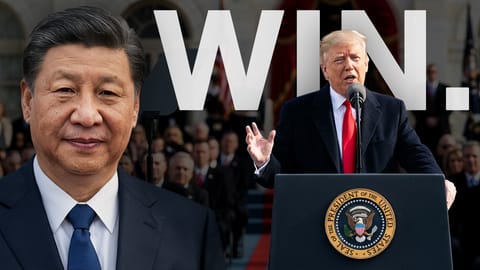
It shows Chinese President Xi Jinping, edited to look not like Winnie the Boo, but like Asian Giga Chad, with three simple words above him: "Do nothing, win." Now we don't usually get our geopolitical analysis from memes, but it's difficult to deny that this one has been particularly effective.

But compared to the US, which for those keeping score at home is bogged down in Iran, has just started a trade war with Canada, has alienated its allies in Europe and South Korea, and has unsuccessfully been trying to annex Greenland, well, it's hard to deny that China really does look like "doing nothing" is meaning it's still somehow winning.

Yet that "doing nothing" formulation is being too harsh on Beijing. Rather than just kicking back and chilling, Giga Xi has been working tirelessly to win friends and influence people.

A campaign that has been turbocharged in recent years by the re-election of Donald Trump. And while very few would claim that Trump set out in his second term to actually help China win, it's getting increasingly hard to argue that an increase in Chinese influence hasn't been a side effect.

So, China has been a part of this because of the Chinese Communist Party and the Chinese Party, which had been a part of the Chinese Communist Party that it was important to present an image of a "credible, lovable, and respectable" China.

China's global image has taken a hit because of a whole host of issues, both domestic and stage. However, China's treatment of the Uyghur Muslim minority in Xinjiang has drawn global and even accusations that Beijing was committing a genocide.

In Hong Kong, two people had died, more than 2,600 had been injured and over 10,000 arrested, following widespread protests against new laws that had effectively stripped away the territory's autonomy.

And we can't fail to mention the global pandemic, which was both traced back to Wuhan and also saw the Chinese government implement a lockdown so severe it verged on monomenarchal. For a while, China's answer to all of this was to get louder in an attempt to drown out the criticism.

Chinese diplomats adopted an extremely aggressive and nationalistic tone in their public statements, which a lot of observers viewed as decidedly undiplomatic.

This approach to foreign policy earned itself the nickname "Wolf Warrior Diplomacy" after an aggressively mid-movie of the same name that shows a Chinese Special Forces soldier fighting off a bunch of international mercenaries.

Just to give you an idea of how aggressive "Wolf Warrior Diplomacy" was, in 2019, China's ambassador to Sweden, Gwai Tsong Yu, said, quoting him here, "We treat our friends with fine wine, but for our enemies, we have shotguns." It's not the kind of statement that usually makes those on the fence go, "These guys.

Those are the guys that I want to do a trade deal with." And it wasn't just mean words, though.

When Australia called for an international inquiry into China's handling of the pandemic, Beijing hit back with tariffs and restrictions. sanctions on a host of Australian exports, including barley, beef, and coal.

When the European Union sanctioned Chinese officials over Xinjiang, Beijing sanctioned European lawmakers right back, including a bizarre spat in which China specifically targeted the tiny nation of Lithuania. Closer to home, China wasn't showing much restraint either.

In 2020, Indian and Chinese forces clashed in the Gawang Valley along their shared border. Scores of troops from both sides were killed or injured in a conflict where no shots were fired.

This confrontation happened at a time when China was becoming more aggressive in other areas of the Indo-Pacific, such as the South China Sea, and was spending millions of dollars to modernize its military.

In the Global South, meanwhile, China was facing criticism that its flagship Belt and Road Initiative, a global development program meant to connect Asia, Europe, Africa, and Latin America through a network of ports, railways, highways, and energy projects, was a debt trap that would leave the countries involved worse off in the long run.

We're saying all of this to show just how bad public perception of China was during this period, and how little Beijing seemed to care.

In fact, in 2020, the Pew Research Center found that unfavorable views of China had hit historic highs in many countries, including Canada, the UK, and Australia, where 73, 74, and 81% the populations, respectively, had negative views of the country.

It was around this time that Beijing seems to have realized that something needed to change. A lot of loudest wolf warriors began to be quietly reassigned to other areas where their provocative statements could do less damage, and China started to act slightly more normal in the field diplomacy.

This return to more traditional diplomacy led to a major win in the Middle East.

In March 2023, Beijing brokered a deal restoring diplomatic relations between Saudi Arabia and Iran, which shocked the entire world because of the years of animosity, suspected attacks, and espionage between the two Middle Eastern nations.

Obviously, that relationship has once again taken what, with glorious British understatements, I'm going to call a bit of a hit. the time, it was seen as a huge deal. was Beijing's first foray into Middle Eastern mediation, an area that had traditionally been dominated by the US, and it had ended with China getting an agreement most would have thought

Impossible. from diplomacy, China opened itself up a lot more to people from other parts of the world.

In 2023, Beijing announced that it was offering visa-free travel to tourists holding passports from France, Germany, Italy, the Netherlands, Spain, and Malaysia.

Beijing would eventually expand the number of countries with visa-free access to 50. idea behind all of this was simple. more ordinary people had a chance to experience China for themselves without the media or a politician getting in the way, then their opinions of China would change for the better, and they'd tell all of their friends and family. that has

Been extremely successful.

Data from the World Travel and Tourism Council showed that more than 68 million international visitors entered China in 2025, a 15.5% increase from the previous year, and nearly three times the global growth rate of 5.4%.

And while we obviously don't know. many came back raving about the nation's awesomeness the growing online fetish for all things chinese would suggest at least some of them did do you remember during the world cup how americans swelled with patriotism at the sight of european tiktokers getting excited by portion-sized at arby's well china has been

Experiencing its own equivalent for several years now back in the diplomatic arena even the belt and road got a makeover in october 2023 she announced that china would promote both signature projects as well as small and beautiful livelihood programs the idea of small and beautiful programs emerged in 2019 as a way to better connect with the locals of a

Particular nation and to counter the narrative that chinese development programs were debt traps meant to strip a country of vital assets these projects included refurbishing maternity wards in zimbabwe after a cyclone a chinese garden in jamaica to foster chinese jamaica goodwill and a mini hydro power plant in the democratic republic of the congo while not

All of this was successful enough was that by july 2025 the pew research center found that global attitudes towards china were becoming more positive in canada the number of people with an unfavorable view of china has dropped to 63 while in the uk it's dropped to as low as 56. admittedly australia was still 76 negative but a change of 10 percentage points

In once stalwart american allies like canada and 18 in the uk is nothing to be sniffed at but maybe you notice how we chose to frame that as a change in once stalwart american allies because the truth is that while china may be trying to soften its image that alone is unlikely to have produced such a swing no something else happened around this time that

Acted as an accelerant an event that conspired to make america look angrier more dangerous and less trustworthy at the exact same time the chinese were investing in making themselves look cute and cuddly and maybe you'd care to guess what event we're thinking of here american gifts well yeah it's right there in the title isn't it since donald trump was

Re-elected in november 2024 he has pursued a foreign policy that can charitably be called aggressive especially towards america's once closest allies let's start with america's oldest ally of all canada for decades canada was basically uncle sam's best bud and america was a good neighbor to be around they did hundreds of billions of dollars in trade each

Year tens of millions of people crossed the shared border on trips and holidays and ottawa supplied the us with a steady stream of cultural icons from keanu reeves to joni mitchell via captain kirk and the director of the top grossing movie of all america on a more serious note canada was such a good neighbor that it sent more than 40 000 troops to support

Washington during the war in afghanistan following 9 11. and you'll notice that we're talking about this relationship in the past tense that's because trump has spent his second term in office antagonizing ottawa he kept floating the idea of canada becoming the 51st state and took to calling prime minister mark carney governor and then there was the trade

Deal on friday the 21st of august ottawa away from the negotiating table after washington tacked on last-minute demands including a clause that would have limited canada's ability to strike trade deals with anyone else the relationship between the two states hasn't just deteriorated at the highest levels of government even among civilians the attitude

Towards the u.s has changed a recent poll by the non-profit angus reed institute published on the 10th of august found that 48 of canadians viewed americans unfavorably not viewed trump unfavorably or viewed the republican party unfavorably but americans this marks one of the lowest levels of public trust in bilateral relations in decades conversely

According to a poll from the same organization canada's opinion of china has improved the poll published in october last year found that 27 of canadians had a favorable view of china up from 16 earlier this year and nearly three times the all-time low recorded in 2021 of 10 percent now let's move on to greenland in december 2024 even before he had been sworn

Into office for his second term president trump wrote on social media that it was important for america to own greenland for national security rather than a joke or a bit of trumpian trolling this escalated into a full-blown diplomatic crisis earlier this year when in the wake of the u.s capturing maduro there seemed a genuine chance the administration would

Try to seize the danish administered island by force at the height of the crisis danish troops were preparing to blow up air strips to deny us forces a landing place it's hard to overstate just how shocking this entire episode was to europe denmark has long been among the most pro-us nations on the planet has sent its sons to die in america's misadventures

In afghanistan in iraq and the reward was being threatened coming on top of heavy tariffs levied against europe in 2025 and the coordinated humiliation of president zelensky by jd vance and trump in the oval office the greenland crisis was broadly seen as a catalyst for public anger to come boiling up polling today shows that more people in europe's biggest

Nations trust china than they do the u.s under trump away from europe trump's domestic policies have also affected america's relationship with its asian allies in september 2025 immigration agents raided ihondi battery plants in georgia and detained hundreds of south korean workers an episode that triggered genuine outrage in seoul south korea has also been

A victim of america's international policies the war in iran significantly dented america's interceptor stockpiles forcing washington to pull vital interceptors including the terminal high altitude area defense fad system from seoul trump ordered the pentagon to cut short an annual joint defense exercise with seoul because of his very good relationship with

North korean dictator kim jong-un and because seoul refused to join the war in iran with friends like these right separately tariffs on india push new delhi visibly closer to both moscow and beijing and doing years of american work to bring india closer to the west and this past may at the shangri-la dialogue in singapore defense secretary pete hegseth told

The region's officials that the era of america's subsidizing wealthy allies defense was over pushing them toward a target of 3.5 percent of GDP.

For countries like Singapore and South Korea, which spent 2.8 and 2.6 percent of their GDP on defense, this target is achievable even if it will require sacrifices. countries like Japan and the Philippines, which spend 1.4 and 1.3 percent of their respective GDPs on defense, more than doubling that figure will mean brutal domestic trade-offs.

Nonetheless, observers believe that Asian nations will significantly ramp up their defense spending, both to protect themselves against China and to appease Washington. Still, despite seeing China as a threat, most Southeast Asian countries now prefer Beijing to the United States as a trade partner, according to the 2026 State of Southeast Asia Survey.

That same report found that U.S. leadership under President Donald Trump had become the region's biggest geopolitical concern, rather than anything China is doing.

In a separate poll by Ipsos from April this year, 55 percent of respondents across Asia believe that China will have a positive effect on the world over the next decade, while only 40 percent said that the U.S. would have a positive impact. And then there's Africa.

Within his first few months back in the Oval Office, President Trump had signed an executive order freezing nearly all foreign aid pending a 90-day review. That review did not spare much.

In March, Secretary of State Marco Rubio announced that 83 percent USAID's contracts, around 5,200 of them, were being canceled outright because they did not serve America's best interests.

By July, the agency itself was gone, folded into the State Department, after six decades of operation. Those cuts were brutal for parts of Africa.

Oxfam, a global organization that fights inequality to end poverty and injustice, reported that 23 million children would lose access to education, and 95 million people would lose access to basic health care, which would lead to 3 million preventable deaths each year.

And this is just part of Trump's retreat on the continent. In July, Semaphore reported that the U.S. had left 41 out of the continent's 54 countries without a Senate-confirmed ambassador, which was limiting America's ability to conduct diplomacy on the continent and Africa's ability to connect with Washington.

China has moved fast to plug some of the worst shortfalls, delivering food aid to Somalia, Zimbabwe, Zimbabwe, and Zambia, and giving South Africa a $3.49 million grant facilitated by UNAIDS to fund HIV prevention for 54,000 students The grant marked China's first major entry into a sector that has long been dominated by the U.S. President's Emergency Plan

For AIDS Relief, PEPFAR initiative, and demonstrated just how willing Beijing was to fill a role that America had carved out for itself.

This willingness has paid off massively. As of today, 62% of Africans view China's influence positively compared to 52% for the U.S. However, there's still a massive gap between what Washington used to provide and what Beijing is currently offering.

U.S. aid had a budget of $43 billion, about $6.5 billion of which went to sub-Saharan Africa in 2024, while China gave the continent much less.

Poland, a senior credit research analyst at Red Intelligence, told the South China Morning Post that China was only 10th on the list of the continent's biggest donors. China also doesn't have the infrastructure and networks that USAID built up over the decades that it was in service to ensure that aid gets the people who need it most.

And this is just one of the challenges that China is facing in its quest to dislodge the US from its position as the world's preeminent power.

The other major challenge is the fact that no matter what Beijing does, some countries will always view it with suspicion and mistrust, especially those in Asia. Take Japan, for instance.

In November 2025, newly elected Prime Minister Sunai Takaichi told Parliament that a Chinese attack on Taiwan could be considered an existential threat for Japan, one serious enough to justify military action.

Beijing's response made the old wolf warriors look like nuns by comparison.

China's Consul General in Osaka wrote on X, quoting him here, "The filthy head that recklessly sticks itself in must be cut off without a moment's hesitation." This statement, and China's other moves, including suspending Japanese seafood imports, putting export controls on any exports with military use, and discouraging its citizens from going to Japan,

Told the world that for all of Xi's posturing about a more lovable China, the old instincts still lurk beneath the surface.

For other countries, especially those in the region, this will be a stark reminder of just how big a problem China can be if its interests are threatened in any way.

It's also a reminder that no matter how belligerent Washington is acting, this belligerence hopefully has an expiration date. President Trump's term will end. He'll shuffle off to play endless rounds of golf, and whoever comes next could just as easily reverse course and restore America's relationship with its allies.

In China, on the other hand, Xi Jinping has set himself up to be president for life after presidential term limits were removed in 2018. Washington's hostility is one administration's choice. China's foreign policy, on the other hand, with all of its wolf warrior moments, feels more permanent simply because of how much control Xi Jinping has.

And the fact that whoever takes over after him will most likely be a hand-picked successor chosen to ensure the continuity of Xi's policies. This means that Washington, through a future administration, has a chance to reverse the foreign policy failures of the Trump administration.

The question now becomes whether they will actually do it, or whether they will allow China to keep racking up wins.

Insider access

Watch with Fronts Insider

Fronts Insiders get every video, the complete archive, and private sponsor-free playback.

Insiders Receive

  • Every WarFronts, HomeFronts, and Insider video
  • Complete sponsor-free video archive
  • Support independent conflict journalism

Already a member? Log in →

Signed in or already a member, but still locked? Fix an access problem

From $5/month — cancel anytime