
Violence is Exploding in South Sudan. And More.
Simon Whistler • September 4, 2026
Members only
Note: this transcript was generated by AI and may contain errors or inconsistencies.
Welcome back to The Briefing Room, your weekly rundown of underreported conflicts and undercover geopolitical stories from across the globe. It's going to be a rather depressing one this week, at least to start out with, when we cover a mass casualty cattle raid in South Sudan that pulls back the curtain on a country that's teetering on the cusp of open war.
Then we're traveling just a bit north to Sudan, where the paramilitary rapid support forces are secretly courting support from Israel as their primary sponsor, the United Arab Emirates, draws ever closer to Jerusalem on the world stage.
Finally, we're going to North Korea for a peek behind the curtain at a strange power shift within Pyongyang's military command at a moment when some 50,000 North Korean troops are allegedly preparing to deploy into Russia. As always, thank you for your support here on Fronts, and let's get into it.
South Sudan, where an intense outbreak of intercommunal violence has left at least 49 people dead at last count.
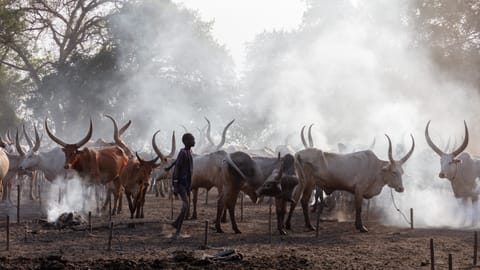
But although the clash in the nation's Warup State originated in tribal and resource-driven disputes, it speaks volumes about the mass violence that has become routine in South Sudan today. The incident in question was an armed cattle raid carried out by a group that attacked Warup State from across the border with the neighboring Unity State.
In the pre-dawn hours on Thursday, the 27th of August, the raiders struck a temporary traveling cattle camp built by members of a rival tribe, as well as a nearby village that the cattle camp relied on.
At least 49 people were killed in the incident, although the death toll has not been formally updated over the last several days, and with 33 others wounded, many of them severely. The final count is expected to be somewhat higher.
South Sudanese state security forces were unable to respond to the violence, which local leaders blamed on a quote, armed cross-border criminal network.
Unfortunately, these kinds of raids are nothing new in South Sudan. The nation spent six months under a state of emergency recently, starting in 2025, because of the sheer number and intensity of cattle raids across the country. In the same area as this latest attack, another 60 people were killed and 50 others wounded in a similar attack about a month ago.
In that attack, an estimated 350 armed young people participated, burning the village of Akok Boba. Back in March of this year, another cattle raid saw 58 deaths and 71 injuries after that particular raid devolved into a complex extended shootout.
Of course, after incidents like these, it is only natural to wonder why this pattern has emerged, why cattle raids with dozens of fatalities have become a new normal for South Sudan?
The answer to those questions is not a mystery, but it does require a bit of nuance to understand in its entirety. These attacks exploit community divides that exist in parallel across three separate dividing lines at once. Ethnicity and tribe, resource scarcity, and civil conflict.
On the question of ethnicity and tribe, South Sudan's targeted communities are typically Dinka, the country's largest ethnic group. For the Dinka, even in the mid-2020s, cattle are everything.
The size, health of a herd is wealth whether for a person a family or a community cattle are seen as both a cornerstone of dinka identity and as a central focus of dinka spirituality in warup state and the surrounding region the dinka typically come under attack from a rival group called the newer a group that happens to include many displaced well-armed
Young people with minimal support from the state or their communities in other parts of south sudan dinka herds have come under attack from groups called the mandari and the missy era although it's newer youth who've perpetuated the several recent attacks that we've mentioned and we should be very clear this violence is neither a case of one-way traffic nor
Constrained to relatively rare mass casualty attacks dinka new air communal violence is a constant in this part of the country going in both directions on both the individual and the communal scale then there's the resource scarcity element cattle herders no matter their tribe or ethnicity are in constant competition for grazing lands and water and that
Competition forces groups into regular confrontations it's a similar situation to the one playing out across northern nigeria where semi-nomadic herders often clash with settled farming communities along the arid southern edge of the sahel region over the last several years in south sudan droughts and heat waves have only become more intense water is scarcer
The arable land footprint is shrinking and herding communities well accustomed to following their cattle across the landscape are now coming into contact with resource scarce communities much more frequently and the country's backdrop of civil conflict only makes this whole thing worse for one thing the rivalry between the dinka and the new air leadership
Was the driving factor behind south sudan civil war from 2013 to 2018 those tensions have been flaring again recently especially after south sudan's president a dinka man named salva kia turned on his vice president and wartime adversary a new air man named rig machar in 2025 kia saw machar charged with treason and murder after an attack on military base
That killed hundreds at the hands of the new air white army an ethnic militia that draws recruits from the same communities where these recent attacks have been taking place south sudan as a whole is on a nice edge right now and there are few signs that tensions will be coming down anytime soon especially with the prospect of a succession crisis after salva
Kia succumbs to one of his many apparent health conditions making matters worse the civil war in the following years of organization into ethnic militias have ensured that south sudan is overflowing with firearms and other weapons groups that want to enact violence on each other consistently have the means do so pour all those tensions and all that history
Into vulnerable south sudanese communities and the result is exactly what we're seeing now the groups on opposite sides of these intercommunal clashes are the same ones on opposite sides of an ethnic divide in which those rival ethnic groups only recently got done fighting a civil war and have organized on the premise that they'll return to war soon enough
Even when they'd rather avoid each other.
Those groups are being forced into conflict, both because cattle-raising communities have little choice but to feed their cattle by any means necessary, and because disenfranchised, well-armed, displaced communities, especially young people, want what those cattle raisers have.
And all of this in the world's youngest nation, where humanitarian aid is desperately needed, but where, in mid-August, UN officials revealed that at least 36 humanitarian personnel had been killed in the country since January, surpassing the total already that was recorded in 2025.
Those figures, by the way, came out before the latest news from Jongle State, where two UN peacekeepers from Ethiopia were killed in an ambush and seven others were wounded.
If there's any positive sign to take away from any of this, it's that South Sudan still has not collapsed back into a full-scale civil war, despite the very real prospect that war could return in the near future.
But as these intercommunal attacks reveal, South Sudan is winding its way down the path to renewed open conflict, as raids like these are normalized, and the state reminds its people, however inadvertently, that it is simply unable to intervene.
For our next story, we turn our attention a bit further to north, to the war-torn nation of Sudan, where we need to discuss a recent revelation by the French investigative outlet Africa Intelligence.
According to their reporting, the Paramilitary Rapid Support Forces, or RSF, been cultivating ties with Israel. That's the same RSF that has been fighting the Sudanese Armed Forces, or SAF, since 2023, and has been credibly accused of committing genocide, as well as a host of other war crimes.
In May 2025, a delegation from the RSF secretly traveled to Tel Aviv and met officials from the African Division of Israel's foreign ministry, as well as Israeli intelligence officers.
The delegation was led by Abdul Rahim Hamdan Dagalo, the RSF's deputy commander and brother of the group's leader, Mohamed Hamdan Dagalo, more commonly known as Hameti. Another brother, Al-Ghani Hamdan Dagalo, handles the group's procurements and was also present at the meeting in Tel Aviv.
After their first encounter, Hameti's two brothers returned in February this year, this time accompanied by the RSF's legal advisor, Ezzeddin El-Safi.
This wasn't the first time that the RSF's senior leaders were meeting with Israeli officials. In June 2021, Axios reported that a private jet associated with Mossad flew to Khartoum, where Israeli intelligence officials met Hameti.
This was two years before the Civil War, back when Hameti and the SAF's leader, General Abdel Fattah al-Burham, were still working together as part of Sudan's post-Bashir transitional government.
Axios added that Hameti had been trying to build an independent relationship with Israel, separate from the relationship that other parts of Sudan's transitional government were already maintaining with Jerusalem.
This is extremely important because while Hameti and Burhan were nominally working together in the transition government, their relationship was fraught with tensions that would eventually boil over, Leading, of course, to the Civil War. And it would suggest that Hometi was at the very least hedging his bets long before the war started.
The RSF didn't just have contacts with the Israeli government, they also had ties to one of the most prominent Israeli businessmen. In May 2020, a sleek white Cessna flew from Cyprus to Khartoum, where it stayed for 45 minutes, offloading extremely sensitive cargo for the RSF.
The plane was owned by Interlexa, a spyware firm that was owned, in turn, by Tal Dillion, an Israeli former intelligence officer who has established an EU foothold in Greece and Cyprus.
The cargo was high-end surveillance equipment made in the EU, which had the ability to hack into most devices. It was apparently so sensitive that it had to be smuggled out of Khartoum to the RSF stronghold of Darfur to prevent the army from seizing it.
This is not the kind of equipment that you would like to see in the hands of a genocidal paramilitary group.
So, this is hardly a new relationship, which makes the most recent meeting all the more notable. Why would the two DiGallo brothers, both of whom are under the kind of sanctions that make travel a nightmare, travel to Israel? And why would Jerusalem accept such a meeting, especially with all the public outcry around the RSF?
For the DiGallo brothers, the answer is pretty obvious. The meeting was their latest attempt at securing international legitimacy for the RSF and the breakaway government they have established in the Darfur region of Sudan. Every government that agrees to meet with them.
Every official that agrees to shake their hands brings them one step closer to their goal. For Israel, the answer is a lot less clear cut. One reason why Israel may be doing this is because of its close ties with the United Arab Emirates.
The UAE, despite constant annals, has been the RSF's main backer since the war began, providing the group with everything that it needs to wage war, from weapons to training grounds in neighboring countries and even Colombian mercenaries. At the same time, the UAE has been improving its relationship with Israel.
The two countries normalized ties in 2020 through the Abraham Accords and have become increasingly more aligned since then.
During the war with Iran, Israel reportedly sent Iron Dome batteries and Israeli personnel to the UAE to help defend the country from Iranian attacks.
The Royal United Services Institute, or RUSI, a London-based defense think tank, has since described the Emirates as Israel's most operationally significant Arab partner, a testament to how close the relationship between the two nations have become.
Viewed under this light, it's possible that Israel's decision to cultivate ties with Hameti and the RSF is nothing more than an attempt to make its closest Arab ally happy.
While this would make for a neat story, it does not give the full picture. To get there, we've got to talk about Turkey. Ankara is quickly shaping up to be Jerusalem's next big geopolitical rival after Iran.
So far, that rivalry has seen the two countries compete for influence in several places, including Somalia and Syria. Sudan could soon join that list.
Since late 2023, the Turkish defense firm Baykar has supplied the SAF with more than $120 drones and warheads under a contract signed five months after the u.s sanctioned sudan's military procurement agency turkish support hasn't stopped at hardware either middle east eye reported that turkish drone operators have been active inside sudan alongside the saf
Viewed under this slide israel's support for the rsf seems like a strategy meant to deny its geopolitical rival a stronger foothold in africa and finally we have to consider the fact that israel may simply be hedging its bets because it doesn't just have ties to the rsf it also has ties to the saf in february 2020 general burhan had a secret meeting with
Israeli prime minister benjamin netanyahu during which the two countries agreed to move towards normalizing relations sudan formally joined the abraham accords the following year in february 2023 just two months before the war began then israeli foreign minister eli cohen visited sudan to meet burhan and talk about deepening the relationship and just a week
After burhan's forces recaptured the presidential palace in khartoum in march 2025 he secretly sent an envoy to israel to push the normalization process forward the sudanese envoy also planned to coordinate with his israeli counterparts on how to present burhan in a positive light to the trump administration israel wouldn't do any of this especially not that
Last task if it was fully convinced that the saf would be defeated by the rsf in the end neither would it entertain the rsf if it was convinced that the saf would win instead israel is trying to make sure that it has close enough ties with both the saf and the rsf that whoever comes out on top will view israel as an important ally and it just might work
Because both groups need all the friends that they can get and finally we turn to north korea where one of the most important men in the hermit kingdom is out of a job in pyongyang of course everyone and everything is beholden to the will of kim jong-un but of the few north koreans to find their way onto the short list of real decision makers no quang chol
Used to be near the very top now he's out on his ass at a sensitive moment for the north korean military as tens of thousands of troops traveled toward the russian front lines born in 1956 no quang chol has been a military man for most of his life currently a four-star general he was part of the later generation of deputy leaders under kim jong-un's father
Kim jong-il when kim jong-il died no was one of the 232 members of his funeral committee marking him as one of the highly relevant internal figures who was expected to play a prominent role in kim jong-un's early leadership he served as the minister of defense during two separate tenures first from june 2018 to december 2019 and again from october 2024 until
This past week in his first go-around no was by kim jong-un's side just days after his elevation to greet donald trump at a meeting in singapore and he earned a bit of notoriety in the u.s when he refused trump's offer of a handshake saluting instead and he got trump to salute back the circumstances of his first dismissal as defense minister didn't seem to
Be out of the ordinary this is north korean after all, and we can only read the tea leaves and try to discern what might be happening behind the scenes.
But after he left the top job, he moved into a research post and continued to play an active role in the North Korean military apparatus. His successor would go on to become North Korea's vice premier, and the guy after that would be promoted to lead the Central Military Commission, basically putting him in charge of the North Korean military.
The guy after that was an older party veteran who seemed to have just been rotated in and out of the position without making much of an impact.
So the fact that Noh was neither elevated nor quietly shuffled to the back but rotated to a new, similar post after his first ministerial go-around suggests that he was a true military career man, something that Kim Jong-un tacitly confirmed by elevating him again just a couple of weeks before North Korea sent troops to Russia for the first time.
In his post as defense minister, Noh oversaw the largest and most dramatic North Korean development abroad in multiple generations, first with an initial deployment of about 3,000 troops under his watch, and then up to 12,000 by year's end.
A few months later, North Korea acknowledged that its troops were fighting alongside Russians in the occupied Kursk region, trying to clear out a Ukrainian force that had seized a significant chunk of territory.
Noh oversaw both the expansion of that deployment and the decision to support the deployment with construction crews, military engineers, and other troops helping out Russian forces in the back lines. The deployment was highly controversial around the world, and it was the source of what North Korea clearly considered to be some very positive PR.
But it was also the source of some much-needed education for the North Korean military.
Despite its long standoff with South Korea, the North had virtually no modern warfighting experience, either in frontline roles or in learning about the complex logistics and techniques required to sustain the style of attritional combat that Russia and North Korea share.
So, although it's relatively common for North Korea to rotate through defense ministers quickly, it would seem to be an odd decision to dismiss Noh right at this moment.
According to August reports from Ukrainian Intelligence, North Korea is expected to drastically step up its troop deployments to Russia from a previous peak of roughly 14,000 soldiers to what Kyiv indicates will be up to 50,000 troops.
If Ukraine's intelligence services are correct, then those troops will be taking over rearguard duties in the Russian oblasts bordering Ukraine, including Kursk, Belgorod, and others. They'll also include hundreds of drone operators who will presumably be guiding strikes against Ukraine and familiarizing themselves with the ins and outs of drone warfare.
Those troops will allow Russia to send tens of thousands more soldiers to the front lines, feeding even more young Russians into the meat grinder ahead of what Ukraine claims will be a round of mass conscription and possibly a march directly on Kyiv.
For that reason, Noh Kuang Chol would seem to be exactly the guy North Korea would want to have in charge of the military-industrial complex, a senior leader with direct experience at the helm of a very similar deployment, now given the task of scaling up an operation he's already carried out before. instead, on the eve of this alleged new deployment, Kim
Has chosen to rotate No to the back.
Not only that, but he was demoted within the Communist Party's leadership, shifting him to the post of first Vice Director of the Munitions Industry Department, meaning he'll oversee munitions production. The post still has some power of its own, but it is a clear step down, both professionally and personally, within Pyongyang's intense internal hierarchy.
According to North Korea, no success will be tasked with modernizing and advancing the country's armed forces.
But his replacement, Kim Song-gi, is mostly a political figure, his newly installed deputy at the head of the North Korean military is an elder statesman who was thought to have been pushed out of the party's top echelon due to his age just a few months ago.
To be clear, none of this means that North Korea's troop deployment to Russia will necessarily look any different than it would have under no Kuang Chol's leadership. in a moment when Pyongyang is about to send troops abroad at a scale unseen in generations, odd decision to sideline the one guy who would seem to know how to make that deployment happen. for
Watching.
Watch with Fronts Insider
Fronts Insiders get every video, the complete archive, and private sponsor-free playback.
Insiders Receive
- Every WarFronts, HomeFronts, and Insider video
- Complete sponsor-free video archive
- Support independent conflict journalism
Already a member? Log in →
Signed in or already a member, but still locked? Fix an access problem
From $5/month — cancel anytime
