
WarFronts Weekly 3.24.2026.
🟨 WarFronts Weekly | Russia Begins Spring Offensive & More
Evan Moloney • March 24, 2026

“Russian forces are unlikely to seize the Fortress Belt in 2026 but will likely make some tactical gains at a significant cost.”
-Assessment by the Institute for the Study of War, 21 March 2026.
Russia Begins Spring Offensive, Focuses Fire on Sloviansk:
Russia’s long-anticipated springtime offensive against Ukraine is likely underway, after a recent expansion of its ground operations in Donetsk Oblast. Russia’s ultimate target appears to be the city of Sloviansk, a major strategic target and the northern linchpin of Ukraine’s vital fortress belt.
On Friday, Ukrainian Donetsk Governor Vadym Filashkin ordered the mandatory evacuation of children from the city, in a clear step to prepare Sloviansk for a coming battle. While Russian forces are not prepared to attack the city directly, it is well within range of Russian short-range missiles and long-range artillery, and is likely to come under near-continuous bombardment as Russian forces approach.
At present, Russia holds positions approximately twenty kilometers from Sloviansk, and will have to work their way through several layers of Ukrainian defenses before attacking the city directly. Ukraine’s defense is currently anchored by the ruined town of Lyman, where Moscow attempted a large-scale mechanized assault on March 19.
If Russia can capture Lyman, its forces will then need to repeat the process in several outlying villages, where Ukrainian forces are well-prepared to delay an advance and impose costs upon Russian fighting forces. To relieve pressure on the area surrounding Sloviansk, Russia is expected to launch parallel prongs of its spring offensive against Kramatorsk and Kostyantynivka, although Sloviansk seems to be Russia’s top objective.
On the battlefield, Russia appears to be adjusting its tactics to cope with Ukraine’s drone-dependent approach to its defense. While armored-vehicle assaults have been relatively rare across the last two years, Russia’s opening attack on Lyman paired scattered armored vehicle advances with motorcycle and buggy swarms, ground infantry units, and waves of drone and guided-bomb strikes.
Ukraine, however, has reported early success in addressing these new sorts of advances, and drone units appear to be keeping up with the influx of new local targets. Ukraine has placed an emphasis on medium-range drone strikes against logistical and staging areas, while its elite first-person-view drone operators remain highly effective in strikes to eliminate infantry and vehicles.
While Russian force concentration around Sloviansk creates a more favorable situation than in other areas of the front, Moscow’s attacking troops will face serious difficulty in making forward progress. Sloviansk and its surrounding villages hold a high-ground advantage, and the troops at Russia’s disposal appear to be poorly trained and depleted, even at the start of this offensive.
As a result, Ukraine may use the Sloviansk offensive as an opportunity to bleed Russian forces, pouring attack drones—which Ukraine can produce in excess—into a grinding defense where Russia will expend troops at far higher rates than Ukraine. At this time, Ukrainian degradation of the Russian military is a top priority, as pressure rises on Vladimir Putin to recruit from relatively elite urban populations, and Russian citizens chafe under growing social controls from the Kremlin.
Image Credit: “Sloviansk Saint Alexander Nevsky Church” by vlatamst is licensed viaCC-BY-SA 3.0.
This Week on WarFronts:

On Saturday, WarFronts explored the growing likelihood of US-enforced regime change in Cuba, where daily blackouts, energy blockades, and food shortages have now become a fact of life.
Also on Saturday, Cuba’s power grid collapsed yet again, in its third nationwide blackout in under a month. According to the Cuban Electric Union, the blackout was prompted by a generator failure at a thermoelectric plant. This time, per Cuba’s Ministry of Energy and Mines, the nation was able to maintain localized power supply to sustain hospitals, water delivery systems, and other critical infrastructure. In prior rounds of blackouts, hospitals have not been so lucky, with sudden power cutoffs threatening patients who depend on lifesaving, electrically powered equipment, or those who were undergoing surgery when blackouts hit.
Hungarian Elections Become Pan-European Concern:
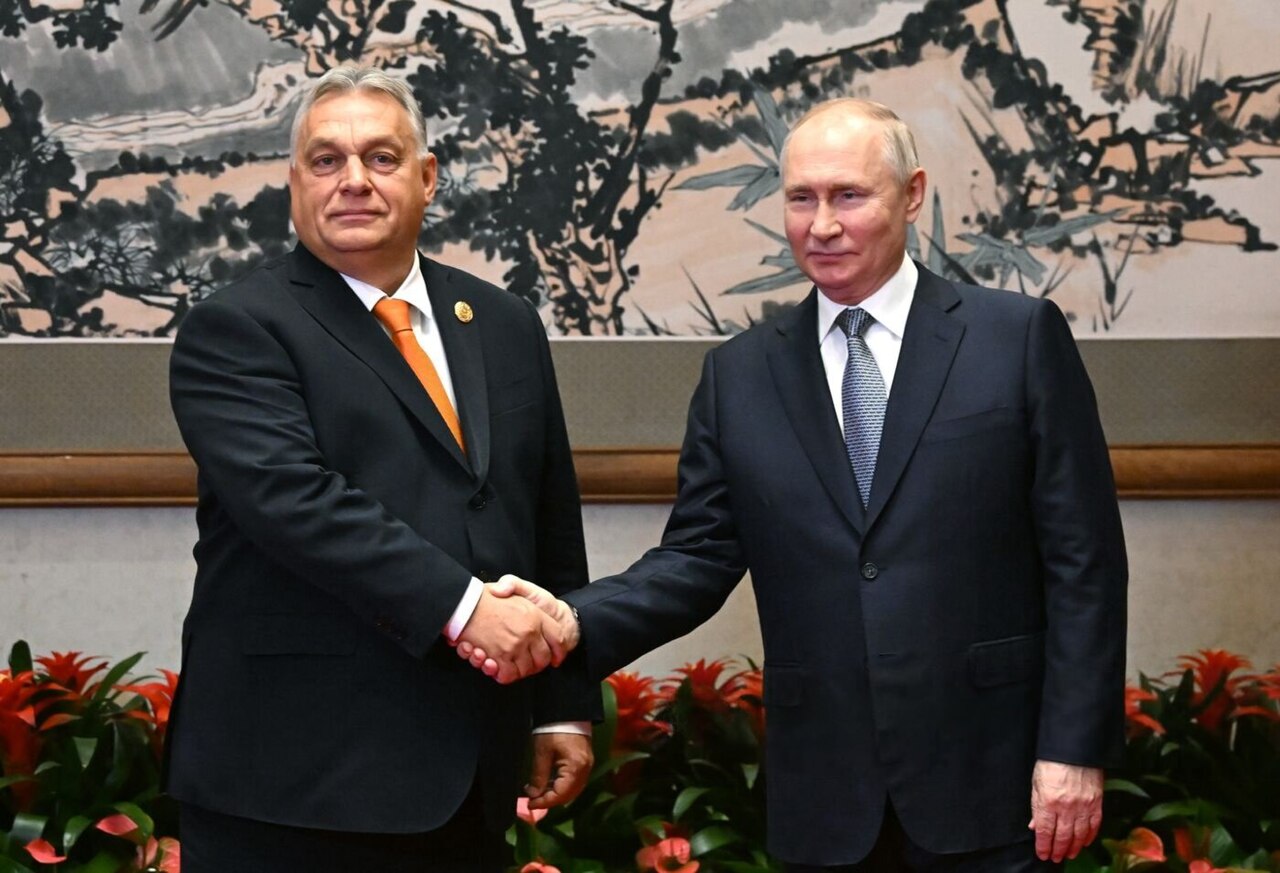
With less than three weeks left before Hungary’s pivotal election, incumbent Viktor Orban is stuck several points behind his main rival, anti-corruption activist Peter Magyar. According to a new report via accomplished investigative reporter Catherine Belton, via the Washington Post, Orban’s allies in Moscow may have conspired to turn the election in Orban’s favor.
According to an authenticated internal report circulated within Russia’s foreign intelligence service, agents supported a false-flag proposal to feign an attempt on Orban’s life. Dubbed “the Gamechanger” by Russian planners, the staged assassination attempt was expected to re-focus the Hungarian campaign toward concerns of state security and political stability, where Orban is perceived to bring key advantages.
As of the time of writing, there have been no known attempts on Orban’s life—legitimate or otherwise—in this campaign. Recent global events, however, have raised the specter of violence as a distinct possibility, as demonstrated in the July 2024 attack on Orban ally Donald Trump, and the shooting of Prime Minister Robert Fico in neighboring Slovakia, two months earlier.
The Post also uncovered another layer of alleged subversion by Orban, undermining Hungary’s European allies. Per the report, Orban’s foreign minister engaged in routine contact with Russia’s foreign minister during European Union meetings, passing detailed live reports along to Russia. His rival Magyar vowed an investigation into the allegations if Magyar’s Tisza party is elected to lead the nation.
The claims have only deepened the divide between Orban and his European counterparts, as the European Commission demanded an explanation from Budapest. Weighing in on the issue, Polish Prime Minister Donald Tusk claimed on social media that Hungarian spying was a known concern; “We’ve had our suspicionsabout that for a long time.” European Union officials broadly confirmed Tusk’s claim, speaking anonymously to global media.
The accusations against Orban may come with a political cost for Europe, as they risk rallying Hungarians around the incumbent government in a moment of external challenge. For months, Orban has made attacks on Ukraine into a cornerstone of his campaign approach, insisting that Ukrainian President Volodymyr Zelesnkyy will drag Hungary into the ongoing war across the border.
Orban has routinely opposed EU spending on Ukraine, most recently by vetoing a key support package. Orban alleges that his rivals intend to force Hungary into a conflict, and has accused Ukraine of attempting to attack him and his family. Now, after Orban withstood a dressing-down at a European Council meeting, international analysts fear that European leaders may have partially validated Orban’s accusations of anti-Hungarian sentiment, galvanizing support for Orban at a critical moment.
On Sunday, Budapest welcomed CPAC Hungary, a European version of America’s largest right-wing political convention. While Trump and US Vice President JD Vance will not attend, Orban welcomed right-wing luminaries from across Europe, including Geert Wilders of the Netherlands, Alice Weidel of Germany, Marine Le Pen of France, and Santiago Abascal of Spain, among others. Trump provided a video message in support of Orban’s re-election.
Image Credit: “Orban Viktor es Vlagyimir Putyin 2023-ban” by Grigory Sysoev is licensed viaCC-BY-SA 3.0.
What We're Reading:
According to US intelligence, anywhere from 15,000 to 20,000 Islamic State fighters and family members are now at large across Syria, after the breakdown of the Kurdish-led detention apparatus that Syria had relied on for years.
In this War on the Rocks analysis, Center of Political and Foreign Affairs director Kelly Kassis explains the compounding security challenges facing eastern Syria, as the nation’s new transitional government fails to assert control over Islamic State elements in the countryside.
Around the World:
An airstrike on a hospital in Sudan’s Darfur region left at least seventy people dead, including thirteen children, according to the World Health Organization. The strike targeted a teaching hospital, and appeared to have been launched by the Sudanese Armed Forces, whose officials claimed to have attempted to strike a nearby police station.
The Sudanese Civil War is spreading across the Chadian border, where the paramilitary Rapid Support Forces and pro-regime ethnic militias now regularly wage hit-and-run attacks on either side of the border zone. Militia fighters, predominantly affiliated with the Zaghawa Joint Force, have found relatively safe haven on Chadian soil, where they threaten both Chadian local stability, and RSF supply lines from the neighboring nation.
Also in Sudan, the Rapid Support Forces and other allied forces launched an offensive northward from the South Sudanese border, toward the border city of Kurmuk. According to local sources, the RSF may have been supported by neighboring Ethiopia, an allegation that has been amplified by the Sudanese Armed Forces.
In Myanmar, fighters loyal to two rebel armies , where the Myanmar National Democratic Alliance Army (MNDAA) captured the town from their former allies, the Ta’ang National Liberation Army. Both of the groups are ethnic militias, who formed two-thirds of the Three Brotherhood Alliance that anchored the key rebel push, Operation 1027, in 2023 and 2024. The two groups have a history of intermittent skirmishes and disputes, but in this case, the MNDAA appears to be working to unlock a strategic highway, for Beijing’s benefit.
A raid in Burkina Faso by the JNIM terror insurgency left approximately twenty Burkinabe troops and partnered militia fighters dead, at a site east of the city of Kaya. In neighboring Mali, however, local reports indicate that JNIM has agreed to a trucewith the ruling military junta, and agreed to stop its attacks on fuel convoys until at least May of this year.
As the war in the Middle East continues to escalate, security is deteriorating in the Israel-occupied West Bank territory, where, this week, Israeli settlers rampaged through over a dozen villages on two consecutive nights and destroyed Palestinian homes, fields, and vehicles. The raids were prompted by the killing of an 18-year-old settler in a road collision on Saturday; Israeli troops and police units were present for settlers’ retributive attacks, but largely declined to intervene.
French naval vessels interdicted and boarded the Mozambican-flagged oil tanker Denya on Friday, after identifying the vessel as part of Russia’s sanctions-dodging shadow fleet. The ship had departed from Russia’s port of Murmansk several days prior, and was escorted into French custody near Marseilles. This is France’s second shadow tanker boarding this year.
US and Nigerian officials confirmed that the United States has deployed multiple copies of its MQ-9 Reaper drone to Nigeria alongside approximately 200 troops, to facilitate intelligence-gathering against a range of militant groups in the country’s north. According to both nations, those drones are not being used to carry out airstrikes at this time.
Russian state media revealed that paramilitary troops from the nation’s Africa Corps are present in the Republic of the Congo, where long-time dictator Denis Sassou Nguesso was recently re-elected in a tightly controlled vote. Africa Corps units are believed to be working in a troop-training and tactical advisory role; the Republic of the Congo deals with a long-running, but low-grade insurgency in the aftermath of the Pool War of 2016 and 2017.
A Colombian Air Force airlifter crashed in the Amazon on Monday, while carrying 125 people on board. According to Peru’s Defense Minister, the C-130 plane hit the ground shortly after takeoff, and the resulting fire triggered the explosion of ammunition carried onboard. Sixty-six people are reported killed, as of the time of writing.