
WarFronts Weekly 5.19.2026.
🟨 WarFronts Weekly | New Report Alleges Cuban Drone Threat & More
Evan Moloney • May 19, 2026

“If [US invasion] were to materialize, it would trigger a bloodbath with incalculable consequences, plus the destructive impact on regional peace and stability.”
-Cuban President Miguel Diaz-Canel, on X.
New Report Alleges Cuban Drone Threat:
According to a Sunday report released by Axios, the blockaded nation of Cuba has acquired over three hundred military attack drones, and is considering plans to leverage those drones in attacks against American warships, the US Navy base at Cuba’s Guantanamo Bay, or the islands of the Florida Keys.
Axios cites classified US intelligence in its report, which indicates that because of the presence of Iranian military advisers on Cuban soil, Washington considers these drones to constitute a meaningful threat. Per Axios, Cuba has been building a drone stockpile since 2023, using drones acquired from Russia and Iran.
If true, then the presence of military attack drones would be the latest known instance in which the Cuban military has sought to learn from the wartime experience of its allies abroad—including Russia, where an estimated 5,000 Cubans have taken part in the invasion of Ukraine. Russia and China each operate outposts on Cuban soil.
Cuba forcefully denied the allegation once it was made public, accusing Washington of creating a “fraudulent case” to justify sanctions and military intervention. Axios acknowledged that according to US officials, Cuba is not believed to be planning any imminent attack on US interests, instead describing drone warfare as a contingency plan in Cuba’s arsenal.
On Monday, however, Cuban President Miguel Diaz-Canel threatened a “bloodbathwith incalculable consequences” if the United States were to attack. Diaz-Canel has attempted to signal ongoing resistance to US action, including the possibility of an indictment against 94-year-old ex-leader Raul Castro, and a visit to Cuba by CIA Director John Ratcliffe—who demanded that Cuba make “fundamental changes” to prompt negotiations with Washington.
The type of drone allegedly in Havana’s possession has not yet been identified, either officially or unofficially, although the threat of attack against the Florida Keyswould imply a range of roughly two hundred kilometers at least. Axios’ report describes the issue as an “attack-drone threat”, meaning that these are one-way kamikaze drones.
While any kamikaze drones in Cuba’s possession would present a meaningful threat to the United States, the technology does have limitations. A total of three hundred drones may be enough to overwhelm local air defenses in a small handful of locations, but this stockpile would run out very quickly in the event of all-out hostilities with the US, if the munitions are not tracked and destroyed prior to launch.
Cuba’s partnership with Iranian advisors may help to evolve Havana’s offensive potency, but Cuban forces are broadly inexperienced in drone warfare. The United States, meanwhile, would be expected to deploy air-defense systems surrounding Cuba in the event of full-scale attack, and may be able to concentrate enough air defenses that a wave of Cuban drones could be intercepted in its entirety.
Image Credit: “An aerial view of Naval Base Guantanamo Bay’s windward side […]” by James Schoole isdedicated to the public domain.
This Week on WarFronts:

Last Friday, WarFronts hosted an interview with Illya Sekirin, a former front-line drone operator and current strategic advisor to Ukrainian high command. In that interview, Sekirin detailed the possibility that Russia may attempt a new offensive against a NATO-member state in the near future, possibly capturing the three Baltic states.
On the same day, Ukrainian President Volodymyr Zelenskyy issued a similar warning, alleging that Russia is searching for ways to draw Belarus further into its invasion, and may be considering an attack on a NATO member state from Belarusian territory. While Zelenskyy did not name a specific target nation, Latvia is currently understood to be the most vulnerable NATO nation in the area, and shares borders with both Russia and Belarus. Latvia’s ongoing political crisis, also related to the Ukraine invasion, has only made matters worse.
India, Pakistan Take Positions on Gulf Rivalry:
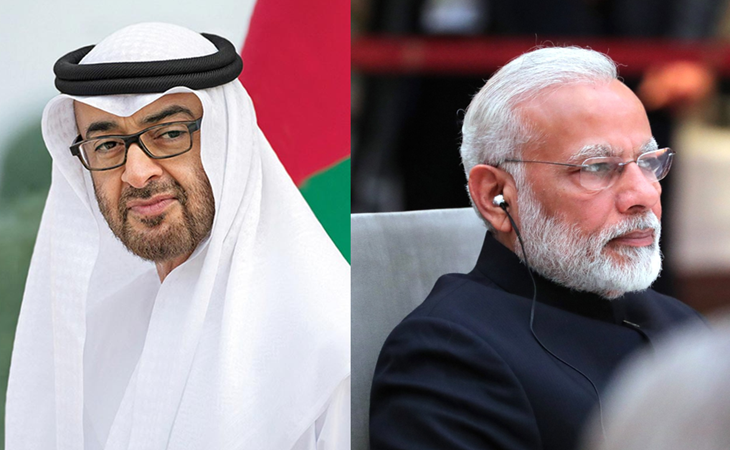
South Asian rivals India and Pakistan are each pursuing an increasingly active role in the Persian Gulf’s growing schism, which pits the United Arab Emirates (backed by Israel) against Saudi Arabia (joined by Turkey, Qatar, Egypt, and other nations). While New Delhi and Islamabad each sense an opportunity to counter each other’s influence, the two nations are also working to take advantage of growing demand for a regional security guarantor.
Last Friday, India and the Emirates made international headlines, when the two nations agreed to the framework for a strategic defense partnership. In an announcement following a visit by Indian Prime Minister Narendra Modi to the UAE, the two nations’ foreign ministers announced new cooperation on defense-industrial matters, maritime security, cyber-defense, military training and exercises, and the establishment of strategic petroleum and liquefied natural gas reserves.
The framework brings real benefits for India, which has suffered profound disruptions to its domestic energy sector after the Strait of Hormuz was mostly closed to maritime trade. For the Emirates, the deal is an endorsement of Abu Dhabi’s recent decision to leave OPEC, as well as a partnership with one of the world’s small handful of nuclear-armed nations. Israeli media hailed the deal as a stabilizing influence on the region.
Not to be outdone, Pakistani government and security sources confirmed to Reuters that Pakistan has already deployed some eight thousand troops to Saudi Arabia, along with a squadron of fighter jets and an air defense system. The deployment includes eighteen combat aircraft, mostly Chinese-designed JF-17 fighter jets, along with two squadrons of drones. The 8,000 new troops will join thousands of Pakistani soldiers previously deployed to Saudi territory.
The deployment is Pakistan’s latest effort to support Saudi Arabia, in line with a mutual defense pact that the two nations signed in 2025. According to one source speaking to Reuters, the troop deployment may be semipermanent, and could grow to a force of up to 80,000 Pakistani troops, joined by warships and additional military aircraft.
Also this week, both Riyadh and Abu Dhabi have worked to advance their respective visions of a post-war order in the Persian Gulf. According to the Financial Times, Saudi Arabia has floated the idea of a regional non-aggression pact, including Iran, to several other Middle Eastern capitals. The idea has garnered the support of several European capitals, as well as the European Union writ large.
The Emirates, meanwhile, established a joint fund with Israel that will guide the acquisition and development of new weapons systems, per reporting by the Middle East Eye. The deal will clear a path for the Emirates to invest in Israeli air defense system development, and will include the acquisition of other air-defense measures and innovative weapons.
Image Credit: “РусскийПремьер-министр Индии […]” by Kremlin.ru islicensed under CC BY 4.0. “Sheikh Mohamed bin Zayed al Nahyan aka MBZ, the […]” by Kalashae islicensed under CC BY-SA 4.0. Composite by WarFronts.
What We're Reading:
Eighteen months after the fall of Syria’s Assad dynasty, transitional authorities continue to hunt down enforcers of the old regime, many of whom have attempted to quietly return to civilian life.
This profile by New Lines Magazine explores the case of Hala Mounir Mohammad, a resident of Syria’s Latakia Governorate who worked as a hairstylist before and after the fall of the regime. According to a growing number of former Syrian detainees, Mounir lived a double life in Syria for years, moonlighting as a particularly fearsome prison guard for Assad’s notorious Air Force Intelligence branch. Months after her arrest, much of Mounir’s community has yet to accept the charges against her, as is often the case when the abuses of Assad-era enforcers come to light.
Our WarFronts/HomeFronts Team is proud to announce the launch of Fronts.co, our brand-new subscriber service.
Around the World:
Ukraine launched heavy drone and missile strikes against Moscow over the weekend, in Kyiv’s biggest attack on the Russian capital since the start of Russia’s invasion in 2022. Ukraine struck defense-industrial targets, an oil refinery, multiple pumping stations, a factory that produces precision-weapon microchips, and other targets across the Moscow region, leveraging over 1,300 drones across the weekend. Three people were killed in the Moscow region and eighteen injured, including twelve in the capital city, although drone debris from successful interceptions appeared to be responsible. The attacks were a reprisal after Russia launched over 1,500 drones and missiles within just twenty-four hours last week, and were confirmation of Ukraine’s ability to strike Moscow, despite its restraint during Russia’s May 9 Victory Day parade.
A drone strike sparked a fire at the United Arab Emirates’ only nuclear power plant on Sunday, after three drones traveled into Emirati territory and another three were shot down in Saudi airspace. The Emirates noted that the drones had entered from the nation’s western border, implying that they were not launched by Iran directly; Iraq-based proxy militias or Yemen’s Houthi rebels may have been responsible. No radioactive material was released in the strike, and the nuclear plant was unharmed; an on-site generator was destroyed.
An Israeli airstrike in Gaza last Friday killed Izz al-Din al-Haddad, the leader of Hamas’ military wing and one of the few surviving architects of the October 7, 2023 attacks against Israel. Al-Haddad’s death was acknowledged by Hamas, as well as al-Haddad’s family, who indicated that his wife and daughter were also killed in the strike. Al-Haddad had led Hamas military operations since the death of Mohammed Sinwar in May 2025.
The United States and Nigeria carried out a series of joint airstrikes against Islamic State targets in the country’s northeast, in the Lake Chad region, killing roughly twenty Islamic State members according to the Nigerian military. One day prior, a joint US-Nigerian operation killed Abu-Bilal al-Minuki, the second-in-command of the Islamic State – West Africa Province—but not the second-in-command of the global Islamic State, as both governments have alleged. Elsewhere in Nigeria, a raid on a village in rural Katsina State left at least ten people dead, including women and children, at the hands of what one local resident described as “heavy armed bandits with sophisticated weapons”.
A suspected cartel attack in Mexico’s Puebla State left at least ten people dead on Sunday, including six men, three women, and a child. The motive for their killing has not yet been publicly identified, but Puebla State is the frequent site of cartel-related violence against civilians. More broadly, central Mexico is witnessing a spike in cartel attacks that has caused thousands of families to leave for safer territory.
A Houthi-run court in western Yemen sentenced nineteen people to death on Sunday, after they were convicted of establishing an armed group that fought alongside a Saudi-led, anti-Houthi multinational coalition from 2015 to 2023. The sentence was announced just days after the Houthis and Yemen’s internationally recognized government agreed to the largest prisoner swap in the conflict’s history.
Venezuela deported the Colombian-Venezuelan billionaire Alex Saab to the United States, three months after his arrest in a joint US-Venezuelan operation in Caracas. Saab is a close ally of Nicolas Maduro, and is likely to provide information to US authorities that will strengthen Washington’s legal case against the detained president. On Monday, Saab was charged with money laundering and bribery for purposes of self-enrichment.
After a highly contentious, month-long vote count, right-wing Peruvian opposition leader Keiko Fujimori and leftist candidate Roberto Sanchez will move on to a June runoff election. The country faces a serious and evolving internal security crisis, as transnational criminal groups expand their presence on Peruvian soil. Separately, Fujimori’s fourth attempt to win the presidency will provide yet another reckoning on the legacy of her father, deceased former dictator Alberto Fujimori.
Hungarian President Tamas Sulyok is resisting calls from new Prime Minister Peter Magyar demanding his resignation, after Magyar has taken expansive action against enforcers and enablers of ousted ex-premier Viktor Orban. A direct Orban appointee, Sulyok’s role is largely ceremonial, but his resistance will likely prompt an attempt at early constitutional reform by Magyar and his allies.