
WarFronts Weekly: 9.29.2026.
🟨 WarFronts Weekly | Daring Ukrainian Airdrop Raises Operational Security Concerns & More
Fronts Staff • September 29, 2026

“People have run out of food. They’re making soup with weeds, throwing in purslane, lamb’s quarters, and amaranth. I can’t even talk about the animals anymore — they have it worst of all. I just cry and don’t know what to do.”
-Unidentified Ukrainian resident of Oleshky, speaking to Ukrainska Pravda.
WarFronts Weekly
29.09.2026
Daring Ukrainian Airdrop Raises Operational Security Concerns:
Since 2022, the southern Ukrainian city of Oleshky has been under continual Russian occupation. Beginning this May, Russian forces have imposed a blockade on the area, where an estimated 2,000 residents—including around fifty children—still remain. But although a daring Ukrainian drone drop recently delivered around 4,000 kilograms of food to the city, Kyiv’s handling of the situation has raised legitimate concerns of incoming Russian reprisals.
Under the current state of siege, residents of Oleshky have been barred from evacuating, as Russian troops actively interfere with any incoming deliveries of supplies, by drone or otherwise. According to sources on the ground, the city has not received any food through ordinary means since the blockade began in May. Those same sources claim that residents suspected of having contact with Ukrainian leaders or military personnel are executed immediately.
Russia’s decision to blockade Oleshky, rather than conducting a standard occupation, appears to be intended to turn residents into hostages amidst nearby front-line fighting. Ukrainians in the city are without medical supplies, and must move around frequently to avoid drone attacks.
After relying on home gardens for most of the summer, one resident told Ukrainska Pravda: “People have run out of food. They’re making soup with weeds, throwing in purslane, lamb’s quarters, and amaranth. I can’t even talk about the animals anymore — they have it worst of all. I just cry and don’t know what to do.”
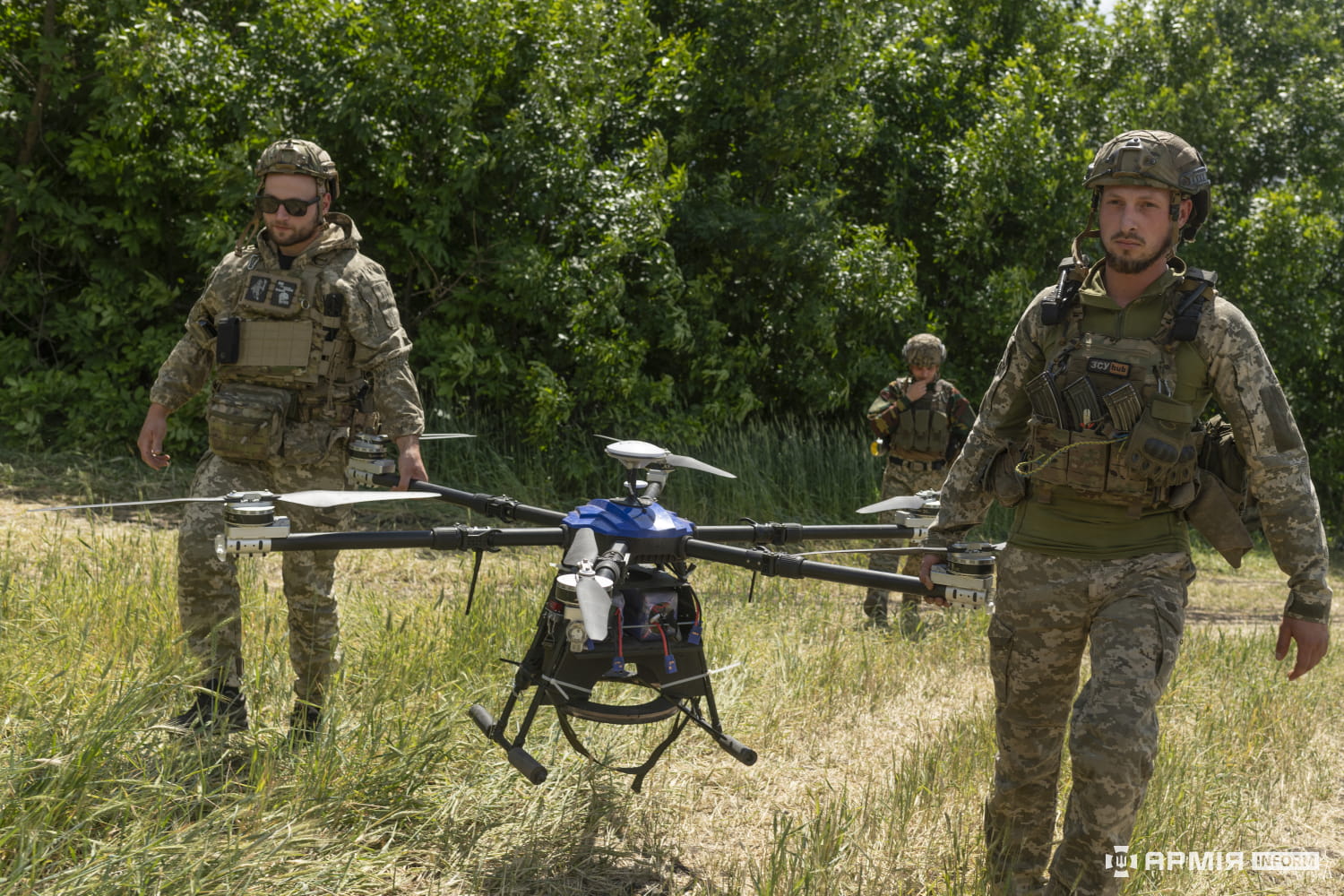
As the city’s predicament worsens, Ukrainian forces have relied on heavy-lift multirotor drones to deliver food and medicine, using heavy-lift models that can also resupply front-line units or act as bombers. Because Oleshky is a front-line town, Ukrainian heavy drones can reach the area relatively easily, although they are likely to be shot down on approach or exit.
So, when Ukraine managed its four-tonne delivery to Oleshky within the last week, delivering small supply packages across one hundred locations in total, the operation provided desperately needed relief for locals. But the Ukrainian governor of Kherson region, where Oleshky is located, may have done more harm than good—publicly acknowledgingthe operation, and detailing the specifics of Ukraine’s aid delivery. Officials in Kyiv later amplified those remarks, through their own statements on the matter.
While Russia was likely to target aid recipients and delivery drones anyhow, experts and Ukrainian observers expect that now, Russia will redouble its efforts to hunt down and punish any residents who took the aid once it was delivered. Even according to Kherson’s governor, Russian troops are confiscating parcels and detaining residents who’ve found them. Their lives may be in acute danger, especially now that Oleshky has become a subject of greater international attention.
Image Credit: “Kazhan bomber hexacopter in 25 th Airborne Brigade of Ukraine” by ArmyInform is licensed underCC BY 4.0 International.

Introducing DefenseFronts:
The team behind WarFronts, HomeFronts, and Fronts.co is proud to announce the launch of DefenseFronts on YouTube.
On DefenseFronts, our team takes a close look at the global defense industry, focusing on the tech, the tactics, and the cutting-edge innovations that shape modern battlefields. From changing alliances to future flashpoints, we know that today's global military-industrial complex is a window into tomorrow's geopolitics. With Simon at the helm, and a growing team of experts and Fronts-universe veterans working behind the scenes, we know you'll love DefenseFronts, so check it out.
This Week on Fronts:

While most of the world’s foreign-affairs coverage focuses on European, Indo-Pacific, or Middle Eastern conflicts and controversies, the rich and complex stories of the Global South often go unnoticed.
That’s why our Fronts team offers Due South, a regular podcast focused on affairs across Africa, Latin America, South Asia, and Oceania. Fronts Africa Correspondent Wilfred Waimiri interviews guests from all over the world, for an in-depth examination of geopolitical issues that few outlets are willing to touch.
Recent episodes include Dr. Yagiz Sullu on African economics, open-source intelligence expert Paweł Wójcik on the Sahel security crisis, and Dr. Caroline Mose on Kenyan youth and elections. This week, Due South will feature Mike DeAngelo of the Critical Threats Project, on the evolving crisis in Ethiopia, and Robel Alemu, communications director of the Amhara Association of America.
More Questions Than Answers After RAF Fairford Incident:
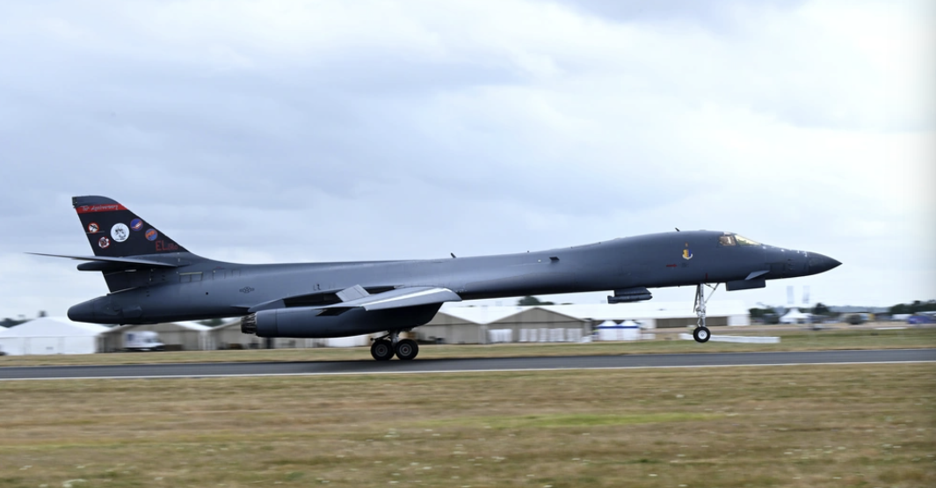
A weekend security incident at Britain’s RAF Fairford air base is still under investigation, after five men were apprehended near the base on suspicion of preparing a terrorist act. But although RAF Fairford hosts American long-range strategic bomber aircraft, and could credibly be a target of several nations and non-state groups hostile to the US and Britain, new details suggest that the suspects’ motives may have had little to do with global affairs.
RAF Fairford was already the subject of immense internal scrutiny prior to Sunday’s incident, with the British military tightening security at the site and raising its assessed threat level. Britain and the United States were aware of threats to the airbase, according to British security insiders.
So, when a local farmer encountered three white vans blocking a country road, in the sleepy nearby village of Whelford, UK authorities leapt into action. The vans, fraudulently labeled to resemble a real mobile fuel delivery service, were intercepted as they approached the base. Five men were apprehended at the scene, and were later pictured with their shirts removed while being held by armed police.
According to local British authorities, the vans had been tracked for nearly an hour prior to the local farmer’s call to emergency services. National officials later indicated that the vans were thought to be carrying explosives, with a bomb-disposal robot deployed to the scene.
On its face, the incident seemed to be an obvious attempt to threaten RAF Fairford. While British law enforcement did not immediately identify a foreign power backing the suspected attack, Iran has threatened attacks against military targets in Europe that support US operations in the Middle East. Russia, meanwhile, is behind an escalating sabotage campaign against Europe, while European nations face an enduring threat of Islamist extremist attacks by non-state groups.
Over the following days, however, British counterterrorism police appear to have found substantially less evidence of a terror or hybrid threat than anticipated. All five arrested suspects were found to be Londoners, aged 23 to 25, while the suspected vehicle-borne bombs were found not to be active explosive devices. The suspects were later granted bail—a highly unusual decision, if counterterror police had gathered enough evidence to link them to a specific act or threat.
American authorities have doubled down on the idea that the incident was, indeed, a likely terror plot, backed by a foreign power. US Secretary of State Marco Rubio claimed on television, in a Monday interview, that the incident “clearly involves the hands of a foreign actor”. US President Donald Trump criticized the bail decision, stating that the US “would not have released them”.
Despite the US’ stance, however, Britain’s handling of the situation suggests that the men may have intended to carry out a petty crime, such as fuel theft. Nonetheless, the head of the UK’s counter-terror police, Laurence Taylor, indicated that the men are still under investigation and have been released under strict bail conditions, with police keeping “an open mind” on potential foreign involvement.
Image Credit: “U.S. Air Force B-1B Lancer arrives at RAF Fairford to support RIAT 2025 [Image 6 of 6]” by TSgt Robert Trujillo, identified by DVIDS, isdedicated to the public domain.
What We're Reading:
Russian President Vladimir Putin is increasingly isolated within Russia, as elite discontent and economic panic mount within the Russian oligarchy. This extended report, by the Australian Broadcasting Corporation, offers a new series of testimony from Russian sources who have recently interacted with Putin—highlighting both his paranoia, and his consolidation of Moscow’s power under his personal control.

Join the Fronts Community:
Love our work on WarFronts, HomeFronts, and DefenseFronts?
Fronts.cois our team's independent media outlet, where we join forces with global conflict analysts and subject-matter experts, to dive deeper on geopolitics than we ever could on YouTube.
Also on Fronts, we host our premium subscriber service, where we offer exclusive video episodes and ad-free access to our entire YouTube back catalogue.
Frontsvisitors enjoy free access to our regular podcast series, Due South and the Middle East Roundtable,no account required, plus a free selection of written articles and this very e-mail newsletter, WarFronts Weekly.
A subscription to Frontscosts just $5 USD each month, or $50 USD each year. With your support, our team can maintain our independence, and create new, free offerings like HomeFronts and DefenseFronts, for all of our fans around the world.
Around the World:
At least forty-nine people were killed in an airstrike by Myanmar’s military on Monday, when a bomb hit a busy market in western Rakhine State. The airstrike impacted the town of Kyauktaw, far from where government forces are attempting to advance in a counteroffensive against rebel positions in the same state. The airstrike appears to have killed mostly or entirely civilians, in the deadliest single strike on a Rakhine State civilian target since a December 2025 bombing of a hospital killed thirty people.
Ethiopian federal forces and allied militiamen announced the capture of the strategic town of Alamata, roughly 120 kilometers south of the capital city of the Tigray region, a week after Tigray rebels and an allied resistance coalition began military operations against Addis Ababa. The capture of Alamata is a key early setback for the rebels, who launched an offensive to consolidate control over Tigray, but have faced stiff resistance from government forces after a series of early, minor victories, including the seizure of airports that were ceded by government forces.
Over fifty troops from Niger’s security forces were killed last week in two separate attacks, in the area of Abala-Filingué on Wednesday, and in Birni N’Konni on Saturday. In the first attack, a militant group ambushed a convoy of national police, while the latter attack led to the deaths of more than thirty troops under unclear circumstances. The al-Qaeda-linked insurgency JNIM and the Islamic State – Sahel are both highly active in Niger, but the Islamic State claimed responsibility for these attacks. The killings come just weeks after mutineering front-line troops narrowly failed to overthrow Niger’s military government, weakening Niger’s capacity to resist the jihadist groups in hard-hit areas.
Afghanistan’s defense ministry announced that it killed twenty-eight fighters and wounded thirty-two others in the eastern border province of Nuristan, after the group crossed over from neighboring Pakistan. According to Kabul, the group included Islamic State militants and former members of the pre-Taliban Afghan government, and had received support from Pakistani militias. Islamabad rejected Kabul’s claim, and insisted that its intelligence services have not recruited, trained, or facilitated Islamic State or other anti-Kabul activity. Afghanistan’s latest claims echo Pakistan’s claims in the opposite direction, accusing the Afghan Taliban government of directly supporting the Pakistani Taliban militant group.
Across the border in Pakistan, the northwestern city of Dera Ismail Khan was hit by an explosion on Saturday that killed at least twelve people, and injured thirty others. The Pakistani Taliban claimed credit for the explosion, in which a suicide bomber attacked a police checkpoint with a vehicle-borne device. Most of the dead were security personnel, according to a local police chief, with two civilians confirmed to be among the dead. On Monday, militants in Pakistan’s Tank district carried out another attack, a drive-by motorcycle shooting that left three police officers dead and three others wounded.
At least eleven people were killed in a retaliatory attack by Haitian gangs in the central region of Artibonite, after a Sri Lankan unit of Haiti’s UN-backed Gang Suppression Force killed at least three gangsters while clearing out illegal road tolls. The gang reprisal came after the Sri Lankan force left the area, with gangsters instead burning homes and killing civilians. The death toll is expected to rise in the coming days, while the Gang Suppression Force faces a United Nations renewal vote today.
Fighting erupted again in the Somali city of Baidoa on Monday, where forces loyal to the former president of Somalia’s South West State launched their latest attack on federal positions. While the battle spread across several neighborhoods, with casualties reported, the scale and impact of the latest round of violence is not yet known. Baidoa had recently received reinforcements from Mogadishu, in preparation for new resistance attacks—which Mogadishu claims are carried out by an alliance comprising South West State loyalists, and the jihadist organization Al-Shabaab.
Serbian President Aleksandar Vucic resigned from his post on Sunday, ending his second and final five-year term eight months before its scheduled conclusion. The timing of Vucic’s decision will allow him to seek a parliamentary seat in Serbia’s upcoming election, on October 25—which will, in turn, clear the way for his appointment as Prime Minister if his ruling Serbian Progressive Party can retain its mandate to form a government. Vucic and his allies are expected to win the election despite public protests, after years of authoritarian backsliding and an unusual consolidation of power in the Serbian presidency.
Indian opposition leaders are demanding the resignation of Gyanesh Kumar, the nation’s Chief Election Commissioner, after The Indian Express revealed that Kumar’s two top deputies raised at least fourteen formal objections within just ten months over Kumar’s handling of voter rolls. According to Indian political analysts, around 130 million people have been struck from voter rolls, roughly one in eight eligible voters, since Kumar began a set of revisions last year. India’s rising, youth-led Cockroach Party has threatened to hold nationwide protests over Kumar’s role, starting this Friday, while the leading opposition Congress Party has called for a treason investigation.