
GlobalInsider article10 min read
AI is Proliferating on the Battlefield. The Ethical Implications are Hard to Ignore
AI safeguards are particularly hard to implement in defense, but having a human pull the trigger has always been the fail safe. Now, that's being sidelined.
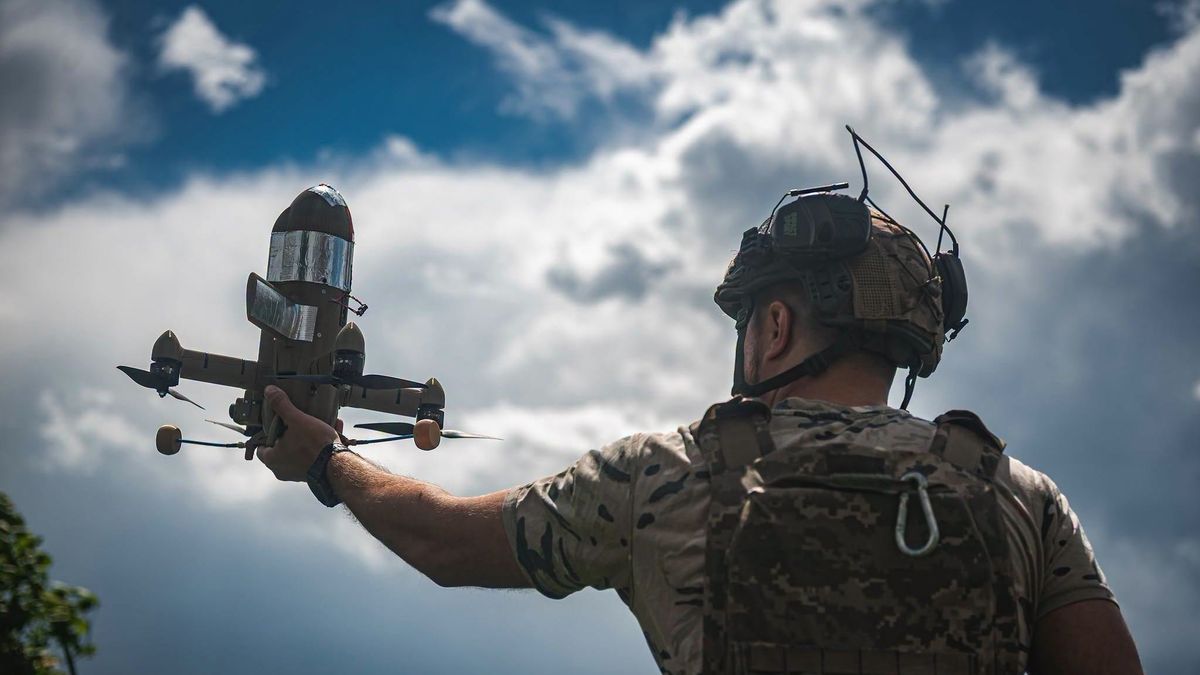
In recent weeks, AI has garnered a lot of press for advancing the field of mathematics. But on a wholly different field - the battlefield - the advantages of AI have been visible for some time. As one Ukrainian operator put it, “robots don't bleed,” and Ukraine estimated that over 22,000 lives had been saved by this summer, purely by sending uncrewed autonomous systems (UAS) into combat rather than humans. These systems are increasingly “human-independent:” collecting, processing, prioritizing, and sometimes even killing without input. So why should it matter if there's no human in that blur of technological speed? After all, if AI can learn to detect cancer, why can’t it detect an enemy combatant?
You won’t be surprised to learn that there are issues. One fundamental way AI is trained is to use a bunch of photos as “training data.” Training essentially asks the AI to sort the commonalities and differences in a set of data. “Fit” is whether the AI found the thing you were looking for. Did it in fact detect cancer or - as in one infamous example - did it instead flag the ruler at the bottom of the image? A German firm, for example, was developing a new AI to detect violence on public transit. But any excitement about selling the police on increased detection rates quickly disappeared when it became apparent that the AI associated heavy outerwear with criminality. Perhaps everyone with a weapon was wearing a coat to conceal it… In Germany though, it's more likely merely a signifier that it is, in fact, winter. Moved into national security, where the “bad guys” could have a different national dress than your training data? Ruler, meet ethics problem.
What Loop?
Most ethical AI approaches want to see the training data, and see the AI in action: test data, roughly speaking. Can the AI find cancer in images with no ruler? How many of its suggested kill shots were civilians, wrongly profiled? That would be test data. There are ethical AI approaches that examine the algorithm itself– that algorithm which, even in the most civilian of contexts, is expensive to train, probably proprietary, and quite possibly full of trade secrets. Throw in classification, and it’s a hard ask to examine that. One option would be to create “law-following AI,” or AI programmed to obey at least a subset of laws… but as Anthropic employees have pointed out, what is programmed can be un-programmed.
The way we've traditionally found rulers– as much as AI has a “traditionally”-- has been through some level of human review. In addition to being unethical, AI that discriminates on national dress isn't exactly useful. A human reviewing the output of such an algorithm might have a similar reaction to one confronted with lots of images of rulers: the fit is off. Experience, intuition, morality and all the rest would say that there were too many rulers. Or that the one person currently being targeted was probably innocent. That feedback would provide more training data, which helps “fit” the algorithm better. Looking at how much companies like Anthropic have spent in training data, effort, and lawyers to develop the “best” models, that fit is important. It's the difference between an AI scheduling assistant finding meeting times to your boss’ “when are you free this afternoon,”and the old auto reply suggestion of “no.” As algorithms get better, their mistakes get better, and harder to catch.
To use a very civilian example, that fit is important because too strict a fit could lock anyone out of their iPhone unless they had the same expression and lighting as the original photo. (Much) too loose and it might let anyone with the same eye and hair color unlock the phone. Most people would prefer a fit that lets them unlock the phone lying in bed with their face slightly smushed, but that doesn't unlock for their sibling, child, or parent. Put into defense terms, the fit should keep China from accidentally surveilling its entire Uyghur population. AI should not be so poorly trained that it discriminates or generalizes based on race– even though that's what cheap, poorly trained AI tends to do. An appropriate fit should find the AI tracking the target, and pretty much only the target.
Loading…
We couldn’t load the rest of this article just now.
Insider article
This article is for Fronts Insiders.
Two-thirds of this analysis is still to come.
Free, no card
Read this free with a Fronts account
Then one Insider article a month. No card, no password.
- Enter your email
- Read on
- Confirm your email later
The robot check is taking too long.
or email support@fronts.co
The form could not start. Reload the page and try again, or email support@fronts.co.
Make a free accountAlready have one? Sign in below.
Fronts Insider
$5 a month · or $50 a year
- Every Insider article
- 132 exclusive videos
- All 938 WarFronts and HomeFronts videos, sponsor-free
- Cancel anytime. Money back within 30 days.

Already an Insider? Sign in and you'll land back here.
Insider article
This article is for Fronts Insiders.
Two-thirds of this analysis is still to come.
Your free article
Read this one free
You get one Insider article a month. Use it here?
Fronts Insider
$5 a month · or $50 a year
- Every Insider article
- 132 exclusive videos
- All 938 WarFronts and HomeFronts videos, sponsor-free
- Cancel anytime. Money back within 30 days.
Free to read now
No account needed
The US Withdrawal from Iraq is Islamic State's Best Chance for a Comeback
Paweł Wójcik · 12 min read
We Spoke to One of Britain's Top Generals about Drones. This is What He Had to Say.
Fronts Staff · 12 min read
Tanks are Not Dead. They Do Need to Change
Jakub Janovsky · 11 min read