AfricaInsider article15 min read
Russia is Trying to Sustain Africa Corps at all Costs. Here's How.
Key insights1 of 4 shown
- Russia has constructed a viable alternative maritime logistics route through Togo to sustain Africa Corps operations in Mali after facing political obstacles in Guinea.
- Locked: for Insiders
- Locked: for Insiders
- Locked: for Insiders
In mid-July, a convoy of Russian military vehicles crossed the border between Burkina Faso and Mali, heading toward Bamako, where Moscow’s Africa Corps are bogged down battling an insurgency. While Africa Corps is regularly resupplied and reinforced by Moscow through a sophisticated maritime and land logistics network, the new element is the point of entry to the African continent: Lomé. The convoy had traveled north from the port, in Togo, following the arrival earlier that month of the Russian cargo ship MIKHAIL BRITNEV. For the first time, Moscow had demonstrated the existence of a viable alternative to its well-established Guinean supply route to Mali, a landlocked country.
This supply chain relies on key elements: commercial cargo ships, politically accommodating ports, road corridors, Russia-linked commercial infrastructure, and a willingness to transport military equipment.
Guinea had been a vital partner in this scheme, but Togo now appears to be replacing it: a sign of significant political shifts in the Gulf of Guinea that could have wider impacts on Russia’s wider Africa strategy.
Conakry: The Kremlin's Vital Port in Africa
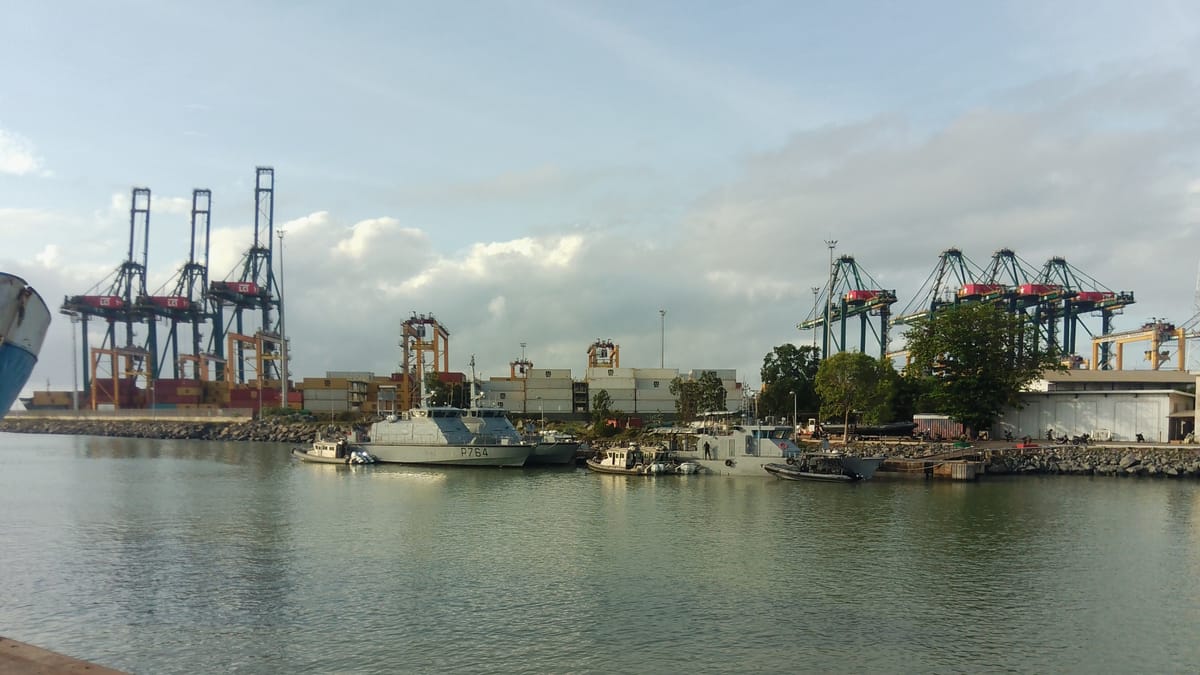
Guinea depends heavily on its port, situated on a small peninsula. This one piece of infrastructure accounts for a significant portion of the country’s GDP and is under the government’s full control, which explains the presence of foreign companies such as Rusal (Russian), Albayrak (Turkish), COSCO (Chinese), and CMA CGM (French).
Since Guinea is one of the world’s largest exporters of bauxite as well as gold, the port’s strategic role is clear. But Conakry’s importance lies in the wider ecosystem around it. The port shortens the road run to Bamako to roughly 995 kilometers, a distance that can be covered by a military convoy in around 17 hours under ideal conditions, although real movements require far longer once security, loading, fuel and border procedures are included. The road is not totally safe (multiple terrorist groups operate in western Mali), but it is direct: Guinea to Mali, rather than a chain of coastal and Sahelian transit states.
The use of the Port of Conakry by Russia for military purposes has been confirmed on multiple occasions since January 2025 through a combination of ship-tracking data, commercial satellite imagery, geotagged videos of convoys, and local news reports.
The first clearly documented instance dates back to January 2025. The writer of this very piece, along with RFI’s fact-checking unit, tracked the Russian cargo ships ADLER and SIYANIE SEVERA as they sailed from Murmansk to Conakry. The unusual route taken by the two ships off the coast of Morocco quickly drew the attention of analysts. The ADLER was located at dock from January 7 to 12, and the SIYANIE SEVERA from January 11 to 18. Maxar imagery subsequently showed a large military convoy on National Route 1 in Guinea on January 14. Three days later, a video showed a convoy of about 100 vehicles entering Bamako.
Comments on social media by port employees and local sources confirmed that this footage revealed a military supply chain transporting equipment “from sea to road” destined for a “nearby” theater of operations (meaning Mali). No official statement was ever issued by the three governments (Mali, Guinea, and Russia), underscoring a desire for discretion regarding the equipment transport operations.
Nevertheless, local sources (which corroborate online statements by certain employees) have made it possible to establish three points:
First, that the unloading operations involved the entire port, which was sealed off by security forces. Second, that these operations took place exclusively at night. Finally, that Guinean military personnel helped secure the convoy all the way to the Malian border.
This logistics operation was used again in May. The author and RFI investigators identified the sanctioned Russian vessels, the BALTIC LEADER and the PATRIA, in Conakry from May 25 to 28, 2025, while eyewitness accounts and videos posted online reported the presence of an associated convoy on the Guinea-Mali route.
Unlike the first attempt, Malian state television showed the arrival of new equipment in Bamako on May 31, claiming that Russia was sending military aid intended for Malian forces. However, the presence of electronic warfare equipment in this convoy (in particular an RB-531B, which is a modified BTR-80) suggests that at least part of the convoy was intended for Africa Corps rather than for Mali’s troops, who are not trained to use such equipment. Not that this should be a surprise: Moscow’s presence in Mali relies on a deliberately blurred line between supplies for the Malian Armed Forces (FAMa) and those for Africa Corps.
A third delivery was made by the Russian cargo ship SABETTA from Baltiysk to Conakry, identified using vessel tracking data and satellite imagery. Satellite images showed the ship in Conakry with military vehicles on board on March 21, 2026. The British Royal Navy also confirmed that it had tracked the SABETTA and the Russian landing ship ALEKSANDR SHABALIN in the English Channel earlier that same month.
The Ships That Made It Work
The table below lists the vessels involved in all publicly documented Russian deliveries to Africa Corps.
Vessel | IMO | Loading/departure evidence | West African port call and onward evidence |
ADLER (2025) | 9179854 | RFI and The Sentry place the January pair leaving Murmansk in early December 2024; the accessible record does not safely attach the 14 or 21 December departure date to a specific vessel. | RFI tracked it at Conakry 7–12 January. An archive MarineTraffic capture records anchorage arrival on 11 January and departure on 12 January, probably a difference between port-area and anchorage fields. A convoy was imaged on Guinea’s RN1 on 14 January and filmed in Bamako on 17 January. |
SIYANIE SEVERA (2025) | 9250385 | Same Murmansk-to-Conakry movement; the vessel was already under US sanctions for Russian military-logistics activity. | Conakry, 11–18 January 2025. It is linked to, but does not by itself prove responsibility for, the January convoy. |
BALTIC LEADER (2025) | 9220639 | Departure port and loading date are not established in the sources reviewed. | Conakry, 25–26 May 2025. RFI identified the vessel there; witnesses placed a convoy on the Guinea route on 28 May and Malian television showed equipment in Bamako on 31 May. |
PATRIA (2025) | 9159921 | Departure port and loading date are not established in the sources reviewed. | Conakry, 27–28 May 2025. The ship formed the paired May delivery with BALTIC LEADER. |
SABETTA (2026) | 9347061 | An archive tracking capture records Kaliningrad departure on 22 February 2026 at 11:13 UTC+3. Satellite imagery later showed military vehicles at Baltiysk in early March; the precise loading/departure sequence therefore remains unresolved in public material. The vessel was tracked west with ALEKSANDR SHABALIN. | Conakry, 19 March 2026 at 14:01 local tracking time; Airbus imagery showed the vessel and its cargo on 21 March. A convoy reached Bamako around 24 March. |
MIKHAIL BRITNEV (2026) | 9081370 | Arkhangelsk departure, 3 June 2026; Baltiysk call, 11 June; archive tracking shows Baltiysk departure at 13:47 on 18 June. AIS went dark after the Channel passage on 23 June. | Archive tracking shows Lomé arrival at 03:07 on 9 July 2026; satellite imagery showed it in port on 12 July. A convoy linked by reporting to the cargo crossed from Burkina Faso into Mali at Doulai Diassa on 23 July. |
The ALEKSANDR SHABALIN should not be confused with the cargo ships: it is a Ropucha-class landing ship of the Russian Navy (MMSI 273318470). Its presence alongside the SABETTA and, later, the MIKHAIL BRITNEV signals a military-linked movement, but is not in itself evidence of a specific cargo.The appearance of Russian warships (in early 2026) alongside civilian logistics vessels also coincides with the timing of sanctions against the “shadow fleet” imposed by Western countries (particularly since 2025) as well as Ukrainian attacks on Russian cargo ships, reflecting Moscow’s fear of losing supplies destined for Africa Corps.
Loading…
We couldn’t load the rest of this article just now.
Insider article
You've read the first third. Keep going.
Two-thirds of this analysis is still to come, plus 3 more key insights.
Free, no card
Read this free with a Fronts account
Then one Insider article a month. No card, no password.
- Enter your email
- Read on
- Confirm your email later
The robot check is taking too long.
or email support@fronts.co
The form could not start. Reload the page and try again, or email support@fronts.co.
Make a free accountAlready have one? Sign in below.
Fronts Insider
$5 a month · or $50 a year
- Every Insider article
- 129 exclusive videos
- All 885 WarFronts and HomeFronts videos, sponsor-free
- Cancel anytime. Money back within 30 days.
Already a member? Sign in and you'll land back here.
Insider article
You've read the first third. Keep going.
Two-thirds of this analysis is still to come, plus 3 more key insights.
Your free article
Read this one free
You get one Insider article a month. Use it here?
Fronts Insider
$5 a month · or $50 a year
- Every Insider article
- 129 exclusive videos
- All 885 WarFronts and HomeFronts videos, sponsor-free
- Cancel anytime. Money back within 30 days.