
To Mobilize or Not to Mobilize: Will Russia See A New Wave of Military Mobilization in 2026?
Sign-up bonuses topping $41,500 can no longer fill Russia's ranks, and Ukraine's drone campaign is bleeding men, fuel, and trucks — leaving Putin one option he has dodged since 2022.
Jompy • June 22, 2026
Up next
When There's Unrest in Russia, Watch the North Caucasus
Neil Hauer · September 7, 2026 · 9 min read

Why Did Russian Democracy Fail? Start With its Minorities
Henrik Hannes Herkel · August 24, 2026 · 13 min read

What's Really Going On With Fedorov’s Firing? A Former Adviser Explains
Mykhailo Fedorov’s dismissal was officially presented as part of a government reshuffle. The real explanation lies in his growing popularity, his confrontation with Ukraine’s military establishment, and the powerful interests threatened by his defence reforms.
Illya Sekirin · August 18, 2026 · 12 min read
Since the partial mobilization in late 2022, Vladimir Putin has done everything he can to avoid declaring a new wave. But he’s running out of options as Ukraine takes the initiative.
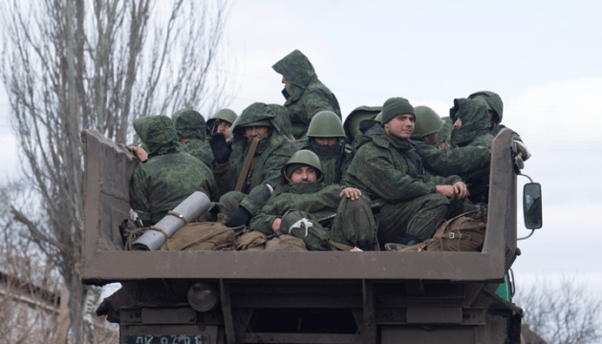
Russian mobilized troops transported on a dump lorry somewhere in Ukraine, 2023. Source: Telegram.
Russia's Falling Recruitment Numbers
As the Ukraine War nears the four-and-a-half year mark, Russia’s military problems are mounting. Since the September 2022 partial mobilization order and the failure of the Ukrainian summer 2023 offensive on the southern front, the Russian military and political leadership has bet everything on capturing Eastern Ukraine. This monomaniacal focus has led to some of the highest casualty rates seen by any major power since WWII.
The initial wave of mobilized reservists (mobiks) from late 2022 was expended all through 2023 in countless attacks (often in a pointless way) against Ukrainian fortifications to try and grab more ground in the Donbas. After the backlash the Kremlin suffered in the eyes of the Russian population for the poor management of the 2022 partial mobilization, it was decided that in order to avoid another round - and the panic that would bring - the Russian central administration and its regional administrations in the oblasts would bolster volunteer recruitment.
Through competitive salaries and expensive one-time sign-up bonuses, a constant influx of volunteer recruits was secured. As time went on, the payments had to be increased to keep attracting enough recruits —circa 30,000 per month— to both compensate for casualties in Ukraine, and also slowly increase the size of the Russian army. As the costs grew, so did the financial burden, until it reached what we might call the current tipping point.
Average one-time recruitment bonuses today reach over 3 million rubles (roughly $41,500), in a context of ever growing inflation and economic stagnation. This is one of the main factors behind the surge in Russian military spending. Some 28,5 billion rubles ($393.9m dollars) were spent on one-time enlistment payments just in the first quarter of 2026 alone - a figure that naturally doesn’t even include pensions for disabled soldiers and the families of deceased ones.
Yet Russia has nonetheless in recent months been unable to reach its recruitment goals. Russia recruited 71,216 contract soldiers in Q1 2026, 19,000 fewer than in Q1 2025. In 2025 it was estimated that Russia attracted circa 420,000 new recruits, and in 2026 the plan was to get another 417,000. This figure currently seems unreachable. As it stands now, the 2026 figure won’t be sufficient to go on with their planned expansion of the military, meaning new planned divisions and brigades may have to be scrapped.
At the same time, Ukraine’s forces are getting more adept at taking Russian troops off the board. While exact figures are contested, it’s generally thought that Russia has gone from recruiting more troops than it loses, to rough parity. Just the drone units from the Unmanned Systems Force (USF), which aren’t even the only Ukrainian drone formations, eliminate on average 6-8,000 Russian soldiers each month. Kyiv’s hope is to flip the ratio even further in their favor. Coming on top of the million-plus casualties (KIA, MIA, and WIA) already suffered since the start of the invasion, the Kremlin’s ability to keep pressing the frontline is now being called into question.
Even Russian specialist soldiers have been relocated to infantry roles to supplement the endless demand for fresh troops, often to the detriment of things like logistics. In the wider economy, Russian companies are being encouraged to try and sign their workers up to the military, despite the enormous labor shortage.
To be sure, Moscow’s current problems are not just the result of manpower issues. Recent developments, such as the refusal of Starlink to keep providing its services to the Russian state, and the Kremlin crackdown on social media (including platforms used by frontline troops, like Telegram), have only further damaged Russia’s military position. But the headline story is that Russia is drifting towards a manpower shortage. Combined with other crises, this could force the Kremlin to make some unpalatable choices… up to and including a renewed wave of mobilization.
Compounding Crises
A consistent take that has floated around online since 2022 is that Western sanctions on Russia failed. It might be more accurate to say that their impact was more-delayed than expected, building up over the long-term rather than landing with a bang.
Today, though, it’s clear that they’re causing strains on the Russian economy. Just to keep the conflict grinding on, the Kremlin has been forced to sink the national budget into the military effort —over 26,5% of the entire budget goes on the Ukraine War alone, with roughly another 14% going on other military and security spending. To fund this, Putin is increasingly having to sell the family silver. The Kiel Institute’s latest report found that:
“liquid sovereign wealth fund assets have fallen from 6.5 percent of GDP at the beginning of the war to just 1.8 percent in April 2026.”
Meanwhile, interest rates remain stubbornly high, as does inflation. To which have now been added the costs of Ukraine’s long-range strike campaign, which began in earnest in late-2025 and has been picking up ever since.
After testing gaps in the Russian Air Defense (AD) grid, Ukraine started to exploit these, helped by its own advances in drone research and technology —such as the Fire Point drones, and the Flamingo cruise missile— and the world-wide coverage of Starlink. New long-range systems able to deliver bigger payloads over hundreds of kilometers allowed Kyiv to strike deep within Russia, in targets spread from Crimea to Moscow and beyond.
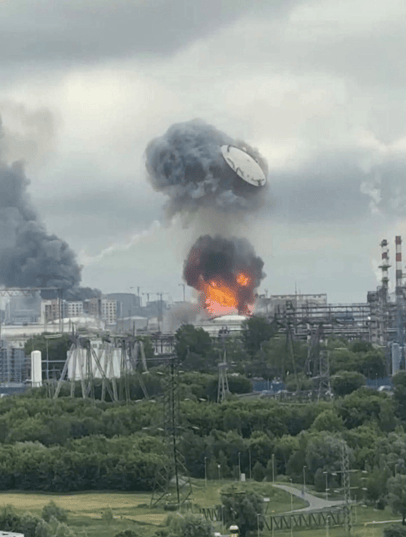
Fuel storage tanks at the Moscow Oil Refinery exploding during the June 18th attack. Source: Telegram.
Refineries and fuel storage tanks have been the main focus of this effort, aiming to deprive Russia of its oil revenues. By most counts, the production, refining and export of Russian oil has reached low records as a result of this campaign - contributing to a fuel shortage in certain regions and sectors of the economy. Non-oil infrastructure is also starting to be hit. Russian Navy assets in the Caspian and Baltic seas were recently targeted, the latter happening just as the St. Petersburg International Economic Forum (often referred to as the Russian Davos) was being held. Ukraine and allied states have also recently started to go after the Russian shadow fleet of oil tankers that sold their cargo internationally and evaded sanctions.
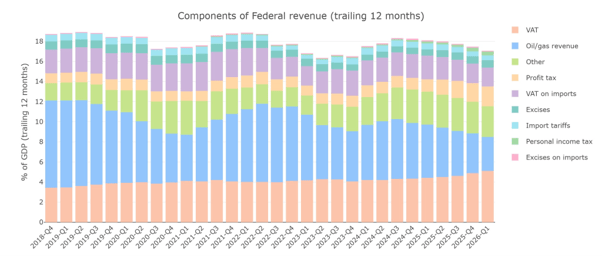
Shrinking Russian oil and gas revenues in recent years. Source: @jakluge.
The other great crisis that’s now threatening to merge with the economic and manpower issues comes in the field of logistics. Just as failures in Russian air defense have allowed Ukrainian drones to hit oil refineries at long distance, so too have they opened the way for Kyiv’s current mid-range strike campaign.
By now it’s the norm to see daily compilation strikes by the USF on AD systems. Some 2-3 systems have been hit a daily basis for months now, far more than can be replaced. And so far the Russian government has been more worried about protecting Moscow with an oversized AD ring than defending the frontline as much as possible. The current attrition is such that old systems that had been phased out have recently been seen refurbished and making a comeback.
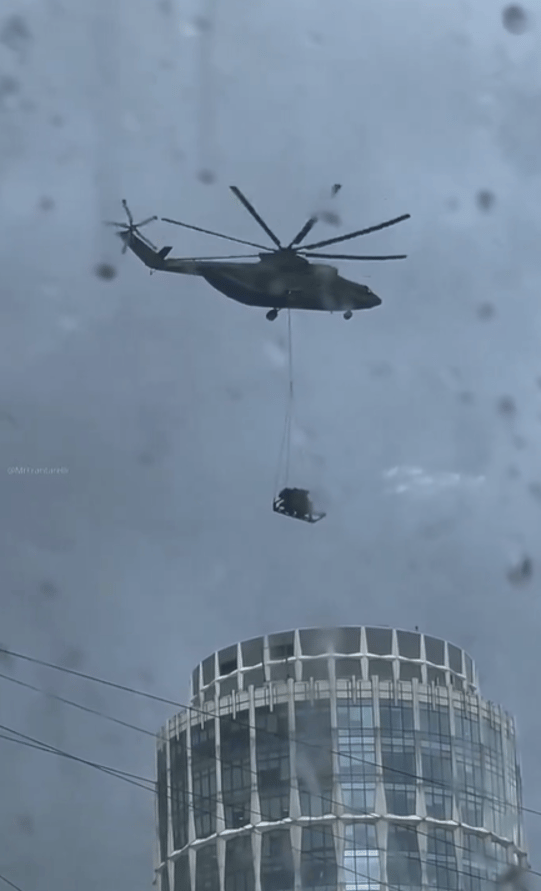

Russian Pantsir air defense system set up on top of a building in Moscow (1) and AD rings in and around Moscow (2). Sources: Telegram (1) and @jembobineuse (2).
As a result, Russian logistics are being heavily interdicted all along the frontline, sometimes to a depth of up to 200 kilometers in their rear, and with a special focus on the southern ‘land bridge’ to Crimea. Barely a month since the campaign started, the land bridge is already suffering: Russia’s military transport traffic along the R-280 route, linking Novoazovsk and the land corridor to Crimea, has reportedly dropped by 71% in just two weeks, from 3,800 trucks per day at the start of the period, down to 1,100 trucks by early June. Civilian traffic has been banned to avoid the PR hit of Russian civilians being caught in the middle of drone strikes. Trains have been attacked, as have bridges and ferries connecting Crimea to the mainland, creating further bottlenecks there. The only strong connection that remains in place for now for Crimea is the Kerch bridge.

All bridge connections between Crimea and southern Ukraine have been recently damaged by drones. Source: @clement_molin.
The stated aim by Ukrainian authorities is to completely cut off Crimea and make it untenable as a military staging area for the southern front, forcing Russia to supply their troops there exclusively through the exposed coastal highway from Mariupol. An additional bonus is the destruction of Russian logistical capacity. USF forces are claiming an unsustainable amount of 100-300 Russian trucks damaged or destroyed each day. Civilian trucks are starting to be requisitioned to compensate for losses and even Soviet-era trucks overhauled from storage have been spotted. Current production from the main truck manufacturers such as KAMAZ is already underwhelming and buying trucks from abroad, such as from China, will be very expensive.
The overall effect is a southern front that’s suffering from all sorts of shortages on the Russian side. Ammo and weapons, fuel, water and food rations, spare parts, vehicles, clothing, drones… all are being denied to troops who were already exhausted and undersupplied. It’s likely no surprise that rumors of a possible Ukrainian counteroffensive are centered around the southern front. And while they remain rumors for now, it’s inarguable that the situation could quickly shift from “difficult” for the Kremlin, to “desperate”.
Tides of men as a solution?
While there are many factors behind the current predicament Moscow now faces, there is one common thread: drones. Drones strike infantry, AD systems, economic infrastructure and communications. Fire control over key ground routes give Ukraine the edge to recover the strategic and tactical initiative after a long period in which it stayed in Russian hands. And while Moscow at times equalled Kyiv in the drone game, recent developments have seen Ukraine pull far ahead.
As things stand, then, we can make some tentative predictions for the second half of the year. Russia will likely suffer another blow to its army, probably in the southern front, as it is slowly starved of supplies. Right now, the Kremlin remains hyperfocused on completing its conquest of the Donbas - a campaign that will likely soon see the city of Kostyantynivka fall, followed by a push towards Kramatorsk and Sloviansk. But advancing here may be accompanied by a partial withdrawal in the south, not under the pressure of a general, conventional offensive as Ukraine tried in 2023, but rather because logistics interdiction will have made parts of the land corridor impossible to hold. The southern front might therefore become fluid again, with Ukraine maybe even exploiting armor thanks to its bigger drone coverage, and having some local-sized breakthroughs.
Already Ukraine has launched some small-scale, local offensives that are taking back ground for the first time in a long time. It’s likely that this last month, Russia lost more ground than it took from Ukraine, and bigger counterattacks are happening right now in places such as Lyman.
The Kremlin may be willing to accept this as the cost of taking Donbas. But should the southern front start to crack while the push towards Kramatorsk and Sloviansk simultaneously stalls out, then difficult choices may have to be made. It’s the author’s belief that this will finally drag Putin and his clique to the place they’ve resisted for so long: doubling down with a new wave of mobilization, the first seen in the country since late-2022.
Obviously, there are alternatives, but each comes with its own set of issues. Russia could once again try to outpace Ukraine in the drone race. Indeed, that seems to be the intention with the Rubikon Group, an elite drone force that has become the Russian equivalent to the USF. However, recent developments have impeded Rubikon from nullifying the Ukrainian drone campaign and striking back in force. Things can go back to an equilibrium of forces, but it doesn’t look likely in the short-term. Russia is also setting up other new drone formations in a similar pattern to Ukraine’s brigade-integrated drone units, but their effectiveness remains to be seen.
Nuclear weapons are also off the table, given the likely opposition from China. As such, a new wave of mobilization may be the safest bet, even if it means sacrificing current social stability and causing unrest for the long-term benefits of victory in Ukraine.
Russians themselves are not blind to this possibility. Fear of a new mobilization may be behind the increase in the number of Russians telling pollsters that the people around them are “worried”. Moscow has been setting up all the legal infrastructure and reforming the bureaucracy needed for it to happen, and milbloggers and other influential personalities sanctioned by the regime have also argued for it.
The crucible will probably be the explosive conditions of the frontline and Russian homefront during this summer, as the Ukrainian drone campaign reaches its peak. Recent reforms in the reserve will enable the Kremlin to call up as many men as they need, which means a minimum of 300,000 mobiks, the same number as in 2022. It remains to be seen if it’ll be an organizational chaos as it was four years ago.
Russia’s war footing economy has in the last two to three years managed to reach maximum arms and supplies production capacity. Most factories have seen their output increased thanks to the cannibalization of the state budget, and where new production isn’t possible refurbishment of old Soviet-era stockpiles has occurred or acquisitions abroad, mostly from North Korea, have happened. Russia has devoted a big share of its arms production to reconstitute their core formations for a postwar army where predictably antidrone measures will have been developed and traditional hardware such as tanks will make a big comeback to the battlefield.
Yet we should expect the new wave of mobilization to suffer the ultimate fate of the one in 2022, even more so now under the conditions of drone-infested warfare. Mechanized columns will maybe make a short comeback, but we can expect the main effort to be done by light infantry-based assaults that are becoming increasingly suicidal in this drone-saturated landscape. Logistics will not improve with the arrival of hundreds of new soldiers who require daily supplies to be effective. The troops will need water, food, ammunition and fuel, but if drone coverage can be maintained it’ll be very hard and costly to supply them with what they need.
In other aspects Russia will be even worse off than in late 2022. For example, Ukraine has managed to achieve artillery parity with Russia, and AD attrition might allow Ukraine to push the Russian air force further back.
In the end, the only logical outcome of another mobilization will be a human wave attempt to steer the course of the war, as Russia tries to fall back on its traditional superpower of mass to overcome its technological failings. In a grim way, this approach makes sense. Ukraine suffers a chronic shortage of infantry, which Kyiv has managed to so far offset with its cutting-edge use of drones. But drones cannot hold ground on their own —despite some increasing attempts at robotic infantry and UGVs— just like airplanes can’t defeat countries without ground forces coordinating with them to topple the enemy (a lesson recently re-learned by the United States and Israel in Iran).
The Kremlin knows this. And a massive influx of warm bodies will encourage Russian high command to perhaps even try and open new, secondary fronts: perhaps adding to current diversionary efforts around Sumy or Kharkiv, staging some provocation in the Baltic states to spread fear among the EU and force them to cease sending aid to Ukraine, or moving troops around Belarus to force Ukraine to pull soldiers it can’t afford to replace to guard the northern border.
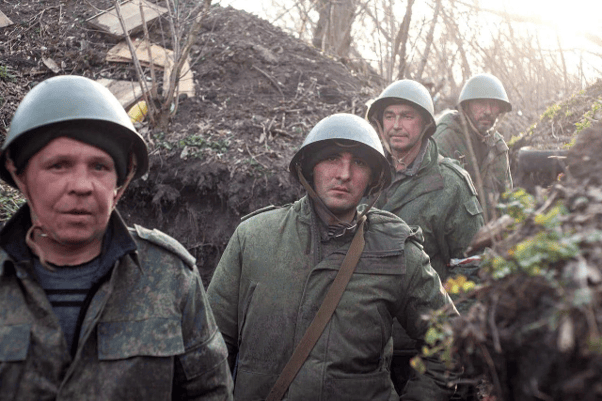
Russian mobiks in a trench in Ukraine equipped with Soviet-era gear in 2023. Source: Telegram.
The question then is whether a mass of men alone will be enough to finally overpower Kyiv’s armed forces. If Ukraine manages to hold back the tide of Russian infantry infiltrations and assaults thanks to its combined arms focus and constant military reforms, Kyiv will likely have won the war. This won’t mean they’ll retake back all lost territory; Ukraine is as exhausted as Russia, although they’re fighting for their own survival. The goal now is to just wear Russia down so much that even the Kremlin will have to accept the costs are not worth the potential reward.
As such, the next phase in the war might be one of human lives against machines. Russian mobiks on one side, Ukrainian drones on the other. Either the moment Kyiv’s lines finally crack, or the moment when it becomes undeniable that we have entered a new era of warfare as epochal as the invention of the machinegun. In the end, whoever goes down first in that final round will decide the war.
Written by
Jompy is an OSINT analyst who has done extensive research on Russian military hardware storage and repair facilities and keeps track of the flows of equipment shipped to the Russian ground forces to replenish them since the start of the invasion of Ukraine.
Related articles
When There's Unrest in Russia, Watch the North Caucasus
Neil Hauer · September 7, 2026 · 9 min read
Why Did Russian Democracy Fail? Start With its Minorities
Henrik Hannes Herkel · August 24, 2026 · 13 min read
What's Really Going On With Fedorov’s Firing? A Former Adviser Explains
Mykhailo Fedorov’s dismissal was officially presented as part of a government reshuffle. The real explanation lies in his growing popularity, his confrontation with Ukraine’s military establishment, and the powerful interests threatened by his defence reforms.
Illya Sekirin · August 18, 2026 · 12 min read
Continue in
Become a Member
Members get full access to premium reporting, in-depth briefings, and subscriber-only analysis.
Insiders Receive
- Full access to all premium articles and briefings
- Exclusive subscriber-only analysis and dispatches
- Support independent conflict journalism
Signed in or already a member, but still locked? Fix an access problem
From $5/month — cancel anytime