Russia-Ukraine WarInsider article17 min read
Ukraine is also Running Out of Armour. Here's Why.
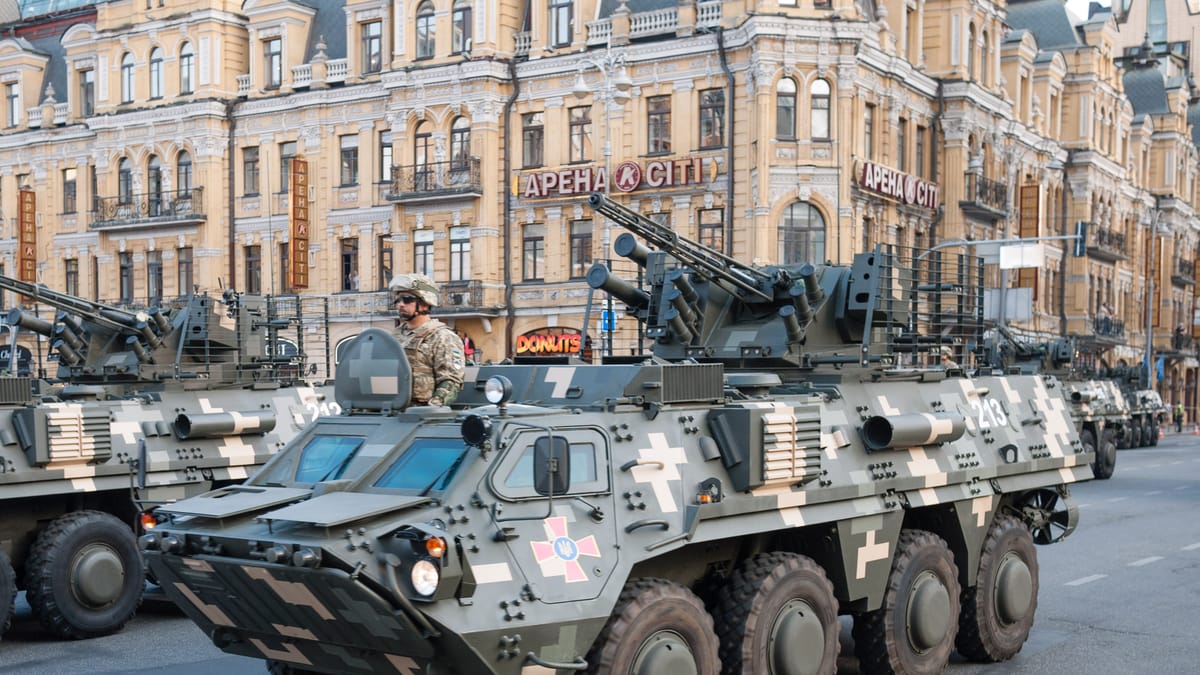
Ukraine’s Soviet-era legacy heavy equipment reserves were key to allowing the nation’s defenders to protect their homeland. But just like Russia’s stockpiles, everything has an end.
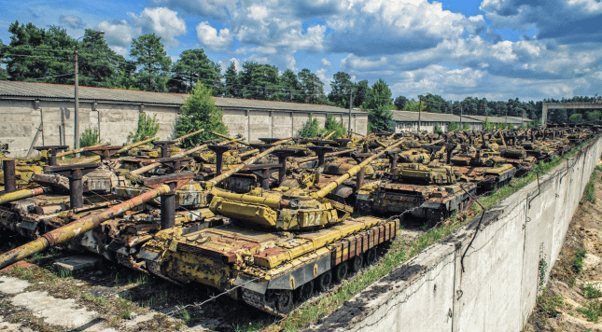
Old T-64/-72/-80 tanks stored and squandered in the Kyiv Armor Repair Plant (BTRZ) in 2019, Ukraine. Source: Reddit.
A few months ago, we published an article surveying what over four and a half years of fighting had done to Russian armor. The conclusion was that, while Moscow had lost eyewatering numbers of tanks in Ukraine, its vast Soviet stockpiles, plus ramped-up production, had allowed it to reach the present day with a tank fleet larger than the one it started the war with (even if the tradeoff had been consigning those old stockpiles to the history books).
Yet Russia is not the only combatant in the Ukraine War that began 2022 with a spectacular number of old tanks left in storage bases. As a former Soviet state, Ukraine also inherited vast fields of heavy armor. The question is whether Kyiv used it to the best of its ability, and what that might mean for the state of Ukrainian armor today.
Post-Soviet Decay
At one point, Ukraine had one of the biggest armies in the world. Even once the newly independent Ukrainian state started to downsize in the face of the country’s economic depression and inability to maintain such a bloated military, Kyiv still held one of the largest armament stockpiles in the world.
What happened to it, then? Well, as with most post Soviet states, the answer can be best summed up with three simple words: corruption, incompetence and apathy.
With nearly one million personnel, over 9,000 tanks and 2,000 warplanes (among other equipment) at independence in 1991, Kyiv was forced to brutally downsize just to reduce their expenses and rationalize their military. By the end of 2013, there were just some 150,000 people in the Ukrainian military, and no more conscription. Equipment was also mostly obsolete and thousands of pieces had been phased out during these decades, both for the shrinking budget and also to enlarge private pockets. Between 2005 and 2014, military equipment worth almost 3 billion UAH was sold (equivalent to roughly 666 million USD in current prices). A lot of the remaining kit that wasn’t sold or scrapped was simply put to rest in deep storage depots and left to rust.
By the 2014 Russian invasion of Crimea, the Ukrainian military had been left to rot for over two decades, under the peace guarantees of the 1994 Bucharest Memorandum. That, and the underlying pro-Russian feelings among much of the Ukrainian political, economic and military elite made defending against the initial invasion much harder. As a result, when Crimea and parts of the Donbas region were seized, considerable amounts of Ukrainian hardware and manpower fell into Moscow’s hands.
While Ukraine and Russia did reach a deal on the transfer of captured Ukrainian equipment, not all of it was returned—only 92 of the 126 Ukrainian airframes stationed in Crimea were ever sent back, for example.
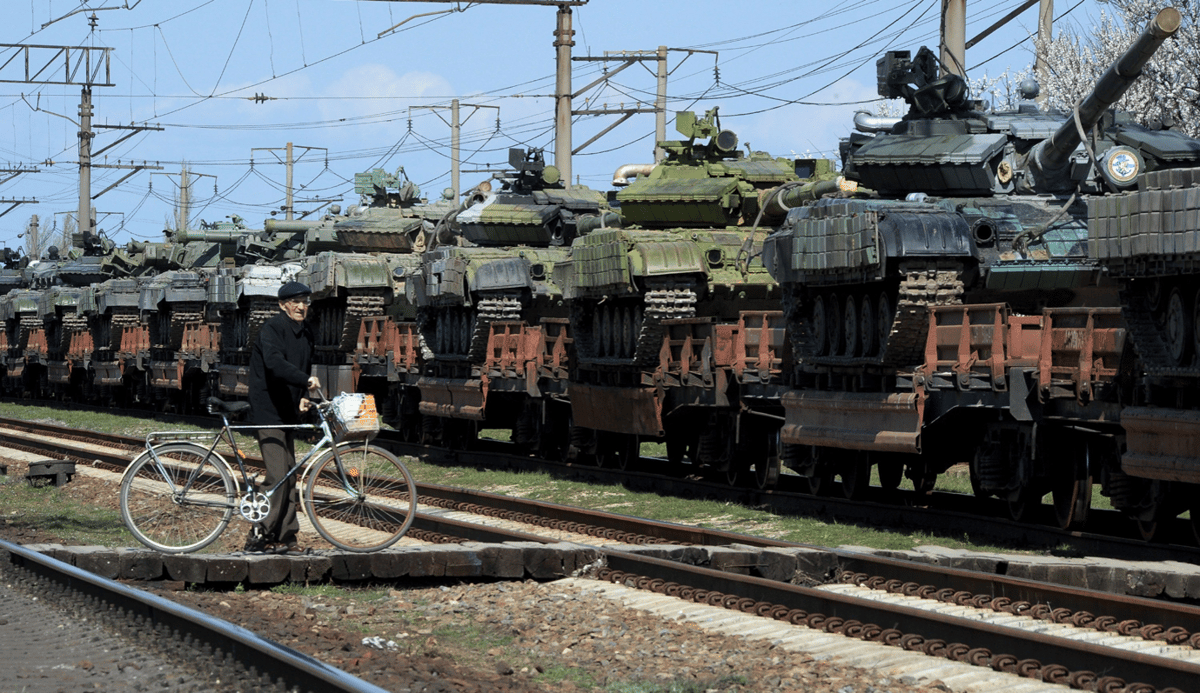
Ukrainian T-64 tanks being returned to Ukraine by Russia after the annexation of Crimea, 2014. Source: X.
As such, 2014 can reasonably be called the military’s low point, with a significant amount of the remaining army deserting, and what was left armed with small amounts of obsolete equipment. Ukraine undertook several waves of mobilisation, calling up roughly 200,000 soldiers and creating new units, but all this also required more equipment.
An Industrial Race Against Time
By 2014-15 Ukrainian forces fielded exclusively Soviet-era gear and weapons, or at best modernised Soviet ones. For example, by 2014 the Ukrainian ground forces used some 250 T-64B tanks, a type of Soviet tank barely exported abroad at all due to its technical complexities, and manufactured and mainly deployed in Western Soviet Union, meaning Ukraine inherited a considerable amount of them. On top of this, they also had roughly 1,000 extra T-64As and T-64Bs in storage almost intact, as well as over 150 T-80s and several hundred T-72s, having phased these out from active service. In the case of other armored vehicles, such as the BMP infantry fighting vehicles, Ukraine started the conflict in Donbas with around 1,500 BMP-2s and 1,100 BMP-1s, plus hundreds more BTR-80s and older BTR-70s and -60s.
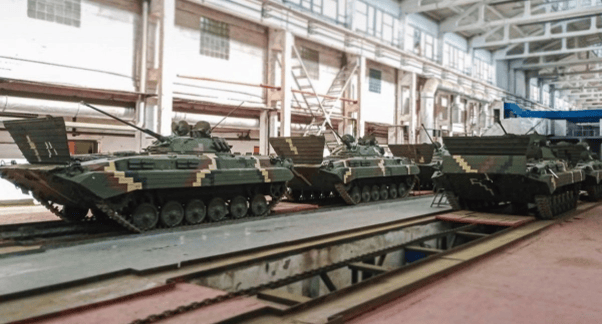
A batch of overhauled and modernized BMP-2 IFVs delivered to the Ukrainian army in 2021 by the Zhytomyr BTRZ. Source: Ukroboronprom.
While several modernization efforts had been underway for a long time, it was only then that things really picked up. Massive refurbishments happened to quickly repair and field thousands of pieces of equipment to equip the newly created and staff formations of the ground forces and stall the Russian proxy forces in the eastern oblasts. Things like the Bulat modernization package for T-64Bs picked up the pace from the previous rate of 10-12 units a year. Old Armor Repair Plants (BTRZs) from Soviet times now once again saw activity in their workshops.
Artillery-wise there were similar efforts. Probably several thousands pieces of artillery —tube and rocket alike— were reactivated over this period starting in 2014. As Ukraine needed enough firepower to win on the battlefield and then to hold their ground during the static fighting between 2015 and 2022, artillery was desperately needed. And it wasn’t just relatively modern Soviet pieces such as 152mm D-20s and 122mm D-30s towed howitzers, and 203mm 2S7, 122mm 2S1 and 152mm 2S3, 2S5 and 2S19 that got refurbished, but also hundreds more of antique, towed pieces such as 152mm D-1s, 85mm D-44s or 100mm T-12s. At a single BTRZ located at Shepetivka, more than 400 pieces of equipment were overhauled and shipped to active units between 2014 and 2017 (in the end, an old gun is always better than no gun). The same happened with rocket artillery systems, like short-range Grads or long-range and guided Smerch and Uragan.
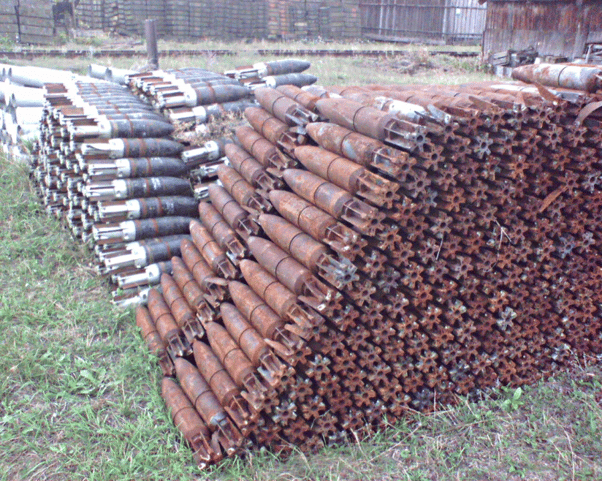
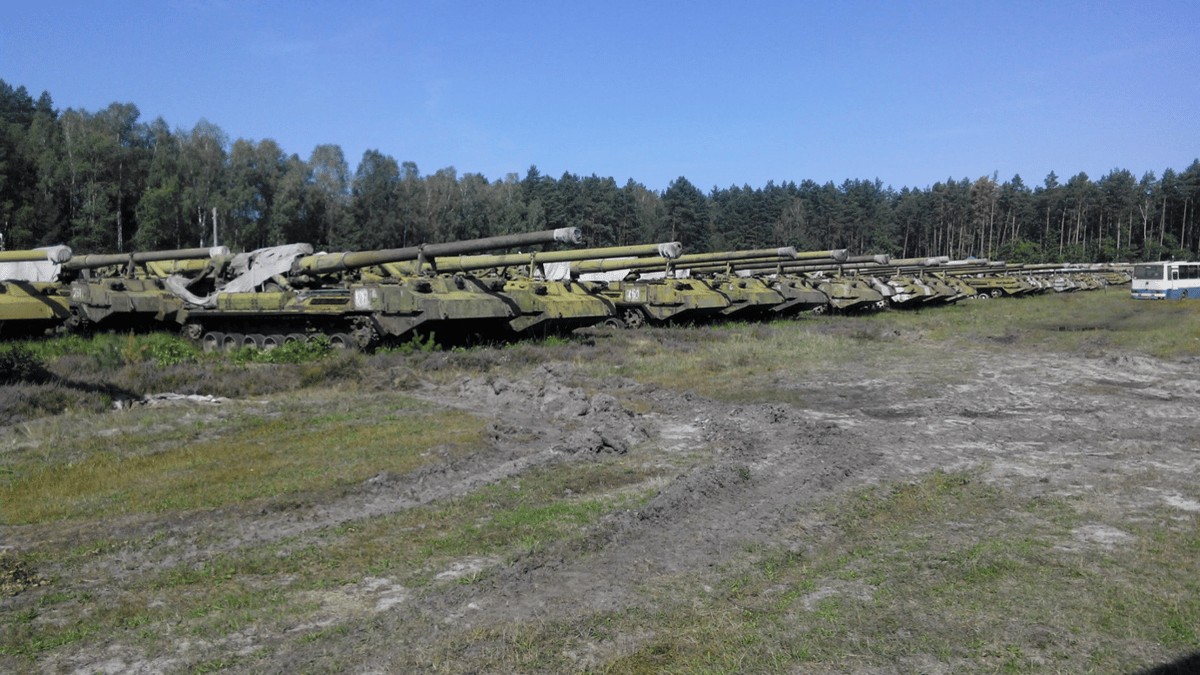
Above: rusty artillery shells in a Ukrainian depot before 2014, showing the pitiful maintenance standards. Below: stored 2S7 Pion self-propelled artillery howitzers in the 1448 Central Artillery Base, Orzhiv, 2010s. Source: X.
Finally, it’s also worth mentioning the air force. As one can imagine by now, the Ukrainian air force suffered a stark decline after 1991, with the newly independent Ukraine simply unable to maintain it. Airplanes are some of the most expensive and complex machines that exist, and Ukraine inherited hundreds of jets and helicopters. By 2014, most of the Soviet inherited airframes had been sold abroad, scrapped, cannibalized or put in airplane graveyards, and the air force was thoroughly defunded. It fielded just some 24 Mig-29s (66 more in storage), 14 Su-27 (41 more in storage), 23 Su-24 (97 more in storage) and 24 Su-25 (22 more in storage), among the main jet types. The situation was the same with the helicopter force, with most of them in storage and just a few Soviet types still in flying condition.
Loading…
We couldn’t load the rest of this article just now.
Insider article
You've read the first third. Keep going.
Two-thirds of this analysis is still to come.
Free, no card
Read this free with a Fronts account
Then one Insider article a month. No card, no password.
- Enter your email
- Read on
- Confirm your email later
The robot check is taking too long.
or email support@fronts.co
The form could not start. Reload the page and try again, or email support@fronts.co.
Make a free accountAlready have one? Sign in below.
Fronts Insider
$5 a month · or $50 a year
- Every Insider article
- 130 exclusive videos
- All 895 WarFronts and HomeFronts videos, sponsor-free
- Cancel anytime. Money back within 30 days.
Already a member? Sign in and you'll land back here.
Insider article
You've read the first third. Keep going.
Two-thirds of this analysis is still to come.
Your free article
Read this one free
You get one Insider article a month. Use it here?
Fronts Insider
$5 a month · or $50 a year
- Every Insider article
- 130 exclusive videos
- All 895 WarFronts and HomeFronts videos, sponsor-free
- Cancel anytime. Money back within 30 days.
Free to read now
No account needed