
What Will Russia's Military Look Like After the Ukraine War?
Staggering losses will force Moscow into hard tradeoffs — cutting its navy and air force, betting big on drones — but the force that emerges could be more dangerous than the one that invaded in 2022.
Jakub Janovsky • July 13, 2026
Up next
Ukraine is also Running Out of Armour. Here's Why.
Jompy · October 6, 2026 · 17 min read
“A Gun to Go and Die With”: How Russia Recruits in Africa
Casus Belli · October 1, 2026 · 11 min read
Ukraine's Intervention in the Sahel is Hurting Russia. It's also Destabilising the Region.
A handful of Ukrainian trainers embedded with Mali's Tuareg rebels are fighting Russia's Africa Corps — but their allies include al-Qaeda's JNIM, and Kyiv's drone tactics are already reaching the jihadists.
Paweł Wójcik · September 24, 2026 · 7 min read
The last four years have seen Russia suffer equipment and manpower losses in Ukraine that far exceed those of any other major military power in a conventional war since WWII. But while the war shows no signs of ending soon, some analysts are already trying to figure out what Russia’s post-war military may look like.
The bad news, from an EU/NATO perspective, is that the Kremlin is not out for the count and may yet again field a fearsome fighting force. The bad news from a Russian perspective is that rebuilding this force will require painful decisions and tradeoffs.
To get a handle on what this might mean, we’ve explored the current status and future needs of each part of the Russian conventional armed forces, the Russian manpower situation, and the resources that Russia will likely have for rebuilding its post-war military. Taken together, the picture they paint offers our best forecast as to what a post-war Russian military may look like, and what it might be capable of.
Equipment
Russia inherited a veritable mountain of equipment from the USSR, and despite the fact that a lot of that equipment was sold, donated to friendly regimes, dismantled for parts, or rusted away in open storage, come 2022, Russia still had one of the largest stockpiles of weapons and ammunition in the world. But as we have all seen, over the course of its invasion of Ukraine, many thousands of pieces of equipment were either directly lost in combat or due to wear and tear.
However, the Kremlin was not solely reliant on old Soviet stock. Once it became clear that the war in Ukraine wouldn't be a quick “special military operation,” the Russian government massively increased spending to boost military production across the board. At the same time, it started pulling Soviet-era weapons from its vast storage bases in order to bridge the gap between the frontline losses and what was being newly produced.
As of 2026, here is the reported Russian annual production rate for some of its major weapons platforms:
200+ T-90 tanks,
400+ BMP-3 IFVs,
500+ BTR-82 IFVs,
40-60 fighter jets (including 6-12 semi-stealthy Su-57s)
Ground forces
The results of increased Russian military production and restoration of stored equipment, combined with the declining use of armored combat vehicles on or even near the frontline, have allowed the Russian ground forces to first stabilize their losses and later even fully rebuild their fleet of tanks, combat vehicles, and various other ground warfare weapons. This will provide Russia with an advantage in its post-war effort to rebuild its military, but it can also become a curse by forcing it to depend on systems that might be hard to upgrade to stay effective on the modern battlefield.
The problem for the Russian ground forces is that until they have an effective counter for the insane drone spam that we are now seeing in Ukraine, Russia won't be able to return to its preferred mobile warfare doctrine. And when new systems are developed to counter drones enough that AFVs can again survive on the modern battlefield, having a large fleet of legacy armored vehicle designs is likely to complicate installing that equipment - making those much-needed upgrades more costly and time-consuming. In Russia's case, though, such effort is likely to be preferred over designing and building a whole new fleet of modern AFVs. So, forget about Armata and similar expensive combat vehicles, and get ready for Russia to push the modernization of its current equipment to its wildest extremes.
An additional problem is that - having now depleted the stockpiles of their inherited Soviet-era weapons - Russia will not have a massive ready reserve of equipment that can quickly replace losses in future conflicts.
Drones
Where Russia will benefit from a major advantage is the use of drones. Except for Ukraine, Russia has by far the most developed and experienced force for both battlefield use and long-range strikes using drones. And while many armies are still adding small drone units here and there in their army structures, the Kremlin’s announced plans are to build its Unmanned Systems Forces into something larger in size than the US Marine Corps - and therefore larger than most mid-sized national armies…
There is no doubt that drones of all kinds will remain an important part of the Russian military and be a major headache for any opponent. What is less certain is whether Russia will be able to integrate its drone forces with the rest of its military to enable more effective offensive operations, and if it will maintain independence, or be at least to some degree absorbed into the ground forces.
Air Force
The Russian Air Force (VKS) faces very different problems from the Russian ground forces, since old aircraft parked decades ago at random bases are usually at best only useful to be stripped for parts - assuming that hasn't already happened many years ago. And unlike ground forces, where you can accept the risk of old equipment breaking down, flying with old aircraft beyond their useful life is only going to result in lots of crashes and deaths of hard-to-replace crews. A significant percentage of Russian combat aircraft are already very old - made during the Soviet era, or shortly after. There is also the fact that some aircraft, like the Su-25s close air support jets, are becoming less and less relevant on the modern battlefield.
Below is a current summary of the VKS combat aircraft, with the author’s estimation of how many of them are operational based on the available data, and how many would be relevant in a conflict with the EU/NATO:
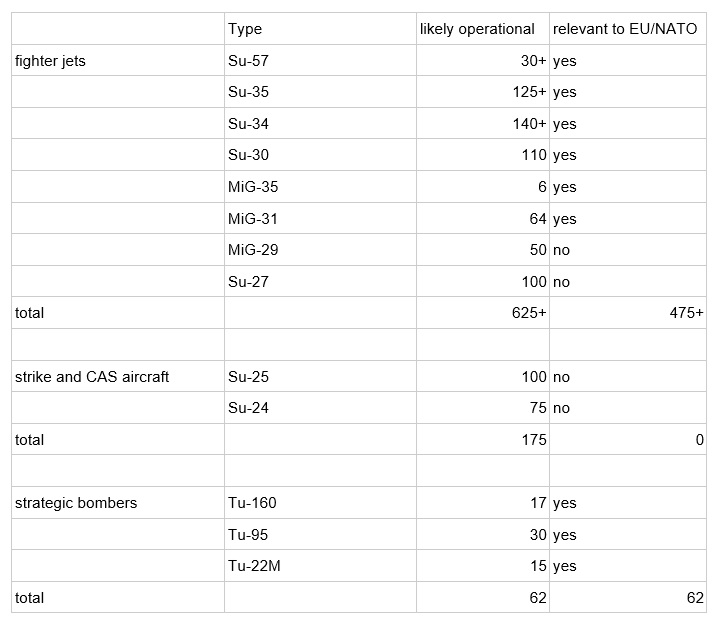
The consequence of all this is that while the VKS is on paper the 3rd largest Air Force in the world, it looks much less impressive in practice, and especially in the context of facing EU/NATO nations, even without the USAF. When you look at the VKS inventory, losses, and the above-mentioned attritional factors, the size of the VKS is likely to continue shrinking even after the war in Ukraine ends, especially if the current wartime production of 45-60 fighter jets per year isn't maintained beyond a ceasefire.
When it comes to long-range aviation, such as strategic bombers, AWACS, aerial tankers, maritime patrol aircraft, etc., the Russian situation appears to be quite dire. Accidents, retirements, and combat losses have significantly shrunk the number of all these aircraft, and there doesn't appear to be any prospect for that trend to change. Just as an example, the A-100 AWACS plane program appears to be frozen, with no operational aircraft delivered, and the only strategic bomber that Russia is now producing is the Tu–160 “Blackjack” and its production rate is just 1 per 1-2 years…
The VKS is also in the unenviable position that while it continues shrinking, the NATO Air Forces are at least maintaining their size, while also adopting 5th generation stealthy aircraft in the form of the American F-35 - putting the VKS at both numerical and technological disadvantage. And Russia has no realistic prospect of shrinking these gaps, so the Russian military will need to operate with the assumption that in case of a conflict with NATO, its Air Force would at best be trying to limit NATO from achieving air superiority.
Air Defense
While Russian production appears to have been able to more or less keep pace with its documented losses of SAM systems, the war in Ukraine has degraded its radar coverage, exhausted most of its anti-aircraft missile stockpile, and demonstrated that the wild numbers of middle- and long-range drones that countries are nowadays slinging at each other can't be countered by expensive missiles.
This turns Russia’s usual advantage of being the largest country in the world into a massive headache - as we have seen with the significant successes of the Ukrainian drone and missile long-range strike campaign. As a result, Russian post-war air defense will need to drastically increase its ability to deal with such attacks - needing both many more troops, and to develop and deploy new systems for affordable tracking and intercepting enemy long-range drones and missiles.
Space Force
After decades of underinvestment, Russian space-based assets have shown themselves to be insufficient even for the war in Ukraine, and as a result, Russia has been increasing both its number of reconnaissance satellites and attempting to build its own Starlink-like LEO communications satellite constellation. It seems clear that this effort will continue after the war ends, because catching up in this area always takes a long time, and Russia has suffered some painful lessons in Ukraine about the importance of space-based assets.
Navy
As the war in Ukraine has shown, with the Black Sea Fleet being bullied away from Crimea and into hiding at the most distant base available, most of the Russian Navy is too weak or old to be of much use in a peer conflict, besides trying to defend its coastal waters. The exception would be its fleet of attack submarines, many of which would pose a serious danger to any opponent, and which are likely to stay the focus of future Russian navy construction.
After the war in Ukraine ends, most of the Russian Navy is likely to get much reduced attention and budget from Moscow, because other parts of the Russian military will be seen as more important for future large-scale conflicts.
Ammunition
Russia started the 2022 invasion of Ukraine with a stockpile of munitions of all kinds that nobody believed could be exhausted. But between the repeated lessons about ammunition consumption being much higher in major wars than predicted, and Ukraine managing to turn numerous major Russian ammo depots into improvised pyrotechnic shows, Russian stockpiles of most types of ammunition appear to be significantly depleted and will need to be rebuilt after the war.
Fortunately for Russia, a lot of its investments went into additional industrial capacity to produce ammunition, so rebuilding its pre-war stockpiles seems doable in about 3-5 years, if factories continue working at maximum wartime capacity 24/7. The problem is that those original stockpiles turned out to be insufficient even against Ukraine, so for any conflict with NATO, Russia will need to aim to rebuild its stockpiles to a much larger size. And the repeated instances of whole storage bases being lost to one or two small hits against ammo in the open and/or poorly built ammo bunkers, will mean that numerous new ammunition storage bases will need to be built - and this time properly.
Manpower
Despite suffering incredible losses in Ukraine (estimated to be around 1.4 million in total, with the number of killed likely around 500 thousand), the manpower of the Russian military has significantly grown from approximately 900 thousand before the 2022 invasion of Ukraine to around 1.3 million in 2026. But the cost this has come at will only become clear after the war ends.
Russia has pulled all available levers to get more troops in the military - from continuously dropping recruitment standards and recruiting criminals from jail, to offering ever-increasing payments to volunteers, and even the first Russian post-WWII mobilization. This has allowed Russia to constantly be on the attack and to use casualty-intensive tactics, but it has also degraded the quality of its troops over time.
Russian frontline troops recruited during the war are often older men around 40 years of age; many suffer from medical problems that would disqualify them from normal military service, and drug and alcohol abuse are reported to be widespread. Add to this that training for new troops is usually just a few weeks, and you can begin to see why these are not considered elite troops.
To address increasing disciplinary issues and to enforce orders for troops to go into high-casualty assaults, the Russian military has adopted brutal punishments, up to and including torture and killing of troops. And just being disliked by an officer, refusing to give a bribe, or a minor disciplinary infraction are likely to have the soldier be assigned to assault infantry, which is practically guaranteed to end up with serious injury or death.
Corruption, criminal activity, and lying in official reports appear to be rife at all levels of combat units' command. This has negatively impacted the morale of troops, as well as the reputation of the military and its ability to recruit in the future.
When the war ends, Russia will face significant problems balancing the Kremlin’s desire to keep the military at a higher manning level than before the war (with a plausible target being around 1.1M) and the fact that many of its current troops are undesirable and of low quality, while many others will want to leave. The retention of the existing troops isn't going to be helped by their aforementioned experiences with brutal disciplinary measures, being subject to extortion and other crimes, as well as losses and other traumatic events they have seen during recent years.
Given that quotas for recruitment and retention of troops were regularly being missed even before the 2022 invasion of Ukraine, and the post-war need to also replace low-quality undesirable troops, this is likely to turn into a monumental challenge. The Russian government will likely need to significantly increase non-combat pay, keep some recruitment payments, and generally improve the troops' living standards if it wants to recruit and retain a reasonable number of troops - but it is unlikely to be enough.
Given that in peacetime, troops can resign, making it hard to force them to stay in the military or to join it, one of the measures that Russia might resort to is to increase the length of its mandatory military service from 12 months to 18 or even 24 months - but that would, in turn, escalate the already existing problems (and related corruption) with dodging conscription.
Limited Resources
As usual, the main limitations for the Russian efforts to rebuild its military after this war will be money and manpower.
Like many other countries, Russia currently has disastrous demographics, but its manpower situation is additionally complicated by a mix of having effectively no unemployment (around 2%) and wartime recruitment having already taken anyone vaguely interested in serving in the military - and promptly either crippled or killed them on the frontline. This means that, after the end of the war in Ukraine, if they want to recruit people who are young and/or have desirable technical skills, the military will need to attract them with significantly improved conditions than it used to offer previously.
Which gets us the money - all the things that the military needs ultimately end up competing for a limited amount of money from the budget that is available. Accounting for hidden and classified items and the recent reports of additional military budget increases, Russia is likely to end up spending around 10% of its GDP on military, internal security, and related areas in 2026. When the war ends, it is practically guaranteed that the military budget will need to shrink a lot - even if it stays at an elevated level compared to the pre-war era. And unless some external event significantly boosts the Russian government's revenue, like another ill-advised war blocking oil export from the Middle East, all the things that were listed above will need to compete for the much-reduced funding.
The most likely candidates for budget cuts are likely to be the Navy and Air Force - those were already uncompetitive against NATO, and the likely decline in investments will force them to fully focus on defense. The Army will be a priority, but since it is a massive part of the overall force and given that it has already rebuilt its AFV fleet, its future AFV procurements might end up having to be sacrificed to fund the other priorities, like how to pay for all the extra troops they want to retain or recruit.
Rebuilding stockpiles of munitions to a higher level than before 2022 is an area that, on paper, shouldn't be difficult, but which has a significant potential for being the usual victim of politicians prioritizing high-profile weapons and capabilities in the budget, resulting in rebuilding those ammo stockpiles taking much longer than necessary. A big deal, given that insufficient ammo stockpiles have the potential to become a serious constraint on the government's military decision-making.
Outcome
Russia is certain to continue being a major military threat to Ukraine and the EU/NATO even after the war, but in the short and medium term, its options for a direct confrontation will be limited by how much it needs to rebuild and to adopt lessons learned in the current debacle. While trying to discredit NATO is something that Russia would love to do, given how poorly the invasion of Ukraine went, the Kremlin is at least unlikely to start conventional war operations that risk turning into another major conflict before its military is fully rebuilt.
The limitations of Russian resources will push it into major dilemmas that will slow down the rebuilding of its post-war military and force it to prioritize - especially if the government avoids cost-effective steps that would be unpopular, like increasing the length of mandatory military service. But these limitations might result in the Russian military making an effort to become more efficient with what it has.
When Russia finishes the process of rebuilding its forces, despite inevitable weaknesses in some areas, the Russian military will likely end up being far more capable and dangerous than it is now, or even than it was before 2022. Therefore, European countries need to fix problems in their armies urgently, if they don't want to look weak. The big risk for Russia is that its economy won't be able to sufficiently support rebuilding its military, and/or too much of the allocated money will get turned into luxury yachts for the top brass. At that point, the Russian military might decline into the status of a middle power with lots of nukes - and so no longer pose a conventional threat to the EU/NATO.
And a factor that Russia needs to account for is that once it joins the EU, Ukraine will, in effect, be part of the EU/NATO security architecture - increasing the difficulty and the risk of any Russian overt acts of aggression against the EU/NATO nations. The Ukraine War may not have ended Russia’s era as a military power, but it has made maintaining its place in the power rankings increasingly difficult.
Written by
Jakub Janovsky is an experienced OSINT analyst and telecommunications engineer who has done extensive work documenting and analysing the Syrian Civil War and the 2022 Russian invasion of Ukraine. He is currently running the Oryx Blog.
Related articles
Ukraine is also Running Out of Armour. Here's Why.
Jompy · October 6, 2026 · 17 min read
“A Gun to Go and Die With”: How Russia Recruits in Africa
Casus Belli · October 1, 2026 · 11 min read
Ukraine's Intervention in the Sahel is Hurting Russia. It's also Destabilising the Region.
A handful of Ukrainian trainers embedded with Mali's Tuareg rebels are fighting Russia's Africa Corps — but their allies include al-Qaeda's JNIM, and Kyiv's drone tactics are already reaching the jihadists.
Paweł Wójcik · September 24, 2026 · 7 min read
Continue in
Become a Member
Members get full access to premium reporting, in-depth briefings, and subscriber-only analysis.
Insiders Receive
- Full access to all premium articles and briefings
- Exclusive subscriber-only analysis and dispatches
- Support independent conflict journalism
Signed in or already a member, but still locked? Fix an access problem
From $5/month — cancel anytime