
What Next for the Iran War? And Other Burning Questions
We break down why a US ground invasion is unlikely, the logic behind Iran's strikes on its Gulf neighbors, and Washington's muddled war aims — in an emergency reader Q&A.
Simon Whistler • March 4, 2026
Transcript
Note: this transcript was generated by AI and may contain errors or inconsistencies.
Welcome back, everybody, to our second emergency Q&A of 2026. It's March. After our first one in Venezuela, I was like, yeah, cool, maybe we'll do another one of these if a big war breaks out, or something, you know, next year, or whenever.
And now here we are, just two months later, preparing to discuss the five wildest days the world has seen since October of 2023. Israel and the US are bombing Iran, Iran is firing drones and missiles at its neighbors, Israel is invading Lebanon again, and the entire Middle East seems to be on the brink of some sort of general meltdown.
Perhaps unsurprisingly, this has left most people with a lot of questions, questions that we're now going to attempt to answer in this exclusive free video.
We've got a lot to get through, and the events are moving quickly, so let's jump right into it. First up, BogdanAlexandru1510 asks simply, will there be a land invasion?
In an interview with the New York Post, President Trump said that he didn't have the yips about sending Americans into war, and Defense Secretary Pete Hegseth told reporters that the administration wouldn't be dumb about it.
While this isn't a definitive yes or no answer, it indicates that the administration is, at the very least, willing to consider putting boots on the ground. So, Bogdan, the question isn't whether they would, rather, it's whether they should. Several analysts believe that a ground invasion would be catastrophic for Washington for two reasons.
First, according to Masoud Khalid Khan in an article for Republic Policy, Iran has cultivated, funded, trained, and in many cases, ideologically shaped a fighting force that shouldn't be ignored. The Shia militia networks spread out across several countries in the Middle East.
Already, the Houthis in Yemen, an Iranian-backed militia in Iraq, and Hezbollah in Lebanon have joined the fight.
If America boots on the ground land in Iran, we can almost guarantee that all these forces and more will flock to join the fight. And these are forces that have been battle-hardened by multiple conflicts, including the Syrians of war, the Iraqi counter-ISIS campaign, the Yemen conflict, and multiple Lebanese confrontations with Israel.
So, at the very least, it will be long, and it will be bloody for Washington.
And given how much the American public dislikes seeing images of their sons and daughters dying in foreign wars, a protracted ground campaign in Iran could quickly erode whatever support Trump has for this operation and doom the Republicans not only in the midterms, but also in 2028.
Second, according to retired Colonel John Collins from the U.S. Naval Institute, there's a simple matter of geography. Iran is roughly 1.6 million square kilometers, more than three times the size of Iraq and about one-fifth the size of the continental United States.
Mountains essentially surround a high plateau, with Zagros Mountains forming a 1,600 kilometer long barrier along the western border and the Urbas Mountains protecting the north.
This means that while paratroopers and other airborne troops could theoretically leapfrog into the country, other ground forces would have to breach the mountain barrier, then travel several hundred miles to most target areas.
They would have to do this while avoiding people who have lived in the area their entire lives and have an inherent geographical advantage.
Additionally, the central plateau, which makes up most of the country, has vast salt plains and areas of shifting sands, which would make cross-country travel difficult for vehicles.
So while a land invasion might seem like the best way to achieve Washington's military objectives, it comes with some glaring risks that cannot be ignored and make the possibility pretty unlikely. On a related note, we now have this from the traveling bard.
Is there a chance that Iran could invade one of its neighbors, say, Kuwait, in order to pull the US into a costly ground war?
And the answer there is theoretically yes, and this was an option available to Iran prior to the start of the conflict, and there's some reason to believe that it could have made strategic sense, or at least that it would have made more strategic sense than, say, conducting kamikaze drone strikes in Dubai or some of the other ways that Iran's chosen to fight
This war.
Iran is at a critical disadvantage against the US and Israel in terms of its relative air power.
It's got drones and a handful of antique or outdated warplanes that now seem to have been mostly destroyed, but it's mostly a sitting duck if it's boxed into fighting an air war. Iran's ground forces are far stronger. The Iranian army boasts about 300,000 troops.
The Islamic Revolutionary Guard Corps has around 200,000 more, and its internal repression forces, the besiege can swell that force even larger, launch a ground offensive against a neighboring country, and it's not inconceivable that Iran could have split the attention of US and Israeli air power or even drawn them into ground engagements.
Iraq, in particular, would have been fertile ground for this sort of disruption since we've already seen Iran-allied militias launch significant attacks on American targets there. But Iran ultimately didn't go that route, and more to the point, it didn't direct a buildup of ground troops on its borders before the US and Israel attacked.
That means the window to move troops without exposing them to aerial bombardment has now closed. But even worse for Iran, it's looking like the United States may try to leverage regional ground troops to fight in the opposite direction.
On Tuesday, Axios reported that Donald Trump had held phone calls with Kurdish leaders in Iraq, where Kurdish paramilitaries control key territory and have amassed thousands of troops on the Iranian border.
Iranian Kurds are a large part of the population in Iran's southwest, and they've been alleged to have taken armed action against Iranian forces during the protests across the country several weeks ago.
Days before the US and Israel attacked, five key Kurdish-Iranian groups formed an anti-regime political coalition, and they may believe that they have a critical window to begin armed resistance to carve out an autonomous Kurdish enclave at a time when Iranian leadership is weak. Next up, from E.W.R.
Plains Botter, is Congress or the Supreme Court going to do anything about Trump violating US law by declaring war without congressional approval? This has been a question that's been hanging over just about every military operation that's taken place for decades, and honestly, it is still contested. territory.
America's Constitution gives Congress and Congress alone the power to declare war.
But as is always the case in politics, the devil is very much in the details. What exactly is a formally declared war? The United States hasn't officially declared war on anyone since World War II, but as you know, the U.S. hasn't exactly been afraid of extending its force throughout the world since then.
Declarations of war aside, the Constitution also gives the President broad authority as Commander-in-Chief to use military force to defend national interests and protect U.S. personnel abroad, so long as it doesn't rise to the level of war in the constitutional sense.
That's deliberately vague, and just about every President since Truman has been willing to use it to their advantage. The main procedural check is the War Powers Resolution, which was passed in 1973 after the Vietnam War.
It requires the President to notify Congress within 48 hours, which Trump has done, and sets a 60-day clock after which operations must stop unless Congress votes to authorize them, with the option given to the executive to extend by another 30 days if he determines it necessary.
The same law, though, does give Congress a tool to force the issue before that deadline. They can introduce a bill directing the President to withdraw forces.
Congress has started that process. A bipartisan Senate resolution from Tim Kaine and Rand Paul would direct the removal of U.S. forces from the region until the legislative branch formally authorizes it, and a vote is likely to take place soon.
Even if it passes, though, which is uncertain at the time of recording, Trump will veto it, and overriding that would require two-thirds in both chambers, which almost certainly isn't going to happen.
Now this, from StormRain6937. What was the purpose of Iran firing missiles at civilian locations in the other Gulf states? Like, what did they think was going to happen other than it just pissing off countries who may have otherwise been at least sympathetic to them?
And look, you're right to bring this up, because by most metrics, it doesn't make any sense at all. While some Gulf states, like Saudi Arabia, reportedly backed Trump's decision to take military action, others, like the UAE, Oman, and Qatar, spent the last couple of months frantically pressuring the White House behind the scenes to stick to diplomacy.
Qatar, in particular, has been a friend to Iran for years, allowing its proxies to establish officers in Doha and offering itself as an intermediary between the Islamic Republic and the West.
In return, Iran has acted like the friend who crashes on your couch for a week and then sets your whole damn house on fire. Gulf nations have been targeted with drones and missiles, five-star hotels in Dubai, gas fields in Qatar, a port in Oman. All these places, and many more, have been hit as Iran lashes out.
Unsurprisingly, any remaining sympathy for Iran has evaporated. As of yesterday, Israeli media was reporting that Qatar was striking missile launchers in Iran, something Doha denies. But while Iran's game plan might seem bizarre, it does also have at least some internal logic.
Logic? We'll do our best to try and explain.
At the heart of Iran's widespread strikes, is a simple calculation that it can raise the cost on america's allies to such a level that they collectively pressure washington into halting its campaign drones hitting dubai are meant to scare emirati leadership into believing that the wealthy expats who make up the city's economic backbone will flee strikes on
Qatari gas fields are meant to terrify europe and america's east asian allies such as japan and south korea that they'll suffer an energy shock beyond that felt in 2022 and attacks on middle eastern airports that act as major hubs are meant to disrupt life for travelers across the globe of course this strategy was bolstered by a heroic assumption that the
Gulf states wouldn't blame tehran for bombing them but washington for starting the conflict five days in and it is pretty clear that hasn't happened so why is iran pushing ahead with a failed strategy well one reason is likely the complete destruction of command and control with leadership wiped out plenty of units are just continuing to hit preset targets
That were decided before the war began lacking a central figure who could say you know maybe it's time we change tactics they just keep on blasting away but there is another reason for the ongoing strikes one that kind of makes at least a bit more sense since the 12 day war last year iran's model of deterrence has relied on a simple threat attack us and we
Will rain hellfire down on the entire region and to be fair to them this plan almost worked the gulf states weren't lobbying washington to give diplomacy a chance because they're secretly a bunch of hippies watching old woodstock footage on repeat no they were terrified iran would pursue the exact strategy that it is now pursuing bombing them and in a weird
Way that could work to the regime's advantage the thing with deterrence is that it only works if opponents genuinely believe you are crazy enough to pull the trigger if the ayatollah had been killed and iran had been all like okay guess it's time to negotiate the threat perception among the gulf states who would have diminished by doing the crazy thing and
Attacking everyone in the region the iranian regime has signaled that should it survive no one should ever again doubt its willingness to set the region on fire should it feel threatened of course the words should it survive are doing a lot of heavy lifting there in all likelihood future historians will judge that tehran should have played the sympathy card
With states like qatar and uae after the initial strikes began but we'd be lying if we said that there is zero method to the regime's madness even if that method is looking shakier and shakier by the day now before we get into that next question just a quick note to say that if you are enjoying this video why not consider becoming a subscriber here it costs
Just five dollars a month or fifty dollars for the whole year and you get access to exclusive content just like this every single week we publish a minimum of two videos and two articles every week and more when something big happens like this war you're already on the site so just head to the subscribe section fill out your details to unlock even more
Videos of me discussing wars and now on with the questions and now on with the Now this one from Eurasei 6732.
The big thing I'm missing is what the US hopes to get out of this and how much they're likely willing to commit to get it. Are they just trying to force a coup? Now, honestly, we're not sure what the Trump administration wants to achieve in Iran because of the mixed signals from Washington.
Let's start with the idea of regime change. In the video announcing the strikes, Trump urged the Iranian people to take over the government, saying it would probably be their only chance for generations. He reiterated that message in an interview with The Washington Post, telling the outlet that all he wanted was freedom for the Iranian people.
This, coupled with the constant calls for Iranian security forces to lay down their arms, promising them total immunity if they did, would seem to suggest that regime change is a key goal for the administration. But then Trump offered a completely different vision for Iran's future.
Fox News host Brett Baier reported that Trump told him his plan for Iran mirrors what happens in Venezuela, where U.S. forces captured President Nicolas Maduro in January.
The problem with using Venezuela as a template is that it directly contradicts Trump's stated goal of freedom for the Iranian people. Al Jazeera reported that even after Maduro's capture, many Venezuelans remain terrified of the government because the repressive apparatus he used is still in place under Rodriguez.
Even if Washington were to pursue the Venezuela model, it would still imply some level of regime change where someone pliable to America's demands is put in office.
But then, in a recent press conference, Secretary of War Pete Hegseth said that this wasn't a regime war. So again, mixed messages. For the rest of the regime's goals in Iran, we turn to Franco Ordonez, White House correspondent for NPR, who reported that the administration had four key military objectives.
Destroying Iran's ballistic missile capabilities, taking out their navy, ensuring Iran never gets a nuclear weapon, and stopping Iran from funding militant proxy groups like Hezbollah and Hamas. The question then becomes, how far is Washington willing to go to achieve these goals? And honestly, that depends on which goal is the most important.
So let's start with regime change. This would need a lot more than just air power because unlike in Venezuela, where it was enough to take out one man, in Iran, Washington would need to destroy the entire system set up since the 1979 revolution.
That would need some level of boots on the ground to either do it directly or to weaken the government sufficiently for the public to overthrow it.
The military objectives are more achievable, but still face serious challenges. Destroying Iran's ballistic missiles and navy can be done with air power. And according to NPR, they've already sunk 10 ships since the strikes began.
But a retired senior officer told NPR that Iranians have more missiles than the US has interceptors, which is a major problem as the conflict spreads. So for this question, USA6732, we'll just have to wait and see what Washington decides. Here's one from Bra Gidbo.
What will the Middle East look like in the after? math of this operation if a full-fledged regime change war were to occur? Would it pave the way for undisputed Israel hegemony in the Middle East? And how will Western allies like Turkey and the Gulf states react to this?
Israel would certainly be the most obvious beneficiary in the region of full regime collapse in Iran. The Islamic Republic has been for decades at this point both its primary existential threat and the largest funder of the proxy forces throughout the region that most directly challenged Israeli security.
Where it starts to get interesting is what the region of tomorrow would look like without the Islamic Republic.
Turkey is a NATO member with a serious military and serious regional ambitions of its own. The militants who marched into Damascus and set up shop there in December 2024 were Turkish-backed and Ankara is emerging as something of a dominant force in both Syria as well as the region more generally.
And suffice it to say Turkey's President Erdogan doesn't exactly think highly of Israel's Benjamin Netanyahu.
Ankara implemented a full trade embargo that collapsed billions of dollars in bilateral commerce over the Gaza war entirely in late 2024. And Erdogan has literally called Netanyahu worse than Hitler. So we don't think that these two are exactly going to make up and be buddy-buddy anytime soon.
There are other powers in the region that are also not on the best of terms with Jerusalem, namely Saudi Arabia. The kingdom has its own vision for regional leadership, one that doesn't exactly involve deferring to Israel on much of anything. Normalization between the two may occur in the future once all of this settles down.
But there's still a very big difference between recognizing that Israel is here to stay in the region and granting it hegemony status. This all links into something we've been documenting in other videos for a while now.
The emergence of two informal blocks in the wide Amina region, a threat of one since Israel and UAE, while the other is defined by a growing alliance between Saudi Arabia and Egypt, with Turkey loosely giving backing.
So far, the impact of these blocks has been most visible in already war-torn regions. UAE backs the RSF in Sudan's civil war, while Saudi Arabia and Egypt backed the military. UAE backs the Egyptian state, so the Saudi-led block indirectly backs rebels in Tigray via their support for the Sudanese military in Eritrea.
But the collapse of the Islamic Republic could see these blocks harden into something more official. So, the most honest answer of what the region would look like would be a more multipolar one. Next up, let's take one from Cheez-It 99.
Why did everyone and their mother know about this attack before it began? So, part of the answer is strategic deterrence. The US wanting Iran to know about the military force in the region so Iran might be pressured to accept American demands.
But since the deterrence and coercion part of the story is fairly well covered, including in a recent Warfronts episode that we published just before the current offensive began, we're going to focus on the other side of your question.
Why could the whole world watch and catalogue... very specific military movements that one would think should be kept a secret. Some of those movements could be kept relatively quiet, like the movement of smaller warships, for example, or the movement of long-range strategic bombers, although there are even some caveats with those.
But most of the movements that really matter are made public in some way, and right now, we happen to live in a time where it's easier to collect and disseminate open-source intelligence than it's ever been.
For aircraft, the simple reality is that most planes fly with their transponders turned on, especially when they're moving across borders or across oceans.
Combat aircraft are often the exception, but massive strategic airlifters like America's C-5 or C-17 or air-to-air refuelers like the StratoTanker or the Pegasus very rarely turn their transponders off when flying internationally.
In the US, air traffic control is generally well-practiced in ensuring that military aircraft are tracked on radar while their transponders are off, but when abroad, they've got to comply with other countries' laws, they may have less trust in the air traffic controllers monitoring them, and there's got to be a really good reason to switch transponders off.
Coordinating a military build-up like this just isn't a good enough reason to justify the risk, especially when secrecy will be compromised anyway, as aircraft stop over in European airfields where plane spotters are never far away.
And while combat aircraft may still be an exception, those combat aircraft have to follow tankers and sip fuel from them periodically in order to make the long journey across the Atlantic or from Western Europe to the Middle East.
So, track where the tankers are going, and you can track where the combat jets are going, especially when, say, a tanker leaves the US and social media lights up with a bunch of people from that area saying things to the effect of, hey, a bunch of F-35s just flew over my house. How cool is that?
Ordinary civilians are not expected to be tracking America's military objectives or bother themselves with preserving operational security, and nor is it realistic that they would be.
Certain non-combat flights can help to track certain movements of longer-range assets, like the way that several open-source onlookers, including our Warfronts team, spotted tanker movements that suggested a group of long-range bombers flying from the US toward Iran.
Surprise, surprise, the US later revealed that four B-2 bombers had been active at that time. By the way, our team primarily uses FlightRadar24.com.
You can play around with it for free if you'd like to see it in action. Once flights are tracked, commercial satellite imagery can often do the rest.
For example, the US flew astonishing numbers of strategic airlifter flights to Middle East bases, and then satellite imagery from those bases revealed newly positioned air defense systems on the ground, so it's not exactly that hard to guess what those aircraft were carrying or what they'd be carrying on subsequent flights with the same start and end points.
For naval assets, like the two carrier strike groups that the US deployed to the region, there's another factor. Carrier groups are very valuable, very expensive strategic assets, typically accounting for about 7,500 sailors and marines, meaning that when those ships go out on deployment, that movement is simply too big to keep secret.
That's especially relevant for a carrier like the USS John.
Gerald R. Ford, which has had to extend its deployment by several months. Try to tell the families of 7,500 troops that they won't be coming home anytime soon without any context or reasoning behind it, and that is a fantastic recipe to cause a panic.
So the U.S. announces that information proactively, even if it pays a price, by sacrificing a bit of secrecy. Next up, an extremely important question from Salmond Mushtaq 118. My biggest question is, did you guys start all these wars, especially this year, to have something to make videos about?
And how did you manage to do all that? Well, we took inspiration from Tomorrow Never Dies, baby!
To which we could only say, you got us, after deciding last year that we were just seeing too much of our families and enjoying too many weekends, we used our signal chat to talk Hexerth into going all out with wars in 2026 in the hopes that none of us would ever be able to leave the basement again.
What can I say? Workaholic's gonna workaholic. And finally, a little palate cleanser from Tiny Tex.
Where are the Tomcats? Are they safe? Are they alright?
And no, Tiny Tex, the Tomcats are not alright. They are now the rubble, formerly known as Tomcats, and we're all very sad about it. And that's it.
That's the end of the Q&A. As always, we'll keep you updated as this war develops, both here and on the channel. And if you enjoyed this, why not subscribe?
For $5 a month, you get access to exclusive content just like this, plus our growing roster of expert written articles. For now, though, thank you for watching.
Related videos
Go deeper
Read the analysis on this topic
The Implications of Iran's Uneasy Ceasefire
The recent ceasefire between the US and Iran has left the world stunned, but what does it mean for the Middle East?
April 9, 2026

In the New Middle East, All Roads Lead to Ankara
As the war between the US, Israel, and Iran unfolds, Turkey's role in the region is becoming increasingly significant.
April 2, 2026
The World Failed to Disarm Syria. The Cleanup Starts Now.
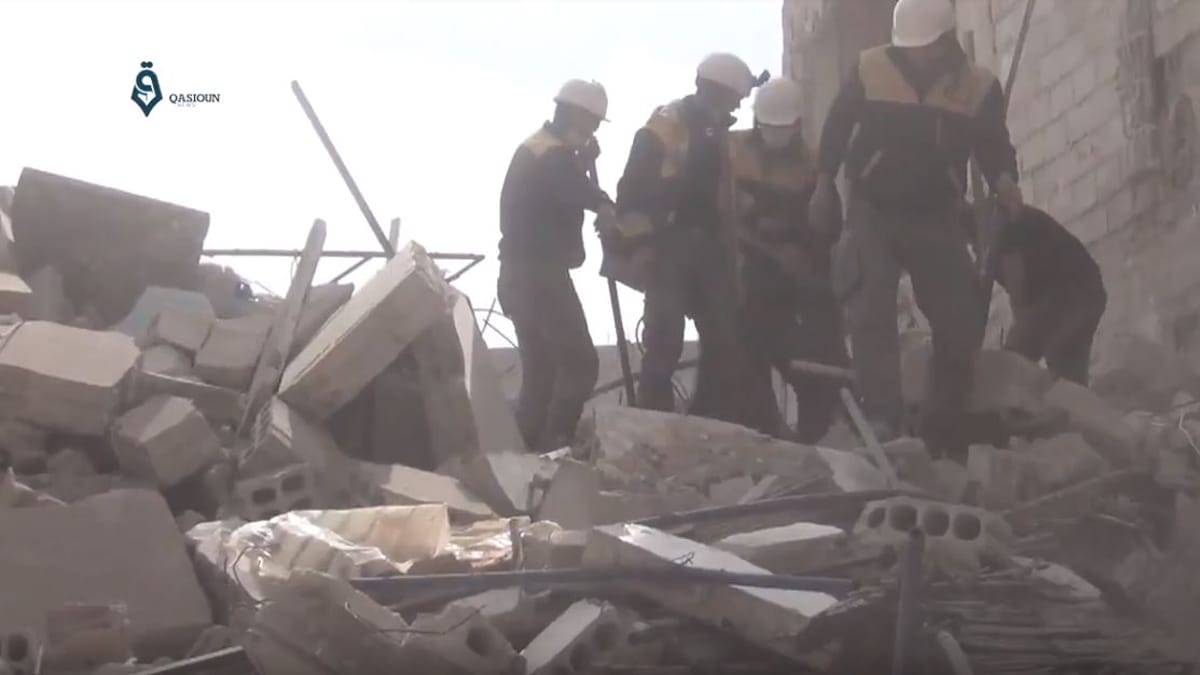
Syria's new multinational cleanup effort is trying to locate a chemical weapons stockpile that was supposedly eliminated in 2013, but much of the arsenal was never truly accounted for.
March 24, 2026
Stay in the loop
Get the briefing that goes beyond the video
Free, no-spam analysis on the stories that matter — delivered straight to your inbox.
Prefer an account? Create a free account