
China Has Hacked Britain's Drone Boats. And More.
Simon Whistler • August 14, 2026
Members only
Note: this transcript was generated by AI and may contain errors or inconsistencies.
Welcome back to The Briefing Room, your weekly Front Stocco programming, where we give our rundown of the global flashpoints, quiet conflicts, and geostrategic chess moves that you might have otherwise missed.
This week, it's a no-good, very-bad week for Russian President Vladimir Putin, as we discuss the new headwinds he's facing from two directions at once, from the increasingly bold nation of Turkey and from a longtime Russian ally in Kazakhstan.
But first, we're going to discuss a recent revelation in the United Kingdom that one of the British military's most important new toys has been compromised by Beijing before it ever got the chance to deploy into combat.
It's the kind of hypothetical that haunts the dreams of military intelligence officers all across the globe, that an extremely important, very advanced piece of hardware could be hijacked and exploited by an enemy. But this week, the British Royal Navy was forced to admit that very nightmare had just recently become a reality.
The story was first reported by The Telegraph, where on the 9th of August, Forensic Investigations editor Richard Holmes revealed that a line of Royal Navy drone boats had been compromised by China.
Just the investigators' guys, guys called Holmes. The Prolo was discovered within a sea drone called the K3 Scout, described as a, quote, low-cost, low-signature, high-performance USB by the company that made it, Kraken Technologies.
Easy to deploy and capable of carrying a wide range of payloads in a strike, surveillance, or logistics role, the Scout is an impressive piece of technology.
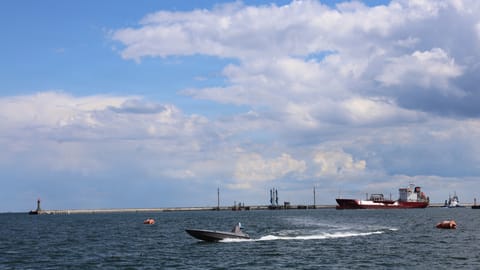
Just over 8.5 meters long, it can hit top speeds of up to 55 knots, or travel as far as 1,200 kilometers of cruising speed, loitering on its own for up to 30 days in the process. Its maximum payload, 600 kilograms, is more than enough to carry all sorts of helpful modules, or an explosive device almost as large as Ukraine's renowned sea baby.
But the UK's problems weren't with any of that.
Instead, China seems to have gotten into the Scout through the camera, a third-party addition to the boat from a Canadian company that, according to The Telegraph, had insisted that technology was secure. Instead, components inside those cameras were found to be beaming data to an IP address in China.
Each boat is fitted with a total of four cameras for situational awareness, as well as a camera mounted on a ball gimbal so that it can look around.
According to the British Ministry of Defense, the breach was only a so-called heartbeat transmission, in which the camera components were sending signals that confirmed that they were online and functioning.
Per the MOD, there was no transfer of any sensitive information to China, either about the boat itself, or about any other sensitive data that a compromised camera might have been able to collect. Now, we should emphasize that we don't know for sure just how the British government went about determining that nothing was compromised.
That is to say, we can either confirm that Britain was accurate in its assessment, or allege that it wasn't. But what we can do is illustrate what might be at stake if Britain is incorrect in its assessment. According to the Telegraph, the scout system's cameras could very likely have observed the faces of, quote, security-cleared staff at the special
Boat Service SBS Headquarters in Poole, Dorset. Those people's identities are a closely guarded secret for obvious reasons, and if China could observe and identify them, then there's reason to believe that any of them would be at risk of being targeted by Chinese or other adversary intelligence groups.
The drone boats also recorded, quote, preparations for Britain's plans in the Gulf, as well as, quote, highly sensitive meetings between senior special forces staff.
The cameras on the boats were capable of continuing to record even when the boats themselves had been switched off. Now, obviously, the revelation turned quite a few heads in the UK, with the Conservative Party calling for a comprehensive audit of military equipment to find other evidence of Chinese meddling.
According to a defense source who spoke to The Telegraph, the incident represented a major security breach and would likely doom the drone's future with the British military, quoting, we have lost confidence in the platform.
After the breach was discovered, the drone cameras were completely cut off from the internet. As of now, however, the British MOD is not known to have worked out exactly what China planned to do with the information it had gathered, or what the nation's other ambitions with the technology might have been.
The drones were operated by Britain's Coastal Forces Squadron and its 47 Commando Unit of the Royal Marines, and it's also on order with US Special Operations Command.
They were slated to deploy to the Middle East, particularly the Persian Gulf, as part of a post-war stabilization force when the U.S.-Israeli war against Iran eventually concludes. The report comes at a time when the British government has been, quite frankly, flailing in its attempt to settle on a security and diplomatic posture toward China.
On the one hand, British military leaders and intelligence heads appear to be quite skeptical toward Beijing, with MI5, British military intelligence, warning parliamentarians in 2025 that Chinese intelligence services were trying to compromise the parliament.
British security services have been highly aware of the potential threats posed by Chinese systems banning Huawei products from accessing the UK's 5G network as early as 2020, and according to another Telegraph report, banning Chinese-made electric cars from SBS headquarters earlier this summer.
Simultaneously, however, the political leadership in London has proved unusually willing to welcome China to locations that are obviously quite sensitive.
That's perhaps best exemplified in Beijing's recently approved plans to build a massive embassy in the heart of London, despite being positioned close to highly sensitive communication lines that China would probably have little trouble hacking into.
Unrelated to the British military's threat assessments, London appears intent on strengthening its relationship with Beijing wherever possible in hopes of striking favorable trade agreements.
For the United Kingdom, the new revelations about the K-3 Scout are a major blow to its new defense plan, which had essentially thrown away any hopes of building a future destroyer in hopes of replacing those ships with a combination of crewed vessel and unmanned drone boat forces.
The effort that led to the procurement of the K-3 Scout was Project Beehive, the flagship initiative behind the new defense plan.
For China, Beijing's continued interest in British military capabilities indicates that despite the UK's waning military power, China still considers the nation to be an adversary worth understanding and infiltrating.
For the rest of the world, the incident was yet another urgent reminder of the importance of well-sanitized supply chains and constant vetting despite the growing relevance of non-traditional defense companies and startups. Next up we turn to the nation of Turkey where this week Ankara decided to approve an arms sale that's sure to turn heads in Moscow.
According to documents that Turkey submitted to the United States Congress, the nation is planning to provide a hefty package of long-range weapons to Ukraine. Several copies of the Atakum's tactical ballistic missile, 12 launchers for America's M270 multiple launch rocket system, over 2,500 rockets, and roughly 47,000 cluster munition artillery rounds.
If the US approves the transfer, as it seems quite likely to do, then this will represent one of the largest transfers of long-range strike and artillery ammunition to Ukraine by any nation beside the US.
For Ukraine, the incoming weapons have the potential to be a huge help at a time when Kyiv is struggling to offset a nearly continuous barrage of Russian missiles and drones as they punch through its critically undersupplied air defense network.
While the rockets and ballistic missiles that Turkey is providing won't be able to intercept incoming Russian projectiles directly, they will go a long way in allowing Ukraine to hit back. These are weapons that Ukraine has used with devastating effect against Russian air defenses, radar systems, ballistic missile launchers, and a range of other targets.
The Atakum's in particular enables relatively deep strikes into Russian territory, where they can hit a full 300 kilometers past the front line.
While the transfer of Turkish cluster munitions is likely to be highly controversial, neither Russia nor Ukraine are party to the Convention on Cluster Munitions, and Russia uses the weapons regularly in its invasion of the Ukrainian East.
For Turkey, these are relatively older systems that are in the process of being phased out and replaced with superior hardware.
But for Kyiv, they're vital to keep Russia occupied, distracted, and in a perpetual state of at least partial defense. The real story, however, is the relevance of that deal for Turkey, in what seems to be one of the nation's clearest statements to Russia since this war began.
Over the last two decades, and especially since the mid-2010s, Turkey's once supportive relationship with Russia has been falling apart.
The two nations are economically interdependent. Russia supplies a high share of Turkish natural gas, and is helping to build a nuclear power plant, while Turkey guards over the Bosporus Strait, the sole point of entry into the Black Sea.
The two nations still trade relatively high volumes, Turkey still fills a decent share of its arsenal with old Soviet-era Russian hardware, and the nation's respective leaders are still able to work together in times of crisis.
But Turkey, very clearly, wants to chart its own course through the world, building itself into a regional economic, defense, and geostrategic powerhouse. By necessity, that's led to increased friction with Russia. But more than that, Turkey's leadership sometimes seems as if it's almost eager to pick a fight with Moscow.
In Syria, Libya, and the conflict between Armenia and Azerbaijan, Turkey and Russia ended up on opposite sides, in proxy battles that culminated with Turkey's preferred allies.
Thank you. over Syria, Azerbaijan driving Armenia out of Nagorno-Karabakh, and the internationally recognized Libyan government resisting a years-long offensive by warlord Khalifa Haftar.
Back in 2015, Turkey even became the first nation to really stand up to Russian airspace violations, warning Russia to stop plying its aircraft into Turkish airspace, and then promptly shooting down a Russian fighter jet after just 17 seconds of an airspace violation.
To be clear, it's not so much that Ankara wants to bring about the fall of Moscow, for instance, or take Russia's place as the dominant force in the Caucasus and Central Asia.
Instead, Turkey seems to believe that by standing up to Russia directly, it can make abundantly clear to the rest of the world that Turkey isn't scared of shit, and that it intends to pursue a totally sovereign foreign policy despite its historical ties to Russia and its membership in the NATO alliance.
But in order to understand just how big a deal this latest arms transfer is, we'll quote Ukrainian war journalist Ilya Ponomarenko writing on X, Dozens of attackants, a dozen M270s, tens of thousands of cluster munitions from artillery.
I honestly don't know how else to explain such a massive sale of such powerful weaponry from Turkey to Ukraine, other than that even Erdogan has finally concluded that Putin is f***ing deranged and impossible to negotiate with in his obsession with the war against Ukraine, and has decided to pick a side.
Beyond the colorful language, which is, by the way, rather fitting when describing a geopolitical switch-up that's that brazen, Ponomarenko is right to point out that this is a statement not just on Ankara's loyalties, but on its apparent belief that Putin and Russia are too far gone.
Since the start of the Ukraine war, Turkey has worked very hard to present itself as an arbiter of potential peace negotiations, a country that can welcome Ukraine on behalf of the NATO alliance, but also get through to Russia.
If Turkey had been able to get negotiations started, then it could have reaped the benefits of what would likely have been described as a diplomatic coup.
Similar to what it seemed, for a moment, that Pakistan might achieve in the Middle East, Turkey could demonstrate that it was such a well-respected, geopolitically skillful arbiter that even mighty Russia came to negotiate at Turkey's table. Now, though, Turkey's upcoming arms transfer is a signal that those efforts have probably come to an end.
As we mentioned, this is one of the largest arms transfers that Ukraine has ever received from a single country other than the U.S., and for a nation so skilled at navigating the geostrategic tides, it's highly unlikely that Turkey would have somehow misunderstood the signal that this would send.
But as we discuss this deal as a signal to the world and to Russia, it's worth noting one other element of the signal Turkey sent. On the same day that the Turkish transfer request to Washington was revealed publicly, Turkey put out a new call for a moratorium on Black Sea attacks for both Ukraine and Russia to follow.
That request comes at a difficult time for all nations in the region, as Moscow and Kyiv expand their long-range drone and missile campaign to attack commercial shipping, including vessels that are Turkish-owned or fly a Turkish flag.
But when that request might otherwise have been taken as a Turkish plea to both sides imploring ukraine and russia to make a sensible decision and display some decency well the message is a bit different now turkey will still be open to negotiating a settlement with russia but ankara will no longer waste its time trying to keep hidden its preference for the
Side that should win this war and finally today we turn our attention to kazakhstan where that nation's president kasim jamar tokhayev also decided to give vladimir putin the peace of his mind in tokhayev's case however we've got to give an extra round of applause because it takes a special kind of backbone for the leader of a russia-dependent nation to
Travel into russia and deliver the following set of quotes to putin's face perhaps it's time to freeze this conflict and return to the istanbul formula 2.0 he was referring here to a proposal that would stop the ukraine war and restart negotiations where they left off around four years ago another quote how to get out of the situation nobody knows because
There are the positions of both sides but on the other hand there is such a moment and possibility to freeze all this it is a shame young people are dying all this has to be stopped end quote and on the russian justifications for the war that putin holds so dearly tokhayev gently explains that the causes of this war quote are not completely understandable
For many including for us as tokhayev put it countries like armenia and azerbaijan had clear reasons to fight but russia's reasoning to invade ukraine well it just didn't hold up to scrutiny it's been a bit under three weeks since that address and we can happily report that president tokhayev has yet to fall backwards out of a 20-story window or to be
Presented with cups of bunny smelling tea or to exhibit any signs of nerve agent exposure and so on and so forth in fact although he certainly didn't look happy about what tokhayev had said vladimir putin managed to hold it together while he was on stage with his kazakh counterpart saying only that he would discuss the origins of the war with tokhayev during
Their private meeting but over the last several weeks kazakhstan has made clear that this wasn't just an empty rebuke of a foreign head of state instead it's the latest in a series of moves that seems designed to help kazakhstan wiggle its way out of the kremlin's orbit now it only takes a very basic google search to see why that's going to be a difficult
Task for kazakhstan in particular as a functionally landlocked nation excluding the inland caspian sea kazakhstan is dependent on russia for trade taking in nearly a third of its overall imports from russia but sending less than 10 percent of its exports to russia what russia does accept is mostly a stream of natural resources especially iron ore and
Radioactive materials kazakhstan is historically energy dependent on russia too funneling most of its oil exports through the caspian pipeline consortium to export out of russian terminals in the black sea as a post-soviet power that exists squarely within russia's orbit kazakhstan also depends on russia for its defense and it's an integral part of russia's
Geostrategic block the csto but kazakhstan has been working to reduce its russia dependence for a few years you Now, and those efforts are only ramping up.
By 2027, Kazakhstan plans to end all imports of Russian-produced electricity, and it's starting to diversify its oil exports, sending more and more of that oil away to China.
And speaking of China, Kazakhstan has been very important in the creation of alternative pipeline paths, often using Chinese funding, to create trans-Asian oil shipping networks that go around Russia completely.
Kazakhstan has been very happy to involve itself with China's Belt and Road Initiative and a whole slate of related projects, using China as a sort of counterweight to reduce the crush of Russia's influence. And it's starting to broaden its relationships with Turkey and even the EU.
Unlike many modern ex-Soviet states in Moscow's orbit, Kazakhstan is enthusiastic about prosecuting citizens who go to fight against Ukraine, often handing them long prison sentences, and it's been willing to enforce export controls that prevent military-related materials from being transferred into Russia, informally bringing itself in line with Western
Sanctions, even if it can't join properly.
On defense, Kazakhstan is stepping up its indigenous production of ammunition and starting to modernize its military in a process that will see many ex-Soviet systems phased out. As for why Kazakhstan wants to make all these changes, we actually covered one of the bigger reasons on war fronts in late 2025.
Russia seems to be exploring the possibility of an eventual Kazakhstan invasion. We'll refer you to that episode if you'd like to learn more.
But for now, suffice it to say that Russia may believe it could capture resource-rich Kazakh land without much of a fight, especially considering that the rest of the world will have a much harder time supporting Kazakhstan than Ukraine on the basis of simple geography.
For Kazakhstan, China is the sole exception, and if Kazakhstan could work on becoming really, really important to China, then it gives itself the chance that Beijing could help to prevent an attack. In a much broader sense, however, Kazakhstan has been little more than a Russian vassal state since it gained its independence in 1991.
Frankly, it's just been really easy for Kazakhstan to depend on Russia for everything, and it's been prohibitively difficult and expensive to try and build connections elsewhere.
But between the war in Ukraine, the diminished global profile and prospects of the Russian Federation, and the threat that Kazakhstan could be next on Putin's menu, that calculus has finally shifted.
What President Tokayev told Putin on stage in Russia was a message that took real bravery to convey directly, but that message just reaffirmed a change that Russia and Kazakhstan both know is underway, even if the Russian leadership might be a lot less happy about that change than the Kazakh people. Thank you for watching.
Watch with Fronts Insider
Fronts Insiders get every video, the complete archive, and private sponsor-free playback.
Insiders Receive
- Every WarFronts, HomeFronts, and Insider video
- Complete sponsor-free video archive
- Support independent conflict journalism
From $5/month — cancel anytime
