
middle-east
Iran Daily Dispatch — Monday, March 23, 2026
No-fluff daily news and developments on the Iran War, every weekday. Want to be notified when the Daily Dispatch comes out? Sign up for the Iran Daily Dispatch newsletter.
March 23, 2026 · 7m
Transcript
Note: this transcript was generated by AI and may contain errors or inconsistencies.
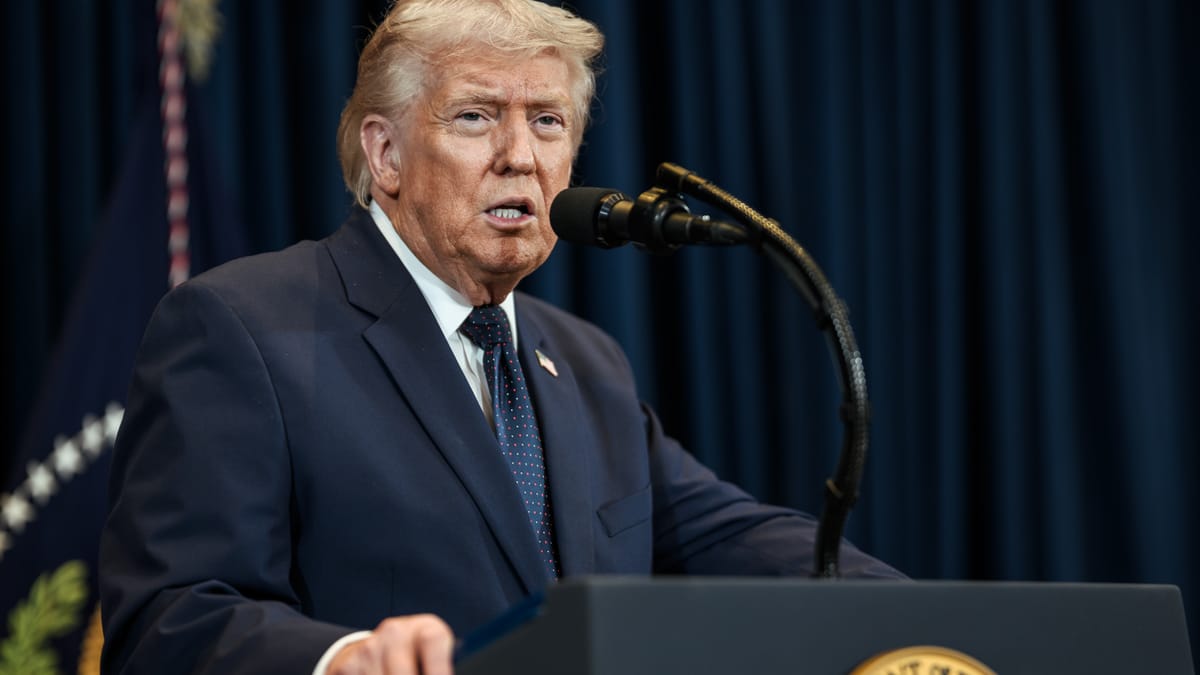
This is the Iran Daily Dispatch, Episode 5, Monday, the 23rd of March, 2026. I'm Tessa Danvers for Fronts.co. Late Saturday night, local time, in Washington, D.C., U.S. President Donald Trump publicly issued an ultimatum to the nation of Iran via social media.
In that post, Trump threatened to launch direct airstrikes against Iranian power plants, with the intention to destroy those plants completely unless Tehran opened the blockaded Strait of Hormuz within 48 hours.
Trump's threat was motivated by the events of the prior several days, starting with a U.S.-approved Israeli airstrike against Iran's critical South Par's natural gas field.
In retaliation, Iran destroyed a portion of Qatar's Ras Lafon liquefied natural gas complex, struck a Saudi oil processing center on the Red Sea, and hit one of Israel's two key oil refineries in the city of Haifa. We've covered those events in greater detail on prior episodes of the Daily Dispatch.
Those strikes set off an ongoing cycle of mutual escalation, with Israel, Iran, and the United States now focusing fire against key economic and infrastructural targets that had been avoided during the war's earlier phases.
Just hours prior to Trump's ultimatum, the U.S. and Iran had continued that escalatory cycle with what Iran alleged was a bunker-buster attack by the United States against its Natanz uranium enrichment facility. Iran responded in short order, with a Saturday missile strike against the Israeli city of Dimona.
Israel's main nuclear reactor and the suspected center of research for its unacknowledged nuclear weapons program are both located near Dimona, signaling that the strike was most likely intended as retaliation for the Natanz attack earlier in the day. Also on Saturday, another Iranian missile struck the nearby desert town of Arad.
According to Israel's health ministry, 180 people were injured in the Dimona and Arad impacts combined, although none were killed.
These strikes came in areas where Israel is believed to have positioned some of its greatest concentrations of air defense systems, contributing to concerns over a looming shortage of air defense interceptors in Israel and elsewhere.
Despite the apparent retaliatory nature of Iran's strike against Dimona, it was this attack that seemed to prompt Trump's threat against Iranian civil energy infrastructure. While Iran's energy grade sustains military operations, conflict experts have emphasized that any such attacks would primarily harm civilians.
In response to Trump's ultimatum, Tehran offered its own guarantee of military escalation, in the event that either Washington or Jerusalem chose to act upon those threats.
Iran's increasingly prominent parliament speaker, Mohamed Bagir Khalibov, announced on social media that any such strikes would lead Iran to treat vital infrastructure across the Middle East as legitimate targets.
Critically, Iran didn't just match the United States expansion of its target list, but published a list of named targets that could be at risk, which included several critical desalination and water infrastructure plants.
Across the water-scarce Middle East, and especially in the states of the Persian Gulf, strikes against desalination infrastructure are seen as a true worst-case scenario.
A high share of the population of every Gulf state is dependent on desalination plants, and most possess only limited water reserves meant to address temporary and localized service interruptions. If Iran were to destroy those desalination plants as promised, it would invite retaliation against its own desalination infrastructure.
But it would also force the world to respond to an immediate humanitarian crisis that would almost certainly prompt the urgent evacuation of several Gulf capitals. Trump's 48-hour ultimatum for Iran is set to expire in the late evening hours on Monday, local time in Washington.
Also over the weekend, Iran attempted an unprecedented strike on the Indian Ocean island of Diego Garcia, a highly militarized atoll that hosts a key joint base for the United States and the United Kingdom.
Diego Garcia is located nearly 4,000 kilometers from Iranian territory, meaning that it is, at least in theory, a target that Iran should not have been able to threaten. Prior to the attempted strike, Iranian officials had consistently maintained that their ballistic missiles were only able to strike targets at a maximum range of 2,000 kilometers.
This weekend's attempt to hit Diego Garcia was not successful, but it signals a growing Iranian willingness to unveil hidden capabilities and expand the scope of this conflict beyond the Middle East. From a technical perspective, it's not a surprise that Iranian missiles could be modified to strike targets at a range greater than 2,000 kilometers.
In fact, that range limitation was understood to be mostly political in nature. But an explicit expansion of Iran's missile strike radius is an implicit threat against all nations within that radius, primarily the nations of Europe.
Berlin, Paris, Rome, and other European capitals are well within a 4,000 kilometer radius, as are tens of thousands of U.S. troops at bases across Europe, Asia, Africa, and the Middle East.
In what may have been an intentionally leaked response to Iran's actions from the United Kingdom, the Daily Mail reported on Saturday that a British nuclear-powered submarine is now positioned in the Arabian Sea. In related news, the weekend's events confirmed Iran's growing preference for cluster munition warheads in its strikes against Israel.
Cluster munitions are capable of scattering dozens of bomblets even after a successful missile interception. That increase in the utilization of cluster bombs has seemed to correlate with a rising number of casualties in Israel, where civilian fatalities remain relatively rare, but injuries and destruction have grown increasingly common.
Over the weekend, Israel continued its strikes against Iranian military and civil targets, including what American and Israeli media claimed was the killing of a senior drone forces commander within Iran's Revolutionary Guard.
Tehran withstood especially heavy airstrikes across Saturday night and into Sunday, while the city of Isfahan came under unusually heavy bombardment. Israel appears to have successfully degraded missile launch infrastructure in the Iranian west, where missiles would have to fly a relatively short distance to reach their targets.
Over the last several days, Iranian launch locations have shifted sharply towards central Iran, suggesting that the remaining missile launchers in the west of the country are either being concealed or are relatively scarce at this stage. Meanwhile, Weekend reports provided limited insight on the status of Iran's surviving leadership.
According to Axios, U.S. and Israeli intelligence now suspect that Iran's new supreme leader, Mostaba Khamenei, may still be alive, but have no proof that Khamenei is issuing orders or taking any sort of active role in the nation's leadership.
Other reports from the United States indicate that Washington is now struggling to identify Iran's current leadership, after the death of de facto leader Ali Larajani several days ago.
Of the officials who seem to be wielding the greatest influence in Iran today, most are either loyal to the country's Revolutionary Guard or are members of the IRGC themselves. The Iran Daily Dispatch is presented and produced by Tessa Danvers and written by Evan Maloney. Simon Whistler is our executive producer.
The Iran Daily Dispatch is a free-to-access audio news brief, available exclusively on Fronts.co. The Iran Daily Dispatch and the rest of our Fronts.co podcasts, articles, and video episodes are made possible by our generous premium subscribers. Thank you, as always, for your support. Thank you.
Free newsletter
WarFronts Weekly
A free briefing on conflict, defense, and security. Delivered Tuesdays, with the Blitz on Fridays.
Membership
Fronts Insider
Enjoy benefits with your membership including:
- Premium reporting & briefings
- Insider videos & visual analysis
- Key Insights summaries