
middle-east
Iran Daily Dispatch — Thursday, March 19, 2026
The Iran Daily Dispatch explores the escalating conflict in the Middle East, following Israel's strike on Iran's South Pars natural gas field and Iran's retalia
March 19, 2026 · 9m
Transcript
Note: this transcript was generated by AI and may contain errors or inconsistencies.
This is the Iran Daily Dispatch, Episode 3, Thursday, the 19th of March, 2026. I'm Tessa Danvers for Frontstock Co. On Wednesday, the Iran conflict entered a new phase of escalation, after an Israeli airstrike on a critical Iranian natural gas field prompted severe retaliation from Tehran.
Israel's strike targeted the South Pars natural gas field, the world's single largest natural gas reserve. Control over this undersea deposit is split between Iran and Qatar, but unlike many of Iran's energy reserves, the natural gas it extracts from South Pars is used primarily for domestic purposes.
Iran is heavily reliant on natural gas to provide electricity and home heating for its citizens, and the natural gas extracted from South Pars comprises approximately 80% of Iran's domestic natural gas needs. As such, South Pars is critical to Tehran in a way that its other export-focused energy installations are not.
To this point in the conflict, Israel and the United States had avoided attacking South Pars, presumably for this very reason.
And while Iran has launched frequent attacks on energy targets across the nations of the Persian Gulf, its strikes have thus far remained limited, demonstrating Tehran's ability to break through Gulf state air defenses and impact critical targets, but not pressing that advantage with drone and missile swarms on the scale that Iran is capable of.
In a tacit recognition that certain lines in this conflict had yet to be crossed, Israel and the United States have avoided some of Iran's most important energy infrastructure, including not only South Pars, but the oil refineries on Karg Island, where strikes had been limited to mostly military targets.
But Israel's Wednesday attack dramatically changed that equation. Although the United States did not participate in the attacks directly, U.S. leadership, including Donald Trump, were aware of the strikes before they happened, and supported Israel's decision as an act of retaliation against Iran's closure of the Strait of Hormuz.
The states of the Persian Gulf, however, made clear that they opposed Israel's decision almost as soon as the news broke, and their reasoning was obvious.
By clearly and deliberately holding South Pars and other critical Iranian energy installations off-limits until now, the United States, Israel, and Iran had all signaled to each other a mutual understanding, that attacking those sites would be an undisputable act of escalation.
Now that South Pars has been attacked, Israel, and by association the United States, have signaled to Iran that their intent was to escalate the conflict into an even more intense phase. In the following hours, Iran demonstrated that Israel's message had been received. In a crystal clear act of retaliation, Iran struck Qatar's Ras Laughan industrial city.
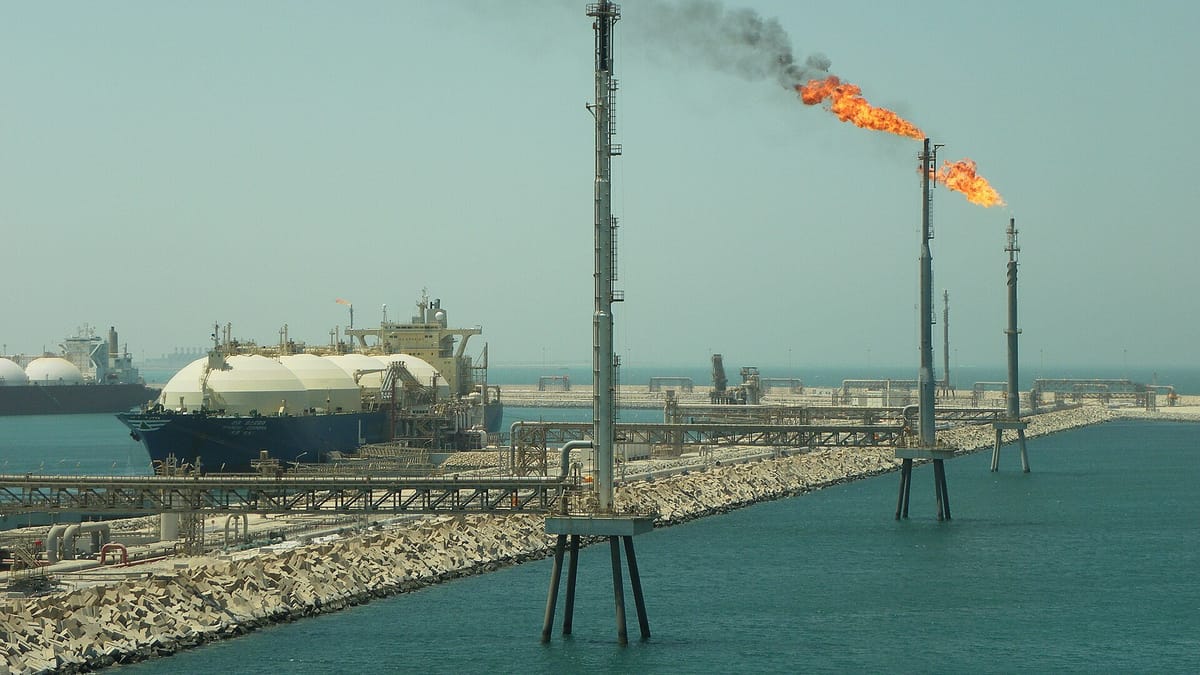
The installation that processes Qatar's portion of the South Pars' natural gas deposit and converts it into its liquefied form, known as LNG.
Ras Laughan is among the most important targets in the entire Middle East, responsible for approximately 20% of the entire world's LNG supply, as well as one-third of the purified helium. and there is something that tells Russia, required to build semiconductors.
Roslafen had already been struck by Iran during this conflict, but those prior strengths were limited, forcing Roslafen to shut down but falling far short of total destruction. On Wednesday, Iran appeared to decide that the destruction of Roslafen was now justifiable.
Iran launched a large volley of ballistic missiles at the facility, sparking massive explosions at several locations. While the extent of the damage is unknown at this time, fires raged at Roslafen through the early hours of Thursday morning. Qatar Energy described quote, extensive damage.
Qatar promptly expelled Iranian diplomats after the strikes and threatened its own retaliation in response. Also Wednesday night, Iran announced that it had struck another oil processing facility, this time at Saudi Arabia's Yanbu refinery, not located in the Persian Gulf but in the Red Sea.
Just days before the Israeli strike on Iran's natural gas, Saudi Arabia had announced that it was diverting its crude oil experts to Yanbu, taking them out of range of the conflict with Iran as its boundaries had previously been defined.
While the Iranian strikes on Yanbu have not been confirmed as of the time of writing, any damage to the facility would suggest that Iran interpreted the strikes on South Pars as a categorical escalation of the conflict. Saudi Arabia also reported missile debris impacts after attempted strikes on its capital city.
By Wednesday night in the U.S., Washington appeared to show clear buyer's remorse over the day's events, with Donald Trump indicating that there should be no further strikes on Iranian energy, according to officials close to America's president.
Per those same officials, as reported in the Wall Street Journal, Trump believes that quote, Iran got the message from Israel's earlier strikes and quote, could be open to targeting more Iranian energy facilities if Iran continues to target the Strait of Hormuz.
In the coming days, it will be up to Israel to choose whether to abide by Trump's new position, while it will be up to Iran to signal whether de-escalation is even a possibility.
In the wake of the Raslafen missile strikes, French President Emmanuel Macron stated that he had contacted both Trump and the leader of Qatar with the intent to establish an immediate moratorium on strikes against energy and water supply installations.
As of the time of writing, no moratorium has been agreed upon or publicly acknowledged by any nation participating directly in the conflict. Elsewhere on Wednesday, Israel, the U.S., and Iran each continued strikes on each other's territory and interests.
An Israeli airstrike killed Iran's intelligence minister, Esmail Khatib, as confirmed by Iranian President Masoud Pezeshkian. Khatib was a key member of Iran's state repression apparatus, alongside de facto leader Ali Larijani and Bezizh paramilitary commander Gholamreza Soleimani, who were killed on Tuesday.
Khatib was a key member of Iran's state repression apparatus, alongside de facto leader Ali Larijani and Bezizh paramilitary commander Gholamreza Soleimani, who were killed on Tuesday.
Israeli officials confirmed that Khatib's death was the latest to result from a new directive. powering the nation's military to kill Iranian leaders based on actionable intelligence without waiting for approval from political leaders. Israeli officials indicated that the policy will remain in place, at least for the near future.
Also Wednesday, Israel confirmed that it had carried out airstrikes on several Iranian naval vessels on the Caspian Sea, where they had been guarding over port and energy infrastructure.
Israel, for their part, absorbed several Iranian strikes over the course of the day, including multiple direct hits that did not appear to have been intercepted by Israeli air defenses.
Meanwhile, Israel absorbed several Iranian strikes over the course of the day, including multiple direct hits that did not appear to have been intercepted by Israeli air defenses.
An Iranian missile hit a hair salon in the West Bank, killing three Palestinians, while Israel acknowledged damage to several private aircraft at Ben Gurion International Airport, attributed to falling missile debris.
Israel also reported the deaths of an elderly couple in Tel Aviv, due to Iranian cluster munitions and missile damage at a busy railway station. Another missile struck an Israeli agricultural community late Wednesday night, killing a foreign worker at the site.
On Wednesday, the Times of Israel amplified recent reports that have suggested shortages of missile interceptors, indicating that stockpiles have only been depleted further in the last several days. In Lebanon, Israel continued attacks against the Iran-allied Hezbollah organization, including in airstrikes that targeted the Lebanese capital city, Beirut.
There, Israeli bombs brought down a 10-story building. On Wednesday, the Lebanese health ministry indicated that close to 1,000 people have been killed in Lebanon since the return to conflict between Israel and Hezbollah, including at least 110 children.
Israel also struck a pair of crossings that allowed passage over the Litani River, the defining line that marks the edge of territory Israel intends to clear in a southern ground invasion. According to Israel, the crossings were being employed by Hezbollah to move fighters and munitions.
Over 1 million people in Lebanon have been displaced by the resurgent conflict thus far. According to Reuters, Washington also placed pressure on another Lebanese neighbor on Wednesday, encouraging the nation of Syria to deploy its forces onto eastern Lebanese territory.
Damascus is reportedly hesitant to risk committing its forces and drawing itself into a conflict that it's mostly managed to avoid. Finally, Wednesday was a complicated day for Iran's neighbor Iraq. Baghdad received both bad news and a rare bit of good news.
Tehran decided to stop natural gas flows to neighboring Iraq, prompting short-term energy shortages that will amount to over 3,000 megawatts, as collateral effects from the war continue to destabilize Iraqi life. For reference, 3,000 megawatts is roughly equivalent to the energy needs of 2-3 million homes.
Also in Iraq, Washington reached a truce on Wednesday, with several armed pro-Iran factions that had carried out attacks against the U.S. Embassy and other targets. According to Mustafa Sadun, the head of the Iraqi Observatory for Human Rights, And in Swedish存起 land is an easy chance to destroy comer à sehen ability.
So you'll have to leave the United States for Human Rights to execute it and investigate the E, to enter each other working and Dansians in the abusers' body. agreement stipulates that the U.S. will not conduct any further strikes on the leaders of those Iraqi factions or their Iranian advisors, while the militias commit to avoiding attacks on the U.S.
Embassy.
The agreement is very fragile and prone to collapse at any time, but marks a rare brief instance of de-escalation in a conflict that otherwise seems to be spiraling out of control. The Iran Daily Dispatch is presented by Tessa Danvers, written by Evan Maloney and produced by Jennifer DaSilva. Simon Whistler is our executive producer.
The Iran Daily Dispatch is a free-to-access audio news brief available exclusively on Fronts.co. The Iran Daily Dispatch and the rest of our Fronts.co podcasts, articles, and video episodes are made possible by our generous premium subscribers. Thank you, as always, for your support. Thank you.
Free newsletter
WarFronts Weekly
A free briefing on conflict, defense, and security. Delivered Tuesdays, with the Blitz on Fridays.
Membership
Fronts Insider
Enjoy benefits with your membership including:
- Premium reporting & briefings
- Insider videos & visual analysis
- Key Insights summaries