
China Got Access to America’s F-35. How Bad is the Damage?
Simon Whistler • September 23, 2026
Members only
Note: this transcript was generated by AI and may contain errors or inconsistencies.
For the United States of America, there are few weapons more important than the F-35 Lightning. It's the world's most abundant fifth-generation stealth fighter and the workhorse of America's stealth fleet, alongside the absolutely monstrous and awesome F-22 Raptor.
The F-35 is a vital tool for American power projection, flying in service with key US allies from Britain to Japan to Israel.
It's among the most sensitive combat platforms that the US is willing to share, and it allows the United States to trust that in the event of global hostilities against nations like China or Russia or Iran, the US and its allies can count on a decisive advantage.
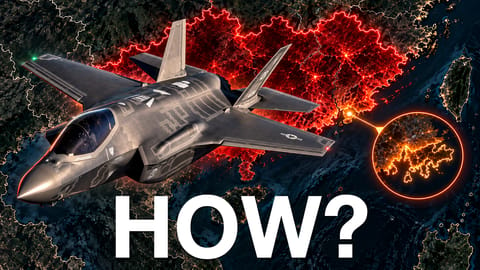
But right now, the US is dealing with a rather massive intelligence failure, when a shipment of F-35 components was quietly nudged off course and diverted to China-controlled Hong Kong. From there, the components disappeared, and while their fate is currently unclear, it's almost certain that they've made their way into Beijing's custody.
So, from America's perspective, just how much of a problem is there? What problem could it be when sensitive fifth-gen technology falls into the hands of the nation's greatest rival? And for China?
Well, what has Beijing actually captured? The sort of hardware that'll make for a nice museum piece, or the sort that'll change the balance of power in the Indo-Pacific? The Theft Now, the F-35 is, above all else, an invention of the United States.
It was built by one of America's foremost defense companies, Lockheed Martin, and the US is both the only nation to fly all three variants of the F-35, and the nation's slated to have the world's largest fleet of the jets once all is said and done.
But the F-35 program has always been an international endeavor, with several US allies deeply integrated into the production process. The UK, for example, builds around 15% of every F-35, whereas Belgium produces tails, Canada produces landing gear and elements of the fuselage, and Italy handles final assembly for European deliveries.
The exchange makes sense for everyone. The US gets to integrate foreign technology and rely on foreign manpower, while these other countries get a close look at a highly advanced fighter program, picking up technical knowledge without having to run the program themselves. But working with foreign partners creates an inherent risk.
A highly internationalized program is easier to infiltrate and partly compromise. There are more blind spots, more loopholes, and more individual people to bribe, coerce, or otherwise leverage in order to gain access. Of course, no participating nation in the F-35 program wants to be the one that gets compromised, and so every participant is quite diligent.
Even still, accidents happen, and more countries involved means more potential points of failure. Unfortunately for Washington's friends down under, the recent theft of F-35 components targeted a shipment heading out of Australia, intended for transit to the United States.
According to the first outlet to report on the story, Politico, the F-35 parts were meant to be repaired in the US, meaning that they weren't operable at the time they were captured.
While the full extent of the shipment is unknown, it's known to have included at least one radar-absorbing canopy, and it's known to have included at least one radar-absorbing canopy, and it's known to have included at least one radar-absorbing canopy, a classified and highly sensitive piece of technology that's difficult for any advanced nation to engineer
From scratch.
The transit of the parts was, officially, the purview of Lockheed Martin. But according to Politico, the company relied on an intermediary to transport the shipment, which, in itself, isn't unusual.
Or at least, it wasn't, until that shipment was rerouted to Hong Kong under unclear circumstances. Quoting the Politico report directly, it's not clear why the equipment was rerouted or who has possession of it now. To say, the United States, Australia, and Lockheed Martin each do not have possession of the hardware.
The US has been aware of the incident since at least June, when the State Department and the Pentagon briefed congressional staff on America's national security committees.
When asked by Politico, the Pentagon confirmed that it was aware of the issue, and working, quote, to retrieve these components, investigate the incident, and place safeguards to avoid a future occurrence. But if we're at warfront, maybe, Frank, those parts ain't coming back.
While the US, government is understandably not willing to go into any great detail explaining the incident, it's simply not an accident that a shipment this sensitive would be rerouted to Hong Kong and just disappear.
And lest you imagine that this is the westernized, Beijing-skeptical Hong Kong of, say, a decade ago, let's just say that Hong Kong hasn't existed since the late 2010s. And while the territory is still a special administrative region of China, it's been fully absorbed by Beijing for all practical purposes.
That includes Hong Kong's ports, where private companies are still technically in charge, but they are expected to comply with Beijing and have little real choice but to do so. As of now, there's no clear publicly known evidence that Beijing was behind the decision to reroute the shipment.
The company entrusted with bringing these F-35 parts to the US has yet to be identified, but Lockheed Martin does depend on commercial partners to handle shipments internationally.
The company doesn't own a cargo ship fleet of its own, of course, and so third party logistics providers are a point of vulnerability for them and for the F-35 program overall.
As for whoever made the decision to approve a shipment being rerouted to Hong Kong, that was a decision that Australian analyst Michael Shoebridge described as, quote, an act of incredible ineptitude and stupidity, end quote.
Shoebridge continued when he was speaking to The Guardian, and so it's more the Chinese taking advantage of an incredible stroke of luck brought to them by the stupidity of the people involved, end quote.
But whether the responsibility lies with some pencil pusher at Lockheed Martin or a bureaucrat within the Australian defense apparatus or, quote, a shipping company that Beijing managed to pressure into rerouting the vessel, that's anybody's guess.
Australian authorities have since acknowledged that they're trying to figure out what went wrong, and they've pledged a review of, quote, everything that has occurred at the Australian end. But according to the nation's acting Prime Minister, Richard Marles, there's nothing to worry about.
Quoting him, my understanding is that there's a sense of comfort, and we're not talking about sensitive equipment here or sensitive parts. That is a claim that we should greet with a level of skepticism. The original Politico report could be wrong, of course, and the shipment might have really included only F-35 parts that were quite benign.
As defense analyst John Conway put it, speaking to ABC News, quoting, there are thousands of components in an F-35. Some are routine in what they are and what they do. Others are more sensitive, end quote.
But if the initial reports are correct and an F-35 canopy was among the parts that have disappeared into China, then that is a quid pro quo. Once in possession of a rival nation, especially one as advanced as China, a canopy like this can be reverse-engineered, with all of its stealthy features unlocked in due time.
China can use that information to adapt the canopy design for its own stealth fighters, or, perhaps more importantly, to gain insights into America's approach to stealth.
With a finished product right in front of them, China's engineers will likely be able to work out the broad principles behind its design before applying those principles to their own work.
A Target of Espionage If, indeed, Lockheed Martin's captured canopy is now in the custody of Beijing, then it's going to be studied in immense detail by a country that's got its own highly advanced stealth fighter programs.
At present, China flies at least 500 copies of its workhorse stealth fighter, the J-20, including small but growing numbers of a more advanced variant called the J-20A.
China's also flying at least 60 or 70 copies of its carrier-capable J-35, a relatively close analogue to the American's F-35. Beijing is hard at work on multiple sixth-generation concepts, including a heavy three-engine aircraft that Western analysts call the J-36, and a tailless twin-jet fighter known in the US and Europe provisionally as the J-50.
With so many ongoing programs and such a heavy research and development burden to keep up with, it should be no surprise that China's engineers on stealth aircraft are among the very best of the best.
So it should also be no surprise that if they really have gotten their hands on the F-35, they'll be able to fly it. And if they do, they'll know exactly how to take it apart and study whatever they find. China's had a known, vested interest in the F-35 program for years, and the US is well aware that China wants to compromise the jet by any means necessary.
After all, it's the primary aerial threat that China is likely to face in any future conflict across the Indo-Pacific. Not only does the US eventually plan to fly over 2,400 copies of the jet, but South Korea plans to operate 60, Japan will fly nearly 150, once its orders are filled, and Australia currently flies 72.
The idea that China could study the system, get an up-close look, or even acquire F-35 tech directly has been one of the most important justifications for American leaders to oppose a sale of the F-35 to Saudi Arabia, despite immense interest in the jet from Riyadh.
The country has been waiting on 48 copies ever since the signing of a deal in November 2025, but US officials insist that Saudi Arabia is both compromised by Chinese intelligence, and also too close of a Chinese military and security partner for the US to be able to trust that the F-35 would be closely guarded.
One Pentagon report, seen by the New York Times, found that it was unclear whether Saudi Arabia would agree not to have contact between the F-35 and Chinese military representatives or hardware, and nor was Saudi Arabia guaranteed to remove sensor and telecommunications infrastructure developed in China that Beijing could conceivably exploit.
And even more frustrating for the United States, it's not entirely clear what China might already have to do with the F-35, but it's not entirely clear what China might already have to remove from the F-35 program.
The Pentagon tries to keep an eye on spare F-35 parts as they move around the world, especially recently, but those spare parts are ultimately the responsibility of Lockheed Martin. In 2023, though, America's Government Accountability Office found that over 1 million F-35 parts had gone missing and couldn't be accounted for just within the prior five years.
That's not the same as saying that those parts were stolen, of course.
Lockheed Martin has its own tracking systems, which have only partially been shared with the US, and militaries lose track of spare parts all the time as they're sent away to warehouses or forgotten due to simple paperwork errors.
But that many missing parts, all in circulation across who knows how many places, combine to create a real opportunity for Beijing, or any other nation that would try to get its hands on that technology. As for what China would hope to gain from this specific theft, well, it really depends on the sorts of equipment that China was able to capture.
If indeed China got its hands on a canopy complete with the F-35's stealthy design characteristics, then it would be a problem for China. But if China got its hands on a canopy complete with the F-35's stealthy design characteristics, then it's not clear that Beijing would simply choose to create a one-to-one copy.
China's done its own extensive research into stealth technology, particularly radar absorption, and it approaches the problem differently than the United States does.
Both countries are cagey about the specifics, for obvious reasons, but the US prefers to use multi-layered chemical stealth coatings for its aircraft, designed to bounce some radar frequencies off of a plane's surface while absorbing others.
China, meanwhile, uses an ultra-thin but highly textured layers of material so that a radar pulse gets caught within the surface, bounces around for a while, and eventually dies out. China's approach has its drawbacks compared to the way America approaches stealth, but it also confers real advantages.
It's effective against a much wider radar frequency spectrum, meaning that it can deal with more kinds of radar, and it's cheaper, easier to mass-produce, and more resilient against environmental stress. So China wouldn't necessarily choose to abandon its own stealth technology and simply, copy America's approach.
Of course, China might do a bit of testing to the F-35 canopy it appears to have acquired, and decide that America's hardware really is better than what China's using.
But given the fact that Beijing's quite advanced on stealth technology in its own right, it's somewhat more likely that China would use the captured components to advance its overall understanding of stealth technology.
There's practically zero chance in today's world that American and Chinese stealth tech experts would put their heads together and create systems that represent the best of both worlds. But China can do something similar by itself, learning the lessons that its newly captured technology can offer.
Or in a worst-case scenario for Washington, it's conceivable that China could take a look at America's technology and conclude that it's already ahead in the stealth race. The other risk for the US is that China would be able to identify weaknesses in the F-35's design.
Even just by analyzing the jet's canopy, China may be able to identify flaws in America's stealth technology, or test new technologies of its own until it finds ways to make the stealth features effective.
The canopy can also be evaluated for physical and mechanical vulnerabilities. Perhaps it's prone to shattering under certain circumstances, or it's got ejection mechanisms that could be forced to trigger without the pilot controlling them. Or perhaps no vulnerabilities exist, and the F-35's canopy is a perfect system.
But no matter how confident the US might be in that technology, it's hard to be completely confident when the tech is being stripped down and analyzed by a highly advanced hostile nation.
If Lockheed Martin, and the Pentagon, can find any solace in the situation, it's that the disappearance of the F-35 parts has failed to break into the front-page news cycle. This situation could very well have turned into a massive scandal, but at least right now, that doesn't seem likely.
Dodging a public blow-up, however, might be the best thing that the US and Australia can hope for. If that canopy, and the rest of the tech in that shipment, really have disappeared into China, then they probably won't ever be seen again. Thank you for watching.
Thank you.
Watch with Fronts Insider
Fronts Insiders get every video, the complete archive, and private sponsor-free playback.
Insiders Receive
- Every WarFronts, HomeFronts, and Insider video
- Complete sponsor-free video archive
- Support independent conflict journalism
Already a member? Log in →
Signed in or already a member, but still locked? Fix an access problem
From $5/month — cancel anytime
About this briefing
A shipment of F-35 parts — including a classified stealth canopy — was rerouted to Hong Kong and vanished. What Beijing can actually learn from the hardware, and why the loss was preventable.