
Could Pakistan Overthrow the Taliban?
Simon Whistler • September 25, 2026
Members only
Note: this transcript was generated by AI and may contain errors or inconsistencies.
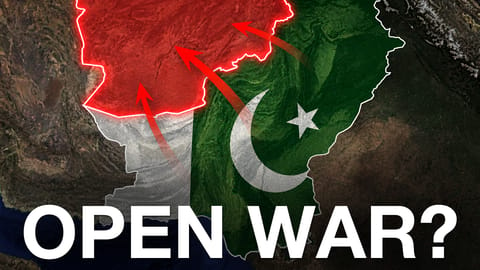
On the border between Pakistan and Afghanistan, there's a full-scale war waiting to be unleashed. Across the last two years, the relationship between the Pakistani government in Islamabad and the ruling Afghan Taliban has broken down completely. Pakistan accuses Afghanistan of fueling terrorist movements and militant attacks.
Afghanistan fails to crack down on the militants who, one way or another, depend on the safe harbor of Afghan soil. In 2025, the two sides clashed in a 10-day-long border engagement that left dozens dead and 5,000 civilians displaced. In 2026, the situation is ten times worse.
The fighting this year has left hundreds, if not thousands, dead, including well past 360 Afghan and Pakistani civilians, with over 115,000 Afghans and 3,000 Pakistanis displaced from their homes.
Afghanistan is becoming more brazen, launching retributive strikes into Pakistan despite its limited weaponry, and Pakistan, according to its own Minister of Defense, believes itself to be in a state of open war. If there's one redeeming truth to this crisis, it's that Pakistan, for the time being, is not calling openly for regime change.
According to recent reports, senior leaders in Islamabad are starting to view the Afghan Taliban as a permanent enemy, while the leadership in Kabul increasingly suspects that their more powerful neighbor might decide to bring them down.
Internally, Afghanistan is straining to avoid a total collapse, as resistance groups become more brazen, and a humanitarian crisis continues to unravel. Five years after they took power, the Taliban are incredibly weak.
And Pakistan? A nation that's never been short on military ambition, might finally have had enough.
Taking Down the Taliban Over the last month, the United States marked two grim anniversaries: 25 years since the attacks of September 11, 2001, and five years since the disaster that was America's withdrawal from Afghanistan, plus the Taliban takeover immediately afterward.
As you might expect, those milestones have prompted a good deal of reflection in the US media, mostly looking at the very complicated legacy of the war on terror, and emphasizing the new, more modern terror threats that the US might not be ready to deal with.
But if you happen to read one particular piece from the New York Times entitled, quoting here, "25 years after 9/11, al-Qaeda still has a home in Afghanistan," then you might have seen a very interesting tidbit on Afghanistan and Pakistan, buried so deep in the story that it could almost be forgotten.
The article discusses Pakistani strikes on Afghanistan, and the militant attacks that are inflaming the new conflict.
Before quoting a senior Pakistani intelligence official who, quote, "said his country's leadership has concluded Pakistan's domestic security would not improve until it had sorted out the Taliban," end quote.
The article continues, quoting again, "Over the past few months, Taliban officials have grown increasingly concerned about the possibility of a Pakistani-backed attempt at regime change in Afghanistan. Anti-Taliban resistance groups waiting in the wings now see an opportunity." If that's true, that's a major change for the nation of Pakistan.
And it comes at a difficult time for Afghan leadership. Right now, the latest news out of the conflict would suggest that the Taliban government is floundering. As Pakistan continues to fight back and forth with the militants who rely on Afghan territory to base their operations, Afghanistan has launched limited retaliatory attacks.
But those attacks have demonstrated their clear, enduring problems: not enough firepower, not enough coordination, and not enough strength to really deter Pakistan from doing whatever it wants. Pakistan, meanwhile, still bases thousands of troops on the soil of its troops. The Taliban, on the other hand, has taken a lot of responsibility for its actions.
The Taliban, on the other hand, has taken a lot of responsibility for its actions. The Taliban, on the other hand, has taken a lot of responsibility for its actions. The Taliban, on the other hand, has taken a lot of responsibility for its actions.
The Taliban, on the other hand, has taken a lot of responsibility for its actions. The Taliban, on the other hand, has taken a lot of responsibility for its actions. But Pakistan has refused to step in and join Saudi counter-offensive operations against the Houthis after the group stormed the Yemeni coast of the Red Sea.
While most of the world has interpreted that exchange quite fairly as Pakistan failing to show up for Saudi Arabia after coming to a mutual defense agreement last year, it's also a recognition in Islamabad that the nation has other military priorities much closer to home. What we don't have for today's episode is any explicit explanation for the situation.
It's only explicit confirmation, from a Pakistani official, that Islamabad's thinking has changed.
Regardless of what's happening behind the scenes, nobody in Pakistan is currently willing to go on the record and admit that the country is now chasing regime change ambitions in Afghanistan.
But given that Pakistani and Afghan leaders seem to agree, off the record, that Pakistan's patience for the Taliban has run out, we're going to spend today's episode evaluating the idea in a different way. Let's start with the conclusion.
Let's take these anonymous officials at their word and assume, yeah, Pakistan really has decided that it's time to focus on destabilizing, undermining, and eventually overthrowing the Afghan Taliban. What would that look like?
And what would we expect to see on either side of the border to suggest that a coordinated destabilization campaign could be underway?
The most obvious place to start is with the tried-and-true method that larger, more powerful states use to tear apart smaller rivals that they'd rather not invade directly: proxy conflicts and, in particular, support for internal resistance and rebel groups. Pakistan doesn't admit to providing any aid or guidance.
But it does admit to providing internal, armed organizations trying to fight back against the Taliban.
But their willingness to at least engage with those groups is something of an open secret. In early 2026, the British think tank, Russi, pointed out that, quote, "Pakistan and political opponents of the Taliban have made regular secret contacts, notably between Pakistan and the National Resistance Front." End quote.
Well, back in 2025, the outlet Newlines Magazine explained, quoting their headline, "Pakistan is quietly shopping for new proxies in Afghanistan.
The Afghan government, too, accuses Pakistan of harboring, arming, and supporting both political groups from the Afghan opposition and their armed allies in the resistance groups." Granted, we have to take those claims from Kabul for what they are.
Pakistan also accused the Afghan Taliban of arming and harboring the Pakistani Taliban, a very dangerous group that relies on the porous Afghan border to keep its fighters safe, but regularly carries out mass-casualty terror attacks on Pakistan's soil. Even still, those rumors persist of Pakistani collaboration with the Taliban.
The Afghan resistance, and over the last few months, those same Afghan resistance groups have been making some very impressive progress. Now, that doesn't necessarily mean that Islamabad is behind those gains, but the groups seem as if they've been injected with a whole lot of momentum.
As an August 2026 analysis from Australia's Lowey Institute explained quite accurately, quoting, "Afghanistan does not have an armed resistance so much as a collection of armed groups operating separately under ambitious leaders with different constituencies, patrons, and political ambitions." But as that same report also points out, each one of those
Fragmented groups has now decided that it's the time to step up operations, quoting again, "Armed fronts announce attacks from Badakhshan to Helmand, opposition outlets trumpet battlefield body counts, and advocates celebrate an expanding cast of commanders and militias as evidence that Taliban rule is finally beginning to crack." Now each of those
Resistance organizations provides a rather different set of advantages, and there's no doubt about it, that the Afghan resistance groups seem to be quite well.
This March, the National Resistance Front, the largest of the groups by sheer numbers, announced that it had carried out 2,000 attacks against Taliban forces since the fall of Kabul.
Those attacks have only intensified since then, and the National Resistance Front, known for its public-facing international leadership and its support from the Afghan diaspora, has claimed increasingly ambitious attacks.
The smaller, more secretive, but seemingly more elite, Afghanistan Freedom Front has stepped up its asymmetric campaign, accelerating assassinations and sabotage attacks, and at times drawing large groups of Taliban fighters into all-out gun battles.
Both of those groups are at their strongest in the Afghan north, although they sometimes strike down into Kabul. But another group, the Afghanistan United Front, is strongest in the south, where a large ethnic Pashtun majority has long been the Taliban's base of support.
This summer, the Afghanistan United Front announced that it would be massively scaling up its operations, and it's proceeded to do exactly that.
Its leader, Sami Sadat, is an ethnic Pashtun, as are many of its members, suggesting that the group can take advantage of growing frustration with the Taliban among Pashtun civilians. Sadat also happens to be a long-time ally of the American CIA, with extensive experience as a special operations commander.
And he's stepping up operations now, in a moment where the relationship between the United States and Pakistan has arguably never been stronger.
Even beyond the three big resistance groups, Afghanistan recently witnessed the arrival of a group called the Homeland Service. The group, which is part of the Afghan Army, was led by a former Afghan special forces commander, which announced its existence in July and promptly took over a town and the surrounding area.
Weeks later, UN Secretary-General Antonio Guterres confirmed that the UN was aware of 88 instances of resistance groups claiming attacks against the Taliban in just May, June and July of this year.
Fifty-five of those attacks have been verified by the UN, which named no fewer than 13 resistance groups that took part. Now, here are more, friends. We recently took an in-depth look at the Taliban.
And the question of whether, under these circumstances, these groups stand a real chance of degrading and dismantling the Taliban. That episode is entitled "Afghanistan is turning against the Taliban," and you can go watch it after you're done here if you'd like a more in-depth look at why we've reached the conclusions we're about to list.
But for today's purposes, we'll just tell you those conclusions straight out.
These resistance groups aren't organizing or coordinating at large scale, at least not yet, and they don't have a secure hold over any meaningful territory, so it's premature to think of them as a single, national counter to Taliban rule.
But what they do have is the ability to operate with near impunity in the areas where they're strongest, degrading Taliban rule, interrupting the Taliban's capacity to respond, and shrinking the zones that the Taliban can be sure they can control.
These groups now have a national presence, drawing from southern Taliban strongholds as well as northern resistance-friendly areas.
And as long as they keep doing what they're doing, they're going to degrade Afghanistan badly over time. The only way to explain it: they're Taliban-ing the Taliban.
And if, hypothetically speaking, Pakistan were to be using those groups to lay the foundation for regime change, then it's fairly straightforward to explain how their divide-and-conquer approach could pay dividends for Pakistan later on.
In a head-to-head matchup, Pakistan vastly outmatches Afghanistan in terms of sheer military might, the size of its armed forces, the amount and sophistication of its weaponry, and the economic and defense industrial power that it has. The Taliban, on the other hand, have a strong military power that it could leverage to support an operation.
To put their advantages into perspective, Pakistan wields the world's seventh-largest military, with 660,000 active-duty personnel and over half a million reservists.
The Taliban's active-duty strength is harder to pin down, but Reuters estimated in November of 2025 that they had only around 172,000 troops. Pakistan operates somewhere around 2,000 relatively modern main battle tanks, with hundreds of older models in reserve. Pakistan operates only a handful, all of which would do better in a museum than on a battlefield.
Pakistan flies 75 American F-16s, nearly 90 French Mirage jets, around 200 Chinese J-10 and JF-17 fighters, and very soon, 40 copies of China's J-35 stealth jet, whereas Afghanistan - and we're not making this up - is confirmed to possess one flyable, combat-capable propeller plane.
For Pakistan, the prospect of beating Afghanistan in a fight isn't really a concern. If Afghanistan wants the smoke, and Pakistan obliges with a full-scale war, Pakistan wins.
The tricky part for Pakistan is figuring out whether it wants to absorb the costs of a war. The Afghan Taliban may have taken over their country, but they're still at their best when they're doing asymmetric resistance, fighting a guerrilla war, and trying to impose as many losses as possible on their enemy while working out a friendly territory.
If Pakistan wants to engage in larger and larger operations, it has to expect that it'll lose.
Even if Pakistan did accomplish regime change in Kabul, it would then be turning the Taliban back into a nationwide resistance at the level of success that Pakistan achieves in destroying and dismantling the Taliban during an initial invasion, or set the parameters of the destruction that the Taliban will achieve later, when Pakistan is forced to occupy
Afghanistan, like the Americans and like the Soviets did.
But if Pakistan really is considering a larger regime change operation, then these fragmented, asymmetric resistance groups will have to deal with it. These resistance groups are a near-perfect asset in helping Pakistan set the conditions before a war.
Because these groups are so geographically dispersed, and operate with so little coordination between them, they require the Taliban to divide its attention constantly. The Taliban can't use the actions of one group to predict the others.
Instead, it has to surge fighters to new problem areas constantly, in all directions, in a constant attempt to put out fires faster than the resistance groups can cause new ones.
That constant cycle takes thousands of Taliban troops away from the Pakistan border, and takes them to the West Bank. They can't do it alone. They can't go to Afghanistan.
They can't go anywhere else. They can't go anywhere else. They can't go to Afghanistan.
They can't go anywhere else. They can't go anywhere else. They can't go anywhere else.
They can't go anywhere else. They can't go anywhere else. And once a war actually started, the Afghan resistance groups could act as a constant peripheral threat, forcing the Taliban to keep a portion of its troops scattered around the country, even when Pakistan is obviously the greater threat.
Ease the pressure on the resistance, and all of a sudden, the resistance might start capturing towns, drumming up support among disenchanted locals, and swelling their own ranks until they, too, are an existential threat. So, everything we've explained about the Taliban situation creates a fairly rosy picture of things for Islamabad.
The Afghan resistance is rising, Pakistan possesses prohibitive conventional military advantages in a head-to-head fight, and the Afghan Taliban leadership doesn't seem to have what it takes to change the status quo.
All that, and we haven't even mentioned how Afghanistan's internal humanitarian crisis has gotten unbearable. And, of course, it's going to be unbelievably bad as the country approaches yet another brutal winter.
Discontent and disillusionment with the Taliban are at an all-time high, as this group that insisted it could rule Afghanistan properly has proven itself to be an utter failure.
But now we've reached the part of the episode where we temper some of the expectations around Afghanistan and explain why, despite its greater strength, Pakistan is unlikely to attempt a full-scale invasion of its neighbor right now.
The first and most obvious reason that Pakistan would hold back is the fact that it's dealing with its own complex internal crisis right now.
We've already mentioned the Pakistani Taliban, which Islamabad accuses Kabul of supporting directly, but it's easy to make the mistake of imagining the Pakistani Taliban as a small terror group when, in reality, they're something closer to a large-scale insurgency.
To give a sense of what they're up to, we can run through some of their attacks across the last two months. In one attack in late July, they used a car bomb and several gunmen to kill 12 soldiers, a pair of policemen, and a forestry official in an overnight skirt. Just a few days later, they used explosive quadcopters in an ambush that killed 10 police.
Just a few days after that, they carried out a suicide bombing outside a police station, killing 7 police and at least 10 civilians.
More recently, in mid-September, the Pakistani Taliban drove a car bomb into a mosque at a police station during prayer, killing over 30 people in the process, just one day after a roadside explosive killed six Pakistani soldiers traveling in a convoy. Pakistan is trying to stay on top of the crisis.
They've also decided to resume cross-border raids into Afghanistan, plus airstrikes to try and disrupt the group's activities. But the fact that the Pakistani Taliban is able to carry out its attacks with such frustrating regularity is a clear sign that Islamabad still has much more to do before the group is dealt with.
Even worse, Pakistan has to deal with another insurgent threat at the same time: an ethnic Baloch separatist movement in its resource-rich but poverty-stricken southwestern province of Balochistan.
And that's on a similar scale to the Pakistani Taliban. Just this month, for example, they've ambushed a convoy near a copper and gold mine in an attack that killed five security personnel and a civilian, and just days later, a Baloch ambush killed nine police officers and temporarily captured eight others.
Taken together, those internal threats mean that the Pakistani military is already spread thin.
Similarly, in fact, to the way that the Afghan forces under the Taliban are spread thin, trying to keep up with a higher volume of resistance attacks but with a much lower average death toll. More than what Pakistan is dealing with.
Then, as mentioned, Pakistan also has to figure out what to do about Saudi Arabia, where it's already stationed thousands of troops to support its treaty partner.
Saudi Arabia's current security situation, where it's under attack from the rapidly expanding Houthi rebel group in Yemen, is a quagmire that Pakistan explicitly doesn't want to get involved with, but the US and Europe haven't shown up to support, and Pakistan's pleas to Iran to get the Houthis in line have had no impact.
At the time of writing, Pakistan is preparing to hold a note. This is the first time that an urgent meeting of military chiefs between itself, Saudi Arabia, and their third treaty partner, Turkey, with a real chance that Pakistan will end up committing to anti-Houthi operations.
And finally, it's worth remembering that Pakistan still has an archenemy, India, and that Pakistan fought its last conflict with India just last year. So that's an internal crisis, a crisis among its treaty partners, and a simmering feud with a fellow nuclear nation that Pakistan already has to keep track of.
Despite all those challenges, Pakistan might survive.
It might still assess that it could win a war against a distracted, depleted Afghan Taliban and successfully carry out a regime change operation. In fact, if Pakistan did make that assessment, then it's probably right.
But whether or not Pakistan could hypothetically succeed in a regime change war against Afghanistan right now isn't the same as asking whether that war is worth it.
And on that question, the answer's almost certainly no. Pakistan faces an ongoing political crisis, with a major protest planned for this weekend in support of imprisoned former Prime Minister Imran Khan.
Inflation is high, fuel and energy prices are high, public debt is a nigh-on-intractable problem, and the country's government, under the shadow military rule of Field Marshal Asim Muneer, knows that it needs to tread carefully to prevent the situation from getting worse.
A full-scale invasion against Afghanistan is the last thing that Pakistan needs right now.
So, while we certainly wouldn't claim that Pakistan has zero regime change ambition for its neighbour, it would be very premature. We would be very sure to claim that the current, lower-grade hostilities between Islamabad and Kabul are about to blow up into full-scale war.
Instead, Pakistan has built itself a strong set of options to manage this situation indefinitely.
Its troops can keep Afghanistan in check through more limited confrontations at the border, and its internal security services can at least keep fighting the Pakistani Taliban, even if they've struggled to gain the upper hand. All the while, Afghanistan's internal resistance groups turn their country into a pressure.
It's a pressure cooker, helped along by a humanitarian disaster that five years of Taliban mismanagement and neglect has only made worse.
Pakistan may not topple the Taliban government in Kabul, or at least not in 2026, but with time, this is a battle that Pakistan should be able to win. Thank you for watching.
Watch with Fronts Insider
Fronts Insiders get every video, the complete archive, and private sponsor-free playback.
Insiders Receive
- Every WarFronts, HomeFronts, and Insider video
- Complete sponsor-free video archive
- Support independent conflict journalism
Already a member? Log in →
Signed in or already a member, but still locked? Fix an access problem
From $5/month — cancel anytime
About this briefing
Islamabad now sees the Taliban as a permanent enemy, and Afghan resistance groups are gaining ground. But Pakistan's own insurgencies make invasion unlikely — attrition is the likelier path.