
I’m Being Spied On.
Simon Whistler • August 25, 2026
Members only
Note: this transcript was generated by AI and may contain errors or inconsistencies.
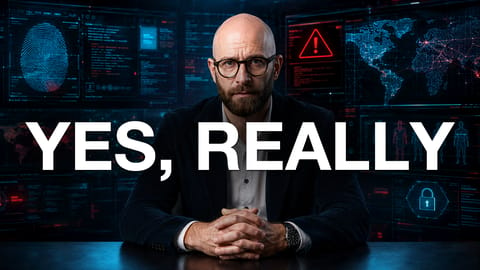
Last week, the Warfronts team was reminded that we're being watched. We'll share the notification on screen. It's the same one that popped up on my personal mobile phone just a few days ago, informing me that my device had been targeted in a mercenary spyware attack. this is actually the second time that I've got an alert like this.
It was just a span of a few months, and it confirmed something that our team has suspected for a while.
That out there, somewhere, there is a nation state that has decided that it's time to keep an eye on us. our knowledge, no other devices have been targeted thus far, and we cannot confirm that whoever was using that spyware was able to gain access to my phone as they intended. also can't confirm that they didn't.
Gotta say, is this something that affects me personally?
It was quite alarming to get that message. I'll tell you what it said in a second. It all reads very serious.
And I said, I'll quote directly from the message, and you'll probably see why it made me little bit nervous. Mercenary spyware attacks, such as those using Pegasus from the NSO group, are exceptionally rare and vastly more sophisticated than regular cybercriminal activity or consumer malware.
These attacks cost millions of dollars and are individually deployed against a very small number people.
But the targeting is ongoing and global. And perhaps the most foreboding part of the quote from Apple was, this attack is likely targeting you specifically because of who you are or what you do.
And as you know, I do this, I present episodes, I own the channel, and I run the team for Warfronts, a channel with global reach, dedicated to coverage of ongoing conflicts, sensitive geopolitical matters, and state-level power dynamics all across the globe. also own the sister channel, Homefronts, where we focus on the political side of those same issues,
And for almost a year now, the media outlet, Fronts.co.
Now, somewhere, in all of that, we seem to have pissed somebody off. pissed many people off. there's a lot our team don't know, and there's stuff we probably won't ever know. We don't know who was responsible, we don't know the specific spyware that they used, and we don't know whether they were successful.
What we do know is that spyware was deployed against us, and in both cases, was of a sophistication that goes well beyond what most private hackers can achieve. kind of cyber attack that would trigger an Apple notification like this is generally the kind that's used by governments.
These are attacks that require an entire team of people to prepare and coordinate using some of the very best software out there. They are expensive, they are time-consuming, and the vast majority of people across the globe will never have to worry about being targeted.
I found out, I'm no longer one of that vast majority of people. when a person is targeted, that automatically tells you two things.
First, that person is involved in something that caught the attention of a well-resourced, sophisticated nation-state, usually because they're a politician, an activist, a whistleblower, a journalist, something else along those lines.
Second, that well-resourced nation-state has evaluated that it's worth spending all of that time and all of that money to try and get a better idea of what that target is up to. And that makes me feel very special. most famous example of government-tier spyware is Pegasus, first developed by the Israeli cyber weapons company NSO Group.
Pegasus has been deployed by a wide range of governments and influential organizations, including in efforts to monitor heads of state and high-level ministers in several nations. also been routinely used to monitor journalists and activists, especially when their work brings them into direct conflict with governments that have Pegasus at their disposal.
Pegasus the only spyware that operates on this level. There are several commercially developed alternatives on the market for anyone who can pay the price, and it's widely understood that nation-states have developed their own specialized alternatives, some of which are on the cutting edge beyond what Pegasus and the other commercial models can achieve.
Those types of spyware are often zero-click, meaning that I or someone else in my position wouldn't even have to click on a suspicious email or open a message. moves through vulnerable systems using exploits ranging from push notifications to undiscovered app vulnerabilities to interactions with servers, and more. it's inside, it can watch a person's
Activity, access calls, photos, messages, and other sensitive information, and if it wants, even activate microphones and cameras without the operator's knowledge. are supposed to be secure, like Telegram or Signal, can have their messages intercepted. data is then intended to leverage, and depending on how a spyware user wants to proceed, they can track
Their targets, blackmail them, use their credentials or knowledge, infiltrate a larger system or really just do whatever else they want.
Now, look, me and my team, we understand, but for dedicated Warfronts viewers, it might be a little bit concerning that we choose to talk about an incident like this. After all, our team has been directly targeted, and perhaps it's a bit risky to be on the receiving end of infiltration attempts like this and then immediately go public with that information.
But we've chosen to share this experience for a couple of reasons. First and foremost, because it's not just about us. weeks after we were targeted for the first time, Reporters Without Borders released their World Press Freedom Index for 2026, an annual tracker that monitors press freedoms in countries across the globe.
Their findings weren't just bad, they were atrocious. quote the summary here.
For the first time in the history of the index, over half the world's countries now fall into the difficult or very serious categories for press freedom.
In 25 years, the average score of all 180 countries and territories surveyed in the index has never been so low. quote. report explains, journalists and press outlets around the world are facing unprecedented attacks, from legal scrutiny and outright criminalization of their work, to blackmail and state surveillance, to threats and physical attacks,
Sometimes fatal ones. look, our Warfronts team, we're not journalists.
We aggregate information, we provide analysis, and hopefully we present that analysis in ways that resonate with our audience.
Warfronts relies on the work of incredibly talented, exceptionally brave journalists from across the globe. them are reporting from conflict zones. of them are reporting as exiles from their home nations.
And far too many of them are forced to decide whether to continue their work despite the threats they face or grit their teeth and shut up to preserve their own safety and then just last weekend i got targeted again but this happens constantly to people who are at far greater risk than we are in the field or stationed abroad while they're gathering the
Information we rely on this should not have happened to us but it shouldn't be happening to anybody the other reason that we chose to publicly acknowledge these incidents is because they provided us with confirmation of something we kind of suspected that yeah we're on people's radars these days people who've watched us for a mile might remember the legal
Threats we received from somalia heavily implying that we were being directly threatened by the somali government albeit with a cartoonishly silly set of demands but we've also had other contacts with global governments that we haven't talked about not all of them malicious by any means but all of them indicating that powerful people in important positions
Were starting to take notice of artwork and with that we had to consider some of the uncomfortable realities we face let's stay with the example of spyware for a moment in both of the nine instances that we've been targeted whoever's behind the attacks decided to use a form of advanced spyware that was caught by apple's internal threat intelligence meaning
That apple could notify me about what happens right now we know about two attempts to infiltrate my phone but there may have been more that i don't know about hello friends how's it today other ways that our team's digital infrastructure could come under attack the sad reality of the situation is that although people in our position sometimes get lucky and
Are informed about an attack against them most of the time you just don't know what you don't know the best thing that you can do is operate on the assumption that you've already been targeted and that's what we've been doing for a while now i've just accepted that i'm probably being spied on gonna spy on you what you're gonna do now let's speak a little bit
About our outlet specifically warfronts fronts.co and the rest of our organization we're fully independent we're a private company with no corporate interests no quiet or hidden investors and no affiliation with any other institution or any government body our funding comes from exactly three sources blackrock help myself eyes ad revenues from platforms like
Youtube sponsors who choose to run ads with us directly and the support of our premium subscribers over on fronts.co of course the targeting of the free press is a problem that goes well beyond our organization it's also a problem that's growing rapidly around the world but it's growing in two ways at once problem number one is that evolutions in technology
From spyware to ai to widespread surveillance and beyond have made it easier to monitor the press while also providing more weapons to use against those who are being targeted some of those weapons are highly sophisticated and require state-level investments to develop or require but others are significantly easier for non-state actors criminal enterprises
Legitimate businesses and even private citizens to get their hands on but problem number two is arguably the more dangerous one that across the globe many countries are tolerating or even creating threats to the free press that would have been unthinkable a few years ago.
Granted, those changes don't always look the same. countries are moving from being very tolerant to being somewhat less tolerant, while others are moving from soft authoritarianism to outright despotism.
But taken together, those changes mean that fewer places are safe, and more places are willing to look the other way when the press targeted, even from outside their own countries. look, we don't know who is behind either of the attacks that triggered the alerts on my phone, and we expect that we won't ever find out.
But Warfront frequently touches on subjects that various countries would be touchy about. we've mentioned, we're not investigative journalists.
We aren't discussing any information that you, an ordinary internet user, couldn't find someplace else online. are, however, equal opportunity offenders. talk about the countries and issues that we deem worthy of discussion, whichever country we're focused on today, we're probably moving on to a different one tomorrow. course, we're not here to figure out
Which country was annoyed, especially because, again, we probably won't ever know for sure.
Instead, we're telling you just about what happened, partially because we can. my core team live in wealthy Western countries, places where press freedoms are sometimes threatened, but where those threats are highly unlikely to be fatal. have the resources to secure and monitor our own digital infrastructure, to work with a legal team, and to fall back on
Our own governments for support, if we ever need to.
Clearly, we've upset someone. But the actual substance of our work doesn't include the sorts of investigations that would put us at acute risk of retaliation.
For many reasons, this team and I, we're lucky to do what we do. But we're also lucky enough to be relatively safe. When something like this happens, we speak about it because we have that luxury.
But also because some of the very best journalists in the world do not. This work isn't a hobby. Journalists have to pay their bills.
They have to live the rest of their lives outside their work. depending on the work they're doing, they may have to think very seriously about how they protect themselves and their loved ones. When I learn that I've been targeted with spyware, I consult with my team, handle our internal business, and make an episode on the issue.
When a person handling sensitive work in dangerous places receives a message like I did, have to make a very difficult decision.
They can continue their work and face infiltration, blackmail, coercion, or even violence. Or they can back off and make the hard but understandable decision to pursue stories someplace else. Countries across the globe are stepping up repression and targeting of the free press because it works.
In an environment where journalists understand that they're working under threat, the entire industry experiences a chilling effect. Critical stories never get published because critical problems are deemed too risky to investigate.
Outlets become less willing to hire or partner with independent journalists for fear of shouldering the costs required to keep them safe or becoming liable for whatever may happen to them.
People who want to be pursuing the stories that really matter choose to do other things with their lives. And people in positions of power are emboldened to suppress journalism even further. For our part, whether it's on war fronts, home fronts, or The spyware attacks we faced might be deeply concerning.
But again, it isn't a new issue. We're operating in a world where these kinds of attacks are common, and where the threat is only continuing to get worse.
Watch with Fronts Insider
Fronts Insiders get every video, the complete archive, and private sponsor-free playback.
Insiders Receive
- Every WarFronts, HomeFronts, and Insider video
- Complete sponsor-free video archive
- Support independent conflict journalism
Already a member? Log in →
Signed in or already a member, but still locked? Fix an access problem
From $5/month — cancel anytime
