
Skip to content
Fronts.co
WarFronts

South Korea Will Be the Next Country to Get the Bomb. Here's Why.

Simon Whistler • August 24, 2026
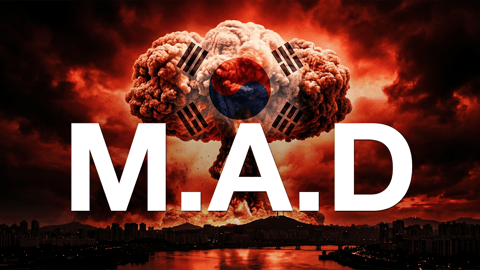
South Korea Will Be the Next Country to Get the Bomb. Here's Why.

Members only

Note: this transcript was generated by AI and may contain errors or inconsistencies.

We'll start today with a quote from the former president of South Korea, Yoon Suk-yol. The Republic of Korea could deploy tactical nuclear weapons or possess its own nukes.

End quote. was speaking during a presentation of policy reports by the foreign and defense ministers in January 2023, when he became one of only two South Korean presidents to actively advocate for Seoul to obtain its own nuclear weapons. he doubled down on this position, with an aide telling the press that it was part of his firm commitment against the

Growing threat posed by North Korea.

Of course, Yoon isn't your run-of-the-mill former president. was impeached in December 2024 after declaring martial law and is currently serving a life sentence for the same.

As such, many of his policies have been seemingly discredited, and the current president, Lee Jae-myung, has made no secret of his desire to keep Seoul out of the nuclear club. we're willing to bet that this current state of affairs is not going to last.

Intelligence chief Lee Jong-siok has called for Seoul to secure the right to enrich uranium to demonstrate its potential nuclear capabilities.

Unlike in Japan, where producing indigenous nuclear weapons is deeply unpopular, the South Korean public consistently tell pollsters that they back the idea, with as many as 70% of respondents supporting getting the bomb. More to the point, recent events have suggested that the government may soon no longer have a choice.

For South Korea, which is still technically at war with the North, security is an even bigger deal than it is for most nations.

The nation's security rests on several pillars. armistice with the North, that's the 1953 agreement that stopped the active fighting and created the Demilitarized Zone, an extremely capable military, and a promise by Washington that any North Korean nuclear strike on the South would trigger a swift, overwhelming, and decisive response, which is American for

Everything is going to go boom. of the ways that promise usually gets reinforced is through joint military exercises.

This month's edition was Ulchi Freedom Shield, one of the largest joint exercises on the Korean peninsula, involving thousands of American and South Korean armed troops across live, virtual, and simulated training, and designed to test how the two militaries would actually fight together, as well as how the South Korean government would keep functioning if

The North ever attacked.

The exercise was scheduled to start on the 17th of August and last for 11 days, but since we're discussing it here, you could probably guess what happened next.

Two days before the drill began, American President Donald Trump posted on Truth Social that because it was too late to cancel, he was asking Pete Hegseth to significantly reduce the scope of the exercises.

President Trump claimed that he was doing this because he had a good relationship with North Korean dictator Kim Jong-un and that exercises were costly and sent a signal that was totally inappropriate and hostile toward Pyongyang.

President Trump later told the press that he was planning to meet Kim, adding that the North Korean leader had responded positively to his overtures, while North Korea later clarified that no such meeting was scheduled to take place, that didn't stop Hegseth from following the president's orders.

The Pentagon confirmed that the drill would end early and that most of the exercises would be canceled or converted. For Seoul, which has been called a model ally by the administration just a few months ago, the cancellation couldn't have come as a bigger shock.

The foreign minister told the National Assembly that they didn't have any advance notice of what Trump was going to post on Truth Social, to which I, as a European, can only say, "Welcome to the club." Now, this isn't the first time that something like this is happening.

During Donald Trump's first term in office, he scaled back US-South Korean joint exercises and had three meetings with Kim with the hope of securing nuclear concessions. The difference is that there was at least some cold, hard logic to those cancelled exercises. Trump really was meeting with Kim, who really was interested in securing a deal.

If the prize was a denuclearized Korean peninsula, then rattling the South like that might almost be worth it. This time, though, there's no logic at all. Kim Yo-jong, Kim Jong-un's sister and one of the highest-ranking officials in North Korea, said that the DPRK was unaware of any recent communications between the two leaders.

She added that North Korea "did not see the reduced scale of the joint exercises as a meaningful concession, didn't plan on negotiating, and had no desire to denuclearize." In other words, Trump just offered the DPRK a gigantic concession in return for nothing. Or was it nothing?

Because while Trump couched his decision in terms of negotiations with Pyongyang, he also made it clear that the decision was to punish Seoul.

In his Truth Social post, President Trump said that it asked South Korea to join the war on Iran and that they had refused. While he claimed in the post that the two things were unrelated, literally nobody was buying that.

In the Oval Office, Trump complained that Washington has 39,000 soldiers defending South Korea from Kim Jong-un, yet they refused to help with what he described as a "very, very easy military operation in Iran." The actual number of American troops in Korea is about 28,500, well short of the numbers that Trump claimed.

Although that's a rounding error next to the larger point he was making, which is that he sees the America-South Korea alliance as a transaction and Seoul isn't holding up its end of the bargain. This isn't the first time that the Pentagon has sacrificed Seoul's sense of security for the Iran war.

During the height of the conflict's hot phase, Washington redeployed some Patriot and Terminal High Altitude Area Defense or THAAD missile defense systems out of Korea to the Middle East to try and plug shortages.

Additionally, Washington recently pulled the USS George Washington, a nuclear-powered Nimitz class aircraft carrier, from its deployment in the Indo-Pacific so that it could relieve the USS Abraham Lincoln, an aircraft carrier that had been deployed in the Middle East for so long that its sailors are beginning to go stir-crazy.

The USS George Washington was the last aircraft carrier in the Indo-Pacific region, which means that the Pentagon now has very few options to respond if things heat up in Asia. And South Korean politicians… they've noticed the gap.

Yoon Sang-hun, a lawmaker from the People's Power Party, the country's main opposition, wrote on Facebook that it was time for South Korea to have a conversation on whether it should have nuclear weapons for self-defense.

Fellow lawmaker Kang Min-kuk, member of the Financial and Economic Planning Commission, agreed, writing on Facebook: that they couldn't continue to leave the nation's security in someone else's hands he added and we'll quote him here we have no means to counter north korea's nuclear weapons the only option is defensive nuclear deterrence using nuclear

Weapons to prevent them from pressing the button and it's not just politicians making the case the dong a ilbo one of the newspapers of record in the country published an editorial that urged seoul to consider a range of options for its defense including nato-style nuclear sharing the redeployment of u.s tactical nuclear weapons and even the deployment of

The country's own nuclear arsenal all of this taken together america being more willing to prioritize the middle east over its asian allies trump seemingly favoring north korea over the south and a surge of pro-nuclear sentiment among south korea's politicians and general public has created what may become an unstoppable push for seoul acquiring the bomb the

Question now is whether they will actually take that final step on the brink south korea has spent years as a threshold state a country that has advanced technology scientific knowledge infrastructure and materials needed to build a nuclear weapon quickly but has chosen not to do so seoul remained at this level rather than crossing it because it had two

Things going for it one it was sitting under america's nuclear umbrella and washington had given it very few reasons to doubt that commitment and two it's signatory of the nuclear non-proliferation treaty the npt is global agreement meant to prevent the spread of nuclear weapons and while members are allowed to leave in the case of extraordinary events that

Jeopardize a nation's supreme national interests any country that does so risks economic and diplomatic isolation on the level of north korea and iran or at least the level of isolation north korea and iran were under before russia started throwing money at pyongyang and america started signing memos of understanding that allowed iran to ship as much oil as

It liked given everything we discussed the previous chapter south korea might just decide that it has a compelling enough case to leave the npt and to pursue nuclear weapons if it did it wouldn't be the first time it walked down that path in the 1970s president park chung he pursued a clandestine nuclear weapons program that was eventually reigned in by

Washington according to a report prepared by the defense department he did it because he feared that the u.s would abandon seoul at a time when the ussr and china were more openly supporting the north korean government a situation that is eerily similar to the one that seoul faces today should south korea choose to develop nuclear weapons it wouldn't happen

Overnight most independent experts believe that seoul would need at least two to three years if not more to develop a nuke because it currently lacks the ability to produce fissile material which it would need to develop first seoul would also need to obtain a detonation device that can set off high-grade explosives with a precision of less than a millionth

Of a seconds which is necessary to initiate the chain reaction as you probably guess this isn't something you could just throw together in an afternoon between crates of bud light south korean experts have a more optimistic timeline they believe that given the advanced technology that seoul has access to, it would only take them six months to get this arm

Material and six to nine to develop a detonation device, meaning that they could have a working bomb within a year to a year and a half. can't say for sure which of these estimates is correct, given that, and I hate to shatter your illusions, we are not nuclear physicists. what we can say for sure is that developing the bomb is going to take time, time that

Will allow other countries to step in.

The primary threats to a budding South Korean nuclear weapons program would come from China, North Korea and Russia. three have their own reasons for opposing Seoul's nuclear ambitions. and Russia don't want to upset the regional balance of power, and North Korea wants to be the only nuclear power on the Korean peninsula.

However, it's an open question as to how far they would be willing to go to curtail Seoul's nuclear ambitions. Seoul can develop nukes while under America's protection, all three countries would be extremely hesitant to conduct any type of kinetic military operation against South Korea because it would mean incurring Washington's wrath.

Instead, they might choose to use economic sanctions and diplomatic pressure to cut Seoul off from the rest of the international community.

Korea could also deploy more troops to the border to try and rattle the South. without American protection, it's almost guaranteed that one of, or all three of, these countries would launch strikes to try and cripple the nascent nuclear weapons program.

And speaking of America, it's an open question whether Washington would intervene to prevent Seoul from obtaining nukes. Back in the 70s, Uncle Sam stepped in to stop it, and most previous administrations would likely have done so.

But the second Trump administration seems unusually chilled out about proliferation, repeatedly suggesting more nuclear powers might not be such a bad thing.

Washington might also be hesitant to apply pressure on South Korea because of how dependent American companies, particularly those at the cutting edge of artificial intelligence, are on the Asian nation. South Korea produces approximately 20% of the world's semiconductors and 60% of the world's memory chips.

These are in extremely short supply, and antagonizing one of the main producers could be catastrophic for the U.S. economy. So it seems unlikely that Washington would be particularly minded to object too much under current leadership, which inevitably takes us to our next question.

What if Seoul really did it? article in the Korea Times, retired Lieutenant General Chun Im Bum, the former commander of South Korea's Special Warfare Command, suggested that Seoul's nuclear arsenal could be integrated into America's broader nuclear umbrella to boost regional deterrence.

This would effectively work in the same way that deployments of U.S. nuclear weapons in Europe and Turkey work, with a dual-key system that would require both South Korea's consent and that of Washington for weapons to be launched. again, this would only work if the nuclear program received Washington's blessing.

And given the premise of this video is that Trump is an erratic ally and South Korea is having to hedge its bets against an Uncle Sam that may not have its best interests at heart, giving the U.S. such control over the nuclear weapons seems like the worst of all worlds. korea could choose to go the french route maintaining full sovereignty over its nuclear

Arsenal setting its own nuclear doctrine and choosing its own targets but while that would be good for sovereignty the downside is that creating wholly indigenous supply chain and support network for nuclear weapons is as paris will attest hard and really expensive work now obviously we don't know for sure what soul will do in the future our crystal ball is

Still stuck at a walbury's warehouse somewhere in moscow we're not even sure that seoul will choose to get a nuclear weapon given all the challenges that we've just outlined but what we can say for certain is that circumstances have never been more aligned for a south korean nuke with north korea growing more belligerent even as it receives money and

Sensitive technology from russia all while the u.s president sows doubt that uncle sam would really step up for seoul in a crisis well it's not hard to see why south korea might feel it needs its own big red button and if it does go down that road well there's no telling what might come next tokyo under prime minister sanita kaichi has started sending up

Trial balloons about potentially acquiring nukes south korea takes the leap japan might follow suit and that opens the door to potentially many more nations in the region sprinting for the bomb as well as the worry of preventative strikes or wars launched to stop them from reaching the finish line one only has to look at recent history of the middle east to

See what happens when one nuclear power gets scared that its rival may be about to acquire the bomb such a cascade would represent a grand failure of america's foreign policy by calling long-standing security commitments into question trump may have opened the door to something much worse a regional nuclear arms race one that could easily get out of control

Thank you for watching

Insider access

Watch with Fronts Insider

Fronts Insiders get every video, the complete archive, and private sponsor-free playback.

Insiders Receive

  • Every WarFronts, HomeFronts, and Insider video
  • Complete sponsor-free video archive
  • Support independent conflict journalism

Already a member? Log in →

From $5/month — cancel anytime