
The World is Whitewashing Myanmar’s Brutal Dictatorship.
Simon Whistler • August 23, 2026
Members only
Note: this transcript was generated by AI and may contain errors or inconsistencies.
Ever since Mar Mar's military took over their country in 2021, the rest of the world has treated their regime as untouchable, authoritarian despots who overthrew a civilian government and then waged five years of scorched-earth warfare against their own people. The response from the international community was swift.
A crush of debilitating sanctions, a diplomatic version of the silent treatment, and invitations to meet human rights defenders in international court.
Invitation. Where the country's former civilian leader, Nobel Peace Laureate Aung San Suu Kyi, disappeared into state custody, her fate was a tragedy. When Mar Mar's pro-democracy protesters and its ethnic militias joined forces and liberated much of the country from military rule, they were praised as heroes all across the globe.
But today, something strange is happening in Southeast Asia. As regional and global governments start trying to make amends, Mar Mar has not changed. Its leader is the same.
Its wartime conduct is the same. And the mass repression of its own people has only continued. But international ambassadors are returning to their posts. are under review.
And instead of being dragged to the Hague for war crimes, Mar Mar's dictator and dined at international banquets. there may not be any consequences in the end. So let's try and understand just why Mar Mar's regime could get away with everything. It's a story Mar Mar's 2025 elections.
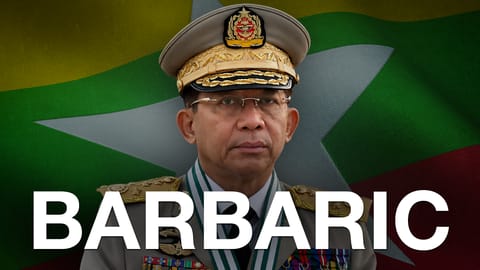
Allow us to set the scene here. The commander in chief and self-appointed of state of state of the country's military dictatorship, long-time general Ming Ong Hwang, has been in charge of the His nation is embroiled in a full-scale war against a multi-dimensional rebel threat that's already chased the military out of most of the nation's countryside.
Despite their use of relentless airstrikes against hospitals, schools, neighborhoods, refugee camps and more, despite their reliance on scorched tactics, forced disappearances and torture of civilians in state custody, the military isn't able to turn the tide.
In fact, over the prior two years, soldiers had sometimes surrendered to the rebels, hundreds at a time, as their commanders tried and failed to adapt to an asymmetric guerrilla war. Ong Hwang knows that his regime is in trouble.
He also knows that the global superpower that props up his regime, China, is growing impatient, starting to side with the rebels and rapidly losing trust in Hwang and his underlings.
This war is militarily costly, but it's also politically costly for China. And although Hwang understands that other world governments might not despise him – the government in Moscow, for example, or the government in Bangkok – he also understands that those countries just can't afford to be supporting a tin-pot military dictator in their spare time.
So Hwang decides that it's time to make the transition to a civilian government, because if Myanmar transitions to civilian leadership, then maybe the rest of the world will allow the country to come in from the cold. sounds like the right thing to do, with a self-installed autocrat realising the errors of his ways and handing power back to the people, then
Do think again.
Because Ming Aung Hlaing's actual intentions were incredibly cynical. Marmar's 2025 election wasn't about transitioning to democratic leadership. It was about doing the absolute bare minimum to give Hlaing a personal makeover and to take off the badges and the big fancy hat so that they could be replaced with a suit and a tie.
In a staggered three-tier election, Marmar citizens were encouraged to go to the polls as long as they lived in the, let's say, 50-ish percent of the country that the military government actually controlled and where dissidents chose to leave or were forced out years ago.
The dissidents who do remain in that part of Marmar are imprisoned, meaning, of course, that they weren't going to get a vote and nor were the millions of citizens living in rebel-controlled territory.
New anti-interference laws gave the country's military broad latitude to detain whoever it wished, while all of the major opposition parties were banned from participation.
Local authorities and military personnel pressured citizens on whether to vote and who to vote for. Unsurprisingly, the military's own political party surged to victory, and that party's new parliamentarians, not the people of Marmar, were the ones who would elect Hlaing president.
One of Hlaing's closest allied loyalists within the military, Ye Win Oh, took over the role of commander-in-chief, while Hlaing transitioned cleanly into his civilian role.
There was, of course, a lot of criticism internationally about how this election was quite obviously an illegitimate charade, but UN Secretary General Antonio Guterres put it best before the vote even took place.
To quote him, "Is there anyone who believes that there will be free and fair elections in Of course, it would be entirely fair to just ask how Hlaing and his allies believed that this scheme would work. After all, the entire thing was so cynical, so ham-fisted, so just over-the-top cartoonishly anti-democratic, that it had no hope of succeeding.
Right? Hlaing's political gamble was stunning in its simplicity, that his military government could blatantly rig and manipulate an election to guarantee their preferred outcome, and then use that outcome to provide the teeniest little big-leave of legitimacy so that the rest of the world could look past everything else.
The way that Hlaing seemed to imagine this would go, all the same people from the military regime could remain power, leading the same government, fighting the same brutal war in the same vicious way, and the rest of the world would just agree to ignore it.
And well, pity those who ever doubted him. Turns out, he was exactly f***ing right. Take the recent actions of China, the global power that's propped up Marmar's regime and helped it survive this long.
Viewers who've seen our Marmar coverage on war fronts before already know the real story here.
China doesn't particularly care who wins this war, but China really cares that nobody on either side of the conflict touches China's sh*t, Chinese-owned businesses, Chinese communities in the big cities and other Chinese assets must remain unharmed, and China is going to support whoever it believes is going to be more consistent about following that ultimate
Rule. bit of a digression from today's episode, but it's just too perfect of an example not to mention.
There is a very important pipeline that runs from Myanmar's coast to the Chinese border, to give China a lifeline in case its Pacific port cities are ever blockaded.
Both the regime in Myanmar and the rebels are so nervous about hitting that pipeline by accident that hundreds or even thousands of refugee families live underneath it or right next to it for their own safety. But China's stance on Myanmar has been changing ever since Myanmar's sham election wrapped up.
Chinese companies and investment groups have been funneling more and more cash into the nation, accelerating existing projects, announcing new ones, and making it clear that they believe they won't face as many consequences anymore.
Xi Jinping and his most important diplomats have been publicly signaling their support for Myanmar's dictatorship, announcing new security initiatives, and talking up the idea of Myanmar as a key priority for Beijing in its own geopolitical backyard.
This year, China has detained or disappeared key opposition figures at dissidents from Myanmar, who had previously been unbothered on Chinese soil.
Beijing has started to lean much more heavily on key rebel factions, using its economic leverage, its ability to crack down on weapon smuggling routes, and other coercive weapons to convince some rebel groups that it's time to sign ceasefires or pause their military offensives.
So great is China's recent involvement that Japan has considered working directly with Myanmar's regime in order to counterbalance Chinese influence. Russia has taken a similar approach, culminating in a visit by Hlaing to Moscow this very week, where he arrived on Tuesday, 18 August.
Since Myanmar's jam elections, the two nations held their first ever joint military ground exercises, the Tiger 2026 series of drills, where Russian troops visited Myanmar's capital city to practice jungle and mountain warfare, drone reconnaissance, counterterrorism operations, and more.
In March, the two nations signed an agreement to provide nuclear power plant for Myanmar, along with developing oil refineries, a seaport, and other lucrative projects. Like Xi Jinping, Vladimir Putin welcomed Hlaing personally in a well-choreographed affair where Russia pledged to increase all kinds of support for its Southeast Asian neighbor.
But the clearest sign that Hlaing's gamble succeeded is the series of calls that have come from inside the house.
Ever since the military coup in 2021, Myanmar has been suspended from the Association of Southeast Asian Nations, better known as ASEAN. In the interim, ASEAN has advocated what it calls the five-point consensus, basically calling for Myanmar to end the war and work toward a peaceful solution if it wants to re-enter the bloc.
As long as ASEAN continues to shun Myanmar, the rest of the world will probably do the same, choosing to defer to Southeast Asian countries on affairs in their own region, similar to the way that the world often defers to the African Union on African affairs or defers to the Organization of American States on affairs in Latin America.
But key Southeast Asian nations and especially Thailand, have been quietly pushing for Myanmar to be reintegrated.
Thailand, in particular, is quite powerful within the bloc, and it views both the Myanmar civil war and Myanmar suspension as a barrier to cooperation on border security, anti-crime initiatives, economic collaboration, and the regional refugee crisis. only that, but Thailand has long feared that by isolating Myanmar, ASEAN was pushing the country even
Further into China's grasp.
But, judging by Thailand's actions, the leadership in Bangkok has also decided that Myanmar's sham elections provide the diplomatic cover that they've been waiting for.
Thailand has escalated its campaign to convince the rest of ASEAN to let Myanmar back in, exerting pressure on its partners while taking steps to normalize the Thailand-M Myanmar relationship unilaterally. Thailand hosted a sit-down between Myanmar's foreign minister and his counterparts across ASEAN, and in August, Thailand hosted Min Aung Hwang personally.
The campaign seems to be working especially well on the Philippines, the country that currently holds the rotating chairmanship of the ASEAN bloc, ironically in a year where Myanmar would have held the chairmanship if it hadn't been suspended.
May, the Philippines have publicly expressed agreement with the idea that it's time for a new approach, that ASEAN's five-point consensus has failed, and that stalwart members of bloc, like Singapore and East Timor, should consider getting in line.
Getting away with it. this in the episode, it's time for a thought exercise that'll leave all of us feeling like we need a shower. Imagine what it must be like inside Ming Aung Hwang's head at the tail end of August 2026.
Despite all the odds, the ridiculous ploy of your sham election, it seems to be working. has finally agreed to give support. is stepping up engagement.
Thailand seems to be breaking through to the rest of ASEAN, and full reintegration seems to just be a matter of time. reintegration happens, you are home free. world will stop punishing you for your war, but it's not going to stop you from continuing that war in the future either. world will have chosen to ignore your abuses of power, your tyrannical
Treatment of your own people, and even the way you decided to rig your own elections, meaning that you've basically got a free pass to keep going.
You're basically president for life.
You're going to get mega rich off these Chinese and Russian development deals, and if anybody tries to get in your way, well, nobody's going to stop you from killing them.
But if you were in Hwang's position, and you decided to respond to your newfound success by getting out of your own way, by allowing the rest of the world to just hand you the victory you've already secured, well, the real-life plang would probably laugh at you. No, he's more of a give me an inch and I'll take a ma kind of guy.
The kind of guy who sees his peers in assy and ready to throw in the towel and decides to make the whole thing just a little bit more humiliating. back to a name we mentioned at the start of this episode, former head of state and Nobel peace laureate Aosang Suu Kyi.
Since she was overthrown by the country's military in 2021, Suu Kyi has basically disappeared into state custody.
For years, she had no contact with her lawyers or her family, rumors circulated that the now 81-year-old was in poor and deteriorating health. often, the military regime has claimed that it's made concessions to her, saying that she'd been moved to house arrest or that they'd shaved a little bit of time off her decades-long prison sentence.
But until very recently, her whereabouts and her condition were just totally unknown.
That changed in early August of this year, when Suu Kyi was finally allowed to meet with an outsider, a representative of the Red Cross, who spoke with her at a photographed meeting. her family, proof of life was a massive relief, even though she was neither evaluated by a doctor nor allowed to speak with her own legal representatives.
Of course, this is Ma Ma's ruling regime, and there's always a catch.
In the wake of the Red Cross visit, Asien attempted to condition Ma Ma's reintegration on Suu Kyi's release.
After all, that would go a long way in proving to the rest of the world that Ma Ma's regime was changing, even moderating, and it would make things much easier for Asien's other members, who would no longer have to answer for their decision to reintegrate Ma Ma while Suu Kyi remained imprisoned.
Ma, however, rejected the demand outright, expressing that if they ever decided to release her, then that release would, quote, only be carried out in accordance with the law.
Meaning, not because of humanitarian or diplomatic concerns, but because Ma Ma's government decided to release her of its own accord. As of now, that appears highly unlikely.
But Ma Ma's newly elected leaders have gone a good deal further, even going out of their way at times, to directly rebuke Asien for even asking that Ma Ma follow the bloc's basic requirements for reintegration.
In July, the military-controlled parliament agreed to formally reject Asien's five-point consensus plan, denouncing it as an act of interference in Ma Ma's affairs and demanding that Asien reassess its stance on Ma Ma immediately.
As for the bloc's special envoy to Ma Ma, who's been banging down the doors to try and get a meeting with Suu Kyi, Ma Ma's foreign ministry announced that because the country had held its elections, quote, "the appointment and the continued role of the new special envoy are no longer necessary." That is to say, yo, we had elections, now f**k off.
A week later, Ma Ma appeared to punt on another core demand from the international community: the return of hundreds of thousands of Rohingya Muslim refugees after they fled the nation in 2017.
To be clear, those Rohingya left Ma Ma because a full-scale genocide that Ma Ma's military carried out and one that the rebel militia that now controls their region, the Iraqi army, has continued in its own way.
According to Huang, Ma Ma Ma has now verified that almost 309,000 refugees in Bangladesh are former residents of that region, Rakhine State, but Ma Ma simply can't take them back under the current circumstances. Rakhine State is partially under rebel control, after all.
It's unstable, and over 4,000 refugees on Bangladesh's repatriation list are identified as terrorists. Over 113,000 more, that's over a third of the overall total couldn't be verified as not being terrorists. Can you prove that I'm not a terrorist?
This is stupid reasoning. Of course, we should emphasize that there's a broader discussion here about whether the Rohingya would be in rather severe danger if they were to return to a nation controlled by the same military that tried to wipe them out less than a decade ago.
But the international community trying to demand basic reforms out of Myanmar, and the slightest accountability for its past actions before accepting Myanmar back into the international community.
As of now, though, Myanmar just won't do it. Unfortunately, Myanmar's stance would seem to confirm the writing on the wall. Huang, his allies, and loyalists Myanmar and the nation's entire military are probably going to get away with it.
Myanmar is refusing to concede anything to the international community because the international community has already made clear that it's willing to fold. Myanmar's elections were about the least convincing charade you could possibly put on, and yet China, Russia, and ASEAN have seen everything they need to.
ASEAN and other Asian countries would certainly like to secure other concessions, the release of Aung San Chi, the return of the Rohingya, etc. That way, they can all save face and avoid their own diplomatic repercussions from nations that are less willing to overlook Myanmar's abuses.
But Myanmar's leadership clearly believes that these other countries will give in, yet again, if Huang makes clear that he's unwilling to compromise. The other reason that it seems Myanmar's regime will get with it all is because of the absence of any other countries that would normally try to step in.
Half a decade ago, the United States probably would have tried to get in Myanmar's way.
But under Donald Trump, the US started easing sanctions against Myanmar in 2025, before those sham elections even took place.
Now the US is trying to secure deals to extract Myanmar's critical minerals, especially rare earth metals, in the same way that the Trump administration has overlooked the ongoing conflict between the Congo and Rwanda so that it can secure consistent access to cobalt and copper.
The European Union, meanwhile, is stepping up its own humanitarian aid commitments, granted only about 10 million euros, but even still.
Japan, as we mentioned, is stepping up engagement with Myanmar to counter China, while India is trying to softly normalize its own relations and maybe even do a quick land swap. As for global organizations, the UN, the international courts, etc., well, the less said about their utter lack of influence these days, the better.
China, meanwhile, has become so powerful in Myanmar that other countries couldn't really compete even if they tried.
While developing nations in Africa, Latin America, or other parts of Asia might court offers from several global partners at once, Myanmar shares a border of over 2,000 kilometers with China. As we've already mentioned, Myanmar is partially dependent Chinese investment and support.
It's the source of more than half of all China's rare earth imports, which China then refines, processes, and sells across the globe.
Put simply, nothing important happens in Myanmar without China's approval, and if other countries did try to punish Myanmar any more than they've already done, then China's dominance would only grow.
And if you'll forgive our Warfronts team for editorializing just a little bit on a conflict that's been a priority of ours for years, this is a worst-case outcome for Myanmar. And it is one that the rest of the world should regard as an embarrassment.
According to the global conflict tracker Ackled, the confirmed death toll of Myanmar's civil war recently crested past 100,000 people, in a war where counting the dead is extremely difficult and where those numbers should be considered an undercount.
Over the last five years, Myanmar's military regime has come to represent the very worst the worst in global conflict zones. They're not alone at the very bottom, but they enjoy the company of the rapid support forces in Sudan, the worst of the cartels in Latin America, the military of the Russian Federation, and the global Islamic State.
Imagine any one of those groups being welcomed back to the international order as they are today, with no change demanded and no change expected before their return, and you'll have some sense of the travesty that is unfolding here.
After five years of war, after routinely engaging in some of the worst wartime atrocities that a military could ever perpetrate, Myanmar's military regime, excuse me, their elected civil government, is getting off with a slap on the wrist. Thank you for watching.
Watch with Fronts Insider
Fronts Insiders get every video, the complete archive, and private sponsor-free playback.
Insiders Receive
- Every WarFronts, HomeFronts, and Insider video
- Complete sponsor-free video archive
- Support independent conflict journalism
About this briefing
Sham elections, quiet handshakes, and returning investors: Min Aung Hlaing's junta is clawing back legitimacy abroad while its war on Myanmar's own people grinds on.
